On the Variability of Money and Real Output

by on April 3, 2007 at 7:22 am in Economics | Permalink

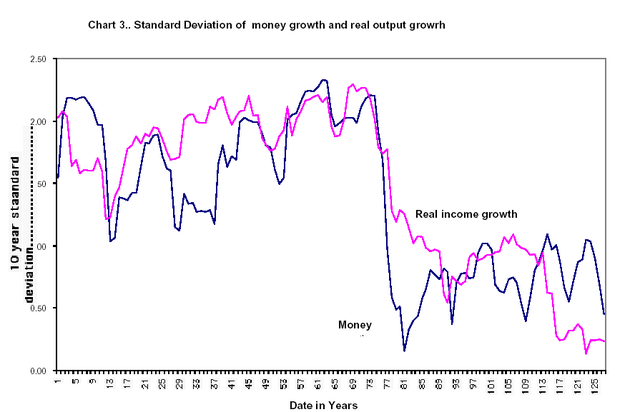
In one of Milton Friedman’s last papers (circa 2006) is this stunning graph.  The graph (click to enlarge) shows the standard deviation of real output and money (M2) from 1879 to 2005.  The sharp break in the series around the late 1970s and early 1980s is evident – the standard deviation of money fell dramatically and so did the standard deviation of output.

Money is partially endogenous so one could interpret this as running from output to money.  The rapidity of the break, however, suggests otherwise.  It’s easy to understand how policy could quickly have made money growth more stable.  It’s much more difficult to understand how or why real output could quickly become more stable.  Moreover, the fact that money stabilized as Volcker and then Greenspan headed the Fed is also suggestive of monetary policy as the driving force.

In one way this is a testament to better monetary policy beginning circa Volcker but in another it’s a damning indictment of how poor monetary policy has been over most of the history of the Federal Reserve.
 Outputm2

anne April 3, 2007 at 8:16 am

We are watching Commanding Heights in my American Government class. I want to show them this graph and explain it to them. Unfortunately, I don’t totally understand it.

I get that a lower standard deviation means that things are less volatile – here in regard to the money supply and real output (is that GDP?) What tangible effects can we definitively link to the more volitile pre-Volcker period? How do I show my students “where the rubber meets the road” regarding the free market with sound money ideas they’ve learned about and what this graph represents?

AZ April 3, 2007 at 8:22 am

The sharp break in the series around the late 1970s and early 1980s is evident

When does the sharp break begin? To me it looks like the large break begins around 77 – but that’s not 1977, it is “year 77″ in this series, where year 1 is 1879 (or 1880). That puts the beginning of the break around “actual year 1957″. And it looks like it is about year 85, maybe year 89, in the series when real income growth and money have “reunitied” (it’s early, I can’t think of the correct phrase), which puts it around “actual year 1969″. The “actual year 1980″ would be year 100 in the series, and by year 100 there seems to be 10 years or so where the two standard deviations are lower. So maybe it’s McChesney who deserves the credit.

Alex Tabarrok April 3, 2007 at 8:35 am

sa and az may be right. Friedman,however, also refers to the break as being at the end of the 1970s but he could be wrong also.

sa April 3, 2007 at 9:22 am

after looking at the pdf, it appears to me that friedman is using a 10 yr lagging period std deviation for both the variables. that’s perfectly fine, but the data series is a little confusing. if it’s 10 yr lagging then the time series should start at 10 yr elapsed, if it’s leading it should end at 115 yr elapsed. this graph is puzzling to say the least.

theCoach April 3, 2007 at 11:17 am

Trying to get an understanding of what this means – this is a very confusing way of labeling the graph, imo. Can we at least say that what is stunning about this graph does not obviously correlate to the Volcker era?

From what I can tell, it appears that the dramatic shift correlates to the post war stabilization following the great depression and WWII. What this says, I do not know — perhaps avoiding world wars makes things more stable?

Rich Berger April 3, 2007 at 12:13 pm

After reading his article quickly, it seems that the “break” he is referring to is not the drop in volatility around 1960, but the loss of coordination between the two series in the late 70′s and early 80′s. At that point, the two series often move in opposite directions. What that means – I don’t know.

wslmwps August 14, 2007 at 4:18 am

liqingchao 07年8月14日

google排名
google排名
wow gold
wow gold
powerleveling
powerleveling
wow gold
wow gold
powerleveling
powerleveling
wow powerleveling
wow powerleveling
wow power leveling
wow power leveling
wow power level
wow power level
world of warcraft powerleveling
world of warcraft power leveling

china tour
china tour
hongkong hotel
hongkong hotel
beijing tour
beijing tour
翻译公司
翻译公司
上海翻译公司
上海翻译公司
北京翻译公司
北京翻译公司
北京搬家公司
北京搬家公司
鼓风机
风机
风机
è´§æž¶
光盘刻录
光盘刻录
光盘制作
光盘制作
光盘印刷
光盘印刷
红外测温仪
红外测温仪
超声波测厚仪
超声波测厚仪

超声波探伤仪
超声波探伤仪
频闪仪
频闪仪
涂层测厚仪
涂层测厚仪
电火花检测仪
电火花检测仪
google排名
仓库
仓库
仓库出租
仓库出租
物流园区
物流园区
集团电话
集团电话
四环素牙
口腔常识
口腔常识
口腔医生
口腔医生
网站设计
网站设计
多媒体
监控
监控
监控系统
监控系统
门禁
门禁
门禁系统
门禁系统
搬家公司
搬家公司
条码打印机
条码打印机
牙周炎
牙周炎

牙周炎
多媒体
world of warcraft power leveling
四环素牙
wow power leveling
SFP
SFP

wow gold
wow gold
wow gold
wow gold
wow gold
wow gold
wow gold
wow gold
wow gold
wow gold
wow gold
wow gold

北京搬家公司
北京搬家公司
北京搬家公司
北京搬家公司
北京搬家公司
北京搬家公司
北京搬家公司
北京搬家公司
北京搬家公司
北京搬家公司
北京搬家公司
北京搬家公司
北京搬家公司
北京搬家公司
北京搬家公司
翻译公司
翻译公司
翻译公司
翻译公司
翻译公司
翻译公司
翻译公司
翻译公司
翻译公司
翻译公司
翻译公司
翻译公司
翻译公司
翻译公司
翻译公司
翻译公司
翻译公司
翻译公司
翻译公司
翻译公司
翻译公司
翻译公司
翻译公司
翻译公司
翻译公司
翻译公司
翻译公司
翻译公司
翻译公司
翻译公司
翻译公司
翻译公司
翻译公司
翻译公司
翻译公司
翻译公司
翻译公司
翻译公司
翻译公司
翻译公司
翻译公司
翻译公司
翻译公司
翻译公司
翻译公司
翻译公司
翻译公司
翻译公司
翻译公司
翻译公司
wow gold
wow gold
wow gold
wow gold
wow gold
wow gold
wow gold
wow gold
wow gold
wow gold
wow gold
wow gold
wow gold
wow gold
wow gold
wow gold
wow gold
wow gold
wow gold
wow gold
wow gold
wow gold
wow gold
wow gold
wow gold
wow gold
wow gold
wow gold
wow gold
wow gold
wow gold
wow gold
wow gold
wow gold
wow gold
wow gold
wow gold
wow gold
wow gold
wow gold
wow gold
wow gold
wow gold
wow gold
wow gold
wow gold
wow gold
wow gold
wow gold
wow gold

asdsad October 13, 2007 at 2:24 pm
sadsad October 13, 2007 at 2:25 pm

如今美女炒股,走势图如美女图片全凭感觉。

謝文豪 April 2, 2008 at 3:34 am

大家好,我是臺灣人,從臺灣一個人搬家來到美國,環境很陌生,感覺很孤單。以前在臺灣幾家知名的徵信社工作過,我是一個優秀的徵信工作者,希望早點找到適合自己的工作。希望通過貴站,認識更多的朋友。

buy shaiya gold December 31, 2008 at 1:52 am

Please come to shaiya gold, we will give you a great surprise.

likaida March 17, 2009 at 2:42 am
likaida March 17, 2009 at 2:51 am
likaida March 17, 2009 at 2:55 am
出会い系サイト June 9, 2009 at 10:44 pm

Comments on this entry are closed.

Previous post:

Next post: