Puebla

by on December 22, 2007 at 5:37 pm in Travels | Permalink

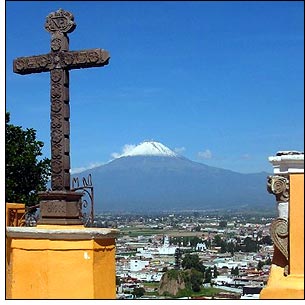
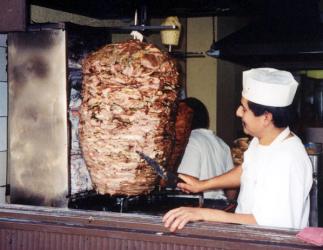
Most of all this is a town of baked sweets, they use sugar and milk as well as in Calcutta.  Sweet milky creme thingies with walnuts, camotes, amaranth with honey, flan, fried coconut cookies, fresh potato chips with tamarind and chili and many other delights.  There is a whole book Dulceria in Puebla, they weren’t kidding.  Mole poblano almost seems like an afterthought.  The produce is also superb; I never had tasted real cucumber before today.  The city is much more beautiful than I had expected and Arabic influences are seen all over, there is even Jerusalem Tortilleria and Beyrut Tacos to add to your dining delights, not to mention the Arabic influence on the baking and of course the architecture.  I used to tell people I don’t like sweet things, but due to globalization that fiction is becoming increasing difficult to maintain.
Floccina December 22, 2007 at 9:41 pm

Have you tried taco de ojo?

enrique December 22, 2007 at 11:11 pm

I love the picture with symmetrical volcano in the background. Is that the “Popocatepetl” volcano, and is it still active?
P.S.: I love Hugh Thomas’s masterful book “The Conquest of Mexico” – it is a thick tome but an excellent read.

saifedean December 23, 2007 at 3:27 am

Varangy,

The Arab influence comes from two main channels:
1- The most important is Arab migration to the Americas. This was mainly Lebanese, Syrian and Palestinian. This will be the reason you see the Beirut Tacos and Jerusalem Tortillas.

2- The Arab influence on Spain that was transmitted through colonial Spaniards to the new world. This, I presume, is where Puebla gets its Arab-influenced Architecture.

Alejandro Hope December 23, 2007 at 8:55 am

Tyler,

Bienvenido a México. It is great to have you and your family back among us. I am glad you are enjoying poblano cuisine, particularly its many sweet delights. Traditional Puebla desserts are a by-product of the proliferation of convents in the colonial and early independent eras. For a city in the Iberian catholic world, having lots of nuns in your past translates into complex, time-consuming, labor-intensive cuisine (Arequipa in Perú is another example of the same phenomenon). Reading your post, I started wondering whether that is something of a general rule: can you find examples of convent/monastery- centered cuisine in, say, Buddhist countries (e.g., Thailand, Myanmar)?

Best regards.

TGrossman December 25, 2007 at 10:48 pm

So how the Cowan family decide where to travel?

花蓮租車旅遊資訊 August 8, 2009 at 5:08 am

Comments on this entry are closed.

Previous post:

Next post: