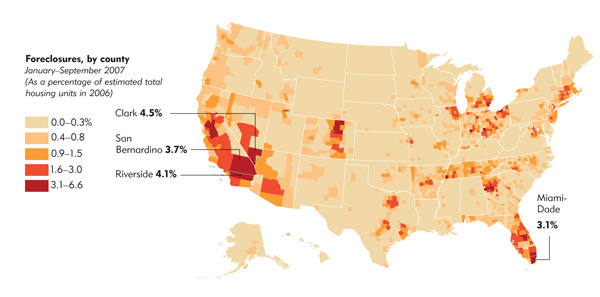
Foreclosures, by county

by on January 8, 2008 at 11:43 am in Data Source | Permalink

Foreclosures

Here is the accompanying article by Matt Yglesias.
Dennis Mangan January 8, 2008 at 12:09 pm

Interesting how they cluster around the main population centers!

efp January 8, 2008 at 1:14 pm

Looks like two different phenomena to me: coasts & cities where properties were over-valued, and the rust belt where land is cheap (dirt cheap? hehe) but people lost jobs.

I’m not sure what to make of TN & AR.

shawn January 8, 2008 at 3:15 pm

…the only thing that doesn’t make sense to me is the crazy high rate in Tennessee and Arkansas. The other areas are mostly portions that were heavily developed over the past few years. We’ve done a fair amount of planning in tennessee, but that state-line divide is the most intriguing. That swath on the east side of colorado is interesting too…I guess that’s just on the east side of the rockies (yep).

tedm January 8, 2008 at 3:17 pm

The map also closely matches the location of concentrations of home buyers with weak credit scores found in the appendix of

http://www.federalreserve.gov/Pubs/Bulletin/2007/pdf/hmda06final.pdf

J January 8, 2008 at 4:25 pm

I don’t know if it’s a factor, but Tennessee has no state income tax; a powerful incentive to create the impression one lives there. Northwest GA and AR have a lot of vacation homes, and I know there’s a lot of speculation in the Las Vegas and Miami areas. Did the article include stats on how many of the foreclosures are on owner occupied properties?

Robert C January 8, 2008 at 9:29 pm

The foreclosure processes is of two types. There is Judicial Foreclosure and Strength of Sale foreclousre
The foremer takes up to a year the latter 6 to 8 weeks. So state by state comparisons in the short run are of limited use. Also, the Florida numbers are understated–many more
are in limbo as the courts in Miami-Dade are notoriously courrupt and inefficient. One judge has 2000
foreclosures on his desk….This is going to get really ugly……

Jacqueline January 8, 2008 at 10:08 pm

Whoo hoo! We’re number 1!

I recall reading something in the Las Vegas Review Journal about hpw most of the homes in foreclosure here NOT owner-occupied, and a lot of them (almost half?) are sitting vacant.

Las Vegas housing prices roughly doubled in a five year period and a lot of people got into flipping houses to get rich quick. The last wave of would-be flippers got caught holding the bag.

Brock January 9, 2008 at 6:46 am

The high foreclosure rates in TN, esp. in the Memphis area where I live, don’t make much sense to me.

Unlike the coasts, the high foreclosure rates in TN couldn’t driven by the collapse of the housing bubble, because there hasn’t been any bubble here. Insofar as TN is representative of national trends, there’s something else going on.

Sol January 9, 2008 at 8:46 am

“Interesting how they cluster around the main population centers!”

You know, at first I just assumed this was sarcasm. Then in the middle of the night, it occurred to me that the map is based on percentage (within the county, I presume), so there wasn’t any obvious reason why the darker spots should cluster around population centers.

If I think of northern Michigan, for instance, there are plenty of poor people, as a percentage of the population. (Where was that great web page with all the stats broken down by zip code?) Why is the rate of foreclosure there so low?

My first guess is simply that the of home ownership turnover is slower there. But if that’s the case, doesn’t that suggest the map itself is badly flawed? It seems like it should be foreclosures as a percentage of active home mortgages, rather than housing units.

John Dewey January 9, 2008 at 10:33 am

Brock: “The high foreclosure rates in TN, esp. in the Memphis area where I live, don’t make much sense to me.”

This article notes the foreclosure “epidemic in Frayser”, a Memphis suburb.

Memphis foreclosures in 2006

Saralyn Williams, program coordinator for the MemphisDEBT Collaborative, explains that:

“title-loan lenders and ‘payday’ lenders, whose exorbitant interest rates can trap customers in a cycle of mounting debt, are prevalent in the area. … Predatory lending really is a big thing in Memphis”

The ABC’s of dollars and cents

“Local officials say Memphis’ high poverty rate and nation leading incidence of bankruptcy make their city a hotbed of predatory lending.”

“DON’T BORROW TROUBLE” ANTI-PREDATORY LENDING CAMPAIGN

ZBicyclist January 9, 2008 at 2:07 pm

Sol wrote: “If I think of northern Michigan, for instance, there are plenty of poor people, as a percentage of the population. (Where was that great web page with all the stats broken down by zip code?) Why is the rate of foreclosure there so low?”

The overall rate of real estate turnover may be lower. (e.g. % of homeowners who have been in their home less than, say, 5 years)

There may be less hope of appreciation, so there was less speculation.

The local banks may be more likely to be holding mortgages rather than selling them. This may make them more patient / more likely to do workouts.

Mortgage brokers, in their rapid expansion phase, didn’t locate here because they didn’t see the market.

Just speculating.

Maybe it’s the strictness of mortgage broker licensing in Tennessee vs. Kentucky that explains the foreclosure differences?

John Dewey January 10, 2008 at 7:12 am

Steve Sailer: “implying that government pressure caused more lending to minorities than colorblind analysis would have permitted.”

Makes sense to me.

Fair and Unbiased December 22, 2008 at 9:49 am

Take these numbers with a grain of salt. The numbers are biased towards urban areas because the sources are more likely to get data from major cities than rural areas. See: http://www.npr.org/templates/story/story.php?storyId=95431537

batage May 14, 2009 at 4:13 am

I can’t understand all the paper

nana May 14, 2009 at 4:16 am

make more thinking about

Comments on this entry are closed.

Previous post:

Next post: