College has been oversold

by on November 2, 2011 at 7:40 am in Books, Data Source, Economics, Education | Permalink

Here, drawn from my new e-book, Launching the Innovation Renaissance (published by TED)  is part of a section on college education. (See also the op-ed in IBD)

Educated people have higher wages and lower unemployment rates than the less educated so why are college students at Occupy Wall Street protests around the country demanding forgiveness for crushing student debt? The sluggish economy is tough on everyone but the students are also learning a hard lesson, going to college is not enough. You also have to study the right subjects. And American students are not studying the fields with the greatest economic potential.

Over the past 25 years the total number of students in college has increased by about 50 percent. But the number of students graduating with degrees in science, technology, engineering and math (the so-called STEM fields) has remained more or less constant. Moreover, many of today’s STEM graduates are foreign born and are taking their knowledge and skills back to their native countries.
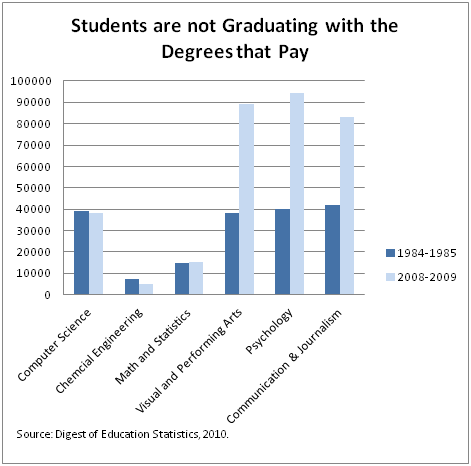
Consider computer technology. In 2009 the U.S. graduated 37,994 students with bachelor’s degrees in computer and information science. This is not bad, but we graduated more students with computer science degrees 25 years ago! The story is the same in other technology fields such as chemical engineering, math and statistics. Few fields have changed as much in recent years as microbiology, but in 2009 we graduated just 2,480 students with bachelor’s degrees in microbiology — about the same number as 25 years ago. Who will solve the problem of antibiotic resistance?

If students aren’t studying science, technology, engineering and math, what are they studying?

In 2009 the U.S. graduated 89,140 students in the visual and performing arts, more than in computer science, math and chemical engineering combined and more than double the number of visual and performing arts graduates in 1985.

The chart at right shows the number of bachelor’s degrees in various fields today and 25 years ago. STEM fields are flat (declining for natives) while the visual and performing arts, psychology, and communication and journalism (!) are way up.

There is nothing wrong with the arts, psychology and journalism, but graduates in these fields have lower wages and are less likely to find work in their fields than graduates in science and math. Moreover, more than half of all humanities graduates end up in jobs that don’t require college degrees and these graduates don’t get a big college bonus.

Most importantly, graduates in the arts, psychology and journalism are less likely to create the kinds of innovations that drive economic growth. Economic growth is not a magic totem to which all else must bow, but it is one of the main reasons we subsidize higher education.

The potential wage gains for college graduates go to the graduates — that’s reason enough for students to pursue a college education. We add subsidies to the mix, however, because we believe that education has positive spillover benefits that flow to society. One of the biggest of these benefits is the increase in innovation that highly educated workers theoretically bring to the economy.

As a result, an argument can be made for subsidizing students in fields with potentially large spillovers, such as microbiology, chemical engineering, nuclear physics and computer science. There is little justification for subsidizing sociology, dance and English majors.

College has been oversold. It has been oversold to students who end up dropping out or graduating with degrees that don’t help them very much in the job market. It also has been oversold to the taxpayers, who foot the bill for these subsidies.

crankee November 2, 2011 at 11:35 am

Grade inflation is the unspoken problem. If the hums and SS students were graded as strictly as STEM kids (or even as strictly as Latin classes were in pre WW2 Ivy League) there would be no mismatch. Furthermore, if most jobs didn’t punish STEM students with low grades by denying them interviews while interviewing high scoring grads of “xxxstudies” courses, there would also be no mismatch. But until the day comes when it’s better to have a C in STEM subjects over an A from fluffy majors when applying for the median general interest job (not specialty jobs like programming), you will always have this “market for lemons” problem.

CBBB November 2, 2011 at 3:28 pm

Yeah this is a big issue. STEM students tend to get WAY lower grades then Humanities. Amongst humanities majors it’s considered ridiculous to have grades below 90% where as in many STEM programs having a midterm where the class average is a failing grade is not at all uncommon. However when you go for a job the employers generally treat all the graduates the same “Hey this history major has a 4.0 GPA but this guy with a physics degree only has 3.0 – this physics grad was definitely a slacker.” Some employers take the difference in difficulty into account but not many.
You want a job in finance? WAY better to go into a jokey subject like economics (Sorry but at the undergrad level Econ is a huge joke) and smoke every course then try your hand at pure math or physics and do mediocre.

TallDave November 2, 2011 at 3:52 pm

Less of an issue for employers I think — you don’t hire an A history major over a B physics major if the job involves physics.

OTOH this is a serious problem in graduate schools, esp. law school, where they use a formula that treats all majors as equal.

CBBB November 2, 2011 at 6:36 pm

I’m talking about general jobs that don’t necessarily require specific knowledge – the number of jobs that ACTUALLY require knowledge of high level physics, math, etc. is very small and only the best of the best are going to get those jobs (ie the B physics major isn’t going to get the physics jobs any way). Most STEM majors have to go for jobs outside their field and since they probably have lower grades then Social Science, Business, or Humanities grads they’re at a disadvantage.

TallDave November 2, 2011 at 10:22 pm

Why would you take a job like that with a STEM degree? There are tons of STEM jobs — employers have trouble filling them, because STEM is hard. B students are certainly employable. Unless your major was pure theory with no practical applications (like pure math or something) you’re very likely going to find something related to your field of study.

CBBB November 2, 2011 at 10:57 pm

Employers are NOT having trouble filling these positions. Listen basic economics states that if they were having trouble then pay should be skyrocketing but it’s not really in those sectors. The reality is all these employers only want the best of the best and particularly with years of professional experience to boot. I’m sorry my major was CS and Math and I’ve looked for two solid years anywhere and everywhere. It’s just not true that there’s as big a demand as they say.

CBBB November 2, 2011 at 11:02 pm

And why would you take a job in a non-STEM field? Well pay and job prospects are much better. The people I know from school who got jobs rather easily majored in Finance, Accounting or Economics and because they had very high marks (these courses are not difficult I took a few Econ electives and getting a 90%+ is no problem at all) and could therefore go and get hired at Deloitte or other consultancies or in banking/insurance. Yeah it’s not exciting work but what is and it REALLY beats having no prospects – especially when you’ve been out for a few years and now you’re considered out-of-date.

TallDave November 3, 2011 at 11:29 am

You seem to be talking about a totally different job market. Visit STEM workplaces and you’ll find a large number of foreign workers — who are well-paid. Many of them don’t even speak English very well.

Accounting majors get hired by accounting firms because they know how to do accounting — in my state you can’t even take the CPA exam without an accounting degree, and your STEM degree would not help get that job you no matter what your grades are. Finance is a little different because they like the STEM guys to become quants — but those can be brutally competitive jobs.

Michael November 2, 2011 at 11:44 am

I was at my local university for a meeting recently. I saw a prospective student and his mother looking lost so I offered to walk them to their destination. We made small-talk along the way. The prospective student told me he wanted to major in theater. This is a $50k/year private university NOT known for it’s theater program. I responded by saying, “Oh, my secretary got her theater degree here!” The mother understood the point of that comment.

But, at the same time, I have a number of friends with graduate degrees in STEM subjects (Ph.D’s, MA’s, etc. in engineering, math, etc.) who often complain that it’s hard to find a decent paying job when so many companies are outsourcing such needs to other countries with cheaper labor. My “pure” math friend freely admits that despite his vast knowledge of theoretical math (he’s truly brilliant), he doesn’t really have any marketable skills, and that even for the rare job where pure mathematical brilliance is of use, some equally bright person on the other side of the world is willing to do the same thing for a fraction of the cost. Of course, anecdotes are not data. I’d wager they’re in still in a better position than my secretary with a theater degree. Then again, of all my old college friends, by far, the most successful were the ones who pursued their passion and succeeded. In their case, that was music, and they’ve each one a grammy (and not together…each individually for separate things).

I’m not sure what my overall point is other that, in general, I agree, but the STEM distinction is probably too simplistic. I think the secret to great success involves a mixture of true talent, hard work, and quite a bit of luck. As an economist would tell you, specialize in where you have the comparative advantage. It may indeed be better to be the best photographer than a mediocre engineer. The problem is, many college kids confuse their passion for skill. There is something to be said for a “safer” choice, but there is also something to be said about taking on some risk.

CBBB November 2, 2011 at 6:42 pm

One thing is only the E in STEM really gives most people any career prospects – the STM are just as much a crap shoot as a history degree.

David Mershon November 2, 2011 at 12:34 pm

I’m working on my M.F.A. in Interactive Media and my bachelor’s was in Visual Arts. I have never had a hard time finding lucrative work, even during the recession. In the video game industry, engineers do get paid a bit more than artists and designers for entry level and mid-level work, but there is generally more demand for artists on a given team than for other specialties, particularly on big budget games. I see where you’re going with this account, but the focus on STEM is reductive. There are lots of well paying jobs available for arts graduates, and I expect there will be even more in the future.

j r November 2, 2011 at 1:33 pm

I agree. The problem isn’t so much an orientation away from the STEM subjects, but an orientation away from commerce. There are so many kids in school or with random degrees who have vague plans of working in “non-profit,” or “public interest,” or “activism.” And along with that is the mentality that someone else (i.e. the taxpayers) owe them the means to support themselves while living out their dreams. If you have some random passion in life, the onus is on you to figure out how to make an honest living doing it.

CBBB November 2, 2011 at 6:51 pm

No there’s not, there’s tonnes of kids in school who want serious careers in engineering, science, IT, finance, etc. This idea that it’s all kids with vague notions of wanting to be do-gooders is flat out nonsense. There are hardly ANY jobs for entry-level candidates whether in STEM fields or elsewhere. That’s the real story.

TallDave November 2, 2011 at 10:26 pm

No, the job market is tougher, but employers are still importing huge numbers of highly skilled foreigners for those STEM jobs — and at good pay.

j r November 3, 2011 at 9:03 am

In what way is what you’re saying exclusive of what I am saying? If you re-read my comment you’ll see that “so many kids in school,” is not an indictment of “all kids.”

Boson November 2, 2011 at 12:53 pm

If you doubt the value of a liberal arts education, then most likely you haven’t had one, or have had a thoroughly mediocre one. A true liberal arts education teaches you how to learn and how to think for yourself, and those fundamental skills apply to any profession, not just technical. My classmates are extraordinarily successful in highly technical fields, even though they majored in philosophy, anthropology, french literature, etc. Do not, in the words of Mark Twain, let your education interfere with your learning. And do not, under any circumstance, try to get a liberal arts education at a crappy university where students are just more chuck for the meat-grinder, and for whom a liberal arts major merely provides more opportunity to get drunk and laid. Do not blame liberal arts for what is wrong with American education:There is an epidemic of idiocy that would not be nearly as bad if people had learned how to think for themselves.

j r November 2, 2011 at 1:10 pm

“It’s all part of the bubble economy. With all those 30 year old finance and consulting airheads making millions for doing simple and overrated work, why should students select something hard?”

Just how many 30-yr old millionaires do you think there are in finance and consulting?

Young people in those fields are very-well paid, but they also work 80-100 hour weeks doing some very tedious work. It ain’t working in a rice paddy, but it also ain’t all that glamorous at the analyst and associate level. By the time people are making anywhere near millions, they’ve been paying their dues for quite a few years.

There may be a few young people making serious bank on trading desks or in asset management, but those people are some combination of extremely lucky or extremely good. They are not the norm.

Christopher Scott November 2, 2011 at 1:47 pm

Fascinating discussion.

I’m curious to hear people’s thoughts on military experience as an alternative to college. I’m a veteran, and self-taught developer/designer, and I’ve had a lot of success despite no degree. Personally I tend to agree with the others who mention less tangible benefits to college (critical thinking, communication, self-reliance) as being among the most important. I do aknowledge that my “research/study skills” are probably lacking, but with the recent glut of open-source academic material (Stanford, MIT, Oxford) available on the web I’ve found more than enough pointers to get me started.

Cindy November 2, 2011 at 1:47 pm

It’s not just about choice. I once taught several undergraduate econ courses (including econ 101 and several upper division course) at a UC campus. College students simply didn’t have the math and analytical skills that’s required for these courses. Their knowledge in math is probably only comparable to 9th graders in China and India. How can you expect them to do well in STEM majors? The problem is with the K-12 curriculum in the United States.

TallDave November 2, 2011 at 1:50 pm

Yep, we get to middle/high school and our performance falls off the charts. That’s because our adolescent-level public schools are basically a prison slash dating service staffed by unfireable drones.

Itchy November 2, 2011 at 5:35 pm

+1 Hit the nail right on the head.

mfm November 2, 2011 at 2:19 pm

Its a shame that college experience is being measured solely in terms of wages. What about the value which we all place on beauty ? Civilizations are not just economies, they are more than that …

Dan Weber November 2, 2011 at 3:17 pm

When college just cost your 4 years of your life, it wasn’t too crazy to study the history of romance novels. When it costs $90,000, it probably is crazy.

The easy credit to students has just bid up the price.

j r November 2, 2011 at 4:46 pm

That’s not what is being said. Wages are not being use to measure the “college experience.” Wages are being used to measure the over-or-under-saturation of the market for a particular set of skills. If the wages of pharmacists are going up and the wages of curators are going down, it’s a sign that there are not enough pharmacists and too many curators. It is not a measure of which society values more.

Dave November 2, 2011 at 2:47 pm

I’m not a statistician, but I know enough to know that the “science” requires massive amounts of interpretation to be useful, and it is the easiest thing in the world to manipulate results to prove any point you wish.

I would love to see the breakdown of the studies comparing college grad pay vs. non-college grad pay, particularly with respect to homeschoolers. There are plenty of intelligent, c…ompetent, “well-reared” and literate people who choose not to go to college. But in the “non-college” demographic, they are lumped together with the hoards of neglected, illiterate, recently-immigrated, non-English speakers that don’t go to college because they have no foundation for real learning.

This grouping together, I believe, skewers the numbers considerably. And it gives a false picture of reality for young, intelligent people considering doing something besides indenturing themselves to a federal loan program for the rest of their lives when they’re not even old enough to buy a beer.

In other words, if you come from a family that taught you the basics and maybe a little bit more, then your future may well be comparable – if not *highly* superior – to that of the average college grad- not just in terms of quantitative income, but in terms of qualitative conditions, such as self-reliance, self-direction, and freedom from debt.

Think about it. . .D

Bill November 2, 2011 at 3:02 pm

What is interesting about this post is that the headline “College Has Been Oversold” let’s people respond with their feelings, and not their facts.

What if the headline had said: “Sausage is Oversold”

You would ask: What type of sausage?

There are more types of colleges and majors than there are sausages.

College is highly differentiated, yet the headline is: “College is Oversold”

What kind of Sausage?

Marian Kechlibar November 3, 2011 at 9:55 am

Actually, I think that the headline is more or less correct.

Quite a lot of people tend to think about getting “A degree”, with A meaning ANY.

Bill November 3, 2011 at 1:59 pm

If I were a surgeon, and operating on your brain, would you want me to be more or less correct.

Marian Kechlibar November 4, 2011 at 6:35 am

Hehe, good reply, but headlines are not head surgeries :-) It is hard to be absolutely correct in <= 10 words.

Bill November 3, 2011 at 2:01 pm

Also, Marian, if you get ANY degree, unemployment and earnings statistics still show college graduates with both higher income and lower unemployment than those without.
It is Less correct to say that ANY college degree has no effect, …. more or less.

CBBB November 2, 2011 at 3:23 pm

NO the STEM thing is a SCAM as well. Sure if you’re in the top 10% of your class you’ll do great but if you’re just an average, or even somewhat above average student then you might as well have majored in Sociology and partied the whole way through university.

Millian November 2, 2011 at 3:29 pm

No, I am going to stick with Milton Friedman on this one. Subsidise the liberal arts because if society doesn’t pay for them, we will end up with too little critical thinking about society. If Friedman endorses a subsidy, it must be doing something right.

Adrian November 2, 2011 at 3:36 pm

These statements are very misleading. I don’t think that we should subject ourselves to the idea that in order to have innovation in the infrastructure and economy in the United States is only through the development of an independent science and math centered workforce. By saying such things you undermine many basic principles in education, and the influence of all those other STEM careers, such as the fact that we do speak English here in the United States, that art and physical programs, as research has continuously shown, only serves as catalysts in the learning process in schools, and that perhaps media is the bridge to the intercommunication of the masses and the new method of communication worldwide.
Is the problem at root the fact that people are choosing the wrong degrees when they attend college? Are you suggesting that liberal arts programs should be cheaper? I don’t understand your bias. If anything, this article should make you realize that there is a problem that the subsidies are not enough for economic growth. What you are suggesting is that we should subject ourselves to provide a workforce that helps the giant companies. Companies obviously require to ends to the spectrum in the workforce: they require cheap labor for physical production (minimum wage) and college educated, STEM degree recipients. In that model, we would have even a larger disparity in the gap of classes in this country. Giving people two options, either go STEM or minimum wage. This is not only idealist on an extremist point of view, but it is also beyond irrational. Where do you leave teachers, news companies, government related jobs, social workers, all those careers that aid in the well being of society in the social aspect? History speaks for itself; they are required careers, and if it requires a college degree, the investment reflects in the prosperity of society. The problem is that today, there is little access to that workforce, because fundamental conservatism says those careers and jobs are not required (i.e. Planned Parenthood, NPR, PBS, Amtrak, etc.) devaluating their value as the years roll on. Since there is a high supply for these careers, economics tells us its price drops.
So where does the government and the occupy movement come into play? First off, they should never work for a top companies in the belief that if they are prosperous so will we. That is the occupy movement, defying the system of Reaganomics and trickledown economics, which history shows to be a failure. There should a system of accountability that holds businesses accountable for the mess that they put is in, and don’t put it on the back of the general public. We pay money in taxes into the government to provide us back with social services for our benefit, not to bail out companies, get us into a humongous deficit and to never blame it on the fact that the government is loaning money to college students who cannot get a job after college.
I wish that your argument was a little more elaborate, because that alone, is very misleading.

TallDave November 2, 2011 at 4:05 pm

You must be in public education, nothing that incoherent could have come from the private sector.

Marian Kechlibar November 3, 2011 at 9:56 am

Can you express yourself in less words, but with a structure? This is unreadable for me, and I am a voracious reader.

If you cannot, you’re probably a teacher.

thehova83 November 2, 2011 at 3:48 pm

Just thinking it over, Alex sounds a lot like Thomas Friedman. We should heavily subsidize STEM’s and shun the humanities like China. And like China, our economy will grow and we’ll all be happy. I don’t think it’s that simple. Economies that still have “low hanging fruit” need more engineers than developed economies.

Also, STEM graduates perform great from a wage and employment perspective right after college versus business and humanity grads (espcially during recessions). But the long term picture is more ambigulous.

CBBB November 2, 2011 at 6:38 pm

Yeah I’ve been performing so great – two years of unemployment forcing me to go back to school.

Cliff November 2, 2011 at 10:02 pm

On average/ “in the aggregate”

Marian Kechlibar November 3, 2011 at 10:01 am

I do not think that heavy subsidization of anything works. I would introduce programs for clever STEM students from poor backgrounds, though. Quite a lot of modern inventors and scientists came from modest households.

The entire “like China” is a nice strawman to beat, though.

The core of the problem is that having too many lawyers and too many chicano studies majors is a net drag on the society, because they are non-productive and tend to actually champion more regulation and more laws to make themselves some work.

Some amount of humanities is necessary, but the current situation in the USA is wildly off-balance.

tiffany November 2, 2011 at 4:20 pm

“Most importantly, graduates in the arts, psychology and journalism are less likely to create the kinds of innovations that drive economic growth … there is little justification for subsidizing sociology, dance and English majors.”

Not true.

(And I apologize if someone has pointed this out already. 279 comments is a lot of comments.)

It’s PRECISELY those graduates in the arts and psychology (and anthropology and sociology, though maybe not journalism or dance) who drive innovation and economic growth.

STEM majors may develop the code for iOS, but graphic designers and human factors teams — many are psychology majors — determine how it looks. Science fiction writers, many of whom were English majors, give inspiration to science fact. Creative writing majors help craft story lines for video games. Microsoft Research has at least one trained anthropologist on its research staff. Google hires designers to improve their products.

Innovation and economic growth requires an awful lot of these non-STEM skills. Rather than undervalue them, we should look for ways to educate non-STEM students in math, science and technology disciplines and vice-versa.

Itchy November 2, 2011 at 5:43 pm

Many non-STEM students CAN’T DO THE MATH. In addition almost every STEM student takes humanities classes stop trying to further water down our curriculum to make us “More well rounded”

CBBB November 2, 2011 at 11:53 pm

I wouldn’t say it’s watering down the curriculum, in all honesty they already pack so much into a lot of these STEM programs – is taking MORE engineering or math courses instead of humanities going to make a difference? They should get rid of the electives though because it makes the program longer then necessary but these schools want their $$$.
And I don’t know if the non-STEM students can’t do math, some people just don’t want to do STEM programs. First year Engineering ESPECIALLY is ridiculously boring, I mean not just a heavy load – all the classes just suck, Calculus, Linear Algebra, Engineering Statics – these are all extremely monotonous and bland courses. It gets better later but the first year material is dull enough to turn even a lot of talented people away.

Cliff November 2, 2011 at 10:03 pm

Uh… no

Marian Kechlibar November 3, 2011 at 10:04 am

“graphic designers and human factors teams — many are psychology majors — determine how it looks.”

As a software developer, I can say: a good graphic designer is a true treasure, but most credentialed graphic designers aren’t good. If you school more of them, you only get more mediocre, unproductive graphic designers.

This is the common problem with all skills that need a strong innate talent. If you took the entire population into an actor school, how many excellent actors would you get from it? Well, some, but not that much, really.

josh November 2, 2011 at 4:32 pm

A large part of the decline in traditional chemical engineering has been from poaching from biomedical or biochemical engineering. There are good arguments to be made that a lot of modern biotech has more to do with chemical engineering than with biology.

Pat MacAuley November 2, 2011 at 4:36 pm

Thanks for speaking out on this topic, Prof. Tabarrok. This is one of the most ruinous long-term problems in our stagnating economy. It’s especially encouraging to see these comments written by someone within the college industry.

Larmanius November 2, 2011 at 5:35 pm

Two observations as one who has done undergrad in the 90s and grad in the 2000s:

1. “STEM” major faculties (science, technology, engineering, math) DON’T WANT anymore undergrad students–or, if they could get away with it–any undergrad students. Cuz if you have students, you have to TEACH them. What a bother! They just want an endless supply of grad student slaves to do their research and fill out grant proposals. So, they on purpose generally have the worst teachers on the hardest material. It takes a lot of a student to decide to stick with hard material taught by people that openly hate them…that’s why the biz degree or whatever always starts to look very nice after even a year…

2. Tech degrees are often woefully out of date. Mech. Engineers still study linkages and mechanical timers in classes. Comp. Sci will still teach Pascal or C on obsolete API’s. Students know this…and often migrate to something non-tech as the major, but then keep up as a “super-hobbyist” on the side…often returning to tech. as a job field with their self-made skills. But, just think how many more could have the skill set of programming it was made into a “core” along with some other tech material…for some kind of new, relevant “Applied Tech” degree?

Itchy November 2, 2011 at 5:47 pm

I said this earlier. The skill that you learn as a Mechanical Engineer is how to think critically and solve problems. Yes, it sucks while you are doing it, but you need to understand how a linkage works. What do you think is between your car and the road?

Brian E November 2, 2011 at 6:21 pm

1. There’s a good case to be made that student loans are not the only subsidy distorting the university system. Of course not every university is like that – quite a few pride themselves on teaching, but students looking for the school with the biggest name instead of the best learning experience will tend to overlook them.

2. There could just as easily be a generic Engineering degree with particular concentrations that differentiate after the second year. Engineering is a skill more so than a set of knowledge; university level students should be practicing the skill instead of learning a knowledge base that will inevitably be obsolete within the next decade no matter how current it is at the time of graduation. In that context it doesn’t really matter if the students are using Pascal or C. Let the employers and trade schools handle the tools training.

Marian Kechlibar November 3, 2011 at 10:07 am

There is nothing obsolete about C, it is still a language of choice for system-level things like writing drivers, AND it helps the students with “getting” how memory really works.

You DO NOT want a Java monkey coder who never saw a pointer or an allocation, and his way of thinking is “oh, memory, it simply IS somewhere there, and it is plentiful”, anywhere near a production code.

Such unhappy person will inevitably produce a 500 MB – large hashtable for a modest task that actually required 50 kB of memory, choking your server dead, but, hey, they didn’t waste their time with obsolete C, right?

I am no friend of Pascal, though. Too sheltered.

ezra abrams November 2, 2011 at 6:22 pm

Quote “Who will solve the problem of antibiotic resistance?”
The problem is NOT lack of qualifed people; there are lots and lots of people, at least here inside Route 128 in Boston
The problem is that when pharma companies do an ROI study, how much they will get back for each dollar invested in a new drug, drugs for neurological disorders and cancer come out way, way ahead of new antibiotics.
so, no investment dollars for new antibiotics.
Part of the problem is how new drugs are used: if you have a new, super $$ drug, like say Avastin, with a good PR campaign, you can get billions of revenue.
But with a new antibiotic, doctors use it sparingly, because eventually bugs will develop resistance, so doctors save the new antibiotics and use them only for bugs resistant to established drugs. After many years – close to patent expiration – most bugs will be resistant to old drugs, so doctors will finally begin prescribing your new drug in volume
Hardly a good biz model.

JJ November 2, 2011 at 7:12 pm

Considering the outlays necessary for a functioning microbiology lab versus those of a functioning English class, could it be that humanities majors are subsidizing the “more valuable” students?

DL November 2, 2011 at 8:44 pm

As someone who has pursued a graduate degree in Biosciences from an Ivy League school, I can tell you that the country has WAY too many scientists. Of all the graduate students and post docs I know, only a small fraction of them (maybe 1/3 or 1/4) can actually find jobs in science. The rest end up in Management or Finance, or they go back to school for an MBA. There’s a reason that there’s more Physics PhDs working in Finance than in Physics, and its not simply a matter of income (though that helps).

I can’t speak for Engineering, as that it seems that the demand for their skills is higher.

Bill November 2, 2011 at 9:21 pm

You can take heart: Mike Scherer at Harvard did a study of who were the most effective managers of high tech companies (in terms of growth and profitability): it was an executive with a science background. (Actually, lawyers did pretty well too.) Surprisingly, CEOs without a science background but with a finance background didn’t do as well.

Robert Thompson November 2, 2011 at 9:56 pm

I find the chart very revealing. Are there any numbers on ethnic diversity distributions between the high paying degrees and the less so? I know many students of Asian background have good academic performance and suffer somewhat when diversity preferences for admissions are in effect. But, even so, are the Asians outdoing the other groups in obtaining the degrees that lead to the high paying jobs?

Cliff November 2, 2011 at 10:06 pm

Longest/best comment thread ever?

Comments are so important to this blog, you should really devote a good amount of effort to maximizing the commenting/comment reading experience. The new nesting is holding up pretty well, but how about a +1 system that orders the comment threads by rating? That would prevent early comments from necessarily getting all the attention, plus it would be a great check on dubious facts.

figleaf November 2, 2011 at 10:42 pm

Oof. This is a tough one. I agree whole-heartedly that STEM education is crucial. I have a BA rather than a BS but almost all my classes were in STEM or STEM-related tracks (including a year of advanced abstract math.) And certainly when I worked in tech it was painfully obvious just how important computer science is and how difficult it is to find people with the combination of education and ability.

That said, even in software engineering and biotech the bulk of graduates don’t actually earn as much as many of the “creative” types who… hire them.

The issue, at least in America, is that for better or worse there’s a huge market for entertainment. It’s absolutely the case that engineering, math, chemistry, electronics, and other hard science backgrounds are critical to the entertainment industry. But it’s also the case that the money generated by Pixar, Warner Bros., Bungee, ABC, Disney, ESPN, and even nominally “hard science” companies such as Exxon, Apple, Monsanto, Toyota is only peripherally due to their STEM employees — a fact that’s reflected in the relative status and compensation of employees in those firms.

I remember taking a Perl programming class with a guy with masters degrees in electrical engineering and math. He was doing graphics-engine programming for a startup composed of… high-school dropout gamers. And getting what amounted to entry-level wages while the marketers and designers were getting what amounted to dot-com dollars.

And for the record my business coach (not as bad an idea as you’d think for anyone with or without a STEM-related degree) makes shockingly more per year now than when he was a genuine, no-kidding, photos-to-prove-it rocket scientist in aerospace.

Point being that like too many other fields in the current market economy the rewards systems for STEM are negatively skewed compared to their underlying value to the economy. Yeah, you can cut back on “liberal arts” courses in, say, anthropology (George Lucas) or calligraphy (Steve Jobs) or economics (Sam Walton) but you’re not going to alter the visible desirability of jobs in those fields.

I don’t like it. I wish it were otherwise. Not sure what to do about it. Except possibly to rate universities, colleges within universities, and professors not on admissions but placements. Except, oh wait, the popular entertainment industry (Business Week, etc.) seems to have exactly zero interest in ranking schools in those dimensions.

figleaf

p.s. Natalie Portman, an entirely credible, published STEM graduate, wouldn’t earn in a lifetime in STEM what she made in her average movie role in Hollywood.

Eric Titus November 3, 2011 at 3:21 am

Agreed, more or less. But I think there’s a tendency for people with X interest to think that there should be more people like them in society. I think there should be more social scientists with computer skills, and vice versa. But will having more engineers really increase the rate of “progress”? As you point out, even companies like Apple are 80% humanities and social science, 20% engineering–the innovations were in design and usability. So I’m of two minds about the whole situation. STEM are great, and certainly having more STEM graduates wouldn’t hurt. But I hate to see the “soft sciences” and humanities denigrated in a world where most of the challenge is learning to use what we already have. Entertainment–that is, making life enjoyable–is as vexing a problem as building a marginally better fuel extraction technique.

Andrew' November 3, 2011 at 7:57 am

The soft sciences aren’t really being denigrated (by me). You can’t reliably expect to be a movie star (or a creative business owner who can hire STEM graduates). And Portman’s performance in movies is probably not worse due to her science and math training. If you are creative, do you need creativity training or would you benefit more from STEM training? It is primarily about making sure you receive some intrinsic value from your education investment.

McFate November 7, 2011 at 12:26 pm

For every Natalie Portman success story, there are a thousand wannabe actors waiting tables to get by. As you note, students can be attracted to the tiny minority of success stories. But those are not the norm… and if sold to students as the norm, that’s doing them a disservice.

You should go into your college education with your eyes wide open. And that means with a realistic assessment of the change in your career earnings prospects as a result of what you do with your four years. Yes, in working hard and teaching yourself programming, you can recover from getting an Art History degree. But you’ll still be behind where you’d be if you had gotten the computer science degree to begin with.

Engineering is a pretty decent path to a secure and dependable income… if you’re good at it and willing to work hard. The real issue brought up by this article, though, is that “everyone has to go to college” is a myth that serves only the colleges’ bottom line.

Robert November 2, 2011 at 11:16 pm

Underlying assumption is that the only purpose of post-secondary education is to provide entry into job market. This aspect has definitely been oversold. Randall Collins explained the phenomenon of credential inflation nearly 30 years ago in Credential Society: An Historical Sociology of Education and Stratification. But education is also about developing one’s fullest personal potential. About becoming an educated, cultured citizen. In capitalist society, it may be the job market that has been oversold: how did corporate American manage to get taxpayers to pay for the training of their workers? Public taxes spent to support the training corporations don’t have to pay for, but realize profits from? Nice deal! Now students take on enormous debt to pay for an education so they can compete for opportunity to work for (relatively) low wages due to overproduction of workers paid for by the state and the victims (I mean students) themselves. Brilliant! But some of us want to actually learn stuff and know stuff and not just get a piece of paper that may or may not get us a job. It’s thinking that univeristy and college is about job preparation that’s wrong headed.

Joshua November 2, 2011 at 11:47 pm

Is there any way to look at default rates by concentration?

freemarketer November 3, 2011 at 2:00 am

I live in India. I wish someone can write about the useless degrees offered by higher education institutions in India at a huge cost to tax payers. Tabbarok and MR readers will find the scenario in India inane.
Even the teachers in departments with single digit or even no student enrollment get huge salaries on par with teachers of the medical school. Any suggestion to shut down non-marketable programmes are vehemently opposed by the very same teachers who advice their own kids to study only the more job-oriented programmes.
I once did an informal survey of 500 teachers of basic sciences and humanities to find out how many would like their children to study those subjects. Answer: 2. A friend found that in 5 universities she surveyed, not a single physics, chemistry, botany, biochemistry or math professor wanted their kids to study the subjects they teach. But they want the tax payers to pay fat salaries for teaching subjects they know are worthless in the job market and do not want their kids to touch with a barge pole.
The only reason there are some enrollments in the zero job potential subjects is due to a massive state subsidy for colleges and universities; in the state of Tamilnadu in south India , the government colleges do not even collect fees, except in so-called “self-financing courses”. I found that invariably these are the courses for which there is demand in the market. If the students pay the full cost for all courses, many basic sciences and humanities departments in state funded institutions will vanish in 10 minutes and the money saved can be used more efficiently.

Yet the government of a poor country liberally throws scarce resources for funding courses few are willing to pay for but study just to say they are doing something rather than nothing. A government of a poor country spending on departments just so some students can tell their families and friends that they are busy doing something, however worthless that something is, is plain criminal. I wonder if such an insane situation exists in any other country

Eric Titus November 3, 2011 at 3:05 am

Even if we had more CS majors, would our system still make sense? From a certain perspective, yes–going to school is clearly worth the 100K+ for most graduates. But, if you apply Coase, the morality becomes a little more unclear. Just because the value of an education is worth, say, 200K, doesn’t say anything about how it should be split up. Should 100K go to the schools, 40K to the lenders, and 60K to the students? The student has clearly gained from going to school, but it seems to me that the educational system could work just fine with significantly less student loan debt. And I am not even mentioning the occasional student who is unsuccessful, where the debt might have a significant deforming effect on his life. If we use financial terminology, a system with high student debt is a highly leveraged system. And now that returns on college have declined, suddenly leveraged is becoming “overleveraged” for a good number of students. Whether you blame students is immaterial to whether the system could be improved.

The problem with student loan debt is the rising cost of college, not the potential payoffs. You can argue all you want about which major students should go into–it’s besides the point. Personally, I don’t think it matters much–I knew someone who was interested in consulting from the get-go, majored in Southeast Asian area studies, and got a job at Bain. I was one of your hated Sociology majors, and ended up getting data analysis jobs that were preferable to those econ/math majors who got sucked into the dismal world of finance.

Ramagopal November 3, 2011 at 10:58 am

“Most importantly, graduates in the arts, psychology and journalism are less likely to create the kinds of innovations that drive economic growth. Economic growth is not a magic totem to which all else must bow, but it is one of the main reasons we subsidize higher education.”

But I thought as libertarians we are not supposed to question the preferences of individuals in the market. The above quote implies that there are instances when preferences can be undesirable, and others know better than me what kind of preferences I should have.

Billy S November 3, 2011 at 11:06 am

The interviewer was correct in the context he probably intended it. Lookup time in a hash table is constant (amortized O(1)). Further, if you have a fixed set of data (i.e. read-only), you can compute a perfect hash function that has a lookup time of strictly O(1). See gperf for an example of an implementation of this. Perhaps you were thinking about computing the hash value of a data sequence, rather than the lookup time once a hash has been computed. Computing a hash value for a given sequence of data is linear (O(n)) with the size of the data being n. However, the time complexity of this is generally not interesting, since any lookup algorithm requires an O(n) iteration over the blob at some point. I was so befuddled by his claim I didn’t bother arguing. There are a lot of people who, having been taught something is true, cannot comprehend the possibility that it is not.

Jack November 3, 2011 at 12:14 pm

perhaps the students have realised the truth about, at least American, culture.
People who deal in or about other people and are at the top of the pile.
People who deal with “stuff” are peons.

Anna November 3, 2011 at 1:00 pm

As much as I hate to admit it, this post has hit the nail right on the head. Throughout high school, all students are pushed to go to college, since we all know that with a degree, your earnings will automatically increase. Right? Well, there may be some truth to that statement, but it is more misleading than it is helpful. I am by no means stating that college is useless and that one may get by without higher education. However, I will say that your salary ultimately depends on the job market. A college graduate will undoubtedly have an edge over a non-college graduate, but what is the point when there are no jobs to be had in the said field?
I was an avid student of music in high school; highly involved in both band and chorus. Both of my teachers urged me to major in music education, for they felt I had a gift for teaching others music. However, the practical side of me won out. I knew that a degree in the arts wouldn’t guarantee a job after graduation. I am a creature of habit, and find comfort in ultimate stability. Therefore I decided that I wanted to pursue a career as a paralegal. I am a Criminal Justice major in hopes that when I graduate, if I cannot find a job as a paralegal straight away, I will have opportunities in other positions.
I feel that college is not about doing what you love. Granted I love music, but music education just did not seem practical for me. Luckily for me, I love learning and reading about what goes on in our criminal justice/legal system, so Criminal Justice is another perfect match for me. I think many college students abandon this practicality and find themselves in a terrible financial situation; crushing college debts and no money flowing in to pay them off. As the article stated, there is nothing wrong with pursuing a career in the arts. But as far as job security goes, you’re better off studying mathematics and/or sciences.

Andy November 3, 2011 at 1:15 pm

Practice what you preach. If you had taken one math class since you were 10 you would know to label your axes.

The bigger issue is why more students don’t want to study these things. I blame high school approaches to science and math. They kill creativity, kill the fun, kill any interest. The fields people want to study are chosen because those fields tend to feed their creative side. Science and math do this just as much – it just isn’t taught that way.

At my school the engineering majors are extremely competitive and spots are limited. Is this true elsewhere? Are there enough open spots in other programs to support a hypothetical increase in STEM interest?

Can society support this? Government isn’t investing in science, research, construction, anything that STEM workers do. When Bush had to cut SOMETHING, ANYTHING, to “finance the war” he chose science programs. And now we’re planning to cut another $120 million from the NSF?

There are bigger issues than what we decide to major in. Make these majors more interesting and more appealing and they will fill up. You can’t force a person to pick a profession – you make him want it.

Tim November 3, 2011 at 3:27 pm

You’ve missed the main concept here. The people who are upset are the ones who are sold on the idea that getting their MBA will get them a job in the MBA widget factory where they can assemble MBA widgets all day. Then they get pissed off because they don’t get a job offer for tons of money that requires no thinking on their part. The arts majors on the other hand go in knowing they’re going to have to put together a 21st century style job “outside their field” and thus frequently end up more successful.

Successful computer scientists are the ones who can synthesize language, design, and constant learning. Unsuccesful computer scientists are the ones who don’t like computers but here there are high paid jobs.

Linn November 3, 2011 at 5:17 pm

“College has been oversold. It has been oversold to students who end up dropping out or graduating with degrees that don’t help them very much in the job market. It also has been oversold to the taxpayers, who foot the bill for these subsidies.”

Non sequitur. Humanities degrees have been oversold, whereas STEM graduates are still in high demand.

jamie November 3, 2011 at 8:53 pm

Can’t help noticing that the sectors with the highest graduation rates, arts, psychology and communication, are the hardest on the list to outsource. Maybe they’re not what America needs, but a PR person and a psychologist is not likely to have their job moved to asia. Adverse seclection at work!

Signed, a well-compensated commercial artist with a visual arts degree.

Liberal Arts Prof November 3, 2011 at 8:54 pm

My God, you’re a moron. If you’ve ever studied a university budget, you would know that colleges of liberal arts heavily subsidize the more fixed-capital intensive STEM departments. A sociology major costs far less to “produce” than a computer science major.

Nabil November 7, 2011 at 4:29 am

A couple of other people have mentioned this. This is an important point. The humanities and social sciences, and definitely the law schools, are helping to fund the expensive STEM fields and medical schools.

Lee November 3, 2011 at 10:28 pm

First of all, I agree with Alex that there are social benefits to education. But, I also agree that our current system of loan subsidies subsidizes both the consumption good and the investment good aspects of our higher education system. In that vein, I’d like to throw an idea out into the ether that I haven’t heard discussed: grade-contingent course-specific subsidies, independent of major (or full-time status).

Basically, if you can get a solid grade in calculus, statistics, an introductory CS/engineering/hard science course, or a (well-designed) principles of microeconomics course, then the government will pay your tuition for that course (preferably the average tuition across schools). If you can get a high grade, then the government will pay you a small sum (the grades would be scaled; see below). Once the course is over, you can go along and major in whatever you want, do whatever you want, etc. Perhaps the benefit could be made contingent on attending a seminar on the labor market for quantitative majors.

Outlays for a program like this wouldn’t be tiny, but they’d still be manageable, since the criteria could be adjusted over time. The impact is fairly immediate, so it helps to address the issue of hyperbolic discounting, both in signing up for the course, and in completing it. The total benefit could easily be capped at one or two courses to prevent some students from simply taking every intro course at taxpayer expense. Create some guidelines for course material to ensure consistency, but make the program opt-in for institutions, so that schools who don’t wish to teach a standardized curriculum don’t have to participate. I suspect that most will, as parents will demand access to the subsidy.

To limit the ability of institutions to inflate grades, my suggestion would be to administer a non-binding standardized test of the material (perhaps modeled on the AP exams?). The results of this test would be used only to determine statistically the fraction of students at each school who meet the required threshold. However, the actual grades assigned by professors would determine who receives the subsidy. This mitigates the incentive for schools to dumb down their curriculum, but it does not actually take the job of assessment away from the professor in any way (you have to get academics to agree to this thing, after all).

This type of policy might increase the number of math/science majors only marginally, but I think that it would provide other benefits. A more numerically-literate populace is better prepared to deal with a wide range of modern issues. However, since the courses to be subsidized are only indirectly vocational, it would be less inefficient than the current types of government vocational training, which are often outdated and which focus primarily on credentialing. Finally, universities can’t game this system very effectively to capture rents from the government subsidy, since introductory math/science courses are a small portion of their overall course offerings. Pass the subsidy along with a law to inhibit price discrimination in government-subsidized courses.

If designed well, I think that this would be a pretty reasonable policy. After all, even for most students that end up majoring in the humanities, I think that there’s substantial signaling value from showing that they are capable of succeeding in a quantitative field. Every business major who learns just enough programming to write a basic VBA macro at work increases the PPF just that much, and a smaller number of students are induced to keep slogging through that weed-out material long enough to get past the learning curve and become quantitative majors.

ah!brightwings November 4, 2011 at 12:38 am

There is nothing wrong with the arts, psychology and journalism, but graduates in these fields have lower wages and are less likely to find work in their fields than graduates in science and math. Moreover, more than half of all humanities graduates end up in jobs that don’t require college degrees and these graduates don’t get a big college bonus.

It should be pointed out that the data linked to at the end of this quote – which indeed shows a big disparity between those employed in degree-requiring fields and those not – is for 25-year-olds. To say this this describes the jobs graduates “end up in” is at best a serious warping of the relevant facts. There may well be data that gives a more realistic picture of the wage forecast for graduates in different majors, but it doesn’t take a (no doubt highly paid) statistics or math major to see that this data is not that.

Lee November 4, 2011 at 10:45 am

First of all, I agree with Alex that there are social benefits to education. But, I also agree that our current system of loan subsidies subsidizes both the consumption good and the investment good aspects of our higher education system. In that vein, I’d like to throw an idea out into the ether that I haven’t heard discussed: grade-contingent course-specific subsidies, independent of major (or full-time status).

Basically, if you can get a solid grade in calculus, statistics, an introductory CS/engineering/hard science course, or a (well-designed) principles of microeconomics course, then the government will pay your tuition for that course (preferably the average tuition across schools). If you can get a high grade, then the government will pay you a small sum (the grades would be scaled; see below). Once the course is over, you can go along and major in whatever you want, do whatever you want, etc. Perhaps the benefit could be made contingent on attending a seminar on the labor market for quantitative majors.

Outlays for a program like this wouldn’t be tiny, but they’d still be manageable, since the criteria could be adjusted over time. The impact is fairly immediate, so it helps to address the issue of hyperbolic discounting, both in signing up for the course, and in completing it. The total benefit could easily be capped at one or two courses to prevent some students from simply taking every intro course at taxpayer expense. Create some guidelines for course material to ensure consistency, but make the program opt-in for institutions, so that schools who don’t wish to teach a standardized curriculum don’t have to participate. I suspect that most will, as parents will demand access to the subsidy.

To limit the ability of institutions to inflate grades, my suggestion would be to administer a non-binding standardized test of the material (perhaps modeled on the AP exams?). The results of this test would be used only to determine statistically the fraction of students at each school who meet the required threshold. However, the actual grades assigned by professors would determine who receives the subsidy. This mitigates the incentive for schools to dumb down their curriculum, but it does not actually take the job of assessment away from the professor in any way (you have to get academics to agree to this thing, after all).

This type of policy might increase the number of math/science majors only marginally, but I think that it would provide other benefits. A more numerically-literate populace is better prepared to deal with a wide range of modern issues. However, since the courses to be subsidized are only indirectly vocational, it would be less inefficient than the current types of government vocational training, which are often outdated and which focus primarily on credentialing. Finally, universities can’t game this system very effectively to capture rents from the government subsidy, since introductory math/science courses are a small portion of their overall course offerings. Pass the subsidy along with a law to inhibit price discrimination in government-subsidized courses.

If designed well, I think that this would be a pretty reasonable policy. After all, even for most students that end up majoring in the humanities, I think that there’s substantial signaling value from showing that they are capable of succeeding in a quantitative field. Every business major who learns just enough programming to write a basic VBA macro at work increases the PPF just that much, and a smaller number of students are induced to keep slogging through that weed-out material long enough to get past the learning curve and become quantitative majors.

K November 4, 2011 at 12:31 pm

The past 25 years have gotten us where we are today; socially, medically, technologically, etc. so instead of worrying about subsidies for the fields that have traditionally kept the world moving forward, why don’t we focus on what benefits we could be gaining by supporting the arts to meet the demands? Clearly I am not saying that we do not need continual advancement and support in the STEM fields and that the flatlining numbers aren’t worrisome on a global scale, but, there are a growing number of artists and alternative fields that are crossing over into those of the STEM…..maybe it is time to shift our thinking about these traditional institutions and what they really mean for the success of a nation, a society, a world…..

Scott Walters November 4, 2011 at 4:39 pm

A hundred years ago, we created an education system designed to mold individuals into cogs in the industrial machinery — the current woeful state of education reflects that ideology. The new ideology, reflected in this pitiful blog post, is that education exists to make the US “economically competitive” through “technological innovation.” This ideology is just as bad as the last one. Education is not job training, it is creating human beings who can think critically, express themselves clearly, and think creatively. Did you notice the last one?: “Think creatively”? That’s sort of important to innovation, wouldn’t you think? Also, I ask whether you can go 10 minutes in our culture without encountering the arts — billboards along the side of the road, radio in your car, TV and movies on your TV set, dance in your videos. In other words, this is a growth field. All you corporate-minded drones need to keep your hands off of education and let people learn.

Will November 6, 2011 at 12:18 am

I have a physics phd. I graduated with a STEM undergrad degree, I got a STEM phd, and I work for an insurance company.

My boss has a history undergrad degree, my team have a english, communications, visual design and one CS degree. My story is not unique- why don’t we graduate more science degrees? There aren’t many science jobs.

If you are going to end up working for an insurance company anyway, why get a science degree? Why not work WAY less hard and get a communications degree?

Sabrina Kiefer November 6, 2011 at 10:09 am

As this is an economist’s blog, perhaps some thought should be given to “market failure” in science education, especially in a country where the majority of higher education is in the private sector.

Possibly, as a national culture moves upward in Maslow’s ‘hierarchy of needs’ in parallel with economic security (or complacency), peoples’ decisions are less dictated by practical considerations and more by affective ones. Decisions are probably made differently in a conformist, developing country such as China. At the same time, more young people in the US are managing to access college education, so why are the numbers only going up in humanities?

My thoughts are purely intuitive but, considering that science developed out of human curiosity, empirical observation and experimentation (quite similar to the sources of creativity), it is surprising that it is often taught in such an aprioristic manner – based on dictating and cramming information, getting right answers and scoring high on tests.

In high school, I got decent B’s or B+’s in science and math, but A’s in humanistic subjects. I was reasonably intrigued by math and science and, given that I attended one of the hardest schools in my urban area, I was probably good enough to pursue higher studies in those fields. However, I often experienced my science/math teachers as aloof, mechanistic, a bit contemptuous towards all but the A students, rather lacking in affect, and in one case sexist.

Doesn’t seem like the kind of stuff that will inspire the passions of the average teenage customer! As I was getting better grades in humanities, it seemed that I would be more “successful” if I specialized in those subjects in college.

Furthermore, alongside increasing evidence that scientific inquiry and economic decision making are not as dictated by ‘rational’ criteria as once claimed – that affective factors tend to creep in despite the best intentions – I think there is also a case for drawing more connections between science and the arts/humanities in education.

My first job after college was in a cultural foundation, working in a program that placed artists on short residencies in local schools. On a site visit to one elementary school, the dancer in residence told me that she had been approached by a classroom teacher who asked “what are you doing in your dance classes? The kids from my class who are attending your course are suddenly learning math faster than those who aren’t.” It turned out that the dancer had been teaching the kids about how steps or movements are arranged into repeating and varying patterns. It seemed that they had somehow translated this experience into their math lessons.

Knowing what scientists know today about the plasticity of the human brain, especially in children and adolescents, yet teaching subjects as if wholly distinct and unrelated to one another, probably does more to damage the way that people choose studies and a career than any manner of funding or subsidy for one field as opposed to another, as does the short-termist focus on grades as opposed to the wider motivations and implications of learning – not just making money but curing disease, solving problems, etc., all of which should positively impact economies.

This may seem like an overly humanistic and qualitative way of looking at things, but perhaps a large number of American youth are voting in a similar way with their feet.

Marios Alexandrou November 6, 2011 at 7:58 pm

I saw the title of this post pop-up in my feed reader and thought I’d check out the post. I figured I’d have something new to add to the conversation. Then I saw the 479 comments that came before mine. Well so much for having something new add! Regardless, thanks for taking the unpopular view and writing about it. That happens too infrequently these days.

KP November 7, 2011 at 1:39 am

I agree that college has been oversold to students. However, if we’re concerned that too few students take up innovation-fostering STEM degrees, why pick out psychology, visual/performing arts, and communications/journalism as particularly problematic? They each account for between 5-6% of all undergrad majors, combined about 17%.

Business alone makes up 22% of undergraduate majors. This is twice as many students as the next-largest group of majors in social sciences and history. Shouldn’t we be encouraging more business students, who may already have some math savvy and a desire to innovate, to switch to STEM degrees? The same could be said of the overwhelming number of undergraduates from elite schools (30 to 40% in the case of Harvard, Princeton, and Yale) who go into finance and consulting. While these fields attract very bright and motivated people, and probably do make a positive economic impact, they seem less like economic engines than like the mechanics who work on the engines.

Further, I don’t agree that there is “no justification” for having college subsidies extend to sociology, dance, and English majors. Certainly there is no economic justification. But we subsidize many activities that, like these, have little chance of producing economic gains for anyone, but enrich public life in other ways. Consider public libraries, museums, religious institutions, and non-profits, which all get subsidies, directly or indirectly, from the tax payer.

Instead of subsidizing some majors more than others, perhaps we should make a greater effort to be upfront with students about their prospects for paying off loans and getting a job, given their choice of major. Giving special subsidies to STEM majors seems to me to get the whole exercise backwards; in that system, those who cost universities the most to educate and who will reap the greatest economic benefits from their education will also be paying the least.

rjs November 7, 2011 at 6:20 am

a teacher pointed something out to me that might be relevant; math & science is right brain stuff, but left brain teachers & administrators diagnose right brain kids as ADHD & drug them into submission…

twri November 7, 2011 at 10:34 pm

There is an implicit assumption that higher education = better jobs. It turns out not to be the case for lot of people including STEM graduates, alpha, beta etc.

The cost of higher education has to come down, for all fields. The current high costs are not sustainable in the long term. Whoever is paying for that education (loans, parents, government etc) can’t keep doing it with a bad ROI.

Check what Sebastian Thrun is attempting at Stanford with AI-Class.
http://www.simplerna.com/2011/10/sebastian-thrun-stanford-on-disrupting.html

Moso November 8, 2011 at 3:06 am

I was one of those kids that went to college only because I was offered a (music) scholarship. After finding out how hard college was and dropping out, I got a job at a supermarket and later transferred to the local public university where I took courses in whatever interested me. I had no idea about a major anymore and just wanted to be done. I realized that having started off in the Arts, I had taken zero pre-req “STEM” courses that would allow me to apply for a useful major and so finished, 270 credits later (needed 180) with loads of debt (even though I worked full-time to pay my way) and my BA in Liberal Studies, Arts & Letters, and Spanish (plus some fluff minors).

I may be lucky to land a job as a bilingual receptionist.

I’ve hung out for the last three years in the company of Indian computer programmers and MSE students. It is more than obvious to me now that having a little more direction from parents and counselors (like my Indian friends) would have helped prevent me from going to college for all the wrong reasons. In retrospect, I would have best attended a vocational/trade school right out of high school or else community college -all cheaper options that can come with government funding/loans (helpful for some). While gaining useful job experience I might have had more of a chance to think about what I actually want to be “when I grow up.” Low-paid is definitely my answer now.

Do you think any High School counselors or teachers ever recommended vocational schools? Heck no. It is currently preached that University is the only way to go since “those who hold BA/BS degrees are paid more (quote).” This statement is true for people that know exactly what career to pursue and the subsequent educational path to follow to reach that goal. For the rest of us, college was a waste of crucial years in which to mature in other ways.

If I could do things over I would -maybe pursue a STEM degree? Be an Optometrist? The pay is much better than secretarial work. I’ve noticed that my math test scores (SAT, ACT, GRE, etc) have always been much higher than my verbal scores even though the last math class I took was in 10th grade. I must of is learned nuthing importent in my linguistics/history lit courses. crap.

Bwa November 10, 2011 at 12:46 am

Please label your Y-axis. Every axis should have a label. I had to read the text to understand what the heck the graphic was. “Hm, maybe it’s salaries…no, that makes no sense.”

Comments on this entry are closed.

Previous post:

Next post: