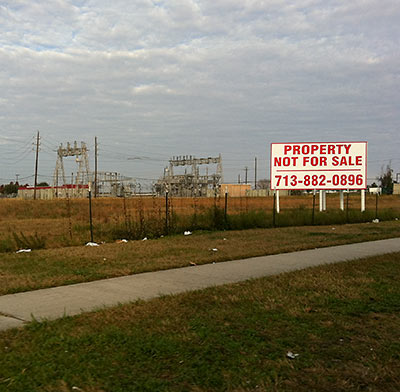
CWM sent me this photo and link:
by Tyler Cowen on December 30, 2011 at 1:33 pm in Games | Permalink
Previous post: The opening sentences of *Paul Clifford*
Next post: Why not treat debt and equity the same?


Get smart with the Thesis WordPress Theme from DIYthemes.

Hahaha!
That’s really quite brilliant. It gets the site far more attention than what it would otherwise see.
That’s quite the high starting negotiation point.
*boop boop boop boop*
Hello. I’m calling about the land you’re not selling? Yes, I’m not interested in buying it.
*click*
For rent?
Maybe the number is for the Hall & Oates Emergency Hotline
In Ghana, property owners do this to discourage con artists.
Ditto for Egypt. Every vacant lot has the owner’s name and phone number posted, most with “This land is not for sale.”
Maybe its this land:
http://www.nytimes.com/2011/12/30/us/in-louisiana-twist-in-legal-fight-over-texaco-drilling-lease.html
713 is a Houston area code.
Just gonna say, they do this in Ghana and Houston?
Both ecomomies with at least some oil wealth.
Builders in Klein, Texas
Logan Homes, L.L.C.
Number: 32231 Status:
Approved: 2006-10-04 (YYYY-MM-DD) Expires: 2009-02-28 (YYYY-MM-DD)
Phone: 713-882-0896, Ask For: Wayne Woodruff
Address: 6411 Glenhill Drive, Klein, TX 77389
Brilliant. So that’s the answer. He’s lost is zoning/subdivision approval and can’t legally market the property for development purposes, so he needs a buyer who can finance the rezoning first.
This is common in parts of Africa to signal that no one should try to buy the property – otherwise a con artist may offer the property to an unsuspecting buyer, who then finds out that they have paid for land to which the ‘seller’ had no title. It tends to be on vacant lots where I guess the potential for fraud is higher.
Oh so it is Houston. I thought that picture had the oh so familiar quasi-post-apocalyptic feel of my city.
it is common here . And no they are not selling it. they are only tired of people asking
Then why the phone number? Why make it easier for peopley ou are tired of talking to to bug you?
Its a way to fight adverse possession.
Easier on the neighbours.
Reverse psychology — or really just a way to get attention in a busy market.
Actually you see that sort of thing from time to time in Latin America. People sell land that doesn´t belong to them and then it’s a hassle for the owner to evict the buyer.
This is quite common in emerging markets because enough people have been successful forging documents and selling plots that don’t belong to them.
Interesting. The Brits and Europeans both developed independent solutions to these problems ages ago at very early stages of development the Britsand early Americans used race-notice statutes IIRC until the Australians invented Torrens’ Title in 1858 and the Brits repatriated the first version of the system that worked in 1925 after several early attempts failed as they did in the U.S.; Americans added the complication of title insurance starting in 1853 which soon spread (U.S. lawyers did title opinions as practice of law before then); the Europeans managed it by not transacting in land much and limiting the number of notaries who can document real estate transactions in any jurisdiction and hanging the loss of the valueable regional notary license over anyone who was unqualified or screwed around the system which made inefficient economically to mess with it. Race-notice is at least as old as the steam engine and probably older (IIRC sometime around the Statue of Anne); regulated notaries have handled real estate title in continental europe since the 1500s or so, pretty much immediately post-feudal). You would think that the title assurance function would have transferred with the real of the adopted colonial legal system pretty smoothly. But, clearly not.
Well as a bargaining tactic, there’s steam.com (which is a domain name highly sought after by Steam which is currently at steampowered.com).
In the case of internet domain names, intent to sell is used as strong evidence of domain squatting, so “this domain is not for sale” is a common term used on domain names: maybe this plot of land is in some country where intent-to-sell binds you to a different set of eminent domain laws.
As a follow up, in
http://en.wikipedia.org/wiki/Microsoft_vs._MikeRoweSoft
The demand for 10,000 dollars in exchange for the domain name was used as evidence of cybersquatting.
It must be the T-Mobile “I now think I can buy the crown jewels because I’m feeling richer affect”
This is a very common site in Kenya.
Comments on this entry are closed.