Christian Odendahl writes:
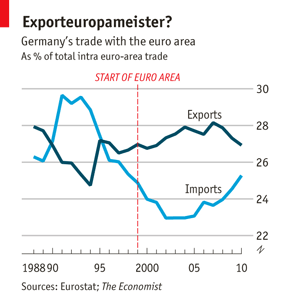
The soaring export demand from Europe for German products is one of those often-heard truisms about the euro crisis that is actually false.
What did change massively, however, were Germany’s imports from the euro area as measured by market share. The collapse in German import share is a sign of a weakening domestic economy. The German current-account surplus vis-à-vis the rest of the euro area was therefore accompanied by import contraction, not unusually high export growth. Wherever the German savings recycling took place, it was not in the euro zone.
The full post is here.


Speaking as someone who worked in Germany during this period, the conclusion and the chart on which it is based are misleading. Germany ramped up their trade with *Asia* during this period, and not just exports. Industries such as retail decided to source from Bangladesh and China not just because they were cheaper but because they offered better service than countries like Italy, which close their factories for 2 months every summer. Germany became a global competitor, a change their EU colleagues refused to do.
I don’t believe the original author is trying to disprove that Germany is an export powerhouse. Instead, there’s a an idea going around that it’s okay (and in fact just)
for Germany to be forced to bail out Greece because much of the gains in the German economy are the result of exports to the periphery
(e.g. Greece borrowed Euros and then spent them on German goods).
If one can show that the gains in the German economy came from exports to Asia and/or the US, then it takes the wind out of the sails of that particular argument.
Weak Euro is for the great benefit of Germany. The production costs of BMWs, Merc, Porsche, VW, Siemens, etc, etc are DOWN. While at the same time their Political Influence is greater than in any time after 1945. The bank deposits are soaring with the hot money from Greeks, Spaniards,Portugeese, Irish looking for safe heaven. And on the top of all of that they can present themselves as victims to the nations their bankers lent money so foolishly. What a great deal they have! However you slice it Germany always win. That’s EU by design.
Paul Blumenthal,
http://www.sh1ny.com Founder
IMHO you are really wrong.
Some German companies are able to produce rather cheaply because the Euro is not as valuable as the DM would have been in this particular situation. So *they* make more money.
On the other hand, this very fact also means that the German citizens lose a lot of purchasing power. Imports are so expensive because the Euro is not as valuable as the DM would have been in this particular situation.
Even worse, German tax payers are forced to use their money to repay the debts of Greek cititzens who are unable or unwilling to do so.
I really fail to understand how the net effect is good for Germany at all.
BTW, Swiss bank deposits are just as soaring even though Switzerland is neither part of the EU nor uses the Euro. Such things do not matter. Reasonable policy does.
Paul, +1 As to Christoph’s comment about import prices, don’t forget real wages increased. Moreover, the expansion of the EU tarriff free zone expanded Germany’s sourcing options within the EU–eastern Europe in particular.
Sometimes people are surprised that tarriff free zones work. I’m not, particularly if you can encompass new trading partners who will tilt toward you (because you are in the zone) and not others who are outside of it.
Utterly incredible, if Germany really is better off through the euro then may any of you two have the kindness to point out how the Target2 imbalances will be resolved. Vendor-financed exports to bankrupt customers are hardly a winning propostion and a foolish strategy, to say the least.
Of course, but these are not advocates for Germans- they are advocates for the bankrupt customers. Always keep that in mind.
What’s this business of fraction of total intra euro-area trade? The introduction of the euro was meant to greatly increase the scope of this trade. If Germany’s share is stable then indeed there must be soaring demand for German exports. If their share of imports is declining that may only mean that they are not increasing imports commensurately.
Ding Ding Ding! I think we have a winner. Once you realize that the chart is normalized by total intra-euro area trade, which expanded as the euro was introduced, you realize that it does show exactly what the Economist denies that it shows – ie., steady imports and increasing exports.
Absolutely true. Germany’s trade as % of total intra euro-area trade doesn’t show anything at all. If Germany stopped importing from the Euro area altogether and bought Chinese imports instead, Germany’s import share would fall to zero, without domestic consumption being hurt at all.
“Wherever the German savings recycling took place, it was not in the euro zone”
Well… I look at the amount invested in the eurozone by German banks, and I can’t help concluding that this is rather wrong. But perhaps the writer defines “savings recycling” differently to me.
Plus, national central banks in periphery countries can finance consumption of German export goods without relying on German savings per se by crediting accounts of national customers and booking a liability with the German Bundesbank via the ECB-system.
German exports as % of German GDP
Exports to PIIGS: 2.5% in 1995, ~3% in 1999, ~5% at peak in 2008.
Exports to all EMU nations: ~13.5% in 2001, 17% at peak in late 2008.
Exports to non-EMU nations: ~16% in 2001, 22.5% at peak in 2009.
I am always amazed how much of Germany’s exports are attributed to a “weak Euro”.
If a weak currency is the key to exports, then Somalia and Zimbabwe should be king. As should Cyprus and Malta because they have the same Euro.
Germany exports a lot because it has 10,000s of companies, from large to small, that produce things that people around the world want to buy and because they offer good after-sale services.
Chinese don’t buy Porsches or BMWs because of a currency exchange rate, they buy them because they don’t want to drive a Dodge or a Fiat. Countries hire Siemens to build their power plants because they don’t want them to implode. People in India want a dishwasher by Bosch or Miele because these products have a good reputation. Art students around the world want Faber-Castell pencils. Clinics buy medicine from Bayer or BASF because these are world-leading companies.
Just yesterday, I heard from somebody who owns a very small vineyard (less than 20 acres) in rural Germany, a family-owned and -run business. He exports part of his wine to a supermarket in Japan. And you will find companies like this in every German state, city, town and village.
Fluctuations in the exchange rate will affect the exporters’ bottom line, but they won’t decide if they get the contract in the first place.
+100
And Somalia and Zimbabwe are kings – in exporting their own starving population.
Comments on this entry are closed.