Category: The Arts
Stocking stuffers
Infrastructure: A Guide to the Industrial Landscape. A picture book for those who love Duisburg, Gary, Indiana, and the Pulaski Skyway. Addendum: Here is a working link to Infrastructure.
Murderball, just out on DVD. I know, some of you thought "I don’t want to see a movie about cripples." That was a mistake of instrumental reason.
Seu Jorge, The Life Aquatic Studio Sessions. David Bowie songs on acoustic guitar, sung in Portuguese, not just the cuts from the movie.
Year-end “best of” lists
Here is a meta-list (why is there no "best of" the "best of" lists?); it is expected to grow to over 500 entries. Thanks to the ever-excellent http://kottke.org for the pointer.
Dana Schutz
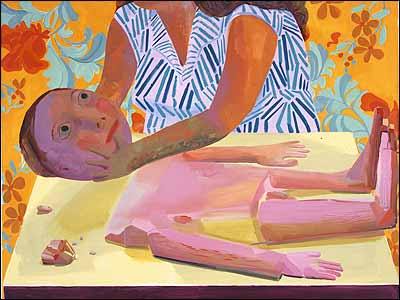
Here is the (cute) artist. Here is an article. Try this picture too. Here is Presentation, go see it in MOMA, I am still thinking about it.



Money
The answer so often is money, what is the question? Alfonso Lorenzo, on the other hand, insisted on being delivered a TV set.
My favorite things Rhode Island
Remember the old saying "Nothing but for Providence"? Well it is not (quite) true. Here goes:
Music: Thumbs down to George Cohan ("Yankee Doodle Dandy"). The obvious pick is saxophonist Scott Hamilton. Have you heard of guitarist Les Dudek? There is also trumpeter Bobby Hackett. But is that all?
Painter: It is hard not to pick Gilbert Stuart. Here are some images. Here is my favorite.

Literature: I have never found H.P. Lovecraft readable, nor have I tried Spalding Gray. Did you know Cormac McCarthy was born in Providence?
Movie, set in: I don’t like Spielberg’s Amistad, nor have I seen Outside Providence. Safe Men is only OK. Please help me out in the comments. Here is a good general list of best movies set in particular states. And if you are looking for directors, the Farrellys are from Providence.
The bottom line: Rhode Island offers some good names, but thematically they don’t add up to anything very particular. In my mind, I keep coming back to the music festivals.
Tonight I am giving a talk at Brown University, in case you are wondering.
Alfonso Lorenzo, updated
You may recall, from a few months ago, a Wall Street Journal article about the mentally ill Mexican amate painter Alfonso Lorenzo. He was the guy who was chained to a wall for a few years; here is my earlier post. The full WSJ article is now available on-line, thanks to Raymond Suarez for the pointer. Once again, here are links to Alfonso’s works.
I welcome the Ubermensch
There is a great scene in the movie Gattaca of a piano recital. (As I remember it). As we listen to the beautiful and complex music the camera slowly pans in on the pianist’s fast-moving fingers until we see why the music is so amazing, the pianist has six fingers on each hand. Was the music written for the pianist or was the pianist written for the music? Even though Gattaca is often understood as a dystopia the movie is great at showing the promise of genetic engineering.
In India, genetic mutation has done what we are close to doing with genetic engineering. Devender Harne has six fingers on each hand and six toes on one foot and seven on the other. He says the extra fingers let him work faster than other children.

If you think the photo has been Photoshopped, it hasn’t. See here for the full story and video. Thanks to J-Walk Blog for the link.
My favorite things Tennessee
Music: Who is really from Tennessee? Putting the Sun Records and Nashville crowds aside and focusing on birth, you have Lester Flatt, Dolly Parton, Tina Turner, and Aretha Franklin. Honorable mention to Chet Atkins and Isaac Hayes. Add in Bessie Smith and yes I enjoy Justin Timberlake too. Brownie McGee and Sleepy John Estes round out the blues representation. A strong category, and if you count "recorded in Tennessee," it hits the stratosphere.
Elvis Presley song: (Marie’s the Name) His Latest Flame.
Author: James Agee, Let us Now Praise Famous Men. Tennessee Williams does not fit, despite his name. There is not much to choose from here.
Film, set in: Here is a list, but I don’t much like Nashville or The Coal Miner’s Daughter. How about the final scene of Goldfinger?

Director: Quentin Tarantino. He is overrated but Reservoir Dogs is a classic.
Artist: Robert Ryman, here is one image, and no need to write and tell me this is ridiculous. Red Grooms is an alternative pick. There is William Edmondson, if you wish to go the "Outsider" route.

Comments are open…
Artistic achievement late in life
…After 1660, with the monarchy restored, Milton’s political dreams lay in ruins under the double blow of the collapse of the Puritan Republic and the failure of said republic to uphold freedom while it lasted. Milton retired to private life and returned to his true vocation, the writing of poetry. He had gone blind while serving as secretary to Cromwell, and now sat composing his poems in his head, and dictating each day to his daughters the portion that he had composed. It was in this retirement that he produced his three long poems, Paradise Lost, Paradise Regained, and Samson Agonistes. He died 8 November 1674.
Milton was born in 1608. Here is my previous post on age and achievement; read the comments on Coase and Stigler.
When do creators do their best work?
Randall Jarrell similarly observed that "[Wallace] Stevens did what no other American poet has ever done, what few poets have ever done: wrote some of his best and newest and strangest poems during the last year or two of a very long life."
In contrast:
[Jean-Luc] Godard has directed scores of movies in a career that continues today in its fifth decade, but there is a strong critical consensus that his most important single work is his first full-length movie, Breathless, which he made in 1960 at the age of 30.
Those two passages are from David W. Galenson’s forthcoming Old Masters and Young Geniuses: The Two Life Cycles of Artistic Creativity. Here is a related working paper. Here are many other interesting papers.
My question: Which economists have done extremely important work after the age of 50? Have done their best work after 50? After 40? Comments are open, I welcome your suggestions but it is not easy…
How to walk through a museum
Donald Pittenger offers some observations on how to visit or walk through a museum. Here are my tips:
1. In every room ask yourself which picture you would take home (if you could take just one) and why. This forces you to keep thinking critically about what you are seeing. More crudely, you have to keep on paying attention.
2. Almost all museums (MOMA is one exception) hang large numbers of second-rate paintings by first-rate artists. Try to find them. Don’t think it is all great, it isn’t.
3. You are probably better trained at shopping than looking at pictures. Do some basic research on prices and pretend you are shopping for pictures on a budget. This will improve the quality of your viewing.
4. Go with a variety of people (but not all at once). It forces you to see the art through their eyes.
5. If you are visiting a blockbuster exhibit, skip room number one. There is too much human traffic, as the people have not yet admitted to themselves they don’t care about what is on the wall.
A key general principle is to stop self-deceiving and admit to yourself that you don’t just love "art for art’s sake." You also like art for the role it plays in your life, for its signaling value, and for how it complements other things you value, such as relationships and your self-image. It then becomes possible for you to turn this fact to your advantage, rather than having it work against you. Keeping up the full pretense means that you must impose a high implicit tax on your museum-going. This leads you to restrict your number of visits and ultimately to resent the art and find it boring.
Comments are open, in case you have further suggestions for how to visit a museum.
Tantrums as Status Symbols
Once upon a time one’s social status was clearly signaled by so many things: fragile expensive clothes, skin not worn from work, accent, vocabulary, and so on. As many of these signal have weakened, one remains strong: tantrums.
CEOs throw more tantrums than mailboys. Similarly movie stars, sports stars, and politicians throw more tantrums than ordinary people in those industries. Also famous for their tantrums: spoiled young wives, bigshot patriarchs, elite travelers, and toddlers.
These patterns make sense: after all, beautiful young women and successful older men are at their peak of desirability to the opposite sex. If you are surprised that toddlers make the list, perhaps you should pay closer attention to the toddler-parent relation. Parents mostly serve toddlers, not the other way around.
Of course, like a swagger, the signal is not so much the tantum itself as the fact that someone can get away with it.
Addendum: Todd Kendall has a data paper on this for NBA players.
My favorite things New Zealand
Having once spent a year living in Wellington, this one is easy:
1. Movie and movie director – Forget Peter Jackson and Lord of the Rings, I’ll opt for Vincent Ward’s The Navigator, where a group of medieval peasants suddenly emerges in late twentieth century Auckland. Ward’s Map of the Human Heart might count as Canadian, but I love its surrealistic treatment of love and memory. What Dreams May Come is sappy in parts but has Robin Williams doing a serious take on Bergman and Dante, doesn’t that sound strange? Note that this category is especially strong – for instance Andrew Niccol directed the underrated Gattaca.
2. Music – The Kiwis have many good indie bands but Split Enz is the peak, buy their greatest hits. Otherwise I’ll nominate the Jean-Paul Sartre Experience, if only for their name.
3. Fiction – Keri Hulme’s The Bone People or Janet Frame’s autobiography are both first-rate, catch the movie too.
4. Painter – Umm…things slow down a bit here. The obvious pick is Colin McCahon, here are some images. Here is my favorite, but I will admit some lameness in the category overall.

5. Food – Fish and chips is to New Zealand as barbecue is to Texas — tops in the world. The best places are owned by Greeks. New Zealand is also a first-rate locale for Malay, Cambodian, and Burmese cuisines.

6. City – Wellington is for me the single most beautiful city in the world, make sure you go to the lookout on Mount Victoria, here is alas only part of the panorama. Wellington is also full of lovely Victorian homes. I will Napier as an underrated second, here is some Art Deco, the city center was destroyed by an earthquake in the 1920s and rebuilt in that style.


The problem? I like New Zealanders so much, I wish there were many more of them. Here is a brief photo tour, if you haven’t already decided to go.

Machu Picchu: Thoughts and Recommendations
Machu Picchu illustrates the real estate adage, location, location, location. Everywhere you look you are assaulted by beauty. For the mathematicians, MP sits on a saddlepoint so if you look North (I’m not sure of the directions but you will get the idea) you see one mountain, turning South you see another, on the East is a sheer cliff falling onto a river, on the West another cliff falling down onto the tiny town of Agua Calientes. Even further out on the East and West horizons are snow-capped peaks. And then there are the ruins themselves, majestic and mysterious. The picture to the right, taken from Putucusi (see below) gives some idea of the location but no picture can take your breath away like the real thing (or perhaps that was just the altitude!). Click to expand.
Adding to the magic is the fact that getting to MP is still relatively difficult. The most common route is by train from Cusco. It’s only 68 km but takes over 3 hours because the train must go backwards and forwards along trackbacks to make it up some of the steep terrain. The ride is not boring, however, as it takes you through mountain ranges alongside a raging river. As you get further and further into the Andes you begin to understand why MP was not formally discovered until 1911. At Agua Calientes you board a bus which takes you on a one-lane dirt road up the mountain. There are no guard rails on the road and the bus drivers periodically have to slam on the brakes as they meet one of their fellows coming in the opposite direction – one of them then has to back up to let the other pass. True, trains and buses are not the stuff of Indiana Jones but neither is this like negotiating the traffic of Rome in order to see the colliseum, there is a definite sense of exploration.
The ruins are a tourist site, of course, but the poverty of Peru means there are few guard rails, plaques or tour guides pushing you on (you can hire a local guide if you want). Again, to me at least, the experience was more like exploring ruins than visiting ruins.
Recommendations
My most important recommendation is to stay the night in Agua Calientes. Most people come in from Cusco for the day – what this means is that they don’t arrive at the site until about 10:30 and they leave by 2:30 to catch the 3:30 train back to Cusco. Outside of these times there are surprisingly few tourists. If you stay the night you won’t have MP to yourself but in the morning or late afternoon you will be able to explore at leisure and take pictures of the site sans tourists.
On the morning of my second day, I climbed the mountain opposite MP, Putucusi, and had the whole mountain to myself on the climb and the summit. Only on the way down in the afternoon did I meet others.
I recommend climbing both Huayna Picchu and Putucusi (but not on the same day!). 
Huayna Picchu is the mountain in all the photos directly connected to MP. Climbing it is not technically difficult but it can be arduous as the air is thin. When I reached the top huffing and puffing, I was shocked to find an ancient Incan laughing at me. At the top is a fort! After doing the climb yourself your appreciation of the work and engineering that went into building at the top of a mountain is increased immeasurably. Also the ruins at the top are dangerous! No guard rails, guides, or people telling you where to go or what to do. Very cool – see picture to the right – off the equilibrium path and you are a goner.
Putucusi is more difficult to climb, there are long sections where you are climbing nearly vertical ladders but reaching the top is worth it.
My debate with Benjamin Barber on cultural diversity
You can find the video here. This may be a more direct link. Here is the Smithsonian summary:
Tyler Cowen and Benjamin Barber present two different perspectives on the role of market liberalization and cultural diversity and representation.
Tyler Cowen advocates working within a liberal market paradigm, using UNESCO as a ‘marketing tool’ for cultural representation and has a positive trade-enhancing vision towards culture.
Benjamin Barber critiques the structure of neo-liberal market expansion, pointing out the inherent structural inequities that maintain this system and do not allow equal representation of cultural groups, communities, and increasingly, nation-states.