Did highways cause suburbanization?

by on September 10, 2009 at 7:09 am in History | Permalink

Via RortyBomb, that is a research paper by Nathaniel Baum-Snow.  Here is the abstract:

Between 1950 and 1990, the aggregate population of central cities in the United States declined by 17 percent despite population growth of 72 percent in metropolitan areas as a whole. This paper assesses the extent to which the construction of new limited access highways has contributed to central city population decline. Using planned portions of the interstate highway system as a source of exogenous variation, empirical estimates indicate that one new highway passing through a central city reduces its population by about 18 percent. Estimates imply that aggregate central city population would have grown by about 8 percent had the interstate highway system not been built.

You can quibble with the model specification but I accept the paper's general conclusion.  A few points:

1. I am reluctant to call this a subsidy without qualification.  Visit an old medieval city like Esternach, Luxembourg ("a formidable fortress erected by Count Siegfried in 963").  The main buildings are grouped together on a hill.  It's value-enhancing that later governments adopted policies, such as near-free trade and national defense, which eased those constraints and spread out the population.  I wouldn't say that the resulting population distribution of say Paris is best thought of as resulting from a subsidy because they're not all on top of a hill somewhere,  I would say it is the result of greater wealth and trade opportunities and law enforcement, with some element of subsidy.  So if you favor the construction of the interstate highway system, as I think most commentators do (try driving for long on Rt.1), it is a rhetorically loaded decision to invoke the word "subsidy" as the major mode of explanation.

2. Greater wealth, transport, and trade naturally cause people to seek out larger homes and greater living space.  In a world with no policy distortions this may well be the dominant effect in various long-run settings.  The rise of the suburbs is not all subsidy-driven by any means.

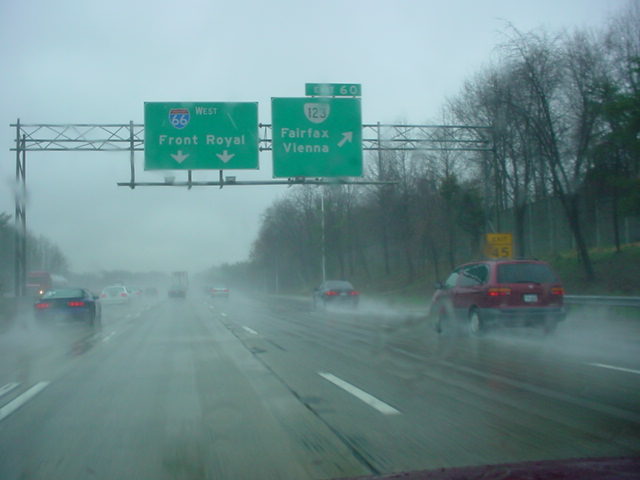
3. I recall the D.C. area quite well before it had either the Orange Line on the Metro (serving the Virginia suburbs) or Rt.66 going into Washington.  The construction of both enabled the suburbs to spread further westward.  But which was more important in driving this process?  Mass transit also can encourage suburbanization, especially the city has abominable public schools.  A longer and better Metro system — most of all with better parking — would have meant even more people moving to the suburbs.

4. Do not forget "white flight."  For American cities, this paper suggests that each black arrival lead to, on average, 2.7 white departures.  When it comes to DC, "black flight" has been a significant phenomenon and it is a major reason why the city has been losing population. 

5. Canada is much less suburbanized than is the United States and the greater "flight from blight" in the U.S. seems to be a major reason (see p.8 here).  When I think of U.S. suburbanization, I think of the failures of our municipal public sector as very important in this process.  In contrast, Fairfax County and Fairfax City governments are of reasonable quality.

6. For competitive Tiebout-related reasons, it is no accident that the public schools are so often better in the suburbs than in major cities.  Countries with strong social norms, such as Sweden, have this problem less.

7. One simple model (which I am not endorsing straight up) is that most American people with kids have a near-lexical preference for living in the suburbs.  Anything that enables them to do so can be called a cause of suburbanization and measured as such.  But isolating and measuring these marginal impacts, in the econometric sense, distracts us from seeing how general and how strong the underlying infra-marginal forces are and those are very often preference-based.

bastiat September 10, 2009 at 8:34 am

The hostility to suburbs has always been a mystery. The costs of commuting are born by the commuters, and in most cases there is still a huge tax subsidy of the inner-city from the suburbs. Why not use cheap land to enhance utility? Why build incredibly dense cities with their own issues? The counterfactual is not people choosing to remain in big cities but people leaving big cities for small towns that would not be as well connected.

matt wilbert September 10, 2009 at 8:51 am

I think point 1 is a false choice. You could have an interstate highway system without having highways that go into central cities.

Jim Meredith September 10, 2009 at 9:01 am

The role of mass transit in suburbanization seems, to me, the opposite of the effect of highways. In most cases, doesn’t mass transit make a city more attractive, leading to greater urban development? As the city becomes more populated and dense, and more people are attracted to its more diverse choice and economic benefits, there is a greater demand for land (and supported lifestyle choice).

Is suburbanization in transit-rich cities, in other words, a natural growth phenomenon, a pressure out from the center, and still a reflection of people seeking diversity? Is suburbanization in highway dominant cities, on the other hand, about fleeing the city, fleeing diversity? (Are highway-dominant metro areas losing/gaining population at a negative differential from transit-oriented regions?)

Matt F September 10, 2009 at 9:16 am

Suburbs grew becuase those that could afford to get away from big city corruption, did. Those that couldn’t became more and more beholden to the corruption. I am surprised that the “markets everywhere” guy missed this point.

Brian September 10, 2009 at 9:47 am

The paper quoted in #5 says the “blight flight” has no significant correlation with urban decline after “white flight” is factored out. Also it says the Canada’s better urbanism bay be related to its lower highway miles per capita.

In fact, it says pretty much the opposite of what you contend here and really makes me doubt the credibility of your sourcing.

Brian September 10, 2009 at 9:55 am

And as far as suburbanization goes, the most interesting question isn’t why we have satellite cities show up as population explodes in the 20th Century. Expansion was inevitable — the nation was full already and population quadrupled.

The big question is why we built such insipid mini-mall, car dependent, cookie cutter and parking lot dreck. We could have regional downtowns and civilized corner stores with walkable little streets and smaller lots and almost no parking. It would be transit acessible and much nicer than what we did build. I think very little of the problem was subsidized freeways; in fact those freeways are disastrously badly managed with no congestion charges. Probably single-use zoning and parking mandates are the principal villains.

Tyler Cowen September 10, 2009 at 10:06 am

Brian, re: #5, read the bottom/last full paragraph on p.8, the paper is sourced correctly.

Doc Merlin September 10, 2009 at 10:15 am

@Jim “The role of mass transit in suburbanization seems, to me, the opposite of the effect of highways. In most cases, doesn’t mass transit make a city more attractive, leading to greater urban development”

You have it backwards. Urban development comes first, THEN comes mass transit. Mass transit almost never precedes large scale urban development.

John Thacker September 10, 2009 at 10:48 am

Mass transit almost never precedes large scale urban development.

You should say that unsubsidized or close to profitable mass transit doesn’t. The government can do lots of silly things, like Buffalo’s light rail system.

improbable September 10, 2009 at 11:12 am

“The role of mass transit in suburbanization seems, to me, the opposite of the effect of highways. In most cases, doesn’t mass transit make a city more attractive, leading to greater urban development?”

This depends on your definition of suburban. Before the growth of the suburbs people now have in mind (postwar, car-oriented) there were previous stages of growth along railway / tram lines, and these new areas were also described as suburbs. (Hence the “suburban line” in London, which Americans would describe as pretty urban.) In many cases the lines did precede the development, well there may have been a village at that stop but it grew enormously. In fact didn’t tram companies initially develop a lot of areas in American cities?

If by suburb we mean only “insipid mini-mall, car dependent, cookie cutter and parking lot dreck” then for sure, mass transit does not produce that. And indeed building transit through such dreck sometimes causes it to compact & crystallise into something more urban — this is currently happening to some parts of Johannesburg, while other parts continue building like it’s 2006 in Phoenix AZ…

Seward September 10, 2009 at 11:38 am

mulp,

Actually, in the case of blacks and Jews, they created their own subdivisions and suburbs. Large areas of Georgetown from before the New Deal are a good example of this. Of course the New Dealers (mostly white folks) appropriate those neighborhoods when all the government bureaucrats came to town.

And as far as zoning to prevent a mix of businesses and housing, that was a Progressive Era idea that got coupled with the City Beautiful movement. All of which were efforts by white, middle class folks to make everyone and every neighborhood look like the white middle class ideal.

Seward September 10, 2009 at 11:41 am

mulp,

In other words, it is no surprise that the culmination of Progressive Era politics was a racist of the likes of Woodrow Wilson.

John Thacker September 10, 2009 at 11:52 am

If by suburb we mean only “insipid mini-mall, car dependent, cookie cutter and parking lot dreck” then for sure, mass transit does not produce that.

Taking out the unnecessary bias, why do you think so? Mass transit around DC enables people to live in car dependent areas with malls, and then drive to the Metro stations. The same thing certainly happens in train stations as well.

But in any case it’s clarifying to see that your objections are purely aesthetic, and have nothing to do with saving energy or anything like that.

Michael Foody September 10, 2009 at 12:25 pm

It’s weird that people are pointing to people choosing suburbs on price and citing revealed preference. I guess people prefer spam to steak too. I think the relative high costs for cities signify that there is a big demand for city style living. A demand that won’t be satisfied, because with cheap gas these sorts of communities won’t emerge on their own, at least they don’t seem too, almost no new cities that feel like cities have emerged in America in the last 100 years.

There is very little magical about the land that cities are built on that makes it more valuable, its value is an emergent product of its densitiy. It’s a weird case as I doubt that big cities like what people seem to like to provide are something that the market is even capable of providing.

Major September 10, 2009 at 1:01 pm

Tyler,

Other researchers contest Baum-Snow’s conclusion. See Highway Penetration of Central Cities: Not a Major Cause of Suburbanization. Quote:

Our look at Western Europe confirms that suburbanization is the norm, in line with our simple dynamics of growth discussion. Suburbanization abroad occurred without the highway penetration story that Baum-Snow elaborates. There are, then, strong reasons to doubt the conclusion that highway penetration of central cities was a major cause of suburbanization in the United States.

John Dewey September 10, 2009 at 1:45 pm

Tyler: “Do not forget ‘white flight.’”

Ed: “As for why this normal pattern was interrupted in the postwar US, my guess is forced racial integration.”

For at least two of the largest and most sprawled U.S. cities, 1970′s forced busing to achieve integration resulted in explosive growth of far suburbs. I have data – but not with me right now – on desegregation of Dallas schools in the 1970′s. As I remember the numbers, between 1972 and 1975, the households of over 50,000 white students had relocated to far suburbs where they could escape busing orders.

My evidence about Houston is mostly anecdotal. I well remember that forced busing was a major consideration for almost every coworker and friend who bought a house in the late 1970′s. Even those with no children quickly recognized the future resale value of homes located in school districts that were unaffected by busing orders.

As I remember discussions with fellow Houstonians, busing of children was a much more emotionally charged issue than was integration of neighborhoods. That was also true in south Louisiana, where close relatives deserted the Democratic Party and even attended KKK meetings following forced busing orders by judges.

Patrick Glenn September 10, 2009 at 2:21 pm

Mid-to-late 19th century streetcar lines were often speculative real estate ventures that did extend into peviously undeveloped suburban areas. The streetcar companies did very well on the real estate, not so well on the transit fees (incidentally, these streetcar suburb – which were considerably more dense than typical suburban/exurban development is these days – were also maligned by the urban elites as “cookie cutter,” culturally bankrupt, etc.)

Anyway, transit has always contributed to urban deconcentration, not the other way around. The highest density historic urban cores in the U.S. – like NYC and Boston – developed as walking cities (pre-transit). Today, you can use transit to create boutique higher-density, mixed-use lifestyle centers (often refered to as transit oriented development or TOD), but these have only a very nominal effect on overall urban density patterns, and they will often have the opposite effect.

Also, I have not read the study referenced by Tyler Cowen, so maybe they try to control for this, but: Any large metro areas that did not receive major new limited access highway infrastructure after WWII would not have had to worry about deconcentration – rather, the massive leakage of population and economic activities from their historic urban cores (and suburbs) would have relocated enitrely to other large metro areas.

joan September 10, 2009 at 2:46 pm

People do not prefer suburbs as such, it is just with their income and existing housings patterns it offers the best solution to resolve their conflicting wants. Rich and poor people live in the neighborhood they do because of the history of the neighborhords. If we stared from scratch poor people would live in the suburbs, not the inner city. When people choose where to live they care about most about these things.

They want to live in neighborhood with an median income more than theirs, or at least no lower. For most people schools quality only serves as a signal of neighborhood quality.

Whites want to live in a neighborhood no more than 30% black but blacks prefer 50 50.

They want a large living space and the larger the household the more space they want.

The want to be near shopping and other amenities but not near enough so they have to live with noise and congestion

They want a short commuting time to their job and care more and more about commuting time when it exceeds half an hour.

People try to resolve these conflicting wants when they choose where to live, and interstate highways shorten commuting times and so made suburbs more attractive.

John Thacker September 10, 2009 at 3:16 pm

More data, comparing density in 1990 to 2000. This uses the Census MSAs, not the statutory city limits.

Seward September 10, 2009 at 3:25 pm

John Thacker,

Well, that seems to go along with what we have long been told; that people are moving out of the Northeast and the rust belt and towards the sunbelt. That to me has as much to do with the adoption of air conditioning as well as the more pleasant Southern and SW winters and the like as it does zoning.

Major September 10, 2009 at 3:32 pm

Cities are formed and then gradually increase in density.

The long-term trend has been a reduction in density, not an increase. High-density urban cores have lost population to low-density suburbs and exurbs. There’s been a bit of moderation of this trend in some cities in recent years, possibly because of immigration, but nothing like a return to the densities of the past.

I think the relative high costs for cities signify that there is a big demand for city style living.

Why? Higher density tends to mean higher land costs (more competition for a given area of land) and higher construction costs. Hence, housing prices tend to rise with density. Higher density housing costs more to supply.

John Dewey September 10, 2009 at 5:18 pm

joan: “People do not prefer suburbs as such”

What does that mean, Joan? Everyone I’ve talked with in my Dallas suburban neighborhood likes it because it is a sprawled suburb. We enjoy distance between our homes. We enjoy the greenbelts and parks made possible by low cost land. We enjoy being free from the noise and congestion of industry. What is the basis for your claim that “people do not prefer suburbs as such”?

Corporations have discovered just how much their employees prefer suburbs and have moved offices to accommodate those preferences. Of that I am positive, as I once planned the relocation of such offices to the suburbs. I know exactly why my employers made those decisions.

joan: “For most people schools quality only serves as a signal of neighborhood quality.”

Really? Are you saying that parents are unconcerned about the quality of education their child will receive?

joan: “interstate highways shorten commuting times and so made suburbs more attractive.”

Perhaps, but families were choosing suburbs long before interstate highways existed. In fact, many were choosing suburbs before automobiles were affordable to the masses.

Major September 10, 2009 at 6:01 pm

People prefer cities to sprawl. You can tell because cities are more expensive.

No, you can’t tell that. Truffles are more expensive than potatoes, but that doesn’t mean there’s more demand for truffles than potatoes.

Major September 10, 2009 at 6:56 pm

Right. And yet the urbanists keep claiming that the higher price of housing in cities compared to suburbs is evidence that suburban housing is desired less than city housing. Sigh.

josh September 11, 2009 at 9:18 am

“cities are more expensive.”

You can buy a 5 bedroom house in Detroit for $10,000!

Comments on this entry are closed.

Previous post:

Next post: