From the always essential FT Alphaville:
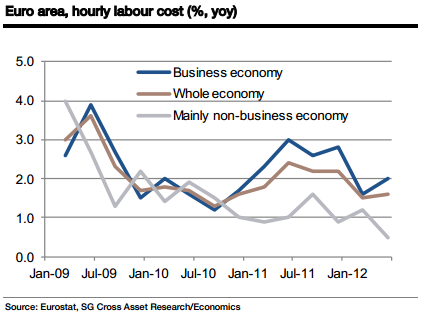
Société Générale points out that unit labour costs — basically, wages — have been falling quite rapidly in the peripherals, and that this is probably due to austerity measures. New data from Eurostat breaks out what the agency calls ‘non-business’ wages: the education, health services, and public administration sectors. In otherwords, ‘non-business’ is a rough proxy for the public sector:
The logical follow-on from the above being that “non-business” sectors are a big contributor to the rapidly falling unit labour costs in the periphery, especially given their large state sectors:
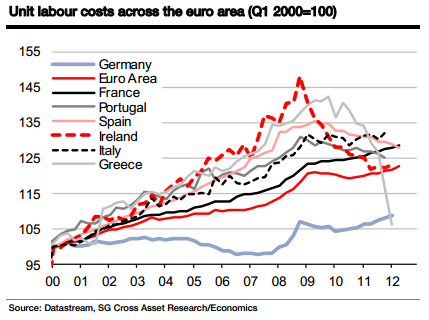
SocGen’s Michel Martinez writes that there are outright wage declines in Greece while in the other peripherals, labour productivity (as measured by ULC) is outpacing wage gains.
TC again: No one should doubt that depreciation and expansionary monetary policy are a much easier path to lower real wages. Yet the claim that wages are outright sticky for long periods of time, when economic pressures dictate wage declines, isn’t holding up that well.
And I would add this: They are not as wealthy as they thought they were.


The first chart, contra the text, shows “non-business” wages not falling, but simply increasing more slowly.
Not in real terms.
But the whole point is that wages are nominally sticky. I take this to be giving the opposite lessen; wage stickiness can last a suprisingly long time.
Inflation in eurozone is 2.6%.
Why would you need to lower real wages?
I guess if that is the same as “keep real wages from rising as circulating cash decreases” I’m with you.
Btw, it would seem Europe is in a position to do something we aren’t- lower the gas taxes. But, policy is sticky.
Real wages are declining if nominal wages are not growing with inflation. Approximately 1.6% nominal wage growth and 2.6% inflation is real wages shrinking 1%. BTW, the most important thing is coverging real wages between the rich (Germany) and the poor (PIIGS), which is happening. Allow that to happen and devalue the currency and you can make the periphery competitive without enormous nominal wage adjustments.
Suppose the real wage you’re currently offering isn’t attracting employment.
That unit labor costs are “basically, wages” is kind of a heroic assumption. Unit labor costs plummeted in the U.S. during the recession as “productivity” soared because businesses were slashing their less-productive units and employees. That doesn’t (and didn’t) mean that the remainder were getting wage decreases.
Great! Let’s have single payer and get those provider salaries under control!
You mean a single payer like Medicare?
I think,
“sammler” made the most important point. If wages are too high by > 10%, relatively, without the possibilty to devalue via extern, 1% less raise doesnt cut that much.
And, unfortunately, you should take all that “unit labor cost”, “service sector productivity” numbers with a lot of salt.
Beyond, look up “Croke Park Agreeent”, “redeployed” and links there in. I see only “tax increases”, but not “wage cuts”. How does this go into these statistics?
erm, typo:
http://en.wikipedia.org/wiki/Croke_Park_Agreement
and
http://en.wikipedia.org/wiki/Irish_budget,_2010
for some numbers
Those graphs speak to me. They say: Europe can survive.
This is the most promising picture I’ve seen in several years of Greeks coming to grips with their situation.
Gee, what a model.
The rate of wage increase isn’t increasing as fast, in real terms there is, at best, a 1% decline in real wages, and there is
Increasing unemployment.
Way to go austerity!
PS–If you are doing intra country comparisons, don’t forget that wages are used to buy things and the composition of things between countries is different. In the US, you buy with your wages health insurance. If you are unemployed or employed in Europe your wage rate change has no effect on your out of pocket bill for healthcare.
Agreed. Debt is what is sticky, not wages.
To be very precise, long-term contracts are sticky.
Can we have a quick refresher on why “depreciation and expansionary monetary policy are a much easier path to lower real wages.”?
Is it just because austerity requires democratic decision and consent, while depreciation and expansionary monetary policy largely just requires the decision of a few unaccountable people?
Sumner replies: http://www.themoneyillusion.com/?p=16322
Some technical remarks: these are average wages per hour, not contractual wages per hour. Normally this would not make too much of a difference but considering exceptional large structural changes this might influence data, for instance if, in Greece, high wage sectors are closing down while low wage sectors are surviving. At this moment in Greece, only finance, real estate en ‘extraterritorial bodies’ show job growth, but that’s another matter. Aside from this, real unit labor costs is a bad metric to gauge productivity – it includes non-exporting sectors like the government and (as it’s based upon GDP) imputed rent of owner occupied houses…. What you need to have is productivity per (cluster of) companies, not unit-labor costs of the entire economy. Also, though lower wages for a company can lower selling prices of a company, economy-wide lower wages of course depresses income and therewith (according to national accounting, on a macro level demand = income = production and a large part of income is of course wage income), unless it is offset by higher wages/interest/rents. By the way – Elstat data from today show that (averages for the last three months) manufacturing orders and manufacturing turnover in Greece is still declining, the only sector which does well is production of energy (probably a new refinery or something like that). And refineries are not really dependend on low wages… The point is that there is a Great Depression size slump in southern Europe. Money in Greece: -35%. Unemployment: 24%. Retail sales: -40%. That’s a situation were more demand is needed, investments, consumption, exports, government demand, whatever. Supply isn’t the problem, at this moment. Let’s start with an EU-wide pension system which prefents cuts in pensions to finance outright capital flight.
It is altogether possible that there are no uncommitted surpluses remaining in the aggregate of the EU economies. What surpluses remain are likely isolated in larger business enterprises ( with global operations and dispersions).
First look at Ireland and Greece, then look at Spain and Italy. Oh dear…
Comments on this entry are closed.