Category: Books
Traffic: Why We Drive the Way We Do
And the subtitle is "(and What It Says About Us)". The author is Tom Vanderbilt and here is the Amazon link. I wrote the following blurb for it:
"Everyone who drives–and many people who don’t–should read this book. It is a psychology book, a popular science book, and a how-to-save-your-life manual, all rolled into one. I found it gripping and fascinating from the very beginning to the very end."
It’s out in July and so far it is one of the best popular social science books of the year.
I also liked the article on traffic — John Staddon’s "Distracting Miss Daisy" — in the latest Atlantic Monthly. It had these two good sentences:
Paradoxically, almost every new sign put up in the U.S. probably makes drivers a little safer on the stretch of road it guards. But collectively, the forests of signs along American roadways, and the multitude of rules to look out for, are quite deadly.
What I’ve Been Reading
1. My Stroke of Insight: A Brain Scientist’s Personal Journey, by Jill Bolte Taylor. What’s it like to lose half your brain in a stroke, be aware of the entire process, be unable to reason coherently, and then recover your faculties over the course of years? This first person account is written by a Harvard neuroscientist.
2. Netherland, by Joseph O’Neill. Many critics are claiming this is the first great 9-11 novel. It grips your attention immediately and has a strong craft but philosophically does it have anywhere to go? It is rare that I put a book down after the halfway mark but that was the case here. Some of you will like this but I look for something more exotic from my fiction.
3. Mirroring People: The New Science of How We Connect With Others, by Marco Iacoboni. This is now the go-to popular science book on mirror neutrons. I especially liked the discussion of why we find conversation easier than giving monologues (well, not everyone does), even though a priori you might expect the opposite.
4. Now the Hell Will Start: One Soldier’s Flight From the Greatest Manhunt of World War II, by Brendan I. Koerner. The story of a black WWII GI who goes AWOL and marries into a Burmese hill tribe. This could have been a great book but as it stands it is a "good enough to read" book. The digressions are often more interesting than the main story.
5. Hedge Funds: An Analytic Perspective, by Andrew Lo. Finally a serious book on hedge funds based on real data, written by a leading financial economist, and covering August 2007. I’ve only browsed the book but it is a must for anyone who follows this area.
6. Jonathan Swift, Gulliver’s Travels. I read this (yet again) on the flight back from Japan, it is still one of the best books and one of the most important books for aspiring social scientists. A must-read if you don’t already know it.
The dumbing down of Borders
You leave the country for a few weeks and you come back to ruin. I’ve visited two Borders stores since my return and both have done away with their new books tables. In one case the table is still there but has about one-quarter as many books on it if that. The very best-selling books now get four to six piles on the table — or more — rather than leaving space for a greater number of titles with one stack a piece. The front of the store offers many more paperback books and many more bestsellers that have been doing well for months. Many bookshelves are gone altogether and replaced with non-book, non-CD, non-DVD items, such as expensive writing journals and gift cards. It’s much more like a Barnes and Noble.

In sum, the front of a Borders store no longer produces much information about the new titles on the market and it is no longer a good place for the well-informed to browse. I’ve yet to compare what’s stocked on the shelves but I am not hopeful about the trend. It’s hard to believe that the front of the store is the only site of ruin.
On the brighter side, maybe Borders Magic Shelf will prove of use. But check it out here — so far it doesn’t compare to browsing a well-stocked new books table nor for that matter Amazon.
What I’ve Been Reading
1. Henning Mankel, Depths. I loved this story. Have I mentioned that Mankell is one of my favorite contemporary writers?
2. Nick Lane, Power, Sex, Suicide: Mitochondria and the Meaning of Life. One of the best popular science books I’ve read in the last few years. Among other matters he explains why curing aging isn’t so easy, why eukaryotes seem to have evolved only once, and why it often should be "The Selfish Cell" and not always "The Selfish Gene." His book Oxygen is excellent as well.
eBook sales are way up
Penguin has reported that e-book sales from the first four months of
2008 have surpassed the house’s total e-book sales for all of last
year. According to the publisher, the spike is "more than five times
the overall growth in sales, year-on-year, through April 2008." Penguin
Group CEO David Shanks said he attributed the jump, in large part, to
the growing popularity of e-book readers.
Here is the link and right here you can buy Discover Your Inner Economist in Kindle form (it’s also available as a Sony eBook) and paperback as well, here is the Amazon link.
Addendum: Here is more on the economics of Kindle.
Who should be bounced from The Great Books series?
Before leaving for Japan, I’d been pawing through these volumes lately — you know, the U. Chicago fat tomes with two columns on each page? The obvious question is which books belong and which do not; overall I’m surprised at how well the 1952 picks have held up and yes that is tribute to the University of Chicago or at least its influence.
I’m sad that Hume doesn’t get his own volume, including many of his shorter essays. Plus I’d like to add Dickens’s Bleak House and at least the first two books of Proust. And who to bounce? I nominate Plotinus as the obvious choice, noting that he has only about 24,000 cites on scholar.google.com, not even as many as Joseph Stiglitz.
In 1990 they dropped four books: Apollonius’ On Conic Sections, Laurence Sterne’s Tristram Shandy, Henry Fielding’s Tom Jones, and Joseph Fourier’s Analytical Theory of Heat. The loss of Sterne is regretted but the others we can do without. You’ll find a list of the added books in 1990 at the first link, about halfway down and yes they did include Swann’s Way. Little Dorrit is not the best or even the second best Dickens selection. Most are good picks though I would have left the Bergson, the Dewey (unreadable), and tossed out some of the shorter works in favor of Ulysses. More William James is never a bad idea; how about The Varieties of Religious Experience? None of the science books will age well. And how about a wee bit of Mises and Hayek to reflect the failures of socialism? Absalom, Absalom would help cover race and maybe Mill on The Subjection of Women should be there too.
Discover Your Inner Economist, paperback edition
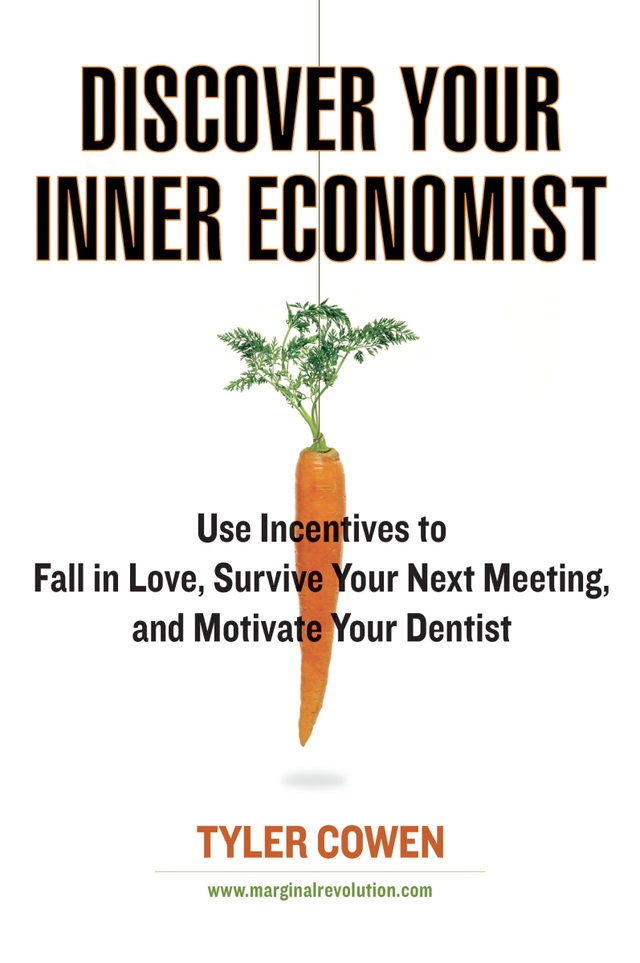
It’s now out in stores or buy it here on Amazon for $10.20. If you order the paperback (or the Kindle edition!) within the next week, just drop me an email and I’ll send you the site address of my secret blog. It has over fifty posts. We work on the honor system, so if you told me you have bought the book I will believe you.
My favorite things Japan, literature edition
I do not know Japanese literature well but nonetheless I recommend the following:
1. Out: A Novel, by Natsuo Kirino. Vicious fun. Dark, violent, etc.
2. Kobo Abe, The Woman in the Dunes. He has been called the Japanese Stanislaw Lem. Why do I never hear about this book? The movie by the same name is good too.
3. Yasunari Kawabata, both The Go Master and The Snow Country.
4. Mishima, Spring Snow, others.
5. Haruki Murakami. My favorite is Hard-Boiled Wonderland (one of my favorite books period) and then Underground, a modern classic of social science (really). I like most of them but I feel he is repeating himself as of late.
6. Shusaku Endo, Silence. Very powerful and I remain fascinated by Japan’s so-called "Christian century."
7. Kenzaburo Oe: I like Teach us to Outgrow Our Madness.
Question: Is Tale of Genji actually fun to read? I would say about half of it, so yes it is worth the time. The best parts are very beautiful and mysterious and unlike anything else in literature. Pillow Book of Sei Shonagon is fun and is a good introduction to the period.
The bottom line: There is lots and lots more that I have never heard of, not to mention manga.
Why Popcorn Costs So Much at The Movies
That’s the title of the new microeconomics book by Richard McKenzie. Here is a book trailer on YouTube. The subtitle is: "And Other Pricing Puzzles."
I am a fan of this book and I wrote a blurb for it. It is popular economics but it is more extended microeconomic reasoning than most of the other popular economics books.
How to find new books to read
TLV, a loyal MR reader, asks:
I’ve always been curious about how Tyler goes about choosing new books
to read. Most people rely on recommendations from others, but Tyler
seems like someone who generates a lot of recommendations rather than
relying on them. What is your process?
Children, do not try this at home, but here goes: visit Borders every Tuesday to look for new books, go to a local public library every other day and scan the new books section, subscribe to TLS, London Review of Books, New York Review of Books, noting that you should spend more time with the ads than the book reviews, read the blogs Bookslut and Literary Saloon, read the new magazine BookMark (recommended), read the NYT, FT, and Guardian and their books sections, review lots of books on your blog and peruse the numerous review copies you get in the mail (thanks, you mailers and yes I do look at each and every one; keep them coming!).
It’s rare that I rely on recommendations from other people.
Oh, yes, you should get free shipping on Amazon.com.
Why are books so outrageously expensive in Brazil?
That’s from a reader request. I’m no expert on Brazil, but here are a few possibilities:
1. Most Brazilians do not read. I don’t mean they can’t read, I mean they don’t read for leisure so much. I was stuck at the Sao Paulo airport for seven hours and did not see a single person reading a book, not once.
Taking that as given, low demand means high prices. That’s why Stephen King paperbacks are cheap and Edward Elgar (the name of an academic publisher) tomes go for $100 and up.
2. Brazilian retailing is not in every way efficient. Efficient retailing in the traditional sense is, by the way, bad for the quality of your food because it means it is easy to serve large numbers. And Brazil has some of the world’s best food, and so inefficient retailing for its books.
3. No other supply source is right nearby and the Portuguese language does not produce an extremely thick market. Note that the Portuguese of Portugal is very different from the Portuguese of Brazil.
4. The Brazilian currency may be overvalued at the moment, at least in purchasing power parity terms, due to Brazil’s commodity exports.
Outliers
The new Malcolm Gladwell book.
And now for something not completely different: Here is Robert Mundell’s hypothesis about Taxi Driver. And yes it is that Robert Mundell.
Spot the Contradiction
Daniel Gross’s review of Sachs’ Common Wealth was bizarre. Consider this:
Even congenital optimists have good reason to suspect that this time
the prophets of economic doom may be on point, with the advent of
seemingly unstoppable developments like….the explosive growth of China and India.
Huh? What kind of upside down logic makes high growth rates proof of economic doom? Proving this was no idle slip Gross goes on to say:
Things are different today, [Sachs] writes, because of four trends: human
pressure on the earth, a dangerous rise in population, extreme poverty
and a political climate characterized by “cynicism, defeatism and
outdated institutions.” These pressures will increase as the developing
world inexorably catches up to the developed world. (emphasis added)
Silly me, I thought rising life expectancy, increasing wealth, and lower world inequality, which is what it means to say that the developing world inexorably catches up to the developed world, was a good thing. And then there is this:
The combination of climate change and a rapidly growing population
clustering in coastal urban zones will set the stage for many Katrinas,
not to mention “a global epidemic of obesity, cardiovascular disease
and adult-onset diabetes.”
Ok, climate change will create problems but how clueless do you have to be not to understand that a large fraction of the world’s people would love to live long enough to die from obesity and other diseases of wealth?
Don’t misunderstand, I know that growth brings problems. My dispute with Gross is not that he thinks the glass is half-empty and I think it is half-full; my dispute is that Gross thinks the fuller the glass gets the more empty it becomes.
Addendum: Dan Gross writes to say that he was summarizing Sachs’ argument. Point noted.
Network Power
Indeed, while this convergence in ways of thinking and living may extend to influence cultural forms like music or food, it need not necessarily do so. It is striking that in this moment of global integration producing massive convergence in economic, linguistic, and institutional standards, we should be so worried about restaurant chains and pop music, neglecting much more significant issues. Famously, Sigmund Freud argued that nationalist rivalries between neighboring countries reflected the "narcissism of minor differences," a pathological focus on relatively trivial distinctions driven by the desire to keep at bay an anxiety-provoking recognition of fundamental sameness.
That is from David Singh Grewal’s Network Power: The Social Dynamics of Globalization, one of the most interesting books on cultural globalization in recent years. He uses the ideas of social networks and peer effects to argue that widespread cultural convergence is occurring, most of all in ways of life. Here is the book’s home page.
There is much wrong in the central thesis. "Ways of thinking" may be less diverse across countries (France is more like Germany than it used to be) but ways of thinking are now much more diverse within countries and in fact within the world as a whole. What’s so special about having diversity distributed according to geographic or political criteria? Once you get over the geography fetish, many of the author’s main mechanisms don’t hold up as accounts of growing sameness of ways of life and thinking. Has the author spent much time poking around Second Life?
Nor is he capable of simply coming out and saying that lots of countries in the world *ought* to be doing more to emulate Anglo-American ways of thinking.
The following claim is also questionable:
To reshape or reduce the power that the social structures we create have over us, we can only summon the organized power of politics. The large-scale voluntarism of sociability, by contrast, has always delivered the most varied and elaborate forms of individual subjugation.
Cranky Tyler is about to come out of his shell, so maybe it is time to end this post. It’s still a book worth reading and thinking about.
On a not totally unrelated topic, here is a good post on babies and globalization.
Wuthering Heights
When Dante Gabriel Rossetti read the novel Wuthering Heights, he wrote to a friend: "The action takes place in Hell, but the places, I don’t know why, have English names.
That is from Jorge Luis Borges, Selected Non-Fictions.