Category: Economics
The Future of Economic Growth: TED Talk
My TED talk, an optimistic account of the past and future of economic growth, is up. I haven't watched it yet but at the time I thought it went well.
Countercyclical assets, a continuing series
Lebanon, at least for now:
But while number crunchers elsewhere toil to trim over-optimistic
estimates into punier real results, statisticians at the Banque du
Liban are revising theirs sharply upwards. Lebanon’s GDP grew during
2008, not at an annual rate of 7.5%, it seems, but at 9% or better.
Yet even that trend-bucking number looks modest compared to other
milestones scored by this small, almost comically turbulent country.
Last year the value of deposits in Lebanese commercial banks rose by
15% to an impressive $94 billion, equal to 327% of GDP. Industrial
exports surged 24%. Tax revenues, tourist arrivals, banking profits and
the number of construction permits all soared by a third or more. A
giant 46% leap in net capital inflows helped Lebanon post a record $3.5
billion surplus in its balance of payments, and boosted the Banque du
Liban’s own reserves to a cosy $22 billion, nearly double its holdings
a year ago.
Nor does this upswing show much sign of slowing. Sales of new cars are
up by 19%, and the number of tourists arriving in the country in the
first three months of this year increased by 50% compared with the same
period last year. Property prices are holding the past few years’ heady
gains, and worries that the global recession would force home thousands
of Lebanese expatriates, slashing the remittances that underpin the
economy, have so far proven unfounded.
Emmanuel Saez wins the Clark medal
Here is one report. Otherwise, at Berkeley, Carl Shapiro is leaving to do antitrust analysis in Washington and Brad DeLong suggests that Joseph Farrell is also leaving Berkeley for the Obama administration.
The substitution of capital for labor, charity edition, seen in Atlanta
I thank Davis King, a loyal MR reader, for the pointer and photo.
Debating Economics
Intelligence Squared has held a series of debates in which they poll ayes and nayes before and after. How should we expect opinion to change with such debates? Let’s assume that the debate teams are evenly matched on average (since any debate resolution can be written in either the affirmative or negative this seems a weak assumption). If so, then we ought to expect a random walk; that is, sometimes the aye team will be stronger and support for their position will grow (aye after – aye before will increase) and sometimes the nay team will be stronger and support for their position will grow. On average, however, we ought to expect that if it’s 30% aye and 70% nay going in then it ought to be 30% aye and 70% nay going out, again, on average. Another way of saying this is that new information, by definition, should not swing your view systematically one way or the other.
Alas, the data refute this position. The graph shown below (click to enlarge) looks at the percentage of ayes and nayes among the decided 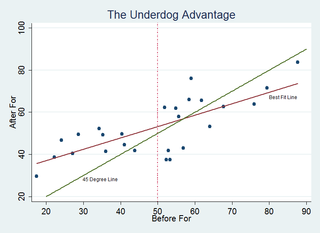 before and after. The hypothesis says the data should lie around the 45 degree line. Yet, there is a clear tendency for the minority position to gain adherents – that is, there is an underdog advantage so positions with less than 50% of the ayes before tend to increase in adherents and positions with greater than 50% ayes tend to lose adherents. What could explain this?
I see two plausible possibilities.
1) If the side with the larger numbers has weaker adherents they could be more likely to change their mind.
2) The undecided are key and the undecided are lying.
For case 1, imagine that 10% of each group changes their minds; since 10% of a larger number is more switchers this could generate the data. The problem with 1 and with the data more generally is that we don’t seem to see a tendency towards 50:50 in the world. We focus on disputes, of course, but more often we reach some consensus (the moon is not made of blue cheese, voodoo doesn’t work and so forth).
Thus 2 is my best guess. Note first that the number of “undecided” swing massively in these debates and in every case the number of undecided goes down a lot, itself peculiar if people are rational Bayesians. A big swing in undecided votes is quite odd for two additional reasons. First, when Justice Roberts said he’d never really thought about the constitutionality of abortion people were incredulous. Similarly, could 30% of the audience (in a debate in which Tyler recently participated (pdf)) be truly undecided about whether “it is wrong to pay for sex”? Second, and even more doubtful, could it be that 30% of the people at the debate were undecided–thus had not heard arguments in let’s say the previous 10 years that converted them one way or the other–but on that very night a majority of the undecided were at last pushed into the decided camp? I think not, thus I think lying best explains the data.
Some questions for readers. Can you think of another hypothesis to explain the data? Can you think of a way of testing competing hypotheses? And does anyone know of a larger database of debate decisions with ayes, nayes and undecided before and after?
Hat tip to Robin for suggesting that there might be a tendency to 50:50, Bryan and Tyler for discussion and Robin for collecting the data.
False Economy, by Alan Beattie
I enjoyed the book, most of all the chapter comparing Argentina and the United States. I was struck by this bit:
New York is the only one out of the sixteen largest cities in the northeastern or midwestern states whose population is larger than it was fifty years ago.
Over that same time period our national population has roughly doubled. The subtitle of the book is A Surprising Economic History of the World.
Handicappling the Clark medal
Justin Lahart reports:
Friday, the American Economic Association will present the John Bates Clark medal, awarded to the nation’s most promising economist under the age of 40.
The Clark is often a harbinger of things to come. Of the 30 economists who have won it, 12 have gone on to win the Nobel, including last year’s Nobel winner, Paul Krugman. Other past winners include White House National Economic Council director Lawrence Summers and Steve Levitt, of Freakonomics fame. Since it was first awarded in 1947, the Clark has been given out every two years, but beginning next year it will be given out annually.
With a deep pool of young talent to draw from, there’s no sure winner. But among economists, the clear favorite is Esther Duflo, 36, who leads the Massachusetts Institute of Technology‘s Jameel Poverty Action Lab with MIT colleague Abhijit Banerjee.
Ms. Duflo has been at the forefront of the use of randomized experiments to analyze the effectiveness of development programs. If teacher attendance is a problem in rural India, for example, what happens if teachers are given cameras with date and time stamps and told to take a picture of themselves and their students each morning and afternoon? Ms. Duflo and economist Rema Hanna tried it out and found that in the “camera schools,” teacher absences fell sharply and student test scores improved. Does giving poor mothers 60 cents worth of dried beans as an incentive to immunize their children work? It works astoundingly well. By answering these kinds of problems, Ms. Duflo, her colleagues, and the many economists around the world she has helped inspire, are uncovering ways to make sure that money spent on helping poor people in developing countries is used effectively.
Harvard University‘s Sendhil Mullainathan, who founded the Poverty Action Lab with Ms. Duflo and Mr. Banerjee, is also likely on the Clark short list. He’s a leading light in the fast-growing field of behavioral economics, studying ways that psychology influences economic decisions. For one paper, he and frequent co-author Marianne Bertrand sent out fictitious resumes in response to want ads, randomly assigning each resume with very African American sounding or very white sounding names. The resumes with the very white names got far more call backs. Mr. Mullainathan, 36, is also applying behavioral economics insights to development problems. One insight: The behavioral weaknesses of the very poor are no different than the weaknesses of people in all walks of life, but because the poor have less margin for error, their behavioral weaknesses can be much more costly.
Emanuel Saez at the University of Calif.-Berkeley, another Clark candidate, has been tenaciously researching the causes of wealth and income inequality around the world, with a focus on the what’s happening at the very tip of the wealth pyramid. But because there is very little data on the very rich, Mr. Saez, 36, and his frequent co-author Thomas Piketty have combed through income tax figures to come up with historic estimates. Among their findings: That before the onset of the financial crisis, the income share of the top 1% of families by income accounted for nearly a quarter of U.S. income – the largest share since the late 1920s.
One thought about the IMF
I believe this point has not received sufficient attention:
In a twist that leaves some experts shaking their heads, the fund needs
money from cash-rich developing countries, like China and India, to
help more developed but strapped countries, like those in Eastern
Europe.
One possibility is that the recent IMF loan program is about making governments better off, not about making people better off. Can you imagine that?
Assorted Links
- Hayek v. Keynes in elegant powerpoints developed by Roger Garrison. Hat tip to Taking Hayek Seriously.
- The Independent Review (I am an assistant editor) appears in several scenes in the new Crowe, Affleck movie, State of Play. David Theroux says the movie would have been better had the writers paid more attention to the contents.
Why is Heinz Ketchup still so popular in Pittsburgh?
From the latest issue of the JPE, Bronnenberg, Dhar and Dube write:
We document evidence of a persistent “early entry” advantage for brands
in 34 consumer packaged goods industries across the 50 largest U.S.
cities. Current market shares are higher in markets closest to a
brand’s historic city of origin than in those farthest. For six
industries, we know the order of entry among the top brands in each of
the markets. We find an early entry effect on a brand’s current market
share and perceived quality across U.S. cities. The magnitude of this
effect typically drives the rank order of market shares and perceived
quality levels across cities.
You'll find ungated versions here. The upshot is this:
Across 49 current leading national CPG brands, dating back to the late 1800s and early 1900s, we find that the current share in markets close to the city of origin, is, on average, 12 share (i.e., percentage) points higher than the national average of 22 percent.
What's amazing is how long these effects — however they are motivated — last. Miller Beer was introduced to Chicago in 1856 (a very early launch though technically not its first city) and it still has an advantage there, relative to other cities. Heinz Ketchup originated in Pittsburgh in 1876 and it still has an market share advantage there, again relative to other cities.
What is the mechanism? Is it that durable relationships with retailers persist for a very long time? Do area consumers develop the brand habit and pass it down across the generations? Or is the brand from a particular area better suited for people of that area in the first place, perhaps for reasons which are demographic or ethnic in nature and somewhat persistent through time?
Markets in everything yes this is real
Each time pets move anywhere, from the Pet Lounge to the pet limo or
from the pet limo to the plane, we track and record their progress,
which means you can monitor your pet’s journey every step of the way
online at Pet Airways Pet Tracker.
Our Pet Airways Promise is that your pet will never be left alone. A pet attendant will always be within a cat's meow.
The airline is for pets only and they are called "Pawsengers." Here are some price comparisons. Here is something akin to a frequent flyer club. The crew aside, humans are not even allowed to fly in the cargo hold. Here is their blog, which includes a clip from FoxNews. I was convinced this was not real but the brilliant John dePalma, the original source of the reference, sends along this BBC story:
The airline has scheduled its first flight for cats and dogs for 14
July and will serve five US cities – New York, Washington DC, Chicago,
Denver and Los Angeles(…)The flights will be made in 19-seat turbo-prop planes operated by
Suburban Air Freight, which have their seats removed to make space for
the pet carriers.
Sentences to ponder
If you don’t give a bank any more money, it doesn’t have any more money.
Here is much more, worth a read on the latest banking plan. At the end of the post the author asks:
Is there another way to explain this even more simply?
I believe the answer is no.
Addendum: Paul Krugman says the same.
Negative interest rates
Greg Mankiw has a very good post (and column) on the idea of negative interest rates. I have long found this a good conundrum to tease (these sad days I dare not use the word "torture") graduate students with. Here is one explanatory passage:
If r is the real interest rate, then the relative price of consumption
tomorrow in terms of consumption today is 1/(1+r). Is there anything in
economic theory that requires this relative price to be less than one?
Unless consumption goods are costlessly storable, which they aren't, I
do not think so. Just as the price of apples can be more or less than
the price of pears, the price of consumption tomorrow can be more or
less than the price of consumption today. If people are eager to defer
consumption, then consumption tomorrow could well be more expensive
than consumption today–that is, the equilibrium real interest rate
could well be negative.
Of course there is more than one good in today's economy and no one holds the consumption basket per se. I've been trying to think through the implications of a negative real rate, combined with zero or near-zero storage costs for some goods, and positive or very high storage costs for other goods. What happens to relative prices and relative inventory holdings? Does this situation serve as a tax on the strawberry industry? If there is one good, with zero storage costs, and roughly flat marginal utility across the indicated range, can intertemporal arbitrage, using that good, force us back to a near-zero rate of return? In what way do the falling MU curves for easy-to-store goods enforce limits on the effectiveness of monetary policy in this setting?
These questions make me dizzy.
Should Ben Bernanke win a Nobel Prize?
Prior to his leading the Fed, I viewed Bernanke as having been in the running for a future Nobel, although not being a necessary or hands-down winner.
Now, let's say that all of his unusual maneuvers at the Fed don't work. I believe his chance for the Prize will be slim. Correctly or not, he'll be remembered as the guy with the failed ideas.
Alternatively, say his methods do work and the economy recovers relatively quickly, with a minimum of additional pain for the banking sector. Should his chance go up? Will his chance for the Prize go up? Should he then be a shoo-in for the Prize? Could his success count as a remarkable and indeed unprecedented test of an economist's theories?

Just wondering.
Partisanship Bias II
David Leonhardt points to another example of partisanship bias, this one from the latest Gallup Poll:
Despite Federal Reserve Chairman Ben Bernanke’s solid roots in the Bush administration, new Gallup polling finds 64% of Democrats nationwide feeling confident in Bernanke’s input on the economy, compared with only 36% of Republicans. This is a complete reversal of the Fed chairman’s image among partisans a year ago, under President Bush, when Republicans had the greater confidence in Bernanke, 61% vs. 40%.