Category: Philosophy
From the comments, on the inevitability of utilitarian judgments
Mario Rizzo writes:
Tyler, please. You should have taken my course this past semester. Benthamite reasons. Bentham is a total mess. One commentator said that Benthamite utilitarianism is a philosophy that tells you what to do when you have the data that you cannot obtain. This is it in a nutshell.
I very often agree with Mario and even here I think I agree with Mario, though Mario doesn't think he agrees with me.
To be sure, I am not a Benthamite utilitarian, if only because I believe rights should sometimes trump utilitarian recommendations. Furthermore, schema for making interpersonal comparisons involve value judgments, which means the Benthamite calculation is never purely descriptive but rather contains significant elements of other, non-Benthamite moral theories.
That said, Benthamite reasoning is hard to escape. Everyone relies on it when making decisions in everyday life, whether it be voting on a job candidate or buying one car rather than another or putting a bus line on one road rather than another. Even a lot of the arguments for following rules rely on an ultimate Benthamite judgment about good vs. bad consequences.
The fact that one might be wrong in any particular estimation — always the case — doesn't change the need to make a final judgment. "Benthamite" makes it sounds more scientistic than it needs to be, since Bentham had some unusual views, but still an assessment needs to be made.
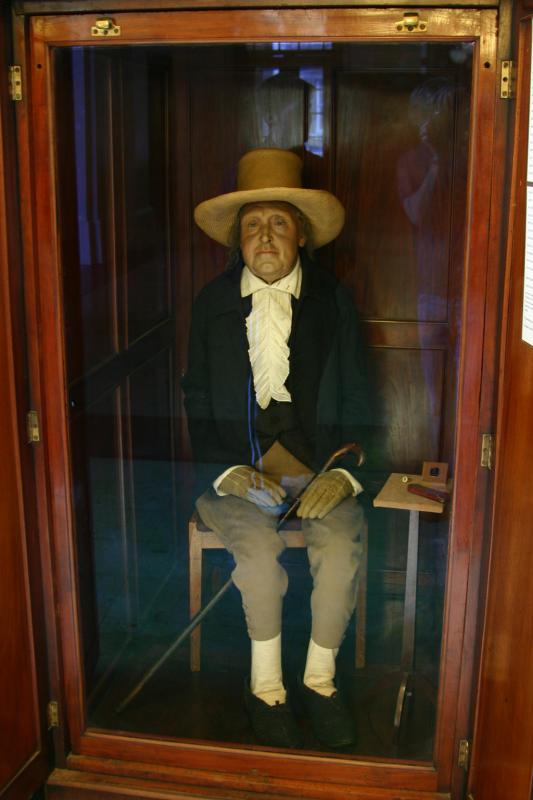
Mario offers an instructive comment: "Bentham is a total mess." Is this an aesthetic critique, or is the suggestion that following Benthamite maxims won't lead to utility-positive results? If the latter, which is what I suspect, Mario is himself a Benthamite broadly speaking and in that sense we (at least partially) agree.
Maybe you're a preference utilitarian, but when it comes to aggregation, or how you interpret "veil of ignorance" results, you're still going to rely on utilitarian constructs to do a lot of the final work in the theory. If your imaginary people are behind a veil of ignorance, they've got to estimate the cardinal utilities (broadly interpreted) associated with different results. You're just shifting the cardinal comparison to a different place, away from the theorist (supposedly) and into the hands of the veiled ones.
Benthamite reasoning is inescapable, though it is a big mistake to make cardinal utility the only relevant value. We're all pluralists now, but cardinal utility should be a major part of the relevant pluralist bundle.
What makes an economist?
When you read about a shortage of women's restrooms, your first thought is whether there is some way of charging for usage.
As it stands, Congress is preparing a bill to regulate the ratio of men's to women's rooms in federal facilities. I would think the theatre and symphony orchestra is where reform is needed, not at the Treasury Department. Men might benefit too ("husband leaving" and "wife leaving" are often complements) and I wonder why Tiebout competition has not enforced better outcomes.
Slavoj Žižek on Sarah Palin
I don't usually blog this topic, but I was struck by this passage, from Žižek's new Living in the End Times. Maybe it's what you would get if Andrew Sullivan were a Lacanian and a Hegelian:
Earlier generations of women politicians (Golda Meir, Indira Gandhi, Margaret Thatcher, up to a point even Hillary Clinton) were what is usually referred to as "phallic" women: they acted as "iron ladies" who imitated and tried to outdo male authority, to be "more men than men themselves." …Jacques-Alain Miller pointed out how Sarah Palin, on the contrary, proudly displays her femininity and motherhood. She has a "castrating" effect on her male opponents not by way of being more manly than them, but by using the ultimate feminine weapon, the sarcastic put-down of male authority — she knows that male "phallic" authority is a posture, a semblance to be exploited and mocked. Recall how she mocked Obama as a "community organizer," exploiting the fact that there was something sterile in Obama's physical appearance, with his diluted black skin, slender features, and big ears. Here we have "post-feminist" femininity without a complex, uniting the features of mother, prim teacher (glasses, hair in a bun), public person, and, implicitly, sex object, proudly displaying the "first dude" as a phallic toy. The message is that she "has it all" — and that, to add insult to injury, it was a Republican woman who had realized this Left-liberal dream…No wonder that the Palin effect is one of false liberation: drill, baby, drill!
Then comes the zinger:
What this means — in Hegelese — the class struggle encounters itself in its oppositional determination (gegensätzliche Bestimmung), in its distorted/displaced form, as one among many social struggles. And, in exactly the same way, "anti-elitist" populism in architecture is the mode of appearance of its opposite, of class differences.
I thought this contrast was better than any review of the book I could write. The author, by the way, makes a contrarian argument that the Khmer Rouge didn't go "far enough" (too weak a constructive plan), is joking some of the time, believes that capitalism is doomed, and apparently is still a communist though he refuses to tell us why he has a better alternative than communism as we have known it. His book is entertaining, but he ought to just become a social democrat and do mass transit studies for the Aarhus municipal government.

Bob Frank and David Friedman on redistributive taxation and positional goods
Remember Bob Frank's argument that wage compression in private firms implies some (possibly libertarian) case for progressive taxation? Here is Frank's original column. Here is David Friedman's critique. Here is Frank's reply. (Angus, by the way, offers another critique.) So many issues are at stake, here is one of them:
He [Friedman] goes on to suggest that my argument implies that “the rich ought to be in favor of grinding down the poor…” These remarks betray a curiously dark conception of human nature. Being concerned about relative position surely does not imply taking pleasure in the knowledge that others are poor. If it did, middle-income people would spend long hours observing people in poor neighborhoods, thereby to boost their own self-esteem. That they don’t choose to spend their time this way doesn’t mean they don’t care about relative position.
What do people spend their time doing? To the extent I care about relative position, what do I do? I take actions to raise my preoccupation with areas I am good at, which is my version of spending long hours observing people in poor neighborhoods, yet without having to feel I am deliberately slumming, which would lower my self-esteem.
In this sense I think Frank should accept Friedman's attempted reductio. That said, I don't accept Friedman's claim that Frank's theory predicts that "the rich ought to be in favor of grinding down the poor." Subtle self-deception about one's own merits is, at least in today's America, a more effective recipe for generating utility. So I believe in the ubiquity of status-seeking, though I see the process as more positive-sum than Frank does. I can think my area of expertise is really important and you can think the same, without it being zero-sum.
That all said, what exactly is the problem with redistributive taxation? Why can't we, for Benthamite reasons, have two rates of twenty and thirty percent instead of one rate of twenty-five percent? Status-seeking or not?
I read this paragraph as best summarizing Frank's point of view:
High social rank, as noted, has substantial instrumental value, and low social rank entails substantial concrete costs, irrespective of whether people care about rank per se. Forcing a productive person to buy more social rank than he wants is objectionable, but the alternative is to give all of society’s most productive members a valuable asset free of charge. That asset would command a high price in the libertarian’s ideal world in which purely voluntary societies could form and dissolve at will. And since its value is a direct consequence of the substantial costs associated with low social rank, a society without redistributive taxation should strike libertarians as even more objectionable.
Here is David Friedman's final response.
Addendum: David Henderson comments.
John Gray on Michael Oakeshott
John Gray often misfires, but still he is one of the smartest and most knowledgeable generalists around:
…Oakeshott was not without illusions of his own. He was able to disparage ideology because he believed tradition contained all that was needed for politics; he could not conceive of a situation in which a traditional way of doing politics was no longer possible. Yet that has been the situation in which the Conservative Party has found itself over the past generation. The leader and his cabal of modernisers could hardly expect to undo the more radical modernisation Thatcher had unwittingly imposed on the party. As Cameron will discover, one way or another, an ideologically driven Conservatism is here to stay – even if it means the party once again drifting into limbo.
The full review, which covers British politics and the forthcoming election, is here. Here is Gray, trying to dismantle A.C. Grayling's rationalism (hat tip The Browser), worth a read.
On Tolerance
“Tolerance” is a feel-good buzzword in our society, but I fear people have forgotten what it means. Many folks are proud of their “tolerance” for gays, working women, Tibetan monks in cute orange outfits, or blacks sitting at the front of the bus. But what they really mean is that they consider such things to be completely appropriate parts of their society, and are not bothered by them in the slightest. That, however, isn’t “tolerance.”
“Tolerance” is where you tolerate things that actually bother you.
Robin Hanson is correct that few people are truly tolerant but peculiarly for Robin he calls for more true-tolerance anyway. I'm all for more tolerance but Robin's own examples suggests that social change is not much driven by changes in tolerance.
As I suspect Robin would acknowledge, gay rights have not advanced because of more tolerance per se, i.e. they have not advanced because more people are willing to accept behavior that bothers them. Advance has occurred because fewer people are bothered by the behavior. Note, for example, that if the former were the case we would not see more gays and lesbians on television, as we do today.
When we are required to confront things that bother us we sometimes (often?) reduce
cognitive dissonance by changing our preferences so that we are no longer
bothered. Thus libertarians and other true-tolerants may play a role in encouraging the intolerable to come forward, thereby forcing the intolerant to reduce cognitive dissonance by accepting what was formerly intolerable. In this sense, a few more true-tolerants might help to tip society towards acceptance of some variant practices.
But since few people are or ever-will-be truly-tolerant, tolerance by itself probably can't get us very far towards a society of peaceful variation. Instead, we will have to argue that variant practices are normal, not bothersome or a subject of indifference. The route to drug legalization, for example, is to encourage more normal people who "smoke pot and like it" to come out of the closet. Kudos to you, Will Wilkinson! In the case of marijuana, I think this is possible but for many of the present and future variant practices mentioned by Robin, the limitations of tolerance put a big constraint on those that will ever be "tolerated."
Bryan Caplan on adoption
I am now more rather than less puzzled. Bryan writes:
On adoption: I think that adoption is a noble, generous act, and admire those who do it. But I personally don't want to adopt.
I can't disagree with any word in that first sentence, but it leaves me uneasy. Bryan's forthcoming book — Selfish Reasons to Have More Kids — is about…selfish reasons to have kids. (It will, I promise you, be very interesting and make a splash.) So here is my challenge to Bryan: write down the ten most important selfish reasons to have kids and then ask how many of them apply to adopted children. Most of them will. Which isn't to say those are the only reasons to adopt (or have) kids, but they are real nonetheless. So why do the adopting parents seemingly get described as selfless martyrs? It's almost as if the selfishness, without the replication angle, has to be stuffed into a box somewhere. Do all those selfish reasons for having kids require replication as a kind of amplifying mechanism, without with we are left with the slightly underwhelming purely altruistic motives?
I think Bryan understands the selfish reasons for having children differently than I do, though I will defer to his own statement of his view. I put a big stress on how children help you see that a lot of your immediate concerns aren't nearly as important as you might think, and how spending time with children brings you closer to — apologies, super-corny phrases on the way — The Great Circle of Being and The Elemental Life Force. In some (not all) ways, adopted children may be teaching you those lessons more effectively than do biological children. It's an oversimplification to say that "children make you a better person," but they do, or should, improve your ability to psychologically and emotionally integrate that a) you want lots of stuff, b) what you end up getting remains, no matter what, ridiculously small and inconsequential, and c) you can't control your life nearly as much as you think.
I would sooner say that these realizations are gifts which children give to us rather than calling them "selfish reasons" to have children. The concept of selfish requires an understanding of our interest and children, very fundamentally, change our understanding of our interests rather than fulfilling our previous goals. That, however, is a moot point and I do understand why Bryan's title packs the proper punch.
(I might add that the cross-sectional variation — who actually has more kids — suggests that religious reasons persuade people more effectively than do "selfish reasons," noting that the religious reasons may well have a significant selfish component. Bryan portrays himself as an intellectual elitist, but he has an oddly unflattering portrait of the elite. When it comes to the dreamworld of political debate, elites are relatively rational but that is exactly the sphere in which individuals are least decisive over actual outcomes. When it comes to the really big, important decisions, such as how many kids to have, individuals in the elite are highly decisive in steering outcomes yet quite irrational. They underappreciate the joy of kids. On net, it would seem that the rational ones are the poor, the undereducated, and the highly religious, at least according to Bryan's latest book. Bryan is a fascinating mix of an anti-elitist elitist, or should I say an elitist anti-elitist?)
I can see why Bryan is keen to have more children of his own, given his charm, intelligence, enthusiasm, and general good-naturedness; free will or not, those qualities likely are heritable to some degree. I might add that his current children are very appealing.
But I still don't grasp why, within his own framework, he is reluctant to adopt and to adopt for (partially) selfish reasons. If you want "similarity," adopt a boy. You can adopt an older child too.
It's not either/or. What about when the pump runs dry or some other obstacle intervenes? What if it's an adopted kid at the margin or just staying put with what you've got? Why not take the plunge? Is an adopted kid so bad on average as to negate the postulated large selfish returns from children? Which of the selfish reasons to have kids are actually most important? Are the selfish reasons so dependent on framing in terms of the Darwinian urge to replicate?
I await enlightenment from my very dear friend.
Questions that are rarely asked
Was it predatory lending when they gave money to Greece?
Arnold Kling offers related comment.
Do women today have more libertarian freedom than in 1880?
Bryan Caplan set off a debate which has spread to many corners of the blogosphere. I have no interest in recapping and evaluating the whole thing but I'd like to make a simple but neglected point: negative liberty and positive liberty are not separable.
Here is one simple scenario. Let's say the government tells me I have to buy and place a five-foot ceramic grizzly bear statue on my front lawn. How bad an act of coercion is that? If I have an upper-middle class income, it's an inconvenience and an aesthetic blight but no great tragedy. If I have a Haitian per capita income, it is a very bad act of coercion and it will impinge on my life prospects severely. I either give up some food or they send me to jail.
In other words, even theories of negative liberty — purely libertarian theories where only negative liberty seems to matter — require standards for degrees of coercion. Those standards will very often depend on how much wealth the victims of the coercion have and they will depend on a more general concept of positive liberty. Negative liberty standards can't help but seep into a concern with consequences.
Fast forward to said debate. When people are poor, apparently small interventions can be quite crushing and quite coercive. To cite the "smaller" interventions of 1880 doesn't much convince me. The real impact of the depredations against women was very, very large, even from some "small interventions" (and I don't think they were all small).
(Also, I would not in this case take the *legal* oppressions to be a stand-alone or exogenous variable, separable from more general societal attitudes. There were various male desires to oppress women, which took a mix of legal and non-legal forms. Asking how bad the "government-only" restrictions were is an odd division of the problem, since the governmental and non-governmental restrictions were an integrated package which worked together in non-linear fashion.)
Every negative liberty theorist is a positive liberty theorist in disguise and this comes out once they start citing degress of outrage, degrees of harm, degrees of coercion, and the like.
I suppose my views are close to those of Will. I also largely agree with Dave Schmidtz and Jason Brennan in their symposium at Cato UnBound.
Department of Isn’t (Robin Hanson, Gnostic)
Food isn’t about Nutrition
Clothes aren’t about Comfort
Bedrooms aren’t about Sleep
Marriage isn’t about Romance
Talk isn’t about Info
Laughter isn’t about Jokes
Charity isn’t about Helping
Church isn’t about God
Art isn’t about Insight
Medicine isn’t about Health
Consulting isn’t about Advice
School isn’t about Learning
Research isn’t about Progress
Politics isn’t about Policy
That's from him. No sex? Can that somehow be signaling to get more sex?
Is the conservative mind more closed?
Julian Sanchez writes:
I’ve written a bit lately about what I see as a systematic trend toward “epistemic closure” in the modern conservative movement. As commenters have been quick to point out, of course, groupthink and confirmation bias are cognitive failings that we’re all susceptible to as human beings, and scarcely the exclusive province of the right …Yet I can’t pretend that, on net, I really see an equivalence at present: As of 2010, the right really does seem to be substantially further down the rabbit hole.
Andrew Sullivan offers up some related links and commentary. I tend to agree with Sanchez and Sullivan, but I thought you all would be a good group to poll. Please offer up your opinion in the comments.
The extreme tension in Caplanian thought
Bryan writes:
Fortunately, the government can handle this problem without spending trillions or heavily regulating the insurance or medical industries. All it needs to do is provide a means-tested subsidy to make private health insurance more affordable for those who need it most. The subsidy should be based on income, wealth, chronic health status – and, given Balan's focus on the deserving poor – on past and current behavior. People who engage in voluntary risky behaviors – smoking, drinking, over-eating, mountain-climbing, violence, etc. – should receive a smaller subsidy, or no subsidy at all. The same goes for people who failed to buy long-term insurance when they were healthy and employed, then ran into health or financial troubles.
First, I am worried about a governmental process which first judges the "deservingness" of each poor person before setting the proper subsidy. Do they videotape your life as you go along, or do they convene a Job-like trial when you submit receipts for reimbursement?
Second, causality is so often difficult to determine in medicine. Say a poor guy had a heart attack but he ate grilled meats for thirty years. Was that irresponsible behavior or not?
Third, and most of all, Bryan loves to stress the heritability of intelligence, income, and even life expectancy, among other variables. But how can your parents be your fault?
This is a fundamental tension in Caplanian thought, namely the desire to promote intuitions of both meritocracy/desert and facts about heritability. Bryan can't have it both ways.
You can leave your comments on this post here.
Markets in everything
Jonathan Keats — a San Francisco-based experimental philosopher who has, over the years, sold real estate in the extra dimensions of space-time proposed by string theory (he sold a hundred and seventy-two extra-dimensional lots in the Bay Area in a single day) made an attempt to genetically engineer God.
That's from the March 15 New Yorker, p.23. You;ll find some confirmations of that claim here. His recent projects include pornography for plants and television for plants.
Test your moral intuitions, Kunming edition
This was a truly strange article, not only for its content but also for its odd shifts in tone. It seems that in China there is a theme park of dwarfs who perform for tourists; this reader felt he had stepped into a Brian Barry article. Here is one sample of what goes on:
And there is the Swan Lake parody, a crowd pleaser in which male dwarfs dress up in pink tights and tutus and wiggle their derrières.
“The first time I wore that, I felt really awkward,” said Chen Ruan, 20, who used to collect refuse with his parents. “But then I got up on stage and people liked it. People were applauding and I felt proud.”
So is this morally OK? Among other things, the article suggests that this theme park is raising the status of dwarfs, and the disabled, in China, at least relative to how things had been. You'll note that Chen Ruan, cited above, used to pick up refuse.
Is it better or worse that some of the dwarfs seem to enjoy the work? In this kind of "few other good employment options, culture of face-saving and honor, don't insult the boss to prestigious foreigners" setting, are there any employee reports that a reporter actually could trust and pass along at face value? What is the proper moral stance of a journalist toward a story like this one?
By the way, the piece claims that the park is not (yet?) profitable.
The Philosophical Cow
Suppose that you are a cow philosopher contemplating the welfare of cows. In the world today there are about 1.3 billion of your compatriots. It would be a fine thing for cows if all cows were well treated and if none were slaughtered for food. Nevertheless, being a clever cow, you understand that it's the demand for beef that brings cows to life. How do you regard such a trade off?
If each cow brought to life adds even some small bit of cow utility to the grand total of co w welfare must not beef eaters be lauded, at least if they are hungry enough? Or is the pro beef-eater argument simply repugnant?
Should a cow behind a haystack of ignorance choose the world with the highest expectation of utility? In which case, a world of many cows each destined for slaughter could well be preferable to one with many fewer but happier cows.
Or is it wrong to compare the zero of non-existence with existence? Should a cow philosopher focus on making cows happy or on making happy cows? If the former, would one (or two) supremely happy cows not be best?
I think these questions are important both for thinking about cows and animal rights and for human beings. Tyler has thought a lot about these issues (e.g. here, here and elsewhere). Some people, however, think that cow philosophy is just a bunch of bull.