Category: The Arts
The commercialization of European art
Arts and business, once parallel worlds in Europe, are
merging as never before. More companies than ever back the visual
arts: Patronage has more than doubled in the past 15 years in the
U.K. and more than tripled in France. The difference is that, where once companies funded the arts
selflessly and on a whim — the chairman’s, or his wife’s — they
now seek bang for their buck: their name in the show’s title, free
museum access for staff and client parties, the right to advertise
their sponsorship, and the right to run spinoff educational and
social programs. And when all is said and done, they conduct
studies to make sure it was worth it.
European nations find themselves so upset by U.S. influence, in part, because they are being drawn inexorably toward our economic model; read more here. And by the way:
Surveys show that only 4 to 7 percent
of consumers see sponsorship as a betrayal of the art, according
to Angela Diakopoulou, managing director of Marketlink Research,
which conducts sponsorship evaluation studies on behalf of
customers such as UBS, Unilever and the National Gallery.
My favorite things Floridian
I am in Palm Beach for a few days, so here goes:
Film: The classic is Key Largo; Bogie’s speech about Edward G. ("more, you want more…") is a (the?) classic statement of behavioral economics. An honorable mention goes to Wild Things, a hot and underrated work of teen film noir. Of course Body Heat was set in Florida as well. As for comedy, Jim Carrey’s debut feature Ace Ventura: Pet Detective, set in Miami and environs, was made before his brilliant comic talents ossified.
Literature: I’ll pick Zora Neale Hurston, with my favorite work as her memoir Their Eyes Were Watching God. She is also quite a libertarian thinker in many ways.
Music: The Allman Brothers, Ray Charles, and Tom Petty are the only competitors I can think of. They are all overrated, but I will opt for Charles’s "What’d I Say?" Tampa Red was pretty good, but often he is attributed to Georgia.
Art: Many notable Americans painted Florida, but how about an artist who is truly of Florida? I’ll opt for the Haitian Edouard Duval-Carrie, here are a few good paintings by him. And here is Kevin Grier’s favorite Duval-Carrie, scroll down to the bottom.
The bottom line: I love Miami Art Deco and roadside architecture, but doesn’t Florida feel just a wee bit underrepresented on the lists of artistic greats?

Addendum: A number of readers argue persuasively that the Allman Brothers should belong to Georgia, not Florida.
Why Do Women Succeed, and Fail, in the Arts?
Given the recent brouhaha over Larry Summers, I have posted my 1996 essay "Why Women Succeed, and Fail, in the Arts." Here is one brief excerpt:
Eleanor Tufts (1974), in her highly regarded book on women artists, presented biographies of 22 of the most prominent female artists in Western history. Biographical research reveals that of the first 14 painters surveyed, 12 had artist fathers.
Women with artists in the family had opportunities to receive training, critical feedback, artistic materials, and studio space. Without strong family connections, women had few means of painting at all…Male artists, who had superior resources and superior access to outside training, were not generally sons of artists…most prominent male artists received formal instruction from an art school or a private teacher. If the development of male artists had been restricted to those who had learned from their families, the artistic record of males would be far poorer than what we observe.
The likelihood of having an artist father, however, declines precisely when training opportunities open up; women then achieve greater success in the nineteenth century art world. The paper also finds that women have achieved much greater representation in "Naive art," (which does not require formal training), watercolors (which involve lower capital costs), and that women have done far better in painting and photography than in sculpture or architecture (the latter two involve higher capital costs and require more cooperation from other people). Leading female painters tend to have been childless, although the remarkable Rachel Ruysch had ten kids. In the textile arts, which are often complements to child-rearing, women have a superior record to that of men.


/modersohnnursing.jpg)


Read the whole thing; I am arguing that remediable external obstacles have prevented women from achieving close to their maximum potential. I am not trying to argue there are no intrinsic differences between the sexes.
Valentine’s Day painting
Here is Marcial Camilo Ayala’s "Adam and Eve," about five feet tall, and painted on amate paper. It is currently held by the artist in Cuernavaca, Mexico.

More Media Bias
Here is the New York Times on The Gates:
Even at first blush, it was clear that "The Gates" is a work of pure
joy, a vast populist spectacle of good will and simple eloquence, the
first great public art event of the 21st century.
Here is the Washington Post:
Ho-Hum. They’re way, way better than the pandas, pigs, cows and other fiberglass tchotchkes that have "decorated" our cities over the past decade. But it’s only a difference of quality, not kind.
Tyler and the Global Cultural War
Tyler is in Paris again, a major player in what the NYTimes calls a global cultural war.
The idea of promoting cultural diversity around the world seems reasonable enough. It recognizes that everyone profits from the free flow of ideas, words and images. It encourages preservation of, say, indigenous traditions and minority languages. It treats the cultures of rich and poor countries as equal. And most topically, it offers an antidote to cultural homogeneity.
Try turning this seemingly straightforward idea into an international treaty, though, and things soon become complicated. Since October 2003, Unesco’s 190 members have been working on what is provisionally called the Convention on the Protection of the Diversity of Cultural Contents and Artistic Expression. It is intended to be approved by consensus this fall, but don’t count on it. There is still no agreement on its final name.
But that is a minor issue compared with more fundamental differences. Led by France and Canada, a majority of countries are asserting the right of governments to safeguard, promote and even protect their cultures from outside competition. Opposing them, a smaller group led by the United States argues that cultural diversity can best flourish in the freedom of the globalized economy.
A bid to break the deadlock is now under way at the Paris headquarters of Unesco…
Tyler will continue to blog from Paris but we are also pleased to be joined this week by our returning guest, Fabio Rojas.
My favorite things French
I do one of these every time I go somewhere. I’ve held off on France out of fear of excess choice, but here goes:
French opera: Debussy’s Pelleas et Melisande is ravishing, try to find the old version conducted by Roger Desormiere. Messiaen’s St. Francis wins an honorable mention; my favorite piece of French music might be Messiaen’s Vingt Regards.
French restaurant: I’ve yet to get into Pierre Gagnaire, considered the world’s greatest restaurant by many. For quick notice, I’ve done well at the Michelin two-stars Savoy and Hotel Bristol, the latter is even open for Sunday lunch, a Parisian miracle.
French novel: Proust is the only writer who makes me laugh out loud.
French pianist: Yves Nat has done my favorite set of Beethoven sonatas. These recordings are brutally frank and direct, and deep like Schnabel, albeit with fewer wrong notes. Few aficionadoes know this box, but it stands as one of my desert island discs. Note that French pianists are underrated in general.
French artist: I find much by the Impressionists sickly sweet and overexposed. I’ll opt for Poussin (this one too), Seurat’s black and whites, and Cezanne watercolors. Right now I would rather look at Chavannes and Bouguereau than Renoir or Monet. As for the most underrated French artist, how about Delacroix? A few years ago some of his small canvases were selling for as little as $60,000.


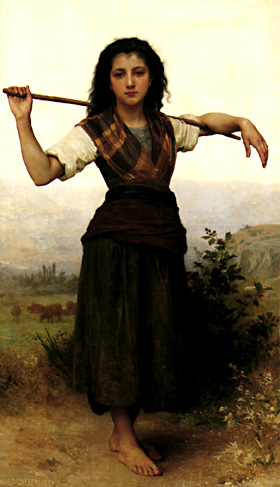
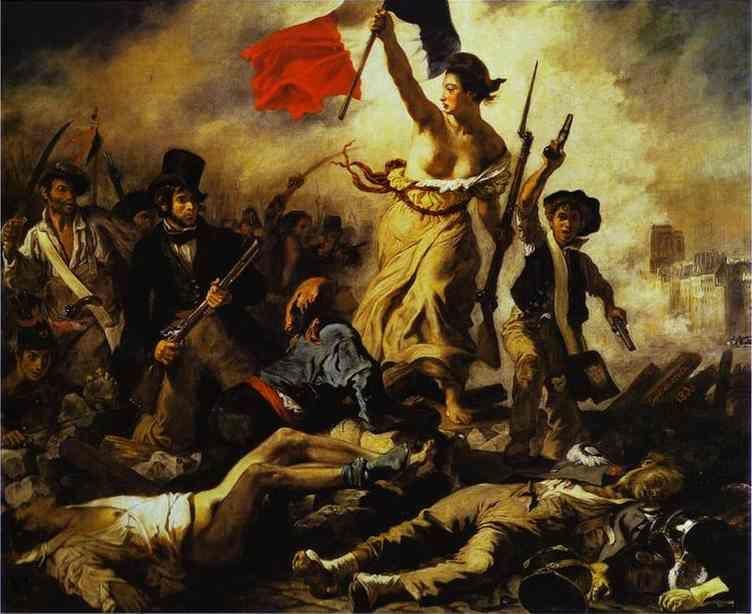
French popular music: Serge Gainsbourg is often called the "French Bob Dylan," but he is more like "the French Beck." Buy this set for a truly eclectic mix of styles.
French movies: If you don’t usually like French movies, you still should watch Robert Bresson’s A Man Escaped, Jean Pierre Melville’s Bob Le Flambeur (a big influence on John Woo, also try Le Samourai), and Theodor Dreyer’s Joan of Arc.
Philip Johnson dies
Here is the story. Here is his masterpiece, the Crystal Cathedral, located in Orange County, California. Here is the AT&T building in New York City. Here is the Transco Tower in Houston. Here is a directory of images and links. I admire this image also.


Tax Art
Part artwork, part political economy lesson, Death and Taxes: A visual look at where your tax dollars go is a very large picture of the discretionary U.S. Federal Budget. Rather elegant even for a non-economist. Warning – it’s a large file don’t try downloading this at home.
Thanks to MetaFilter for the link.
How to save an insolvent art museum?
James S. Maroney, former vice-president of American painting at Sotheby’s, has submitted to the court a plan to save the Barnes Foundation’s finances and keep the collection in Merion on the outskirts of Philadelphia. Mr. Maroney’s plan entails selling life interest in individual paintings: each buyer would pay 10% or more of a painting’s value and would "own" the rights to display the painting for the rest of the buyer’s life. The Barnes would take the painting back when the buyer died…the revenues would be used for an endowment of some $200 million…
All this could be done without lending out the 100 "most desirable" paintings from the collection. And if the museum has a lower discount rate for these paintings than do individuals, the trade makes economic sense. There is, however, only one known precedent in the past (the Denver Art Museum), and informed opinion predicts the proposal will not be adopted. Furthermore the plan fails if it turns out that people buy pictures simply to own them, rather than to look at them.
The quotation is from the December 2003 The Art Newspaper, p.14
The new MOMA
I’ve visited the new and expanded Museum of Modern Art twice in the last week. I am bowled over. In essence New York City has created a new modern art museum by doubling the size of the old. If nothing else, the new museum gives adequate space and attention to prints and drawings. The paintings have more space, there are more of them out, and each room is beautifully hung.
Some winners: Jackson Pollock, William Kentridge, Donald Judd, Sigmar Polke, Chris Ofili, Jasper Johns, and Monet’s Water Lilies.
Some losers: David Salle, Eric Fischl, Julian Schnabel, and John Currin, all nowhere to be found.
Whether you agree with the vision or not, this building has just rewritten the history of modern and contemporary art.
Merry Christmas
Thanks to everyone for reading and supporting MR. Here, in honor of Canada, is a sleighrace from the 19th Century Dutch-Canadian Nicholas Krieghoff.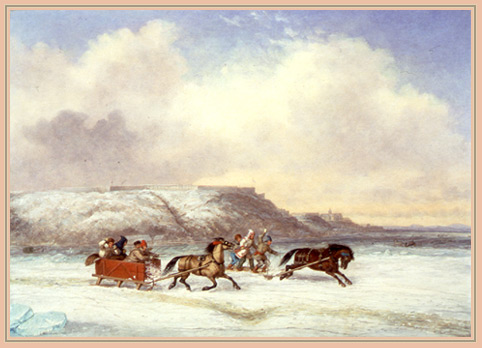
Agnes Martin passes away
One of my favorite contemporary painters, Canadian-born Agnes Martin, just died at the age of 92. Her soft colors and straight lines did much to bring beauty back into art. She was no minimalist but most of all a believer in spirituality and the pure aesthetic. Here is the story. She lived a secluded life and had expressed a desire for no obituaries, but here is one nice painting by her. Here is a nice print.

Science and arts update
1. What did ancient Greek statues really look like? Here is one answer, courtesy of Michael at www.2blowhards.com.
2. "[Researchers] found that English had more of a swing than French, a rhythm produced by a tendency in English to cut some vowels short while stressing others. The melodies of the two languages also differed, with pitch varying far more in spoken English than French.
The team then did the same kind of analysis on music, comparing the rhythm and melody of English classical music from composers such as Elgar, Holst and Vaughan Williams, with that of French composers including Debussy, Fauré and Roussel. "The music differs in just the same way as the languages," said Dr Patel. "It is as if the music carries an imprint of the composer’s language.""
Here is the full story.
3. Digital analysis may provide a new and near-certain means of distinguishing real artworks from fakes, story here.
4. The UK music industry is seeing record sales performance; downloads, legal and illegal, do not seem to be hurting the sector. Sales of music DVDs are especially strong.
5. France is putting on a show of Pakistani truck art.
Kiss of Fire
First, full disclosure: Barbara Nitke is my friend.
Barbara is an exquisitely sensitive photographer whose self-imposed mission is to record lovers at the precise moments when they exchange power, trust and intimacy. Her work (best exempified in her book Kiss of Fire) is not porn; her photos are tinged with sexuality but they’re rarely overtly sexual. On the other hand, they won’t be easy for everyone to look at. Often they depict dominance, submission and pain. Always they depict love. It’s not the naked bodies that jump out at you; it’s the naked souls.
Barbara’s new show, Illuminata: Are You Curious?, opens on Thursday, November 11 at the Art At Large gallery in New York. If the photos aren’t to your taste, you can still go to support Barbara’s courageous lawsuit against John Aschcroft and the Communications Decency Act.