With caveats about the data, yes, but still this is striking:
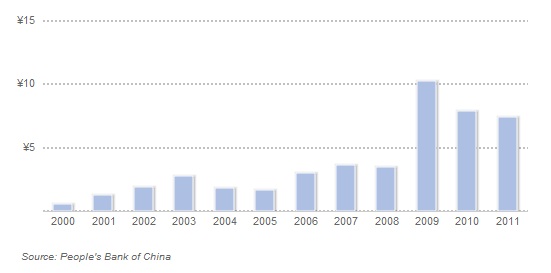
That is from Christopher Balding’s Asia/China blog, the post is here. It is entitled “Why I am Concerned About the Chinese Economy in One Picture.” If you would prefer the words:
From 2008 to 2009 new local currency loans rose from 3.48 trillion rmb to 10.32 trillion according to the PBOC for an annualized increase of nearly 300%.
I do not know if those who praised the Chinese in 2009 for their aggressive stimulus program are having second thoughts, or fearing that the stimulus simply postponed — and intensified — a much-needed adjustment.


That graph shows a flow, not a stock.So calling it “Bank Lending in China”, wile technically correct, is misleading. It’s better to call it “New bank lending in China.” Further, it would be better expressed in percentages (versus beginning-of-period loans, probably). And I think you’d find similar-looking graphs (with different dates) from many countries. So less striking than meets the eye, in my view.
Financial firms are already failing in Beijing. 2009 to 2011 was a return to Soviet-style central planning. Reform died in 2005, financial market reforms halted and the Ministry of Finance muscled out the PBOC. The Communist Party tightened control over the economy through state-owned companies, most of those loans flowed into their coffers. Red Capitalism has all the gory details.
This is why Wen Jiabao talked about the urgent need for reform, why Li Keqiang (his successor) is calling for bold reforms, why Wang Yang (who will likely rise into senior leadership) is talking about the desperate need for “small government” and why they just axed Bo Xilai (Wang Yang’s political enemy), a leftist/populist, from his position of power (and his chief supporter, Zhou Youkang will probably see his power reduced), why Maoist and leftist websites/blogs/microblogs are being shut down and deleted. The reformers are going to (try to?) break the state control of the economy in the 2013-2018 period.
China didn’t stimulate in the sense of public spending, at least based on this chart. For the most part, it stimulated by lowering rates to Chinese and foreign businesses.
So, what you are saying is that businesses took loans that would jeopardize their future.
Bill, the “business” loans that Chinese banks typically make are to state-owned enterprises. And there’s a good slug of local government financing in there as well. So whether those loans (which funded the borrowers’ capital expenditure) are “stimulus in the sense of public spending” is debatable, I suppose, but only on technicalities.
And while I’m at it– credit in China isn’t rationed by interest rates, it’s rationed by quota.
Bob, I am sorry, but Chinese joint venture partners with Amercan, German and other partners often provide the building, equipment and other machinery that is contributed to the venture. Foreign firms have been a big beneficiary to Chinese loans to the local government that purchases and then leases a building, to the joint venture partners, and to other investors. True, the Chinese have also been lending to SOE’s, but they have also been lending to foreign firms and to joint ventures.
The government-linked entities (state corporations etc.) are the ones who take out the loans. Their foreign partners, to the extent they exist take the cash. Yes, they are beneficiaries, but they are not on the hook for the loans Bob described.
So, Yancey, when the Taiwanese company that takes an American partner into Szechuan to set up a manufacturing plant, whose plant and machinery is “leased” to the joint venture, have their technology at risk (although well patented).
I am a bit skeptical because I got a company referred to me to help them deal with some licensing and JV issues in China with their partners. I and a partner who specializes in international worked with them to renegotiate their position. Another client, also in China, had a large part of their plant built for them, along with other infrastructure, but they put in their own machinery and have obligations to export.
When the hose of liquidity opens up, it waters all flowers.
No doubt it was a gamble to run the 2009 stimulus through the (state) banking system — fast but risky — but at the same time one should not forget what 10% annual growth does to GDP. With total GDP of approximately 26 trillion RMB in 2007 and 41 trillion RMB in 2012, the “new bank lending” to GDP ratio is more or less back where it was before the crisis. Why wouldn’t it be manageable to add 10 trillion or so to your debt stock when your income rises by 15 trillion? “The economy” even deposited an additional 1.8 trillion USD (11.5 trillion RMB at today’s rate) with the central bank over this period. Looks like securitized lending to me.
How’s the corresponding graph for the US looking like?
Probably the exact opposite. Bank lending in the US fell off a cliff in the recession.
They peaked in ’09 at 10 bucks. That is striking.
Chinese inflation data are impossible to believe. There’s no way they kept currency and interest rates so low and grew so fast for so long, pumped this much monetary stimulus into the economy and had inflation only moderately higher than the US. Especially when I hear stories here and there of price controls, workers rioting for higher wages and factories leaving for Vietnam. When the Chinese government saw the property bubble popping they simply stopped publishing the data. It seems obvious that they’re manipulating inflation data as well.
How much did a new car cost in 1970?
Or the cost of a harvard education?
But I digress. Clearly, a monetary phenemenon.
Eventually they’re going to have to stop lending out money that won’t be repaid. It will be interesting to see how long they can keep this going.
they did a similar bank lending-led stimulus that seems to have panned out ok:
http://blogs.ft.com/dragonbeat/2009/10/06/chinas-npls-another-financial-time-bomb/#axzz1pj8KqB4r
following the 1997 Asian financial crisis
Comments on this entry are closed.