Category: Education
The Education Transformation of China
University education in China is skyrocketing. In 1996 China had less than 1 million freshmen, in 2006 there were over 5 million freshmen. The freshman class is continuing to grow and university graduates, of course, are just 4 years behind. About half of the entering students are in a hard science or engineering program. As a result, China today produces 3 times more engineers than the United States and will quickly overtake the U.S. in total graduates.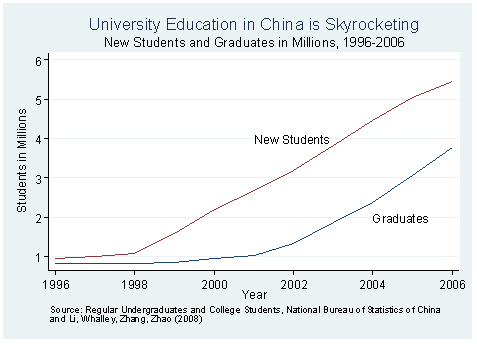
Many people worry about what the Chinese education explosion means for
the United States but I am optimistic. First, as China and other countries grow wealthy the
incentive to invest in R&D is increasing. If China and India were as wealthy as the U.S. the market for cancer drugs, for example, would be eight times larger than it is today – and a larger market means more new drugs for everyone.
Second, the growth in Chinese education is
increasing the supply of new ideas and that too is a benefit to people around the world.
Surprisingly, China’s education system is being
transformed to a
considerable degree by private forces. As late as 1999 the Chinese government
paid for most university education but from 2001 onwards tuition and
fees account for more than half of total educational expenditures.
I have drawn much of the data in this post from a fascinating new paper, The Higher Educational Transformation of China and its Global Implications by Li, Whalley, Zhang and Zhao. The paper has much else of interest.
I will be traveling to China to give a talk at Yunnan University in late June and will report on the transformation as it looks on the ground.
How to read a vita
Ugo, a loyal MR reader, asks:
If you were in a tenure committee how
would you evaluate an assistant professor who, among other things, has
two papers in a top journal with the second paper showing that the result
of his/her previous paper is wrong.(a) Consider this situation has having
two publications in a top journal (the rationale for this is that you want
to give incentives to seek the truth and the two papers contributed to
our understanding of the problem, moreover the author showed to be able
to publish in top JNLs)(b) Consider this situation as having
one publication in a top journal (same as above, but you recognize that
the contribution is less than two papers with a true result).(c) Give zero value to the two papers
(because the results cancel each other).(d) Give negative value to the two papers
(because people wasted time on a wrong result).
The best way to read a vita is to think of it in terms of a portfolio. If all a person had on his vita was a single paper and then its repudiation, I would not think much of the combination. If the person is producing a stream of papers, as a whole pointing toward greater knowledge and fleshing out a coherent research program, I would view the revisions and repudiations as a sign of intellectual strength.
Most questions about how to read vitas can be clarified by this portfolio approach. For instance I am often asked how much a piece in Journal X is worth. The correct response is to ask whether that publication complements a broader research program or not and then to ask how valuable that research program will be.
Not From the Onion
FTC Wants to Know What Big Brother Knows About You
That’s the headline for a story in today’s Washington Post (about government regulation of internet advertising). I suspect the irony was lost on the editors or perhaps this is an Orwellian attempt to twist language.
Addendum: The irony was not lost on the ever-wise Arnold Kling.
Measuring Up
The subtitle of this excellent book, by Daniel Koretz, is What Educational Testing Really Tells Us. Here is one excerpt:
The distressingly large achievement differences among racial/ethnic groups and socioeconomic groups in the United States lead many people to assume that American students must vary more in educational performance than others. Some observers have even said that the horse race — simple comparisons of mean scores among countries — is misleading for this reason. The international studies address this question, albeit with one caveat: the estimation of variability in the international surveys is much weaker than the estimation of averages.
…We are limited to more general conclusions, along the lines of "the standard deviations in the United States and Japan are quite similar." Which they are. In fact, the variability of student performance is fairly similar across most countries, regardless of size, culture, economic development, and average student performance.
I was shocked to read this but the book is highly reputable and persuasive.
Economicwoman.com
That is the site address for a new blog on feminism and economics. Allison, the blogger, points us to a YouTube channel on feminist economics.
Here is Allison’s advice for economics undergraduates; feel free to add to it in our comments section.
I loved this question, and answer
Question for the day: what do libertarianism and the Many-Worlds Interpretation of quantum mechanics have in common? Interest in the two worldviews seems to be positively correlated: think of quantum computing pioneer David Deutsch, or several prominent posters over at Overcoming Bias, or … oh, alright, my sample size is admittedly pretty small.
…My own hypothesis has to do with bullet-dodgers versus bullet-swallowers.
And it ends with this:
So who’s right: the bullet-swallowing libertarian Many-Worlders, or the bullet-dodging intellectual kibitzers? Well, that depends on whether the function is sin(x) or log(x).
Read more here and can you guess who the pointer is from?
The Storm
The storm ravaged the city’s architecture and infrastructure, took
hundreds of lives, exiled hundreds of thousands of residents. But it
also destroyed, or enabled the destruction of, the city’s public-school
system–an outcome many New Orleanians saw as deliverance….The floodwaters, so the talk went, had washed this befouled slate
clean–had offered, in a state official’s words, a “once-in-a-lifetime
opportunity to reinvent public education.” In due course, that
opportunity was taken:…Stripped of
most of its domain and financing, the Orleans Parish School Board fired
all 7,500 of its teachers and support staff, effectively breaking the
teachers’ union. And the Bush administration stepped in with millions
of dollars for the expansion of charter schools–publicly financed but
independently run schools that answer to their own boards. The result
was the fastest makeover of an urban school system in American history.
That’s from The Atlantic just over a year ago. Guess what? It’s working. The storm is coming.
Why aren’t more people going to college?
Brad DeLong writes:
Altonji, Bharadwaj, and Lange do not know.
The whole post is interesting, but from this I can only conclude that Altonji, Bharadwaj, and Lange have never taught Introduction to Composition to a large group of freshman in a public university in the United States. Anyone who has taught such a class — or for that matter talked to anyone who has — will have some inkling why more people are not going to college. Herein lie the roots of growing inequality — on the bottom side at least — and don’t let anyone induce you to take your eye off the ball by playing switcheroo and bringing up the (separate) topic of the growing wealth of the top one percent.
True beyond the shores of Harvard
Blog post of the day, from Brad DeLong, excerpt:
Somebody last week–was it Jan de Vries? John Ellwood? Somebody
else? I forget who, but it is not original to me–said that the right
model for Harvard over the past century is Yugoslavia. Remember the
story of the Yugoslavian socialist worker-managed firm? If you add
another worker to the firm, that worker gets a pro-rata share of the
firm’s value added. The firm’s value added has a component attributable
to the firm’s capital stock, a component attributable to the ideas
embedded in the firm, a component attributable to the firm’s market
position, and a component attributable to the workers. Hire another
worker, and only the last of these goes up: the first three do not, and
so average compensation falls.This means that a worker-managed firm is likely to shrink whenever
it gets good news that makes it more productive–the larger is the
value added due to ideas, capital, or market position, the more
expensive does it become for the existing workers to replace workers
who leave, let alone hire enough workers to expand. While a competitive
market capitalist firm responds to good news about its productivity and
value to society by increasing employment, a Yugoslavian-model market
socialist firm responds to good news about its productivity and value
to society by shrinking. On this analysis, the very success of Harvard
over the past two generations together with its degree of worker
management has created enormous internal pressures not to expand, the
better to share out the surplus among the existing stakeholders.
How to behave when you’re old
Bryan Caplan presents us with his dilemma:
When I’m old, I want to be the octogenarian that the Young Turks
come to with their crazy new ideas. I don’t want to be the senior
professor that the whippersnapper assistant profs avoid. Above all
else, I never want to be a lunch tax – I like lunch too much.Unfortunately, by the time I’m 80 I’ll probably be too befuddled to
figure out how to do any of this. So I want to figure it out now, tape
it on my office wall, and refer to it when the time is ripe.…Not mentioning any names, what
are the biggest social mistakes elderly faculty make? What are some
simple strategies for them to ingratiate themselves to the next
generation? If you’ve got some good advice, I’ll thank you when I’m 80.
If I remember!
I remain a fan of Richard Posner’s book on old age, one of his best. I ask Bryan: would he still take the advice that his 12-year-old self might have taped to a door? Neurological changes aside, the elderly simply have less incentive to be deferential and to court their younger colleagues; Aristotle knew this too.
Bryan’s best lunchtime bet is that, when he is eighty, I am still around at ninety.
An alternative strategy is to find — today — the eighty-year olds who are still fascinating and run your new ideas by them. Most of them will gladly receive you. I used to fly out to Ann Arbor occasionally to meet with the great Marvin Becker, but in general I haven’t done much of this in my life. Call that my failing but it’s another reason why so many eighty-year-olds don’t bother to appeal to Young Turks as a constituency.
Overall I am struck by how little beneficial trade there is between the generations. I find this one of the most striking stylized facts of the social sciences; one simple model is that people don’t want to leave groups that produce fun and high relative status for them, and that is what switching across the generations usually entails.
Do you all have any other advice for Bryan?
Collected advice for young economists
Lots of links, mostly excellent. The Lucas research memoir was new to me.
Hat tip is to Craig Newmark.
How to choose an apartment
Omkar, a loyal MR reader, asks:
I’m looking for an
apartment (Fremont), and it’s my first one. Do you think that most
people over or underinvest in the quality of their accommodations? On
one hand, it’s where you spend the most time (especially if you’re like
me and have in-house hobbies). On the other, I think it’s probably easy
to overestimate the impact an additional unit of luxury housing will
have on everyday life.
The standard results from the happiness literature are that people grow accustomed to lots of living space but that we undervalue the hassle of a lengthy or stressful commute. Kahneman’s work also suggests you should spend more time with your friends, so maybe that means living near them as well. I don’t know if these results are true at all margins. Moving from a mid-sized mansion to a large mansion probably doesn’t make you happier, but the switch from a one- to two-bedroom apartment might.
Personally, I’ll stress the benefits of rooming with someone who is both compatible and intelligent, but that isn’t exactly the question that was asked. Your apartment should also be a gateway to new experiences, so perhaps you should live near the highway. or other effective modes of transport.
So, readers, when we are looking for an apartment, what is the bias we are most likely to have?
Rating RateMyProfessors.com
You’ve heard the reasons why professors don’t trust RateMyProfessors.com,
the Web site to which students flock. Students who don’t do the work
have equal say with those who do. The best way to get good ratings is
to be relatively easy on grades, good looking or both, and so forth. But what if the much derided Web site’s rankings have a high
correlation with markers that are more widely accepted as measures of
faculty performance? Last year, a scholarly study found a high correlation
between RateMyProfessors.com and a university’s own system of student
evaluations. Now, a new study is finding a high correlation between
RateMyProfessors and a student evaluation system used nationally.
Strike another victory for Web 2.0. Here is more.
Graduate school advice
A loyal MR reader asks:
I am now beginning the process of choosing classes for next year. I thought your advice might again be useful. I am in the unusual position of finding nearly all fields potentially interesting. I also feel relatively capable of pursuing most of them, with the exception of pure theory or pure econometrics…I am tempted to do economic history + something else. If I do history, perhaps I ought to do finance, micro, or metrics in order to signal technical capability?If you were in my place, what fields would you choose? Are their particular people…at XXXX…whom you would absolutely want to take a course with/work with? Is it possible to be a macroeconomist without doing extremely technical work? Are some fields more tolerant of heterodox views than others? You told us [once] that you thought econ. grad. school should be Micro 1 – Micro 16. Does this mean I ought to take more micro next year? Given my limited ability to know where my interests will lie in the future, how should I think about this decision?
1. To potential academic employers you are defined by your job market paper, your letters of recommendation, and by your publications, if you have any. Your formal "fields" aren’t that important, nor are your classes per se.
2. Pick classes to learn skills and choose your classes on the quality of the professor, not on the topic per se.
A quick classroom visit often reveals this quality within thirty seconds.
3. Pick a mentor that you, on a personal basis, relate to very well. This is of extreme importance. If he or she doesn’t like you, all is lost.
By the way, here is Ben Casnocha’s advice on how to be a good mentee. What other advice would you all give this person?
The $10 billion Saudi university
A picture is here and yes they claim the finished version will have both male and female students and Western faculty. A question we’ve been asking over lunch lately is the following: how much would it really cost to set up a first-rate university — and not just a technical school — in Asia? Let’s say an Asian businessman were willing to put up $10 billion in endowment: how good would the school be? I see three major problems:
1. Many Asian governments cannot precommit to respecting academic free speech; nor for that matter can the Saudis.
2. An excellent university must be part of an intellectual network near other excellent universities. Arguably with the internet this effect is weakening over time. Still, if they tripled my salary I wouldn’t move to Saudi Arabia or for that matter Japan and that is for reasons related to network effects.
3. Such universities could not precommit to the governance systems (please don’t laugh) that have been so effective in bringing American schools to dominate the world rankings. In fact the more money that one person or government gave, the greater the commitment problem might be. By these governance systems I mean faculty control of appointments, with academic-based monitoring by the Dean and Provost, independent boards, and Presidents willing and able to raise enough money to maintain financial independence for the future. That’s a pretty tall order but you’ll find all those qualities in the successful American colleges and universities. Long-run financial independence also requires a more general culture of philanthropy which is found only in the United States.
Technical schools aside, I do not expect American colleges and universities to lose their leadership role in the immediate future. And if they do, the real competitors will prove to be Europe, the UK, and Canada, not Asia.