Category: Education
I can’t imagine doing this
I find it really useful to write and draw while talking with someone, composing conversation summaries on
pieces of paper or pages of notepads. I often use plenty of color
annotation to highlight salient points. At the end of the conversation,
I digitally photograph the piece of paper so that I capture the entire
flow of the conversation and the thoughts that emerged. The person I’ve
conversed with usually gets to keep the original piece of paper, and
the digital photograph is uploaded to my computer for keyword tagging
and archiving. This way I can call up all the images, sketches, ideas,
references, and action items from a brief note that I took during a
five-minute meeting at a coffee shop years ago–at a touch, on my
laptop. With 10-megapixel cameras costing just over $100, you can
easily capture a dozen full pages in a single shot, in just a second.
I prefer to simply remember what was said. Here is much more, on "How to Think," via Kottke.
Black markets in everything
With candy sales banned on school campuses, sugar pushers are the
latest trend at local schools. Backpacks are filled with Snickers and
Twinkees for all sweet tooths willing to pay the price. "It’s created a little underground economy, with businessmen
selling everything from a pack of skittles to an energy drink,” said
Jim Nason, principal at Hook Junior High School in Victorville.
Here is more, with a thanks to Eric Nielsen for the link. I would put it this way: school kids are more economically advanced than astronauts.
The citation death tax
Dying is not always good for your citations:
The information content of academic citations is subject to debate. This paper views premature death as a tragic "natural experiment," outlining a methodology identifying the "citation death tax" — the impact of death of productive economists on the patterns of their citations. We rely on a sample of 428 papers written by 16 well known economists who died well before retirement, during the period of 1975-97. The news is mixed: for half of the sample, we identify a large and significant "citation death tax" for the average paper written by these scholars. For these authors, the estimated average missing citations per paper attributed to premature death ranges from 40% to 140% (the overall average is about 90%), and the annual costs of lost citations per paper are in the range 3% and 14%. Hence, a paper written ten years before the author’s death avoids a citation cost that varies between 30% and 140%. For the other half of the sample, there is no citation death tax; and for two Nobel Prize-caliber scholars in this second group, Black and Tversky, citations took off overtime, reflecting the growing recognitions of their seminal works.
Here is the paper. As I interpret it, some people are trading (usually barter) for many of their citations and death hinders those trades. These people are overrated to begin with. Black and Tversky, on the other hand, are still underrated. Bet on those scholars whose citations rise with their deaths.
Cooked books
If I had to guess whether
Wikipedia or the median refereed journal article on economics was more likely
to be true, after a not so long think I would opt for Wikipedia. This
comparison should give us pause.
That’s me, writing for The New Republic. But what does this all mean? ("Sadly, the final lessons here are brutal.") I consider the recent spate of fake biographies and memoirs and arrive at some conservative and traditionalist answers.
Department of Hmmm…
…the federal statistics provide evidence for another shift, in which the majority of full-time professional employees in higher education are in administrative rather than faculty jobs.
Here is more.
Bad Incentives?
The Center for Union Facts will ask parents, students and other
teachers Tuesday to nominate the "worst unionized teacher in America."
The center says it will choose 10 and offer each $10,000 to quit;
"winners" must allow the center to write about them on its website.
More here.
Thanks to Lee Spector for the link.
Mad Men
Thomas Schelling showed that it could sometimes pay to be irrational, or at least to appear to be irrational. If they think you’re crazy then in a game of chicken it’s your opponent who will backdown.
It’s known that Nixon understood the theory but in an frightening article in Wired we learn the insane extent to which the theory was practiced.
Frustrated at the state of affairs in Vietnam, Nixon resolved to:
…threaten the Soviet Union with a massive nuclear strike and make its
leaders think he was crazy enough to go through with it. His hope was
that the Soviets would be so frightened of events spinning out of
control that they would strong-arm Hanoi, telling the North Vietnamese
to start making concessions at the negotiating table or risk losing
Soviet military support.
Much more was involved than words, at one point nuclear bombers were sent directly towards Soviet airspace where they triggered the Soviet defense systems.
On the morning of October 27, 1969, a squadron of 18
B-52s – massive bombers with eight turbo engines and 185-foot wingspans
– began racing from the western US toward the eastern border of the
Soviet Union. The pilots flew for 18 hours without rest, hurtling
toward their targets at more than 500 miles per hour. Each plane was
loaded with nuclear weapons hundreds of times more powerful than the
ones that had obliterated Hiroshima and Nagasaki.
The Soviets went nuts but following Nixon’s orders Kissinger told the Soviet ambassador that the President was out of control.
Apparently neither Nixon or Kissinger had absorbed another Schelling insight – if you want to credibly pretend you are out of control then you have to push things so far that sometimes you will be out of control. The number of ways such a plan could have resulted in a nuclear war is truly frightening. After all, Nixon was gambling millions of lives on the Soviets being the rational players in this game.
Next time you are told how a madman threatens the world remember the greatest threats have come from our own mad men.
An educational experiment with higher salaries
A New York City charter school set to open in 2009 in Washington Heights will test one of the most fundamental questions in education: Whether significantly higher pay for teachers is the key to improving schools.
The school, which will run from fifth to eighth grades, is promising to pay teachers $125,000, plus a potential bonus based on schoolwide performance. That is nearly twice as much as the average New York City public school teacher earns, roughly two and a half times the national average teacher salary and higher than the base salary of all but the most senior teachers in the most generous districts nationwide.
Here is the story, thanks to Kurt Muehmel for the pointer. For many years I’ve been telling some of my Ph.d. students that they should consider teaching in private high schools. None of them seem to listen but maybe this will have some impact.
Library of Lost Dreams
Dutch, a kind of archaelogist of recent America, takes us through the abandoned Detroit School Book Depository.
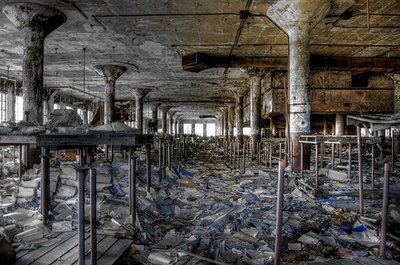
This is a building where our deeply-troubled public school system once
stored its supplies, and then one day apparently walked away from it
all, allowing everything to go to waste. The interior has been ravaged
by fires and the supplies that haven’t burned have been subjected to 20
years of Michigan weather. To walk around this building transcends the
sort of typical ruin-fetishism and "sadness" some get from a beautiful
abandoned building. This city’s school district is so impoverished that
students are not allowed to take their textbooks home to do homework,
and many of its administrators are so corrupt that every few months the
newspapers have a field day with their scandals, sweetheart-deals, and
expensive trips made at the expense of a population of children who can
no longer rely on a public education to help lift them from the cycle
of violence and poverty that has made Detroit the most dangerous city
in America. To walk through this ruin, more than any other, I think, is
to obliquely experience the real tragedy of this city; not some
sentimental tragedy of brick and plaster, but one of people.Pallet after pallet of mid-1980s Houghton-Mifflin textbooks, still unwrapped in their original packaging, seem more telling of our failures than any vacant edifice. The floor is littered with flash cards, workbooks,
art paper, pencils, scissors, maps, deflated footballs and frozen
tennis balls, reel-to-reel tapes. Almost anything you can think of used
in the education of a child during the 1980s is there, much of it
charred or rotted beyond recognition. Mushrooms thrive in the damp ashes of workbooks. Ailanthus altissima, the "ghetto palm" grows in a soil made by thousands of books that have burned, and in the pulp of rotted English Textbooks. Everything of any real value has been
looted. All that’s left is an overwhelming sense of knowledge unlearned
and untapped potential.
More pictures here.
The Power of Vouchers
Many studies of education vouchers have looked at the achievement of children who are given vouchers and who transfer to private schools. Generally these studies have found small but meaningful improvements (e.g. here and here). A voucher program, however, is about much more than transferring students from lousy public schools to better private schools it’s about creating incentives to improve the public schools.
Florida’s Opportunity Scholarship Program rated schools. Students at schools that received an F in multiple years became eligible for a voucher that allowed them to attend a private or higher-rated public school. In Feeling the Florida Heat? (ungated version) a paper sponsored by the Urban Institute Rouse et al. look at what happened at failing schools.
…we find that schools that received a grade of “F” in summer 2002 immediately improved the test scores of the next cohort of students, and that these test score improvements were not transitory, but rather remained in the longer term. We also find that “F”-graded schools engaged in systematically different changes in instructional policies and practices as a consequence of school accountability pressure, and that these policy changes may explain a significant share of the test score improvements (in some subject areas) associated with “F”-grade receipt.
Thus, this paper shows two things. First, that the test scores of the students in the public schools improved when vouchers gave the schools better incentives to perform. Second, at least some of the improvement comes from changes in how students are taught. The author’s note, for example:
…we find that schools receiving an “F” grade are more likely to focus on low-performing students, lengthen the amount of time devoted to instruction, adopt different ways to organize the day and learning environment of the students and teachers, increase resources available to teachers…
It is not true that "nothing can be done to improve the schools." Incentives matter.
Notice that Florida’s program worked even though the program was very weak. It offered vouchers only to students in the worst schools and only after those schools received F grades in multiple years. The vouchers were relatively small and could not be topped up. In addition, the program lasted only a few years before it was declared unconstitutional by Florida’s supreme court.
A true voucher program would be national, would not discriminate among students, would offer funding equal to that spent on students in public schools and would be permanent. Competition in such a system would be more intense and even more productive than in Florida’s program.
Hansonian Normality
Yesterday my friend Robin Hanson walked into my office and said "Heh, how about that football game!" My world was momentarily jarred. This may be the most normal thing Robin has ever said to me.
Fortunately, things are back to normal today. Robin is speaking at a conference on the Search for Extra Terrestrial Life. Gotta love GMU.
Didn’t Bob Tollison write a paper on this once?
What words of wisdom. Via email, Ed Lopez fills me in:
Laband and Tollison’s 2000 JPE paper speaks to your MR post yesterday on co-authorship [TC: I’ve added the links]:
"In this paper, we compare the incidence and extent of formal coauthorship observed in economics against that observed in biology and discuss the causes and consequences of formal coauthorship in both disciplines. We then investigate the economic value (to authors) of informal comments offered by colleagues. This investigation leads us naturally into a discussion of the degree to which formal collaboration through coauthorship serves as a substitute for informal collaboration through collegial commentary. Data on manuscript submissions to the Journal of PolzticalEconomy permit us to shed additional empirical light on this subject. Finally, we demonstrate that while the incidence and extent of formal intellectual collaboration through coauthorship are greater in biology than in economics, the incidence and extent of informal intellectual collaboration are greater in economics than in biology. This leads us to search for evidence (which we find) of quids pro quo offered by authors to suppliers of informal commentary on manuscripts and to speculate that the greater importance of intellectual collaboration in economics (relative to biology) might imply greater pay compression in economics than
in biology (Lazear 1989). We find compelling evidence of such pay
compression in terms of the distribution of formal intellectual property rights to scientific contributions."
They
find the more quantitative work increases likelihood of co-authorship.
It’s also been increasing over time with decreasing information costs.
They also cleverly get citation and salary effects from the number and
stature of scholars listed in the acknowledgments.
The Mercatus Masters Fellowship
George Mason University has a new program for people who want a Masters in economics — not a Ph.d. — and wish to apply their knowledge to the so-called real world. The value of the scholarship award is up to $80,000 (over two years); more information, including contact information, is here. The application deadline is March 15. Good bloggers, by the way, tend to be good teachers. Just think, if reading us for free is worthwhile, if the non-convexities are not too severe being paid to hang out with us is maybe not so terrible either.
My Law and Literature reading list
The first real meeting of the class is today; we will be reading and viewing the following:
The Bible, Book of Exodus and later selected excerpts.
Herman Melville, selected stories, including "Bartleby"
Franz Kafka, "In the Penal Colony."
Snow – Orhan Pamuk
Neuromancer – William Gibson
Leo Tolstoy – Great Short Works, including Hadji Murad and Ivan Ilyich
Eugene Zamiatyin – We
Jose Saramago – Blindness
Jack Henry Abbott – In the Belly of the Beast
Fernando Verissimo – Borges and the Eternal Orangutans
J.M. Coetzee – The Life and Times of Michael K
Law Lit, by Thane Rosenbaum, selections
Mario Vargas Llosa – Who Killed Palomino Molero?
Francisco Goldman – The Art of Political Murder: Who Killed the Bishop?
Films: Battle Royale, others, including I hope some new releases.
Markets in everything, food fight edition
Juniors Rachel Whitcomb, Elizabeth Soergel and Taylor Procida are among those who protested an offer last month by the principal of Wilde Lake High School to pay students to identify participants in a cafeteria food fight.
…an intense debate erupted within the Columbia
school community over whether administrators should reward students for
informing on misbehaving peers. Last month, the student newspaper, the
Wilde Lake Paw Print, published three columns by students critical of
the principal’s offer."I find the administration’s recent use of monetary incentives
considerably more frightening than a food fight," wrote editor
Katherine Driessen, a senior.
Have you wondered how corporate scandals can go on for so long?:
Philip Soergel, a parent who complained to Howard schools
administrators about the principal’s offer, said: "We were aghast. I
had never heard of this. Kids are getting these kinds of lessons in how
to tattle on one another."
Here is the story. It seems no one has turned in the perpetrators, I guess the price isn’t very high.