Category: Film
Roger Ebert is blogging
Here; I wonder if he still reads MR…
I thank Scott Cunningham for the pointer.
Netflix pricing
It looks kind of screwy; 3 movies at a time is $16.99 a month but 8 movies at a time is $47.99 a month. After three movies, the average cost of a rental (see the link for the numbers) is either flat or rising. Why go for the 8 movies deal instead of setting up separate accounts and queues, thereby saving money? Why is Netflix encouraging everyone to do the 3 movies a month version of the plan? Why are there no quantity discounts past the 3 movies a month margin? (And, by the way, aren’t there still lower prices for newbies, at least for a while?)
I suspect this is one of those pricing models that traps a small number of overenthusiastic patrons into paying more, keep a few others away from overgorging on old Jackie Chan films and then quitting prematurely, and de facto gives most customers a pretty flat pricing structure. Transparency is sacrificed but does anyone really care?
The pointer is from Angus Hedrick.
seriously
The New York Times reports:
In “The Visitor”, Richard Jenkins plays an economist whose flagging joie de vivre is restored when he takes up drumming.
It opens today in limited release.
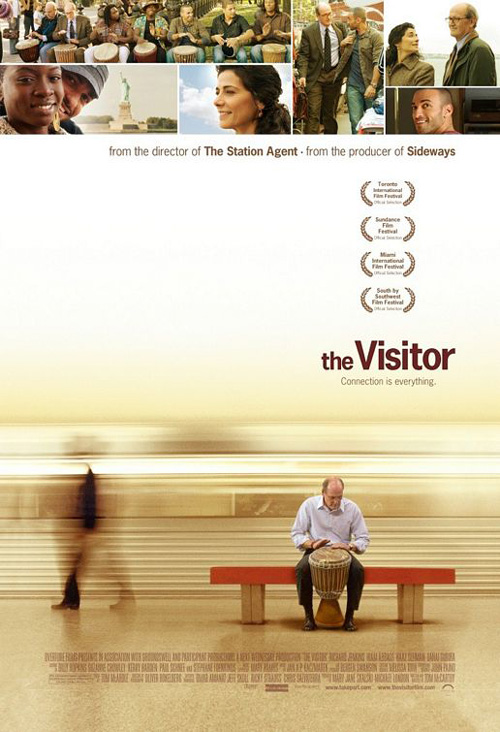
It’s by the guy who made The Station Agent, a movie about a New Jersey resident with achondroplasia; here is more information.
Markets in *everything*, a continuing series
*Tenure*, the movie, starring Luke Wilson. Seriously. They are about to start shooting.
10,000 B.C.
There are increasing returns to scale, set in a general Carneiro-Oppenheimer political equilibrium, albeit with multiple equilibria and possible revolution, depending on the behavior and path of charging woolly mammoths. Hunter-gatherer societies have martial virtue and also an idea or at least practice of liberty. They don’t have agriculture or easy transport or efficient risk-sharing or an expensive priestly caste. The desire for plunder, slaves, and tax revenue causes the wealthier agricultural societies to raid the hunter-gatherers. The hunter-gathers can adopt the technologies of the wealthier peoples more easily than the overlords can/will adopt the ideologies of the hunter-gatherers. If the revolt succeeds (see the above remarks about multiple equilibria), the result is both liberty and a higher standard of living. For unknown reasons, female members of the hunter-gatherer society have market power in the agricultural society, even when they are slaves.
I’m not saying that model is true but I have heard worse from social scientists.
The Spanish idea of the film canon
I’ve been reading César Vidal’s El Camino Hacia la Cultura, which might translate roughly as "The Path Toward Culture." Imagine a Spanish Harold Bloom, yet trying to be more representative than idiosyncratic in his canonical picks. Overall his choices are what you would expect, albeit with a strong emphasis on modernism and in fiction he stresses the Continental novel of ideas. The very useful poetry list is full of Spaniards. Here is his list of the best movies (worldwide) since the 1990s:
Jacob’s Ladder (TC: I love this movie), Dances with Wolves, Dreams (Kurosawa), JFK, Glengarry Glen Ross, Malcolm X, Groundhog Day, Schindler’s List, Forrest Gump (ugh), The Shawshank Redemption, Braveheart, Fargo, The English Patient, Titanic, The Apostle, Saving Private Ryan, Matrix, Magnolia, The Sixth Sense, Nueva Reinas, El hijo de la novia, Gladiator, Return of the King, De-Lovely, Apocalypto (TC: !…another winner).
The absence of traditional indie cinema and most European cinema is striking. Sadly Asian movies are missing altogether, except for Kurosawa. Overall I am struck by a) the gutsiness of this list, and b) the author doesn’t seem to see it as gutsy at all.
Library of Lost Dreams
Dutch, a kind of archaelogist of recent America, takes us through the abandoned Detroit School Book Depository.
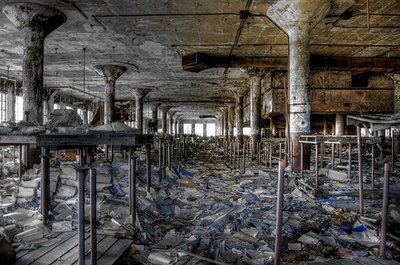

This is a building where our deeply-troubled public school system once
stored its supplies, and then one day apparently walked away from it
all, allowing everything to go to waste. The interior has been ravaged
by fires and the supplies that haven’t burned have been subjected to 20
years of Michigan weather. To walk around this building transcends the
sort of typical ruin-fetishism and "sadness" some get from a beautiful
abandoned building. This city’s school district is so impoverished that
students are not allowed to take their textbooks home to do homework,
and many of its administrators are so corrupt that every few months the
newspapers have a field day with their scandals, sweetheart-deals, and
expensive trips made at the expense of a population of children who can
no longer rely on a public education to help lift them from the cycle
of violence and poverty that has made Detroit the most dangerous city
in America. To walk through this ruin, more than any other, I think, is
to obliquely experience the real tragedy of this city; not some
sentimental tragedy of brick and plaster, but one of people.Pallet after pallet of mid-1980s Houghton-Mifflin textbooks, still unwrapped in their original packaging, seem more telling of our failures than any vacant edifice. The floor is littered with flash cards, workbooks,
art paper, pencils, scissors, maps, deflated footballs and frozen
tennis balls, reel-to-reel tapes. Almost anything you can think of used
in the education of a child during the 1980s is there, much of it
charred or rotted beyond recognition. Mushrooms thrive in the damp ashes of workbooks. Ailanthus altissima, the "ghetto palm" grows in a soil made by thousands of books that have burned, and in the pulp of rotted English Textbooks. Everything of any real value has been
looted. All that’s left is an overwhelming sense of knowledge unlearned
and untapped potential.
More pictures here.
Cloverfield
I thought this was a remarkable cinematic event. But you need to know that the characters are supposed to be vacuous and annoying, and that the opening scene is supposed to be obnoxious and superficial. The heroism is supposed to be thin. (The whiney NYT review I read is, in retrospect, an embarrassment.) And that the movie is supposed to make you feel physically nauseated. You are in fact witnessing a disaster. Most of all this is a movie about how the young’uns have no tools for moral discourse and that all they can do is utter banalities and take endless pictures of each other and record their lives for no apparent purpose. I can’t recall any other movie that so completely devastates its intended demographic. The integration of sound blips and flashing lights is brilliant. The homage to the tanks attacking Godzilla is loving. I didn’t even know how good this movie was until after the halfway point. Bravo.
My Law and Literature reading list
The first real meeting of the class is today; we will be reading and viewing the following:
The Bible, Book of Exodus and later selected excerpts.
Herman Melville, selected stories, including "Bartleby"
Franz Kafka, "In the Penal Colony."
Snow – Orhan Pamuk
Neuromancer – William Gibson
Leo Tolstoy – Great Short Works, including Hadji Murad and Ivan Ilyich
Eugene Zamiatyin – We
Jose Saramago – Blindness
Jack Henry Abbott – In the Belly of the Beast
Fernando Verissimo – Borges and the Eternal Orangutans
J.M. Coetzee – The Life and Times of Michael K
Law Lit, by Thane Rosenbaum, selections
Mario Vargas Llosa – Who Killed Palomino Molero?
Francisco Goldman – The Art of Political Murder: Who Killed the Bishop?
Films: Battle Royale, others, including I hope some new releases.
The Diving Bell and the Butterfly
This movie, with its hints of Metamorphosis and Maya Deren, probably will stand as one of the best of the last ten years. Of course it has a deeply economic theme: how much of the value of life stems from our ability to trade, and how much from our ability to play games of pure coordination? Plus the French health care system is so good that all the nurses are beautiful and pay infinite attention to a single patient, or maybe that is just how French movies are made.
Why are Hollywood Unions Powerful?
Glen Whitman asks a good question, Why are unions so powerful in the entertainment industry when unions
are generally weak and in decline in most other sectors of the economy? (Tyler asked the same question several years ago.)
I went to the family expert, my brother the movie producer and he had this to say:
…unlike in most other unionized industries, it’s the INDIVIDUAL members of the unions in the entertainment industry that the management / owners want to work with. For example, Tom Cruise is a member of SAG, (I use him as an obvious example, but every other known actor is as well) and if the studios and producers want to make a film with Mr Cruise, and we all do, we have to come to terms with SAG. Similarly, Steven Spielberg is a member of the DGA, same issue. Though writers are not household names, it’s the same issue, there are specific individuals who the studios want to be writing their TV shows and screenplays. It doesn’t matter if Joe or John or Mary is stacking the boxes, flipping the burgers or ringing the cash registers so management can easily hire a non-union member to do the same job, in the film business we need to work with specific individuals who happen to be union members. Thus the power of those (comparatively) few empowers them all.
Combine with a bit of Hollywood leftism and the fact that the big names don’t lose much from unions and you have a very powerful cartel. About the only way to break the cartel would be to turn the big names into owners – this has been done a few times but the stars earn so much anyway that even then the incentives to deviate are small. You Tube can give is a
parade of amateurs but as soon as the amateurs become stars this
model suggests that they will be co-opted into the union framework. Like my brother, I don’t see the power of Hollywood unions ending anytime soon.
Satanists Unite!
Here’s a mini-review of my brother’s movie Weirdsville.
Weirdsville – a
dark and devilishly funny comedy about a pair of junkie crooks who
can’t seem to catch a break to save their lives. Throw in a couple
Satan worshipers, a band of vigilante little people and a pair of
curling stone wielding drug dealers and things get, well – considerably
weirder. The film is littered with fantastic offbeat and unexpected
moments that keep the laughs rolling. Moyle meanwhile, adds his
signature rock n’ roll flare and gives the film a cold, gritty feel
that keeps you on just enough of an edge. Definitely a trip worth
taking.
So who is complaining? The Satanists! Here is one email:
I would just like to voice my opinion and state that I do NOT appreciate the way you portray Satanism in the least. Using the same-old watered down mass-media version or not, it still tends to give us a bad name. I am not asking you to remove this movie or change anything on it, just think about it.
By the way, long-time readers of Marginal Revolution may be wondering whether the Satan worshipers in Weirdsville are a commentary on my brother’s previous blockbuster.
Weirdsville
Here’s a cool idea from a new Hollywood movie producer, a money back guarantee!
Nicholas Tabarrok is putting his money where his mouth is. The
producer from Toronto-based Darius Films is certain that audiences will
crack up during the screening of his oddball comedy Weirdsville, opening Friday, or he will refund their movie-ticket money come Monday morning.Tabarrok tells Playback Daily it was a "spur of the moment" idea.
"It occurred to me that this is a common thing… If you buy a
product and you’re not satisfied, you get your money back… The same
principle [should apply] to film," he says.
Brilliant, innovative, incentive-compatible! You’d think this guy had an economist for a brother or something.
Dylan movie. Sort of.
The new Dylan biopic, starring Christian Bale, Cate Blanchett, Marcus Carl Franklin, Richard Gere, Heath Ledger and Ben Whishaw – all as Bob Dylan – is starting to get some coverage. As a lifelong Dylan fan, I’m excited to see the movie. The film is currently doing the rounds of the film festivals, and is going into wider release slowly from September through March (depending on your country).
Early reports only whet my appetite:
- A slew of trailers (both official and unofficial) on YouTube [HT: Cass Sunstein]
- This is Not a Bob Dylan Movie: a beautifully-written essay in today’s NY Times magazine
- A wrap-up of other reviews, from filmmaker Todd Haynes
- Some extremely high variance early reviews.
An aside: From many hallway conversations, I can report that Dylan is a surprisingly popular artist among the econ gliterati.
An economist at the movies
Reason magazine, November issue (p.8), asked me to pick the three "best" and "most libertarian" movies of all time. (Exactly how do those values get weighed against each other? Like a good economist I sidestepped the aggregation issue and picked what I wanted to.) My third selection was:

Battle Royale: Why do so few people know this 2000 Japanese cult classic? The underlying political theme is that totalitarianism can end only in a war of all against all. This classic of resistance and liberation shows how tyrannous circumstances degrade mankind.
Can you guess my other selections, including my fourth dark horse pick?