Category: Uncategorized
Still room on the downward side (Italo-Polish fact of the day)
Consider this: In 2009, Fiat’s five biggest Italian assembly plants produced 650,000 cars using 22,000 workers. That same year, a single Fiat plant in Tychy, Poland, produced 600,000 cars with 6,100 workers. Too many inefficient plants, coupled with a plunge in consumer demand, have left not only Fiat, but other car makers such as PSA Peugeot, Citroën and Adam Opel…bleeding cash.
That is from “Fiat Chief Retools Car Maker,” the story is here. I thank Kurt Busboom for a pointer.
Assorted links
1. IMF podcast for An Economist Gets Lunch.
2. Finland may be the first out of the eurozone after all.
3. Winning and leading submissions for the Wolfson Prize on leaving the euro.
4. Update on Austro-Chinese business cycle theory, funny about that excess capacity isn’t it?
5. Summary coverage of the LIBOR scandal, from The Economist.
6. Arnold Kling on the economics of PEPCO.
7. New urbanization blog by Paul Romer and Brandon Fuller.
8. Josh Barro is completely correct and many commentators on my original post failed a reading test.
Measuring the results of on-line learning
Here is a paper from Marsha Lovett, Oded Meyer, and Candace Thille:
Abstract
The Open Learning Initiative (OLI) is an open educational resources project at Carnegie Mellon University that began in 2002 with a grant from The William and Flora Hewlett Foundation. OLI creates web-based courses that are designed so that students can learn effectively without an instructor. In addition, the courses are often used by instructors to support and complement face-to-face classroom instruction. Our evaluation efforts have investigated OLI courses’ effectiveness in both of these instructional modes – stand-alone and hybrid.
This report documents several learning effectiveness studies that were focused on the OLI-Statistics course and conducted during Fall 2005, Spring 2006, and Spring 2007. During the Fall 2005 and Spring 2006 studies, we collected empirical data about the instructional effectiveness of the OLI-Statistics course in stand-alone mode, as compared to traditional instruction. In both of these studies, in-class exam scores showed no significant difference between students in the stand-alone OLI-Statistics course and students in the traditional instructor-led course. In contrast, during the Spring 2007 study, we explored an accelerated learning hypothesis, namely, that learners using the OLI course in hybrid mode will learn the same amount of material in a significantly shorter period of time with equal learning gains, as compared to students in traditional instruction. In this study, results showed that OLI-Statistics students learned a full semester’s worth of material in half as much time and performed as well or better than students learning from traditional instruction over a full semester.
Of course not every university has students as good as those at Carnegie Mellon. A longer and more general article is here, hat tip for both goes to AT.
Assorted links
The Iceland dust-up
There has been enough coverage that I won’t summarize the entire debate, suffice to say that Krugman offered a picture like this:

Some writers from the CFR (I am not completely sure how to attribute authorship), offered this picture, along with some analysis and links (and further pictures). The key point is that the second picture considers a longer time horizon, and all of a sudden the relative performance of the different countries has changed:
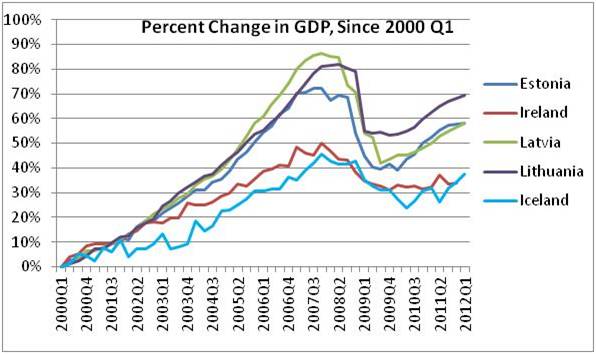
They argue that in this light, looking over the longer time horizon, the Icelandic story appears mediocre rather than impressive relative to some of the other small countries. A few points:
1. Arvind Subramanian argues we should look at per capita growth and also PPP vs. market exchange rates, read here.
2. Arvind’s point aside, that the pictures give different impressions is more important than either picture taken alone.
3. The second picture brings value-added to the debate, and it suggests stories which the first picture taken alone does not. I’ll come back to that.
4. The debates have mixed together a few different questions, such as “how well have the countries done?,” “how well have the countries’ policies done?,” and “should we be looking at both pictures?” Since the answer to the first two is obviously agnostic — too soon to tell — I will focus on the last of these questions and the answer is yes, we definitely should be looking at both pictures.
Krugman’s response, once you get past the inappropriate insults, doesn’t serve up much. He has arguments against the view “Don’t look at the first picture” but no good arguments against “Look at both pictures very carefully and integrate.”
Ryan Avent offers a more polite response here. He focuses on convergence (maybe we should have expected the Baltics to have outperformed Iceland, so a tie means Krugman wins), but this estimate suggests the fixed exchange rate did not really cost the Baltics much in the way of convergence points. In any case I fear the goalposts are being shifted and what we know about convergence and its speed is iffy anyway; for instance anyone worried about bad monetary policy, and opposing 1980s style RBC theories, should be a convergence pessimist for the short run.
Most importantly, there is still no argument against looking at both pictures in a serious way.
So what additional thoughts come to mind looking at the second picture, which you might not get so much from the first picture alone? Here are two:
a. Some countries simply may be more volatile than others, and this may or may not have to do with their policy responses. I’ll note Cowen’s Second Law, namely that there is a literature on this and the people who work in that literature consider this to be a plausible proposition (which does not mean it is here the operative explanation, however).
b. The size of an initial run-up, possibly bubbly at that, is correlated with the size of the later collapse and also the difficulty of recovering from that later large collapse.
There is a literature on that too, start here, it is not an absurd proposition by any means.
By the way, did I mention a 2009 IMF Staff Report which concluded that Latvian “output exceeded potential by 9 percent in 2007.”? That supports the relevance of b) and possibly a) as well, and it discriminates against Krugman’s story of the peak being a point reattainable through policy management.
I take Krugman to be suggesting something like c): all the relevant information for understanding performance is contained in post-bust policy, so we needn’t look at earlier years and in fact doing so may mislead us.
Yet this attempts to pre-settle the dispute by putting all of the explanatory burden on post-crash policy. In general commentators often overattribute results to policies and in any case we should not build in this bias a priori.
Are you a fan of Dani Rodrik’s “every country is different” hypothesis? If so, you probably should think that both graphs are important. Country characteristics don’t morph away overnight, so earlier data points should matter for understanding current policy results.
If we look carefully at both pictures, I say we still don’t know what is going on, but we do have a richer sense of the possibilities.
From now on these two pictures should be shown and considered together.
*Your Sister’s Sister*
I found this film to be a minor masterpiece. It incorporates Girard, Shakespeare, how uncertainty eases deals, and some interesting and possibly true claims about two vs. three-person bargaining games. It is a deep and politically incorrect question to ask why the movie does not start with the Coase theorem already working. I cannot reveal its Straussian propositions about “loser men” without spoiling the plot surprises.

Note: the characters in the film do not seem to consume much information.
Assorted links
Assorted links
Stephen Williamson has doubts about ngdp targeting
Do read his entire post, it is full of content and difficult to excerpt. I would make a few points:
1. A reasonable range of monetary regimes may not matter so much under good times, but we are choosing the regime for the occasional very bad time when a strong response is needed.
2. Williamson’s points about the instability of seasonal ngdp are good, but arguably considering seasonal cycles renders all or most macro theories somewhat incoherent. Given the extreme agnosticism we should then end up in, what is a good policy rule?
3. I believe overnight financial markets could adjust to a variety of reasonable regimes, and indeed the evidence across nations appears to confirm this.
4. Scott for one would definitely admit the all-importance of eliminating interest on reserves.
5. I would add a Straussian reading of ngdp targeting: “The Fed won’t ever do it, because they don’t like to tie their hands. But talking about it may steel their will, and give them a policy rationale, when more expansionary action would be desirable.”
Oddly Williamson does not consider what I consider to be the strongest objection to ngdp targeting, namely that in times of extreme crisis, when loan markets are collapsing, it may force the central bank into a dangerous-and-not-really-output-restoring ratio of currency/credit to meet the ngdp target.
On the off chance that Scott writes a reply to Williamson’s critique, I will link to it in due time. Update: Here it is, I read it after writing my post. It is interesting to compare our responses.
Assorted links
1. On the limited powers of Ben Bernanke.
2. Richard Ebeling on Vincent Ostrom.
3. A long post on libertarianism and the workplace, though I say the post should have more economics.
4. India this week, slideshow.
5. How does Hollywood ever make money?
6. Does the Icelandic miracle disappear if we add in just a little bit of data?
Claims about private color perception
“I would say recent experiments lead us down a road to the idea that we don’t all see the same colors,” Neitz said.
Another color vision scientist, Joseph Carroll of the Medical College of Wisconsin, took it one step further: “I think we can say for certain that people don’t see the same colors,” he told Life’s Little Mysteries.
One person’s red might be another person’s blue and vice versa, the scientists said. You might really see blood as the color someone else calls blue, and the sky as someone else’s red. But our individual perceptions don’t affect the way the color of blood, or that of the sky, make us feel.
Hard for me to judge, but you can read more here, if that click through doesn’t work for you use http://www.lifeslittlemysteries.com/117-if-blood-is-red-why-are-veins-blue.html, hat tip goes to The Browser.
Assorted links
Very good paragraphs
From Timothy Taylor, spotted by Arnold Kling:
Through much of the 1990s, the ratio of owner’s equity to GDP fell, but in the early 1990s, that was partly a result of depressed regional real estate markets in certain states in the aftermath of the collapse of many savings and loan institutions in the late 1980s and early 1990s (which made the numerator of the ratio decline), and also a result of fast economic growth from the mid-1990s on (which made the denominator of the ratio rise). Again, the bottom line is that the spike in the total value of housing that ended around 2006 is well outside the post-World War II historical experience. And the drop since 2006 takes this ratio from by far its highest value since 1950 to by far its lowest value since 1950.
We are not as wealthy as we had thought.
Assorted links
India markets in everything
Premarital investigations cost $200 to $400 and take seven to 10 days. Detectives follow the subject for 12 to 18 hours daily and chat up co-workers, domestic help and tradesmen under various pretexts. “Beware — your neighbor knows everything,” says Sanjay Singh, chief executive of New Delhi’s Indian Detective Agency. “Sometimes more than you know yourself.”
Particularly useful are fake marketing surveys. Enticed into participating with the promise of a free gift, sometimes something as modest as a bottle of shampoo, the subject or a neighbor may reveal a secret relationship or details of a would-be bride or groom’s late-night entertainment activities and smoking or drinking habits.
“People love freebies,” says Krishna Kumar, an Anapol Institute graduate. “Most fall for it hook, line and sinker.”
She worked at a computer company for four years before deciding detective work would be a lot more challenging. Women have a big advantage as sleuths because they’re non-threatening, can mingle better and are more intuitive, she says.
“I like doing premarital investigations best,” she says. “You’re watching someone go in a new direction, and your work could make or break their future.”
…Most premarital investigations are ordered by parents, although sometimes spouses-to-be want a little snooping done, including women keen to size up their prospective mothers-in-law in a society where it is common for couples to live with the husband’s extended family.
The story is here, and for the pointer I thank Vishal Ganesan. Oh, and the results?:
According to detectives, investigations turn up significant problems in about 60% of cases. In about 10%, the discoveries are explosive enough — such as previously undisclosed marriages or serious hereditary diseases — to cause cancellation of the wedding.
For the caste-conscious, a hidden Dalit relative, or so-called untouchable, is also problematic. “Caste and dowries remain huge issues today, and people like to exaggerate,” says Sachit Kumar, director of Globe Detective Agency.
A factor driving premarital investigations is the growing number of cases in which foreigners of Indian descent marry and then disappear, often taking huge dowries with them. It happens to 30,000 brides every year in northern Punjab state alone, according to India’s National Commission for Women.