Death trends

by on December 22, 2015 at 2:09 am in Data Source, Law, Medicine, Political Science | Permalink

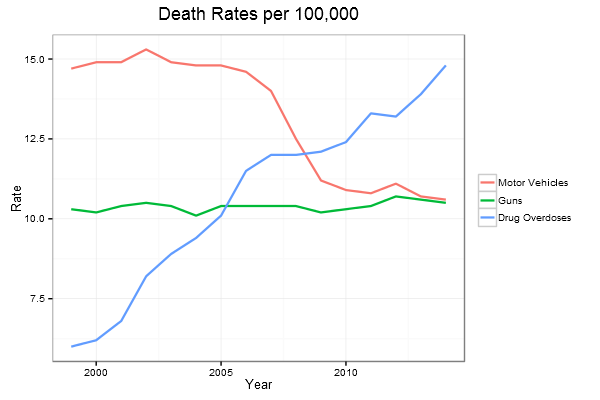
deathtrends

So, once you get past the mood affiliation, where is the big story?

Link here.
Hemlockean December 22, 2015 at 2:19 am

Let’s make committing suicide the most expensive, difficult act ever!

Reply

The Other Jim December 22, 2015 at 8:23 am

Perhaps a special tax on suicide would do the trick? It’s always worth a try. Always.

I noticed that the green line was for “gun deaths” as opposed to “homicides.” I suppose they wanted the number to be more than double what it would be otherwise. I wonder why they wanted that?

Reply

fwiw December 22, 2015 at 10:25 am

Why are you confused?

It is a graph showing physical causes of death, and not attribution of the causes.

Why are drug overdoses not relegated to homicidal/suicidal/accidental categories?

Reply

Gochujang December 22, 2015 at 11:15 am

I am pretty sure all three are sometimes used for suicide.

The chart does not look like a shift in method, or even primarily about intentional death. It looks like good work with auto safety. It looks like steady state with guns.

And something big and bad happened with drugs.

Reply

Harun December 22, 2015 at 11:27 am

+1

Reply

Justin Kelly December 22, 2015 at 11:58 am

There is actually a huge shift going on, the split used to be 50/50 between firearm suicide and homicide, now it is closer to 33/66 with suicide being more predominant.

Reply

jonfraz December 22, 2015 at 2:37 pm

We’ve gotten much better at trauma care, which is one reason gun homicides, which often occur where medical help can reach the victim, are less than they were. Gun suicides however tend to occur where the victim won’t be found until it’s far too late

Justin Kelly December 22, 2015 at 6:28 pm

@jonfraz: Yes, I have heard this rationalization before, and we have gotten better at trauma care for gunshot wounds, but everything beyond that strikes me as a hypothesis.

It might stand to reason, but wheres the data comparing the survival rate of people shot by others to the survival rate of shooting yourself for two separate decades? Where the actual data on time to find people who survived shooting themselves (there are a surprising many of them) vs other gunshot victims? Until then its plausible conjecture; not to be pedantic, but this is exactly where social science screws up so often.

GC December 23, 2015 at 3:28 am

“wheres the data comparing the survival rate of people shot by others to the survival rate of shooting yourself for two separate decades?”

What would be the point, considering blowing your brains out with every point over your read our under the chin at point blank range tends to be 99.99% fatal (actually, 100%, considering the 0,01% is when one slips and actually grazes the side of the skull, not producing an actual internal intrusive trauma), whatever the decade, whatever the innovation in trauma treatment? Head wounds that can be saved are usually those where the bullet has traveled and lost at least part of its power and are not longitudinal to the skull axis (more typically, frontal lobe perimetral).

Justin Kelly December 23, 2015 at 10:14 am

@GC, Frighteningly this is not the case. Lots of people use shotguns, use birdshot, and survive only to be horribly disfigured… then there are plenty other circumstances where the person survives self inflicted headshots, I read then all the time. If we are going to argue that there is a trauma care coefficient that is improving survivabiliy for one category, then it must be applied to the other, otherwise you are not doing science, but searching for rationalizations for your current beliefs.

Nathan W December 25, 2015 at 2:51 am

While obviously improved trauma care improves survival in both categories, it should be exceedingly obvious that people who try to commit suicide by firearm are less likely to receive care in time. If survival rates doubled, from 0.01% to 0.02%, this still isn’t very significant from the macro perspective.

Dan Weber December 28, 2015 at 12:59 pm

The fact that you think survival rates from firearm suicide are on the order of 0.01% shows how little you know about firearms. Or how little you have even cared to do a basic Google search.

Massimo December 22, 2015 at 1:41 pm

Guns are the most popular suicide method. And homicides/accidents and suicides are very different things socially.

“Vehicular fatalities that are suicides vary from 1.6% to 5%.” That’s not a popular method. Carbon Monoxide poisoning is higher.

Drug overdoses are harder to categorize.

Reply

mahmet December 22, 2015 at 4:30 pm

Guns are #problematic and if you disagree with me I will unfriend you on Facebook. #OpenMinded #LiberalsareTolerant.

Reply

T. Shaw December 22, 2015 at 11:24 am

Holy shit! Already, you have gotten 140 comments.

Here’s the big story: Liars can make anything they want out of statistics.

Second big story: drug overdose deaths are soaring.

Third big story: motor vehicle deaths are down.

In 1789, America was founded by geniuses. In the 21st century, it is now run by idiots. You can “take that to the bank.”

Reply

msgkings December 22, 2015 at 12:30 pm

Hey T. Shaw, I happen to think the US today is the best country on earth. If you don’t we won’t miss ya.

Reply

dax December 23, 2015 at 4:41 am

“Hey T. Shaw, I happen to think the US today is the best country on earth.” Well, you’re an idiot. Better stay in the US where you belong.

Reply

msgkings December 23, 2015 at 2:52 pm

Got any better ones to propose?

mulp December 22, 2015 at 1:46 pm

What I hear is

America was founded by conservatives…

Since 2000 it’s been run by leftist intent on destroying America because they hate America.

And that’s why Trump is leading the Republican party – Republicans are clearly the leftist destroying America.

Reply

Thor December 22, 2015 at 2:43 pm

“Sir, the radiologists have a diagnosis for you. You have MULP for brains. I regret to say that the condition is serious and debilitating.”

(Translation: stop it. You are becoming as predictable as Prior.)

Reply

JonFraz December 23, 2015 at 1:43 pm

If the Founders had been conservatives they would never have rebelled against Britain. Monarchy, aristocracy and an established Church were the conservatives positions du jour at the time. The Founders got rid of all three. They were 18th century liberals (though not, of course radicals, unlike the French Jacobins). The conservatives packed up and moved to Canada.

Reply

Tyler December 22, 2015 at 2:20 am

I thought the big story was that the rates for gun deaths in all other developed countries don’t even make it onto this chart.

Reply

Rafael Pereira December 22, 2015 at 7:18 am

Absolutely. Just because death rates by gun are stable, it doesn’t mean they are at an acceptable level. A comparison to other developed countries countries gives a better picture for that matter.

But the chart points to an alarming trend of increaing death rates by overdose and which by far does not get as much attention in the political debate

Reply

Willitts December 22, 2015 at 8:18 am

What is an “acceptable” level? What does that mean?

This reminds me of my college econ professor who had to explain to his liberal friends that the optimal level of pollution is not zero.

One one hundredth of one percent is pretty damned small, especially when most of those are suicides, and those people would have just used another means to off themselves. Koreans do it with rope. Californians do it off bridges.

One one hundredth of one percent means that the average person is not likely to know anyone who was killed with a gun.

What’s remarkable is that in a country with 100 million gun owners with 300 million guns, that this death rate isn’t 100 times higher. It blows out of the water the idea that a gun culture results in more deaths.

Reply

fwiw December 22, 2015 at 10:37 am

Ahem. By definition, the optimal level of pollution is zero. It is just that we optimize for things other than pollution.

Optimal gun deaths are zero. However, we as a society have decided that we prefer liberty (or potential liberty from tyranny) over pure safety. We’ve optimized for other things. That’s not bad; we’re optimizing something else in the same way we’re optimizing human comfort over environmental purity.

The gun culture here has resulted in more deaths than other places. Your appreciation of fewer deaths than is possible is… weird. Given that our 300 million people have 300 million cars, 10 million elevators, and 5 million revolving doors, it’s a miracle that hundreds of thousands of people don’t die every day getting to work. We still push towards the optimal level of death that is zero, rather than celebrating our work culture.

Reply

Cowboydroid December 22, 2015 at 11:11 am

Please do not use phrases like “we as a society have decided.” There is no rational collective decision-making process. Individuals make decisions and choices. Collectives are an abstraction.

Lord Action December 22, 2015 at 1:06 pm

“Please do not use phrases like “we as a society have decided.””

As someone who leans libertarian, I’ve never understood this objection.

We have pretty well defined processes for collective decision making. They’re not bad. Not liking the outcome does not mean the process does not exist or that it has no outcome.

mulp December 22, 2015 at 1:56 pm

The cowboy does not want to admit that jack boot big government not only flows from We the People, but that it has made elevators, escalators, tall buildings, cars, air, much less likely to harm and kill We the People.

I bet cowboy denies corporations are collectives because that smacks of communism where every share is equal. Except when the leftist elites create a two or more classes of shares…. Doubt cowboy owns the leftist elitist plutocrstic shares, only the shares of the proletariat masses.

Nathan W December 22, 2015 at 11:37 pm

With a background in economics and environmentalist sympathies, I can easily agree that the “optimal” level of pollution is not zero.

2 points: 1) the fact that economists have adopted the word “optimal” does not mean that this is truly a societal optimum, 2) in a similar point, it most certainly reflects a value judgment where GDP growth is presumed the be all and end all of everything, and disregards the fact that other people hold other value judgments.

While I’m pretty comfortable arguing in favour of “economically optimal” tradeoffs which accept some level of pollution, don’t let the use of the word “optimal” in economics let you trick yourself into thinking that you’re inherently right. It is a value judgment, and those who argue that the “optimal” level of pollution is zero are not wrong, rather, they are making a different value judgment.

In using the rhetoric of “economically optimal”, do not allow yourself to think that your own value judgment is not implicit in this.

Slocum December 22, 2015 at 8:51 am

Why would we care, specifically about ‘gun deaths’ rather than homicides and suicides by all causes? In the U.S. suicide rates are stable, but not particularly high by international standards. Homicide rates are half what they were in the early 90s and the lowest they’ve been in a century, but they no longer seem to be declining and are still high in comparison to other developed nations. Even so both suicide and homicide rank quite low on the list of causes of death. The overall death rate is about 1000 per 100,000. Cardiovascular disease accounts for 250 of that while homicide accounts for less than 4.

Reply

Gochujang December 22, 2015 at 11:19 am

You do not address accidental deaths, which are also associated with all three mechanisms.

We could note a society more open to auto safety than gun safety.

No one complains that a third brake light is a slippery slope to “them” taking away all our cars.

Reply

Dan Weber December 22, 2015 at 12:32 pm

Because there isn’t a large lobby talking about taking away all our cars.

(I knew a few people in my 20s in an urban area who talked about it, but they all got cars when they got kids.)

Check out the TNR essay someone else posted. It’s not “satire” or “moving Overton’s window” or “trying to start a conversation,” even if the writer later tries one of those excuses.

Gochujang December 22, 2015 at 1:14 pm

There are so few people who want a total gun ban that no one even polls it. It is off the radar, except as a fear-object.

Detrk December 23, 2015 at 7:00 pm

The powerful lobby in the realm of gun control is certainly the nra, which opposes all and any sensible regulation. If the fear is a gun ban, this is idiotic. Far better to allow modest and sensible increases in gun control to take away the argument of anti gun groups.

Guns aren’t notable because they are such a huge problem. They’re notable because of how far from optimum policy is.

Brian December 22, 2015 at 7:59 am

Also, big mass-shootings make for big sensational stories that grab attention the way, say, terrorist attacks do. And while overall gun deaths are stable, there’s some evidence that the frequency of mass-shootings is on the rise.

Not to mention, there isn’t any political faction claiming we can’t or shouldn’t do anything about drug overdoses or automobile deaths because, you know, “stuff happens.”

Reply

Erick December 22, 2015 at 10:21 am

There are lots of groups saying we shouldn’t do anything about automobile deaths. There are many policies which would likely result in less automobile deaths which are opposed all the time: Raising the driving age, increasing funding for mass transit, raising gas taxes, lower speed limits, increase punishments for traffic violations, speed and red light cameras. There are many more.

For drug overdoses, it’s less intuitive, but there are also policies which could reduce in less deaths which are also opposed. Criminal justice policy in general (whether you argue more or less punishment would help), increased funding for drug treatment, punishments for doctors who overprescribe painkillers.

Reply

Cowboydroid December 22, 2015 at 11:13 am

There is no evidence that the frequency of mass shootings is on some kind of upward trend over any meaningful period of time.

You’re several times more likely to die from an asteroid impact than a mass shooting. That puts the media’s coverage into perspective. It also lays bare the political agenda for disarmament.

Reply

Dan Weber December 22, 2015 at 12:24 pm

You’re several times more likely to die from an asteroid impact than a mass shooting

Oh, c’mon. People actually die in mass shootings every month, while total asteroid deaths for the past century are on one hand.

Your opponents say stupid stuff. This doesn’t mean you should say your own stupid stuff.

Reply

Yet another MR commentator December 22, 2015 at 12:00 pm

Is not mass shootings a negative externality that affects the American image?

Sure you can get a job, but do high skill or worth immigrants, temporary or otherwise, want to risk their kid’s from kindergarten to the university getting slaughtered even if it is low?

What about the tourism industry? I would surmise that high gun ownership counties have low tourism.

Reply

Dan Weber December 22, 2015 at 12:25 pm

What about the perceived risk of immigrants who are concerned about being killed by Muslims? Even if it’s irrational, it still hurts our industry, and we should DO SOMETHING ABOUT IT11!!!11one

Reply

Nathan W December 22, 2015 at 11:40 pm

I doubt many visitors the the USA are particularly concerned about Muslims. I personally can say that the massive amount of guns everywhere deters me from wanting to spend time in America.

Yet another MR commentator December 23, 2015 at 9:57 am

I do not think high gun ownership counties really care about tourism or have anything to offer the external world except some low skilled labor that can be replaced by machines.

That whole flyover territory thing again. And no I do not live in the US and am grateful for that.

Dan Weber December 28, 2015 at 1:05 pm

There are areas of America you don’t go to, just like there are lots of developing nations that are great tourist destinations where you shouldn’t go hop on a bus and visit.

I don’t worry at all about guns in my daily life. Not one bit. (If I owned a gun I would have to worry a little bit about how I secure it, but I don’t.)

Of all the reasons that America should increase regulations of guns, “foreigner says he’s scared of guns so won’t visit” is very very low on the list.

Justin Kelly December 22, 2015 at 8:40 am

When you caveat statements like this with “in all other developed countries” you tacitly admit that it is an economic development issue. The areas in the US where homicides are high are inner city ghettos that have more in common with South America (which is often excluded from analysis) than Europe. The areas in the US that look like Canada have homicide rates similar to Canada. Then you have Switzerland and Andorra where most males are required by law to keep firearms in their home (and no, ammunition at home is not banned) that have homicide rates similar to Britain.

It should be clear, if you have socio-economic factors like a rich European country, you’ll get the homicide rates of a rich European country, regardless what your gun laws are.

Reply

T. Shaw December 22, 2015 at 11:38 am

Guns!

What’s the total annual deaths per 100,000?

Let’s all ignore deaths’ meaningful causes like alcohol, fast food, salt, tobacco, etc. and, think about medical and hospital mistakes which are far more deadly than guns.

Guns are not the only instruments of physical causes of deaths. The knife or razor blade once were the go-to for suicide.

Ban baseball bats! Each year the average number of persons murdered by dreaded blunt instruments is in the range of 500; assault (long weapon, semi-auto, pistol grip, high capacity magazine, flash suppressor) weapons account for approximately 300. Look it up.

America was founded by geniuses who, among many magnificent things, wrote the Bill of Rights into the Constitution. Now, it is run by idiots. .

Reply

mulp December 22, 2015 at 1:58 pm

Yep, We the People have put conservative Republicans in charge.

Reply

Steve Sailer December 22, 2015 at 2:20 am

What in the world is going on with motor vehicle deaths?

Reply

JVM December 22, 2015 at 2:42 am

I believe miles driven per capita fell off a cliff around 2008 and hasn’t recovered. Deaths per mile driven might be stable during this period.

Reply

maros December 22, 2015 at 4:55 am

The traffic bounced back strongly in the last 2 years, see
http://www.vox.com/2015/11/25/9800614/peak-car-driving-rebound

Reply

Andrew M December 22, 2015 at 8:06 am

The 2009 “cash for clunkers” program removed the least safe vehicles from the road, which might be why deaths didn’t bounce back.

Separately, ABS has been mandatory on all cars sold in Europe since 2004, and in the USA since 2011. A lot of the cars bought post-recession would have had ABS installed; which might also explain why deaths didn’t bounce back.

Also, the police are stepping up enforcement and fines have risen sharply. Everyone’s driving at 55mph for fear of a $400 fine.

Reply

The Other Jim December 22, 2015 at 8:25 am

So, which is more insane — the idea that everyone is now driving 55, or that “Cash For Clunkers” had a profound effect on saving lives?

I really hope the above comment was satire. So hard to tell these days.

TH December 22, 2015 at 9:07 am

So, heavy regulations led to a marked decrease in deaths? Hmmm … what else could we regulate to decrease death rate …. i’m thinking, I’m thinking …

MOFO. December 22, 2015 at 9:52 am

@TH, do you suppose that no one would be interested in safer cars were it not for regulation?

Kevin December 22, 2015 at 10:09 am

In my observation, average freeway speeds seem to be going up not down.

My understanding was that the drop in auto deaths was mainly due to better safety equipment (abs, airbags, anti skid technologies, etc.) in newer cars, an older population (i.e. fewer inexperienced 16-20 yo drivers per capita), declining miles driven per capita and perhaps safer freeway construction.

John December 22, 2015 at 11:26 am

Not sure where the “everyone is driving 55” is observed, certainlly not the places I drive.

I think a much better explanation for the decline with auto deaths is the improved safety — both ABS and airbages but more likely the understanding of deigned crush zone to control the deceleration rates the ocupants experience — in other words the kenetic engerge of the crash is managed better and not just transferred to the human body.

Hazel Meade December 22, 2015 at 11:49 am

My theory: Uber is making it easier for young adults to call a cab instead of drinking and driving.

Psmith December 22, 2015 at 1:21 pm

Hazel, really interesting idea and something I’d like to research, but I don’t think the timing’s quite right. Uber only started up in June 2009 and wasn’t really noticeable among the college crowd until 2012-2013, AFAICT.

John Hawkins December 22, 2015 at 1:37 pm

Uber anybody??? Ride sharing is used at times when the driver is a biggest threat (ie drunk driving)

jonfraz December 22, 2015 at 2:39 pm

Outside congested urban areas the freeway speed limit hasn’t been 55 in many years

Michael December 22, 2015 at 4:33 pm

2009 was the end>/i> of the steep decline in deaths, and besides, Cash for Clunkers didn’t replace anywhere close to the 33% drop that we see in this decline. JVM’s explanation also is unsatisfactory, as the drop in death rates started in 2006, prior to the drop in miles driven.

ad*m December 22, 2015 at 5:31 pm

ABS (ESP) has been required in European Union on new car types only since 2011, on new cars since 2014. Wikipedia is wrong on this, and Andrew M is also wrong n this.

dearieme December 22, 2015 at 7:51 am

Good point. Similarly, maybe they should plot annual gun deaths per 100,000 bullets sold, per 100,000 population.

Reply

brickbats and adiabats December 22, 2015 at 1:36 pm

VMT per capita has been remarkably stable at between 9500 and 10500 for the last 25 years. It’s risen recently and during the recession it went down, but it was far from “falling off a cliff.” The recent rise hasn’t even had it break 10500 yet because of population increases since 2008/2009.

Reply

Todd Kreider December 22, 2015 at 2:44 am

Nothing much. Tyler’s graph just focuses on the past 15 years so doesn’t give a broader picture of the trend since 1920.

Political scientists and sociologists do this all the time. You hope for better among economists.

Reply

Alan December 22, 2015 at 3:22 am

Political scientists, sociologists and economists choose a start date that best reinforces their prior beliefs.

Reply

prior_test December 22, 2015 at 4:21 am

Come now, the technical term used here is ‘mood affiliation.’

Reply

Slocum December 22, 2015 at 7:16 am

Actually, the broader picture of the trend since 1920 looks much the same — a long, long decline:

https://en.wikipedia.org/wiki/List_of_motor_vehicle_deaths_in_U.S._by_year#/media/File:USA_annual_VMT_vs_deaths_per_VMT.png

The chart is somewhat misleading about gun deaths as well — by combining homicides and suicides and using a short time frame, it obscures the fact that the homicide rate in the U.S. is far below (about half) of the peak rates seen in the 1970-90 period and matches the lowest rates seen in the last 100 years.

Reply

Cererean December 22, 2015 at 7:34 am

So, it would have been much more helpful to have “suicides” and “homicides” as different lines, since that would show that homicides have decreased but more people are committing suicide? Which would, together with drug deaths, suggest perhaps that people are getting more mentally ill..?

Reply

fwiw December 22, 2015 at 10:42 am

or that people that would have died of accidental/health causes are living long enough to die of despair.

Michael Savage December 22, 2015 at 3:36 am

There’s been a very long-run tendency for traffic deaths per mile driven to fall in every country (Smeed’s law) due to average driver experience increasing, better road and car design, changed pedestrian behaviour, declining cycling rates etc. The short-run graph above probably reflects gains from design in early 2000s (anti-roll, airbags etc becoming more prevalent as older cars replaced). There’s huge regional differences in US (Florida. Mississippi double average), and big difference between US and rest of developed world (about twice western Europe).

Reply

Steve Sailer December 22, 2015 at 3:50 am

So, recent safety innovations haven’t proven as effective as old ones like airbags? Makes sense …

I’m going to need to replace my 1998 and 2001 vehicles over the next few years, and I’m willing to pay a certain amount for improved safety. Which of the newer safety options do you recommend as fairly cost effective?

Reply

Bruce Cleaver December 22, 2015 at 5:10 am

I find myself in the same position – in the early stages of looking at new cars to replace an aging workhorse. Looks like front-end crash avoidance systems might be cost-effective, some insurers are offering discounts for cars thus equipped:

http://www.insurance.com/auto-insurance/vehicle-shopping/discounts-collision-avoidance-systems.html

Same article shows risk homeostasis for lane departure warning systems, interestingly enough.

Reply

Steve Sailer December 22, 2015 at 5:41 am

Thanks.

JMCSF December 22, 2015 at 9:32 am

Automotive safety has improved with every new generation of vehicle. Automakers find It pretty much unacceptable for any mainstream vehicle not to have 5 star NHTSA crash ratings. Also keep in mind that the NHTSA has increased its crash ratings standards over the last few years. Yes old safety innovations like airbags and ABS have had some of the biggest impacts on safety, but they are also being deployed in new ways, for example, side-curtain airbags.

Some of the newer safety features I think are worth a look: adaptive cruise control, emergency braking, lane departure assist, and heads up displays.

Reply

Michael December 22, 2015 at 4:38 pm

That would explain a steady decline, but this data (granted a short window) looks like a step function, stable before and after a 2006-2009 period where it dropped 33%. This doesn’t look like a gradual technological story, particularly with the slow rate of replacement of cars (relative to that window).

I remember reading an article a while ago about how changes to Medicare payments for helicopter services dramatically changed the prevalence of Medevac services. I should go back and see if it corresponds with this time window.

Steve Sailer December 23, 2015 at 5:25 am

The spectacular decline in road deaths when gasoline prices went up and the economy collapsed in 2008 is very interesting. I’m sure total miles driven being down several percent mattered, but it looks like the decline in deaths was much larger than the decline in miles.

Perhaps marginal miles are particularly risky? Maybe Keynes’ “animal spirits” correlate with risky driving, especially drunk driving?

MOFO. December 22, 2015 at 9:56 am

I recommend AWD. Safer from a control perspective and you will get stuck less in bad weather. My subaru has literally never been stuck in the snow, despite driving through two of the worst winters on record.

Reply

Dan Hanson December 22, 2015 at 3:24 pm

Airbags provide marginal benefits if you are already seatbelted in.

ABS brakes have not saved as many lives as they thought. The only situation in which they are useful is where the driver is braking hard to avoid a crash, but many fatal crashes happen so fast that ABS or not made very little difference. ABS may have reduced damage claims, though, especially in winter conditions.

By far the best new technology for reducing accident deaths is stability control – especially if you drive an SUV. Stability control has been shown to reduce single-vehicle accidents by as much as 50%. So make sure your new car has some kind of stability control system, wear your seatbelt, learn how to modulate your braking, and that’s all you need. Of course, all cars come with airbags and ABS now, so you just need to make sure it has stability control.

Reply

celestus December 22, 2015 at 9:46 am

I have heard that in addition to specific features, there’s been a change in the culture of auto design. Modern cars are designed to collapse around the occupants in a collision, so you’re more likely to see a car get completely totaled in a crash or even come out of a fender bender with a lot of damage but the driver and passengers are more likely to survive. Take this with many grains of salt as I am not involved with the auto industry.

I also imagine that if hospitals have gotten better at saving lives that’s more likely to show up in car crashes than in drug overdoses or the suicide component of shootings.

Reply

rabidwombat December 22, 2015 at 10:05 am

Surely the “hospitals have gotten better at saving lives” theory would reflect changes in all three categories. Perhaps with a higher impact in the motor vehicle accidents, but we’re both speaking out of assumptions and intuition, not data.

Reply

celestus December 22, 2015 at 10:51 am

Yeah I was speculating or as I said “imagining”, but I’d think that overdose victims and certainly people who shoot themselves are less likely to make it to the hospital.

jonfraz December 22, 2015 at 2:43 pm

Bicycle rates have increased (as gas helmet use)

Reply

Dan Hanson December 22, 2015 at 3:29 pm

Given the major disparity in accident rates between young drivers and older drivers, the first place I’d look for a reason for the reduction in accidents would be young drivers. Are young people driving less? Is the rise of insurance prices or the introduction of graduated licensing programs having a major effect?

Reply

Steven Kopits December 22, 2015 at 10:11 am

Motor vehicle deaths are pro-cyclical, typically.

Here’s my piece on VMT for CNBC, with recovery right on track with our forecast.

http://www.cnbc.com/2015/11/23/traffic-is-getting-worse-heres-how-to-trade-it-commentary.html

And here’s UK VMT:

http://www.prienga.com/blog/2015/9/29/uk-vmt-sept-2015

Reply

brickbats and adiabats December 22, 2015 at 1:39 pm

Hm, I see you’re using people aged 16+, hence it not matching with my recollection. That being said it looks about right. 12 or so years of high oil prices will definitely cause structural changes and densification that decrease vehicular commuting.

Reply

mulp December 22, 2015 at 2:11 pm

Lowering incomes for younger workers whose parents have seen their incomes lowered means eliminating car ownership which means lifestyle changes, and when you have no car, or only limited access to an unreliable car, you see a car as a liability and burden, thus driving is a liability and burden.

Not to mention, while conservatives claim Americans are born to the open road, imagining the movies of the past, and the car ads that still mirror them, conservatives refuse to pay for building the open roads, so instead the roads are filled with traffic and jams.

Think about the car culture of the 50s and 60s vs the truck culture of the past two decades. Stuck in traffic between tractors and trailers, the truck provides the illusion of seeing further, and being armored against your foes boxing you in. The people buying the minis and 50s sports cars style cars are those who lived in the 60s wanting one, but settling for a bug, or rice burner.

Reply

Jason December 22, 2015 at 10:27 am

My guess is that the huge (50%!) drop in motor vehicle deaths in 2008/2009 is confounded by unemployment. People not working as much aren’t going to drive as much and, thus, won’t die in cars as much.

Reply

TMC December 22, 2015 at 11:18 am

Plus the increase of work-from-home.

Reply

Gochujang December 22, 2015 at 11:21 am

The improvement in auto safety is even more dramatic as a 30 year chart.

Cars are better, the dreaded airbags worked, etc.

Reply

Steve Sailer December 23, 2015 at 6:03 pm

My commenters point out that a likely contributor to the spectacular decline in motor vehicle deaths in 2008 and 2009 (down 18% in two years) was due to the collapse of the home construction bubble sending illegal alien construction workers back to Mexico.

Reply

B Cole December 22, 2015 at 2:21 am

Heroin from Afghanistan?

Reply

Brandon Berg December 22, 2015 at 2:57 am

Prescription painkillers, I think. Outpatient use of opiods increased dramatically during this period.

Reply

Vivian Darkbloom December 22, 2015 at 4:20 am

That may be a superficial answer. But, more deeply, both of you need to address the issue of what apparently has happened to the national psyche. Isn’t something causing more people to seek obliteration of “reality” through self-medication? And, isn’t this very possibly relevant to the graph regarding “deaths” caused by guns? How many of those deaths by guns are suicides rather than murders (or disputes over drugs)? The murder rate by guns has likely declined during that period (with a possible exception of that past year or so, which may be off the graph). This seems to be verified by the following comment in the blog post linked to the graph: “Thanks to a rising gun suicide rate — which canceled out a further decline in gun homicides so motor vehicles could catch up — the long-promised day has arrived.”

The real story is that people are killing themselves with drugs and over drugs (often with guns). But, the policy prescription is to legalise drugs and ban guns.

Reply

Yancey Ward December 22, 2015 at 10:09 am

Vivian,

Aging population would be my first guess.

Reply

HL December 22, 2015 at 11:24 am

decline of the west, death of community and spirit.

Reply

Dude December 23, 2015 at 10:12 am

This. And because it is so difficult to discuss and eventually deal with, we focus on everything else.

Sam P December 22, 2015 at 4:47 am

Based on the same data, but broken down into a few more categories: http://www.drugabuse.gov/related-topics/trends-statistics/overdose-death-rates

The growth rate for heroin deaths 2010-2014 is high and over twice that for prescription drug deaths, but base rate of prescription drug deaths is higher than for illicit drug deaths.

Data source is CDC: http://wonder.cdc.gov/ucd-icd10.html

Poking through this database could be a huge timesink. But from a “few” minutes:

Motor vehicle deaths are mostly accidents
Drug overdoses are mostly accidents with suicide around 11% and assaults under 0.2%
Firearms deaths are mostly suicide with assaults under 15% and accidents just over 1%

Accidental motor vehicle deaths are most amenable to reduction through engineering.

Reply

Jan December 22, 2015 at 6:05 am

And a key piece of context is that addicts often switch from prescription opioids to heroin when they can not longer get the pills cheaply or conveniently.

Reply

Slocum December 22, 2015 at 7:25 am

Yes, and then after they switch, they are more likely to OD on heroin in part because illegality makes the potency highly variable.

Floccina December 22, 2015 at 11:30 am

Thank you Sam P for the data link and the overview.

Reply

Jan December 22, 2015 at 5:57 am

Yeah. Doctors started much more liberally prescribing narcotic painkillers after 1) the medical community began to push pain as the “5th vital sign,” and research came out suggesting there were 100 million Americans with untreated pain, and 2) the drug companies, particularly Purdue, the maker of Oxycontin, began to market long-acting painkillers as having a very low risk for addiction.

Reply

Brandon Berg December 22, 2015 at 6:16 am

This came as a surprise to me when I looked it up, because for ten years I’ve been hearing about the government cracking down hard on overprescription, to the point that patients aren’t able to get enough medicine.

Reply

Jan December 22, 2015 at 7:14 am

The government has been trying these past five years or so, but the pain advocacy community and medical organizations have pushed back. Everyone wants those who need adequate pain control to be able to access it, but it is impossible to do that without also having addiction and some diversion. Very tough problem to solve.

Doug December 22, 2015 at 6:24 am

As I’ve mentioned before, almost all the increase in opiate overdoses is attributable to polydrug overdoses. Primarily related to benzos (sleeping pills) and SSRIs (antidepressants). Non-poly overdoses account for less than 20% of opiate related deaths. The real story is greedy pharmaceuticals pushing dangerous and synthetic compounds that interact in unpredictable ways with safer and well-studied natural compounds.

Reply

Too Late December 22, 2015 at 5:07 pm

Thanks Doug. And thanks to your more complete explanation downstream. And thanks to your multiple contributions on this subject in the past.

Honestly, I don’t understand why Tyler doesn’t link to that. It looks like you have identified the problem.

Reply

anon December 22, 2015 at 2:29 pm

IIRC prescription opioid deaths are in slight decline as they’re tougher to get now, while heroin deaths are increasing dramatically. Heroin is simply a cheaper and more prevalent replacement for painkillers for a lot of addicts. Cole, most heroin in the USA comes from the Americas. (Mexico, Colombia)

Reply

Lukas December 22, 2015 at 2:43 am

The important thing is the level in comparison with other rich countries, not the change.

Reply

Adrian Ratnpala December 22, 2015 at 2:54 am

Why that comparison only? Why not also comparison to other countries in the Americas? Other countries with similar levels of ethnic diversity? Other countries with a legacy of slavery?

Reply

Millian December 22, 2015 at 4:28 am

You know exactly why but don’t give a damn. The most fundamental difference between people is, trivially, not whether their neighbours are one skin colour or another, or (re slavery) whether they live in Delaware or Vermont. It is whether their neighbours have the same power, mental outlook and opportunities as they.

Reply

albatross December 22, 2015 at 10:13 am

The most fundamental difference between people sounds like something that should be determined empirically. What’s the evidence?

Reply

Cliff December 22, 2015 at 10:19 am

“The most fundamental difference between people is whether their neighbours have the same power, mental outlook and opportunities as they.”

lol no

Reply

fwiw December 22, 2015 at 10:46 am

lol then what is it? Is it genital size?

Brian Donohue December 22, 2015 at 12:04 pm

So… segregate by socioeconomic stratum? Isn’t there a lot more of that than there used to be?

Also, small towns where all the classes live cheek by jowl, those are the worst?

Unless somehow “mental outlook” is doing most of the work, and it’s uncorrelated with the other two. Which is perhaps the case.

Reply

dearieme December 22, 2015 at 7:58 am

Virtually every country will have a legacy of slavery, won’t it? They will differ in how recent it was.

Reply

Harriet Beecher Stowe, bitches! December 22, 2015 at 9:20 am

“The legacy of slavery” is how progressives oh-so-delicately talk about violent black men.

Reply

msgkings December 22, 2015 at 12:39 pm

“Violent black men” is how scared racists not-so-delicately dismiss the legacy of slavery.

Michael December 22, 2015 at 4:55 pm

So, when the data interferes with your priors, you demand different data? Gotcha.

Reply

So Much For Subtlety December 22, 2015 at 3:02 am

Engineers are making the world safer. Americans just don’t kill that many people. Old people make mistakes with their medication far too often.

Reply

Jan December 22, 2015 at 5:59 am

Those overdose numbers are not granny accidentally taking too much of her meds. It’s opioid addicts. The age groups with the highest OD rates are 35-44 and 45-54 years old.

Reply

Doug December 22, 2015 at 6:27 am

Those are also the age groups with the highest coincident use of prescription sleep medication. Particularly white women in those ages, who have seen the highest increase in overdose death rates. Nearly all opiate deaths are polydrug deaths. And of those the sizable majority are from prescription sleep medication. A non-insignificant minority is from prescription antidepressants.

http://jama.jamanetwork.com/article.aspx?articleid=1653518

Reply

Brandon Berg December 22, 2015 at 7:03 am

Thanks. I didn’t know that. Is this something that happens at normal doses, or does it generally involve abuse? Is the problem that doctors aren’t properly taking interactions into account when prescribing, or that certain people just have abnormally low tolerance?

Reply

Doug December 22, 2015 at 7:13 am

Mixing opiates and sedatives results in substantially lower lethal dose thresholds. I can’t find the paper, but I’ve seen numbers indicating a reduction factor of 2.0 or more. Adding alcohol as a third depressant decreases the margin safety even further. It’s really difficult to determine the characteristic of the typical oxidate-sedative death is, because there’s so little research focused on this angle. Over 100,000 deaths a year occur from preventative medical errors, a substantial proportion being adverse prescription drug interactions. Considering that, it’s pretty easy to believe that the medical community is by and large not accounting for opiate-sedative interactions, or at the very least not educating their patients about it.

dearieme December 22, 2015 at 8:03 am

In general it’s notoriously hard to take drug interactions into account: there just isn’t much high calibre research into them. You might think that there would be a good general interest case for government to fund such work, or foundations/charities. By some immutable law, though, public bodies, and public interest bodies, always seem to have other fish to fry.

Jan December 22, 2015 at 7:22 am

You’re right that mixing these drugs is a problem, but I think you’ve got it backwards. From the paper, opioid painkiller deaths only involve anxiety/sleep meds (benzos) 30% of the time. Whereas overdoses from benzos also involve opioids 77% of the time. Opioid analgesics kill plenty of people without the involvement of other drugs.

Reply

Doug December 22, 2015 at 8:36 am

I’d argue thats a malformed measure to assess drug-specific danger. Benzos are particularly insidious, in that in isolation they’re actually not that dangerous. Fatally overdosing on benzos alone is nearly impossible. Nor are they particularly addictive. The worse aspect of them is probably the very nasty tolerance and withdrawal that develops with regular use. But that’s largely invisible, because its not manifested in the form of homeless junkies. For this reason they tend to be neglected as a “drug of priority” both with regards to control and enforcement as well as education and harm reduction.

But in poly-drug cocktails they become extremely dangerous. They quickly potentiate the respiratory effects of any other depressants. Heroin alone is a lot more risky than valium. You might say that it still seems like primary culprit is the opiate, but the polydrug danger of benzos still applies to a vast array of non-opiate drugs. Adding valium to alcohol, SSRIs, muscle relaxants, antipsychotics, hypnotics, antihistamines or any other depressant is significantly more dangerous than adding heroin.

Jan December 22, 2015 at 9:06 am

I believe you are right about the drug-drug interactions and benzos are flying under the radar a bit, but they are also less of the burden. I do think it would be easier to reduce use of benzos than opioids. People with severe pain really need to be treated, but in most cases anxiety and sleep problems are less acute problems.

Hazel Meade December 22, 2015 at 12:03 pm

I think doctors are overprescribing in terms of number of pills allowed.
Every time I have been prescribed an opioid painkiller in the last several years, I’ve gotten AT LEAST twice as much medication as I really needed. Which leaves me with a large supply of leftover opioids to save for recreational use, if I so choose.
In some cases they prescribed something like Vicodin for something I could have handled with extra strength Tylenol.

Of course, people’s pain tolerance varies. They are probably overprescribing because they are afraid of underprescribing for the 3-sigma low pain tolerance end of the spectrum.

Jan December 22, 2015 at 1:58 pm

I’ve also heard the overprescribing is often about convenience for the physician. Doctors don’t want to deal with (unreimbursed) follow-up calls for refills on painkillers from the 10 or 20% of patients who might not be taken care with just a 3 day supply of opioids. Especially true for dentists, I think. They routinely give 20 or 30 pills when most people just need a few.

Alan December 22, 2015 at 3:13 am

I’ll try. The only way to stop a bad guy selling ice is to give it to good guys. IDK.

Reply

Justin Kelly December 22, 2015 at 10:48 am

Rather attempts at banning guns will be as effective as attempting to ban drug or alcohol. Its a shame that as soon as we relearned this “prohibition era” lesson and started to decriminalize drugs, we set ourselves down the path of carving out a new black market product niche to make criminals rich.

Reply

Michael Savage December 22, 2015 at 3:43 am

Shouldn’t policy focus more on deaths imposed on others? Of course we should seek to discourage suicide/accidental death, but people should be free to choose risky activities, even if they fail to understand the risks they’re taking. Most gun deaths are accidents/suicides, and it’s unclear what steps could be taken to reduce gun killings given cost and ineffectiveness. But most auto deaths are imposed on others, and the cost of bad road design and bad driving are imposed on other road users. Given that the US death rate on roads is extremely high relative to developed world average, I see a stronger case for action on motor vehicle deaths than guns or drugs.

Reply

Kevin December 22, 2015 at 10:20 am

Sensible.

I would perhaps put accidents in a middle class – in particular perhaps accidents due to known risky behavior are closer to suicide while those due to unknown risk factors more resemble homicide.

Reply

Floccina December 22, 2015 at 10:58 am

Right. If you want to decrease death of others you might ban the motorcycle but we do not because most people accept the trade off. Motorcycles are fun and worth the risk to some (though I would not drive one regularly too risky). But to some people Heroin is fun, cigarettes are comforting and alcohol makes the party. I like none of those things but they are not me.
Now, Heroin dosage is more difficult because it is illegal and that can lead to preventable death. Legalize it.

Reply

Tom Davies December 22, 2015 at 4:13 am

Since 2009, the gun death rate has increased to the point where it equals the death rate from motor vehicles. In 2000, the gun death rate was only 2/3rds of the motor vehicle death rate.

Reply

prior_test December 22, 2015 at 4:24 am

Please, let’s not bring any actual interpretation of the data into this discussion.

Reply

MOFO. December 22, 2015 at 10:47 am

Much better to bring ignorant sneering into the discussion.

Reply

msgkings December 22, 2015 at 12:42 pm

BOOM goes the dynamite.

Reply

Ted Craig December 22, 2015 at 7:55 am

Since 2009, miles driven has dropped off a cliff, only rebounding the past couple of years, so that explains part of the shift since then. Murder and violent crime has decline during the same time, but nothing caused a massive drop like a 10 percent unemployment rate caused a massive drop in miles driven.

Reply

Eccdogg December 22, 2015 at 8:00 am

Isn’t it more accurate to say vehicle deaths have fallen to that point? That is what I see.

Reply

TMC December 22, 2015 at 11:05 am

Certainly more honest.

Reply

Millian December 22, 2015 at 4:23 am

Nobody anti-gun claims the correct response is to adopt the policies of 1999, so this kind of fallacious reasoning is, ironically, mood affiliation toward generic conservative positions.

Reply

Millian December 22, 2015 at 4:25 am

This kind of post makes me think of the author as a moderate-IQ person who has read enough books to imitate a high-IQ person.

Reply

8 December 22, 2015 at 8:51 am

New Republic: It’s Time to Ban Guns. Yes, All of Them. https://newrepublic.com/article/125498/its-time-ban-guns-yes-them

Reply

Floccina December 22, 2015 at 11:24 am

Oh good just like heroin in banned

Reply

The Original D December 22, 2015 at 10:45 pm

Guns are addictive?

CiarAn December 22, 2015 at 4:31 am

Umm couldn’t they both be two big problems that are worthy of attention? Did Tyler’s account get hacked or something?

Reply

Bryan Willman December 22, 2015 at 4:34 am

And such data is for the US as a whole, no? (And why claim the issue is guns rather than drug overdoses????)

But if we take, say, all the counties/parishes in the US, and look at deaths by (transport accident, suicide all methods, murder all methods, drug overdose all drugs) per pop, what will we find?

I wager that the finding will be for most counties/parishes in the US, the death rates for all of these things is very low. And that for a few places (Chicago being the current poster child) the rates in both absolute and relative terms are much much higher. So much higher that a small number of places drag the numbers around for the whole US.

Also, this is a fine time to point out that murder is murder regardless of how achieved, and that transportation deaths are deaths, whether the victim died in a car, from being hit by a car, in DUCK/BUS accident (we had one in Seattle recently), plane crash, whatever. Blaming all transport deaths on cars, or all suicides or murders on guns, or all suicides on drug ODs is poor analysis.

Using simple web lookups, numbers would need to be verified:
There were apparently 425 or so murders in Chicago in 2014. One source says 172 murders for all of WA state in 2014. Population of Chicago about 3 million. Population of WA state about 7 million. So on a per capita basis the murder rate in just Chicago (and in reality just parts of Chicago) in 2014 was about 5x to 6x higher than all of WA state. So do circumstances in part of Chicago really inform public policy in all of various states? (Keep in mind Chicago had “gun control” rules so bad the Supreme Court threw them out, WA’s rules are pretty liberal..)

But why always look at the US as a whole, as though circumstances in Chicago or Atlanta are the same, or have any direct relationship to Utah or Alaska, or even rural parts of of Illinois or Georgia???

Reply

Sam P December 22, 2015 at 5:02 am

The data source (http://wonder.cdc.gov/ucd-icd10.html) lets you break things down to census regions. But doing that is going to be a lot of work!

Reply

Steve Sailer December 22, 2015 at 6:49 am

The White Death is concentrated among white people in Red States, especially Scots-Irish ones such as West Virginia:

http://www.unz.com/isteve/the-white-death-by-state/

Reply

Doug December 22, 2015 at 7:01 am

How much of this is due to the burnoff effect caused by the endless culture wars? My sense is that thirty years ago a fair number of intelligent, conscientious native West Virginians would grow up and remain in their native state. Now the cosmopolitan coasts have become obsessed without mercilessly mocking the “wrong type of white people”. Appalachia being ground zero for the ridicule. This kind of becomes a self-fulfilling prophesy. People growing up in West Virginia have their minds repeatedly drilled about how awful their home, and those with the smarts and gumption to leave end up doing so.

Reply

msgkings December 22, 2015 at 1:02 pm

Holy smokes what a bunch of whining….so, coastal elites are meanies to rednecks, so they kill themselves. But of course none of the mean words whites have used against blacks for 350 years have anything to do with their behavior. Slavery ended 150 years ago, why don’t they get over it already?

Reply

jonfraz December 22, 2015 at 2:51 pm

People have been mocking “hillbillies” for time out mind. “The Beverly Hillbillies” aired in the 60s

Reply

Art Deco December 22, 2015 at 5:33 pm

Jed Clampitt and clan were from the Ozarks, not Appalachia. Granny and / or Jed usually got the better of Mr. Drysdale.

JonFraz December 24, 2015 at 1:10 pm

What’s the difference between the Ozarks and Appalachians (other than mileage?) Both are classic “hillbilly” territory.
And yes, Mr Drysdale was a fool, his wife a snob, and even Ms Jane was a bit silly at time. It was a comedy. But there were plenty of laughs at the Hillbillies too and their misunderstanding of mainstream culture.

Deek December 22, 2015 at 5:56 am

It’s difficult to interpret this data without knowing what area is being covered. Does the graph plot worldwide rates or just some countries?

Reply

Jan December 22, 2015 at 6:00 am

And now plot those death rates for other rich countries.

Reply

Cliff December 22, 2015 at 10:24 am

Why?

Reply

Doug December 22, 2015 at 6:29 am

It’s difficult to interpret without backing out explicit suicides. Over half of gun deaths and one sixth of drug overdoses are suicides. How much of the change is driven by accidents versus intentional suicide. And then there’s an even harder to model third category, of extremely reckless behavior by depressed or disturbed people that’s characteristic of a death wish.

Reply

Moreno Klaus December 22, 2015 at 6:33 am

The big story is that for people between 45-65 with not that much education, life since 2008 has become a lot worse, without any hope of recovery (this is valid for both US and EU). See the same with my mother.

Reply

rayward December 22, 2015 at 6:46 am

Gun deaths per 100,000 spiked in the period 1984-94, resulting in projections in the range of 18 per 100,000 by 2000. http://www.realclearpolicy.com/blog/2015/12/21/guns_vs_cars_and_drugs_1500.html Instead, the rate dropped precipitously in the 1990s (when you know who was president) and been flat since. What this doesn’t account for is gun deaths by race. In every state that collects the data the gun death rate for blacks is higher, substantially higher. http://kff.org/other/state-indicator/firearms-death-rate-by-raceethnicity/. I didn’t find trends by race, but I wouldn’t be surprised if the trends reflect a declining death rate for whites and rising death rate for blacks. In any event, since blacks are far more likely to die from gun deaths, it’s not surprising that blacks deem gun deaths and gun violence as more of a continuing crisis than do whites.

Reply

Steve Sailer December 22, 2015 at 6:50 am

Drug overdoses are up among whites and American Indians, down or flat among blacks and Hispanics.

Reply

Doug December 22, 2015 at 7:03 am

And those are exactly the same groups that saw the fastest rise in prescription sleep medicine since 2000. Particularly white, middle-aged females. I probably sound like a broken record, but the opiate overdose crisis is really a shadow sleeping pill crisis.

http://www.cbsnews.com/news/cdc-nearly-9-millon-americans-use-prescription-sleep-aids/

Reply

Jan December 22, 2015 at 8:01 am

I’m not saying that these drugs aren’t a problem, but the epidemic is not really being driven by benzodiazepines. Benzos are implicated in less than a third of the deaths that opioids (Rx and heroin) are. And, benzos aren’t that dangerous until they are mixed with narcotics or alcohol, which is why an opioid painkiller is also involved in 77% of overdose deaths linked to benzos. Whereas, opioids kill lots of people by themselves.

Reply

Willitts December 22, 2015 at 8:25 am

Crime rates dropped in the 90s because of truth in sentencing laws that cropped up at the state level in most states. You know who had nothing to do with the drop in crime.

I don’t know why people persist in believing that presidents are capable of moving the needle much less deserving credit for it.

Reply

Cliff December 22, 2015 at 10:26 am

“I wouldn’t be surprised if my bias were confirmed”

Reply

pongogogo December 22, 2015 at 6:49 am

The chart says that death rates from motor accidents, guns and drugs are all appalling. Some have got worse, some were appalling and stayed appalling, some rates of avoidable deaths have improved but are still bad. Even the phrasing of the source article is childish and embarrassing ( Guns vs Cars! Vroom Vroom! Bang Bang! ).

Reply

Willitts December 22, 2015 at 8:22 am

No, they are not appaling. One one-hundredth of one percent is not appalling.

These death rates mean that it is unlikely you don’t know anyone that was killed by these means in any given year.

Reply

albatross December 22, 2015 at 10:20 am

Whether the death rate is acceptable really depends on your technology. What’s an acceptable infant mortality rate in the modern world, vs in 1600 AD? What’s an acceptable rate of death from AIDS now vs. 1985?

Reply

Willitts December 22, 2015 at 4:28 pm

It’s not as relative as you think. Measels had been virtually eradicated, and now people are choosing to not get their kids vaccinated.

Each of us has a different level of what we tolerate. But what we say we tolerate isn’t as important as what our choices imply we tolerate. The US has repeatedly voted against restrictions fon firearms despite steady homicide rates that others consider high. We don’t seem to care (and probably don’t care) if gang bangers murder each other. And I really don’t feel like giving up my liberties because some weak Willy snuffs himself. The reality is that my only fear of guns comes from people for whom it is already illegal for them to own or carry a gun.

Reply

Cliff December 22, 2015 at 10:27 am

So is that the “big story”?? Do you expect to see big news stories about “car, drug and gun deaths are all still too high!!”??

Reply

pongogogo December 22, 2015 at 11:39 am

My point is that this type of comparison between ‘bad ways you could die’ is meaningless – the end result is the same.

For example, take the litany of recent articles which make a facile comparison between rates of terrorism deaths per capita to rates from, say, lightning strikes. It’s irrelevant. The same technique is being applied here and should be called out – it’s an abuse of the data.

Reply

Chip December 22, 2015 at 7:04 am

What is the net effect on life of the drugs used versus the net on guns?

I would be interested in knowing if barbiturates help more people than kill people compared with how many people are helped by guns as opposed to killed by guns.

Reply

Jay December 22, 2015 at 8:59 am

Good point.

But killing and helping people aren’t mutually exclusive. The people who go to Dignitas to get barbiturates for suicide don’t see it as a contradiction.

Reply

Wesley December 22, 2015 at 7:16 am

For motor vehicles, it’s easy – ESC

Reply

Ted Craig December 22, 2015 at 7:58 am

This chart shows just how large the drop in vehicle miles driven has been since 2009. And although the number has rebounded in the past two years, it remains below the peak when adjusted for population.

http://www.advisorperspectives.com/dshort/charts/indicators/miles-driven.html?miles-driven.gif

Reply

MD2 December 22, 2015 at 8:05 am

death rates per 100,000 what?

Reply

8 December 22, 2015 at 8:56 am

Bad feels.

Reply

jorgensen December 22, 2015 at 9:23 am

I assume that it is per capita per year. That takes the combined rate to more than 30 per 100,000 of population per year which then means that about one in forty people will ultimately die from one of these causes.

Reply

Willitts December 22, 2015 at 8:20 am

Vehicle miles traveled in the US had an unprecedented drop after 2008. The car death rate needs to be adjusted by VMT.

Reply

prior_test December 22, 2015 at 9:22 am

It helps to read real econ blogs – like calculated risk.

http://www.calculatedriskblog.com/2015/07/dot-vehicle-miles-driven-increased-27.html

Written by an economist with a seeming mood affiliation to nothing but data, who is uninterested in whether a graph can provide it viewers a Straussian reading.

Reply

Ted Craig December 22, 2015 at 9:55 am
prior_test December 22, 2015 at 10:42 am

Of course adjustments are wonderful – for example, just adjust for whatever you like, then get the numbers you want. Larger population? Make an adjustment. Fewer older drivers, or more older drivers that drive less? Make an adjustment. Decide the correct percentage between voluntary and required driving, then make an adjustment. Those are only a couple of suggestions, of course.

Or the fact that the highest number of miles driven per month was recorded in January, as noted in that July 2015 link, can stand all by itself within that time frame.

And as one can see from your link (which I read before posting the calculated risk one), the author is making his own adjustments based on his own perspective on how to best make the adjustment he seemingly prefers to prove his point – ‘Why use the CNP16OV data for the population adjustment? Wouldn’t it make more sense to limit the population to licensed drivers? The correlation between license holders and actual drivers is far from reliable. Many license holders in households do not drive, especially in their older years. According to Census Bureau data on gasoline sales, dollars spent on gasoline peaks for people in their late 40s and falls off rather quickly after that.

In fact, there’s a good case for using the Census Bureau’s mid-month estimates of total population (POPTHM) rather than civilians age 16 and over for the population adjustment.’

Again, adjustments are wonderful things – anyone can make them as they wish, just like the author above does, with a good explanation of why those particular parameters are chosen. Though the author from that link seems concerned about something other than the actual data of vehicle miles – ‘Ultimately the division of miles traveled by either population group (CNP16OV or POPTHM), while not a perfect match with drivers, is a consistent and relevant metric for evaluating economic growth.’

Calculated risk, as is that web site’s wont, was only reporting data, without making any attempt to adjust it to fit a narrative. Not that calculated risk does not provide analysis – it is just analysis based as closely as possible on data, with a minimal amount of author generated adjustment.

Reply

Willitts December 22, 2015 at 4:36 pm

Calculated Risk deserves credit for aggregating a lot of data and presenting it well. McBride really doesn’t understand analysis very well. Most of his posts of updated data are really just reposts of prior statements. His co-blogger and a handful of people on the site have expert knowledge. Most of the rabble there know nothing about econ or finance.

As “early” as CR identified the crisis, he was still years too late.

Flannery Bro'Connor December 22, 2015 at 8:46 am

I simply can’t get past “the” mood affiliation. So very underreported, this affiliation.

Reply

Dale December 22, 2015 at 9:07 am

Putting aside mood affiliation, it might be important to recognize that these three causes of death are less than 10% of the overall death rates. That does not invalidate these comparisons, but in terms of the “big picture” it suggests that perhaps this is not as significant compared to some other trends (obesity related deaths, cancer, etc.).

Reply

jorgensen December 22, 2015 at 9:17 am

No one has ever tried to stuff a hamburger down my throat or force me to smoke a cigarette.

Reply

Cliff December 22, 2015 at 10:30 am

Or buy a gun or drive a car or take a drug

Reply

Dzhaughn December 22, 2015 at 11:06 am

I hate it when I wake up and I’ve been killed with my own gun. I can understand it if it’s someone else’s.

Reply

jorgensen December 22, 2015 at 9:16 am

I don’t think there is a very high incidence of crazy people walking into a church or college campus and killing people by forcing oxycontin down their throats.

Reply

prior_test December 22, 2015 at 9:18 am

Kool-aid, though….

Reply

Dan Weber December 22, 2015 at 9:57 am

There isn’t a high incidence of anyone killing anybody in churches or college campuses.

If you bring fear-weapons onto the battlefield https://twitter.com/business/status/672165724568309760 you shouldn’t be surprised when the other side uses them too http://abcnews.go.com/Politics/donald-trump-san-bernardino-shooting-appears-tied-terrorism/story?id=35561319

Reply

jorgensen December 22, 2015 at 6:13 pm

Dan

You should look up “boiled frog”

Reply

Dan Weber December 28, 2015 at 1:44 pm

Both sides are turning up the heat on the frog but act surprised when the other side does it.

When one group is really big on shitting their pants at every event and talking about how scared they are and using their fear as a justification for furthering their agenda, they shouldn’t be surprised when the other side does the same thing.

It leads us all to being managed by fear instead of using our heads.

Reply

dwb December 22, 2015 at 9:23 am

Drug prohibition is clearly working!

The recent crackdown on prescription opioids is clearly working!

Prohibition is working so well for drugs, we should apply it to cars and guns!

Reply

dwb December 22, 2015 at 9:24 am

Maybe we should put abortions per capita on the axis and see what Roe v Wade did for those, too.

Reply

Michael Savage December 22, 2015 at 10:29 am

Surprising thing is that enforcement of driving laws does seem to have significant positive effect. France had really high traffic deaths – as bad as the US. It fell to Western European norms in large part from better enforcement, particularly of speed limits. Technology, certainty of being caught, low cost of compliance help. And taking Mill seriously, bad drivers force costs mainly onto others, whereas gun owners and drug takers are primarily putting themselves at risk. I’m fairly libertarian towards guns and drugs, but think the US would benefit from tougher enforcement against drivers.

Reply

LR December 22, 2015 at 9:27 am

Neither trends nor levels are important if you are looking at interventions. What is important is the ability to impact these mortality rates (if you are able to) and what it would cost in $$ and reduction in personal liberty. Therefore looking at the highest current mortality rate or the mortality rate with the strongest uptrend is not a good way to examine the opportunity for the next set of interventions. Here my guess would be auto deaths are easiest and most cost effective to reduce through additional cost effective intervention, but that’s just a guess.

Reply

James Oswald December 22, 2015 at 9:29 am

Well, seeing as how you didn’t label the axes or lines, I’m going to say “blue thing bad!”.

Reply

Cliff December 22, 2015 at 10:31 am

Both axes and lines are labeled

Reply

yenwoda December 22, 2015 at 9:40 am

Without trying to make a political point (really), one difference that jumps out is that motor vehicles and legally prescribed opioid painkillers (which are at the root of the rise in drug overdose deaths) are major quality-of-life enhancers for the people that use them in a way that guns aren’t.

Reply

albatross December 22, 2015 at 10:27 am

yenwoda:

I think you’re failing your ideological Turing test.

It’s always possible that anything that someone values isn’t really good for him. Perhaps all the religious people would be better off if churches were shut down and holy books confiscated. Perhaps all the drinkers would be better off if we reinstated prohibition. Perhaps gun owners would be better off if their guns were taken away. Perhaps pain patients would be better off with fewer pills and more acupuncture or meditation or something.

But the people who value those things can and will be really angry if you try to take them away. That suggests that they believe these things are making their lives better.

Reply

Cowboydroid December 22, 2015 at 11:18 am

It’s that pesky Pursuit of Happiness thing.

Reply

eccdogg December 22, 2015 at 10:32 am

How do you know that? I am not a gun owner, but the folks I know that are seem to get quite a bit of utility from guns. The magnitudes are likely different no doubt, but to many people guns are quality of life enhancers.

Reply

MOFO. December 22, 2015 at 10:59 am

Im going to go out on a limb here and guess that you live and work in fairly nice neighborhoods.

Reply

chuck martel December 22, 2015 at 9:46 am

Geez, everybody dies at some point. How does stirring up a big pot of unreliable statistics add any meaning to anything? If ten more people in Utah are killed by gunshot wounds than the previous year what are the implications? If 250 more people in south side Chicago drop dead because of heroin overdose what does that really mean?

As usual, these analyses produce no predictive capability on an individual basis. No particular person can be identified as being certain to be shot in a gang confrontation, killed in a head-on collision or overdosed by sleeping pills and booze. So, charting all this stuff on a graph and attempting to come to a valid conclusion is an academic pastime that has zero applicability in the real world.

Reply

albatross December 22, 2015 at 10:29 am

So, with a limited budget for protecting yourself, should you spend more time worrying about protecting yourself from car accidents or meteor strikes? Why?

Reply

chuck martel December 22, 2015 at 10:41 am

Thanks for making my point. If I seldom go out on the highway I’d probably be wiser to worry more about falling in the bath tub or dying from radon induced lung cancer. Those things might not figure as much for a penthouse-dweller that showers exclusively.

Reply

Dude December 22, 2015 at 9:55 am

The real story is prescription drug overdoses. Has been.
http://www.cdc.gov/drugoverdose/data/overdose.html

And when you move most of those gun deaths and many of those overdose deaths into the suicide group, you realize suicide is the real story. If you look at drug usage (and the related overdose deaths) being based on despondency, you’d see despair as being the Big Story.

Reply

albatross December 22, 2015 at 10:30 am

Despair, or untreated depression?

Reply

Jay December 22, 2015 at 1:12 pm

Depression is just a blanket term to pathologize certain politically undesirable behaviors and judgments, especially refusing to value one’s future existence within society.

Once pathologized, what is really punitive coercion can be masked as caring and paternalism.

Reply

Floccina December 22, 2015 at 10:24 am

I think legalization of all drugs especially heroin and its antidote would help. Dosage is difficult and inexact in the current market.

Reply

Hazel Meade December 22, 2015 at 11:12 am

They should at least legaliuze the heroin antidote.
Doing otherwise suffers from the same insanity as the theory that making birth control illegal will stop people from having sex.

Reply

Keith December 22, 2015 at 11:20 am

Is there a safe dosage of heroine that people would actually use? People can take low doses of it now but they don’t seem to want to do that.

Reply

Hazel Meade December 22, 2015 at 11:54 am

Heroin overdoses mainly occur because users build up tolerance and thus have to take more and more of the drug to get the same high.
Then they periodically attempt to detox themselves, and when they start using again, they overdose, because they over estimate their tolerance.

Reply

chuck martel December 22, 2015 at 12:58 pm

How do you know this?

Reply

Hazel Meade December 22, 2015 at 2:26 pm

I thought it was common knowledge. Or I know enough experienced drug users that this sort of thing is communal knowledge in that community.

sam December 22, 2015 at 10:55 am

Only the drug overdose number is a useful number, because the others aggregate separate things.

Guns aggregates suicide, internal gang disputes, accidents, and homocide.

Vehicle crashes aggregate crashes which only kill the driver with crashes that kill others.

Single-occupant crashes, drug overdoses, and suicide aren’t people killing others.

Reply

Justin Kelly December 22, 2015 at 11:44 am

This, +1, was going to say something but this is more succinct. People using their cars to kill themselves via carbon monoxide poisoning are not counted in these numbers; apples and oranges.

Reply

Cooper December 22, 2015 at 1:29 pm

Homicides and terrorism are a bigger concern that single occupant car crashes or suicides because they generate massive negative externalities.

Colorado Springs has a suicide rate of 26/100K and a murder rate of 4/100K.

Chicago has a suicide rate of 6/100K and a murder rate of 15/100K.

In which city would you feel more safe? In which city would you rather let your children walk to a friend’s house at night?

Reply

GC December 23, 2015 at 3:51 am

If course a hefty number of gun deaths are actually drug related so, shouldn’t they be somehow counted midway the two?

Reply

TMC December 22, 2015 at 11:15 am

From Powerline: A HISTORICAL PERSPECTIVE ON HOMICIDE
Prohibitions (not only alcohol) seems to fuel homicide.
http://i1.wp.com/www.powerlineblog.com/ed-assets/2015/12/Screen-Shot-2015-12-21-at-3.02.42-PM.png?zoom=1.5&resize=580%2C355

Reply

eb December 22, 2015 at 2:41 pm

The recent study that showed a rise in deaths among white listed drug overdose as a major contributing factor. I can’t recall, but I believe it’s prescription, no illicit drugs that was the big change.

Reply

Cooper December 22, 2015 at 3:08 pm

That may have been the case in the 2000s. In the 2010s it’s all about heroin.

Annual heroin overdose deaths have tripled from around 2,000 in the early 2000s to nearly 7,000 today.

Reply

Dude December 22, 2015 at 4:16 pm

Over 10,000 heroin deaths. Still less than half of prescription drugs.
http://www.drugabuse.gov/related-topics/trends-statistics/overdose-death-rates

Reply

Cooper December 22, 2015 at 6:36 pm

It looks like the growth is largely coming from heroin these days.

The early 2000s saw fast growth in prescription painkiller deaths. Now the biggest growth is from heroin and benzos.

Either way, America’s drug problem is getting worse and worse. :(

Reply

jorod December 22, 2015 at 6:35 pm

I would like to see the gun numbers without Chicago.

Reply

Dan Hanson December 22, 2015 at 7:32 pm

The rapid spike in overdose deaths may be due to fentanyl, an opiod that is all the rage on the streets now. It is an incredibly dangerous drug that can be 30-50 times more powerful than heroin, and which can be absorbed through the skin.

There has been a big change in the usage of fentanyl in the last three years. In Canada and the US, law enforcement seizures of fentanyl have tripled since 2013, and in some places fentanyl alone is now responsible for 30-50% of overdose deaths, whereas a decade ago it was only responsible for about 3% of overdoses.

A big change seems to be that long ago people could only get fentanyl through prescription, but now the big drug cartels have realized its value and are shipping a LOT of it into the country through the illegal drug distribution networks.

Given all the hype that gun deaths are getting, you’d think if the anti-gun people were really just all about saving lives, they’d be in an absolute tizzy about fentanyl. But for some reason few people really seem to care.

Reply

thaloun December 22, 2015 at 8:13 pm

The story is people still make misleading graphs that don’t include zero on the Y axis.

Reply

Nathan W December 23, 2015 at 12:04 am

Often, that makes it impossible to see the story.

Reply

Stephan December 22, 2015 at 11:38 pm
homeandhosed December 23, 2015 at 12:01 am

The rate of change only provides information on whether or not something is getting worse, not on whether or not something is a problem. Are automobiles/prescription drugs/firearms providing net utility or not? These are the relevant questions.

Reply

dax December 23, 2015 at 4:44 am

So American gun deaths are high – higher than pretty much anywhere else outside a war zone – but they haven’t got higher and that’s not a problem?

Reply

dax December 23, 2015 at 4:46 am

msgkings: “Hey T. Shaw, I happen to think the US today is the best country on earth. If you don’t we won’t miss ya.” Hey msgkings, you’re an idiot. Better stay in the US where you belong.

Reply

jk December 23, 2015 at 9:18 am

If only the libtards did not restrict grenades, RPGs, .50 cal machine guns and other more useful tools to protect my liberty. What is a rifle or handgun going to do against Obummers drones, UN black helicopters [you think we forgot about you UN], and nuclear arsenal?

Reply

msgkings December 22, 2015 at 3:35 pm

OK I’ll bite. You are agreeing that the US is the best country on earth while also being ‘the Great Satan’? Can you elaborate? I know you are shy about posting here, but indulge me on your logic.

Reply

msgkings December 22, 2015 at 5:31 pm

@ E.: that actually makes sense, I see your take now. But you do need to work on your sarcasm detector if you are going to spend every waking minute of your life spamming blogs.

Reply

Leave a Comment

Previous post:

Next post: