Category: Economics
Bankrupt Data
Paul Krugman is plugging a new study suggesting that a majority of bankruptcies are due to medical expenses. HedgeFundGuy tears it up. Nice. See also Todd Zywicki’s comments.
The economics of bankruptcy
I’m against the bankruptcy reform not because I think that one side or
the other is getting shafted, but because I think that easy bankruptcy
is one of the great unrecognized strengths of the American economic
system. Easy bankruptcy is what frees people to be entrepreneurs, to
take risks without fearing that one wrong move will destroy them
forever.
Jane Galt has much more, read it.
Why don’t all chains spread nationally?
What prevents the supermarket (or drug store) market from being
consolidated into three or four (or five, or whatever) big truly
national chains? Basically, these places are all the same anyway.
There’s no local character embedded in the Giant brand. Why not reap
further economcies of scale by merging?
He notes that many chains operate only in parts of the country:
We’ve got Duane Reade in New York, along with CVS and Rite-Aid. Here in
DC there’s CVS and a little Rite-Aid, but no Duane Reade and no
Walgreens. I’ve seen Walgreens in Long Island, but not in NYC, DC, or
Boston. I infer from Phoebe’s post that they exist in Chicago. In
Florida there’s a chain drug store called Eckerd, which I noticed they
also have in the Norfolk area. In New York, supermarkets are
D’Agostino, Gristedes, or Food Emporium. Here in DC, they’re Safeway or
Giant. In Norfolk, I saw Food Lion, which I’d heard of because of the
famous lawsuit, and which I also saw when I went to the Outer Banks.
But none of the supermarkets I know from the NYC or DC markets. In the
Boston area, the only supermarkets I saw were Star Market…[TC: what about Wegmans? Get a car!]
I can think of a few reasons for "incomplete" chains:
1. There is an optimal chain of control and monitoring is costly. Think of successful companies as based on some fixed factors, such as an excellent CEO. The value of that factor can only be spread so thinly, which limits the size of the chain.
2. Privately-owned companies offer significant advantages, both on the regulatory front and in terms of coherent control. You don’t have to please the shareholders with a good quarterly earnings report each period. Yet privately-owned firms will have a harder time finding the capital to expand.
3. Competing often depends on region-specific skills. Even if the interior of a Giant is homogenized, success will depend upon contacts with local distributors, a good pool of local workers, good working relationships with local governments and zoning boards, and so on.
4. Path-dependence matters. Most suburban areas have room for only so many supermarket brands. The ones that started first — for purely historical reasons — have a continuing competitive advantage.
5. Many local chains are simply local brand names belonging to a larger national chain with different names across different regions of the country.
6. What are the big advantages of consolidation anyway? Most of the advertising is local not national. And to the extent the underlying wholesale markets are competitive, large purchases won’t get you much of a bulk discount. This, by the way, is one reason why Wal-Mart will decline as trade with the Chinese becomes increasingly common.
Dutch Treat
Holland’s Health Minister has proposed a system for organ donation similar to what I have called (in Entrepreneurial Economics) "no-give, no-take." Under the proposed system people who sign their organ donor cards would receive points which would raise them on the waiting list should they one day need an organ.
My main argument for no-give, no-take has always been efficiency, it would increase the incentives to donate. It’s fairness, however, especially as it intersects with the politics of immigration that is driving the change in Holland.
The Liberal VVD minister defended his proposal by pointing out that
Muslims often refuse to donate organs based on religious beliefs. This
is despite the fact they are willing to receive an organ if they are
ill. "That creates a bad feeling," he said."If you say: ‘I refuse to donate an organ because of my religion,
but I don’t want to receive one either’, than I will respect it. But I
won’t respect a one-sided attitude of receiving and not giving. I find
that problematic," Hoogervorst said.
Thanks to Dave Undis for the pointer.
Plagiarism in economics
…nearly 24% of responding [journal] editors encounter one case of plagiarism in a typical year. In addition, the survey reveals that less than 19% of responding journals have a formal policy regarding plagiarism. Moreover, there is a great deal of variance in what is considered plagiarism and what an appropriate response to plagiarism should be. A majority of editors believe that the economics profession would benefit from a professional code of ethics.
Here is the paper. I believe I have been plagiarized twice during my career, each time by a well-known economist. Not word-for-word copying, but rather using a borrowed idea –and the major idea of the paper — rather directly without attribution. (In each case the instance was pointed out to me by somebody else as well, so I am inclined to dismiss the possibility of self-delusion on my part. Plus in each case I know the plagiarizer had access to the paper.) In each case the plagiarist took an unpublished paper and improved upon my original idea. In neither case did the plagiarist gain anything concrete from the action, nor have I suffered any real net harm. I am not convinced that the welfare consequences of economic plagiarism are very large, but arguably there is an ethical case for devoting more attention to the phenomenon.
Awkward questions about natural resource prices
One of my great joys is going to lunch with Bryan Caplan and torturing him with my contrarian opinions. I will even make up a temporary view toward this end.

Tuesday I told him that most commodity prices are, in real terms, higher than they were a decade ago. Furthermore in many cases both the futures and the spot prices have been rising.
Many MR readers will know that Julian Simon won his famous bet with Paul Ehrlich. Simon challenged Ehrlich to name five resources of his choice. At the end of the time period, those resources had fallen in real price, so Simon won the bet. But Ehrlich probably would have fared better had the bet expired today.
To be sure, most resources are still cheaper in real terms than in much earlier eras. But has the time passed when real resources will get cheaper every period? Is ever-increasing resource plenitude a thing of the past? Market prices seem to indicate so.
Of course you might expect real price declines to resume for most resources. You might cite a similar and premature commodity price scare from the early 1980s. Or you might claim that the special circumstances of Chinese economic growth have led the demand for raw materials to rise faster than the supply, but only temporarily. But would this be betting against market prices? Could we still cite market prices as a sign of Simon’s triumph over Ehrlich? And could we become rich by selling commodities short?
Isn’t it simpler to believe that market prices speak the truth and that the demand for raw materials will continue to outstrip the supply?
Now I am trying to decide whether this was a "contrarian, made up for lunch with Bryan" opinion, or a real opinion…And here is my earlier post on resource prices…
Addendum: Alex points out that the commodity price spike is less than ten years old. Four years would be a better estimate, but this does not change the logic of the argument. If one cites market prices as "sufficient statistics" of resource value, why not apply this logic consistently when real prices rise?
Do gadgets make you happier?
I’m now at a point where if for some reason I can’t use my cell phone or iPod (because I forgot it somewhere, because it ran out of batteries) I miss it, even though before these gadgets existed, I managed to get along just fine without them. One might think, then, that there’s no point in ever acquiring such things. The happiness boost is merely temporary. But while that’s true of each individual gadget, the fact that new cool stuff is being invented and brought to market all the time is an ongoing process that creates many happiness-enhancing moments over the years. A growth-free society would be one in which people were basically deprived of such moments.
Matt Yglesias offers more.
Dear Economist: Are Cities Environmentally Sound?
The Financial Times suddenly has seen fit to offer Tim Harford’s weekly economics column in the U.S. Saturday edition. Here is last week’s sample:
Dear Economist: I am worried about the damage we wreak on our planet, and I want to do my bit to reduce my personal environmental impact. I was thinking of moving to the country and living a more self-sufficient life. But is there a better way? Jocelyn Hathaway, London
Dear Jocelyn,
You should ask yourself, rather, if there is a worse way. London may not appear to be the model of sustainble development, but it is an organic commune compared with what would happen if the other 7m inhabitants selfishly decided to move to the country.
Tightly packed, rich cities such as London are easily the most environmentally friendly way to enjoy modern life. Wealthy people squeeze into cozy apartments…Denser cities mean more efficient transport. Only 10 percent of commutes into central London take place in cars.
Manhattan, the densest and richest city of all, was recently described in The New Yorker magazine as "a utopian environmentalist community" and it is vastly more energy-efficient, per person, than any of the 50 American states.
My advice is to forget all this self-centred nonsense about moving to the country. Instead, you should put double-glazing in your flat, travel to work by bike and relax in the smug knowledge that you are living in one of the greenest cities on the planet.
Of course a full assessment must also include the dependence of cities on the surrounding countryside, and vice versa. Cities both spur and reflect economic growth, which puts pressure on aggregate resources. Nonetheless this answer remains a useful corrective to urban whinging. The real question is when the FT will put Harford’s column on-line to non-subscribers…
Are economists better at games?
"In poker, world champion of poker, Chris "Jesus" Ferguson, has his PhD in Computer Scientist from UCLA and his father teaches game theory there. He and his father have co-authored an article on Borel and von Neumann’s models of poker, and from what I’ve been able to gather, Ferguson’s style of play draws heavily from game theory. He and his father also show why the very best poker players in the world play a very aggressive game (actualy, Borel and Nash showed it, but Ferguson and his dad helped translate it for me) where optimal playing is actually to bluff *a lot* (more than you might think), even though every single book out there that teaches you how to play Texas Holdem recommends a conservative "tight aggressive" strategy. Game theory suggests to raise (in limit poker) with your absolute dead worst hands a lot more than people usually feel comfortable doing – but this is exactly the behavior of the greatest, like Doyle Branson, Gus Hansen, and TJ Coultier. So, I can buy that economics and game theory more generally should make one the better player. But, it’s also interesting to note that the world’s best poker theorists (David Sklansky) is criticized for not being able to pull it off in real play. It’s not enough to actually know the opimal move; it takes a certain level of openness to variance to be truly great at poker. So I suspect it’s a mix of heart and head, and game theory can only take you to the water, but not help you drink."
The African Cliff
Even though I know about AIDS in Africa this figure shocked me.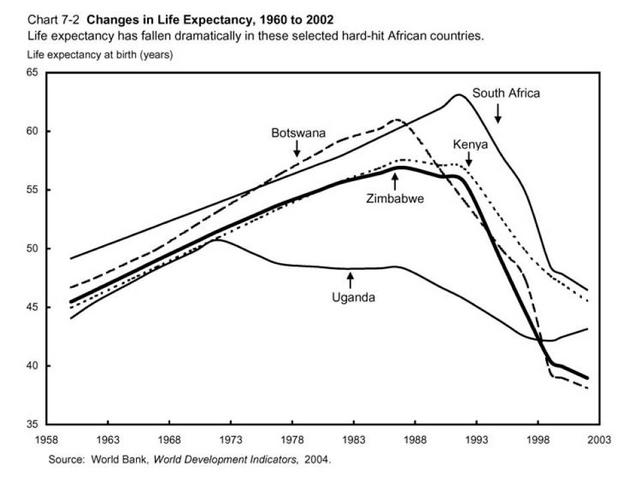
What I don’t understand is why the discussion of solutions focuses so heavily on AIDS drugs when condoms are cheaper and more effective in preventing spread of the disease. And why isn’t condom use in Africa skyrocketing? (A notable exception is Uganda where AIDS rates have begun to level off due to condom use– see graph). Condoms are cheap – even if not to every African they can be easily subsidized by donor groups or governments but there is still a large condom-gap in Africa.
Note that in theory condom use could increase transmission of AIDS if it increases sex. Evidence from the US and elsewhere indicates this is unlikely in practice. Moreoever, it doesn’t explain why more condoms are not being used.
Figure from the Economic Report of the President (2005) via Ben Muse.
Does citrus smell make you buy?
Under certain conditions, a citrus smell seemed to magically open the
pocketbooks of shoppers and increase their desire to spend, according
to Jean-Charles Chebat of the HEC Montreal graduate school of business,
Richard Michon of Ryerson University in Toronto and L.W. Turley of
Western Kentucky University. Their findings appear in the latest issue
of the Journal of Business Research.But retailers with a nose for sales should not order industrial-size
vaporizers and fill them with orange scent just yet. The researchers
cautioned that the citrus smell provoked additional spending only if
stores were moderately busy. If they were too crowded or too empty, the
power of citrus disappeared. "Crowds have their own smells," Chebat
said in an e-mail. "Citrus can counterbalance the effects of such
smells to a certain extent. However, it has its limitations. As for the
least crowded environments, citrus may be too arousing."
Here is the full story. Here is another summary, which includes a discussion of using scents to encourage gambling. Here is a link to the paper and related works.
Copyrighting Storms
Writing in the Financial Times, James Boyle makes an interesting comparison between how Europe and the U.S. treat government produced data, everything from "ordnance survey maps and weather data, to state-produced texts,
traffic studies and scientific information."
On
one side of the Atlantic, state produced data flows are frequently
viewed as potential revenue sources. They are copyrighted or protected
by database rights. The departments which produce the data often
attempt to make a profit from user-fees, or at least recover their
entire operating costs….The other side of the Atlantic practices a benign form of
information socialism. By law, any text produced by the central
government is free from copyright and passes immediately into the
public domain.
Surprisingly, it’s the US which practices the "benign form of socialism."
Take weather data. The United States makes complete weather data
available to anyone at the cost of reproduction. If the superb
government websites and data feeds aren’t enough, for the price of a
box of blank DVD’s you can have the entire history of weather records
across the continental US. European countries, by contrast, typically
claim government copyright over weather data and often require the
payment of substantial fees. Which approach is better? If I had to
suggest one article on this subject it would be the magisterial study
by Peter Weiss called “Borders in Cyberspace,” published by the
National Academies of Science. Weiss suggests that the US approach
generates far more social wealth. True, the information is initially
provided for free, but a thriving private weather industry has sprung
up which takes the publicly funded data as its raw material and then
adds value to it. The US weather risk management industry, for example,
is ten times bigger than the European one, employing more people,
producing more valuable products, generating more social wealth.
Another study estimates that Europe invests €9.5bn in weather data and
gets approximately €68bn back in economic value – in everything from
more efficient farming and construction decisions, to better holiday
planning – a 7-fold multiplier. The United States, by contrast invests
twice as much – €19bn – but gets back a return of €750bn, a 39-fold
multiplier. Other studies suggest similar patterns in areas ranging
from geo-spatial data to traffic patterns and agriculture. “Free”
information flow is better at priming the pump of economic activity.
Link addded. Thanks to Paul van Hoek for the pointer.
Weather Incentives Work?
The Russians will soon find out.
Moscow Mayor Juri Luschkov said: "Weather forecasters in our city and
the surrounding area will be held responsible for financial losses that
the city incurs through their incorrect prognoses."….He did not elaborate on how much the fines would be or if the cash
would be taken from the weathermen, or the companies they worked for.The
fines come after the head of the Romanian National Meteorology Agency,
Ion Poiana, was fired after he predicted warm weather fronts on days
when temperatures plunged to a record minus 36 degrees centigrade.
Thanks to Carl Close for the pointer.
Brad is wrong, so is Brad
Brad DeLong quotes Brad Plummer:
[I]t really doesn’t make a difference whether you pay 40 percent of your income for private health care, or 40 percent of your income in taxes that then go to government-administered health care. I mean, yes, in one sense it makes a difference: If you think the free market is a better way of delivering health care, you’ll endorse option 1; otherwise, you’ll endorse option 2. But in the end, you’re still paying 40 percent of your income….it’s disingenuous to say, "Oh no! America’s doomed! We’re going to have
to raise taxes massively in the future in order to afford things we’d
be spending a good chunk of our income on anyway!"
Brad DeLong writes "Brad is absolutely right. (I like the way
that sentence sounds: I wish *I* heard it more often from others.)"
Sorry Brad (and Brad), I’d like to oblige but there is a big difference between spending 40 percent of your own income on health and having 40 percent of your income taken in taxes and spent on health even if we assume that the spending is on exactly the same thing. The 40 percent of your income spent on health is a benefit of work, a reason to work harder, but the 40 percent taken in taxes is a cost of work that creates a dead weight loss. Moreover, at 40 percent plus the dead weight loss is going to be big.
To make the problem with Brad P.’s thought experiment clear suppose that we documented exactly how everyone spent their yearly income. Now we tax everyone 100 percent and provide them with exactly what they were buying before. Nothing changes, right? Wrong. At 100 percent tax there is no longer any incentive to work – thus no one works and nothing is provided. Everything changes.
Why are land taxes special?
Recently Bryan Caplan and I were chatting about Georgism. Henry George is well-known for his insistence on taxing land. But why land? What makes land special rather than labor or capital?
As I understand the doctrine, there is no special case for taxing improvements on land. Instead government should tax the "barebones" or "in situ" value on land. Say that land currently sells for $100,000 an acre, but would sell for $50,000 unimproved. We should levy the tax only on the $50,000. Supposedly we are then taxing an inelastic factor and creating only minimal distortions. Did not Adam Smith offer a similar recommendation? What better way to fund government?
Fair enough, but then why not tax the in situ values of labor as well? The "barebones" value of labor is of course leisure. That is what labor is worth when no extra effort is added to the picture. Therefore an optimal tax system should try to tax leisure. This may prove difficult, but why should it be harder than taxing the barebones value of land? Note that sometimes we are content to tax complements to leisure, such as large camper vans.

What if we taxed complements to the in situ value of land? These would be the factors — like labor and capital — that add value to barebones land. So I take the Georgist view to imply two claims. First, it is easier or better to tax barebones land than barebones labor. Second, taxing a factor directly is much better than taxing complements of that factor. Since I am not convinced either of these are true, I hold no particular attachment to the idea of a single tax on land.
I also share Benjamin Tucker’s concern as to how the in situ value of land should be defined. Some of the problems are conceptual rather than empirical. Land values are interdependent. When assessing the in situ value of my land, what assumptions should be made about the values of surrounding lands or the actions of other people? When the steamship is invented, should all taxes on American land have risen?
I might add that Bryan has different objections, which he may someday reveal to us all.