Category: Economics
How quickly will we adjust to global warming?
If the sea level rises considerably, the watery real estate of West Bengal will fall in value. Let’s say we knew that Calcutta would flood in fifty years’ time, how would the adjustment process work? Will people leave a dying city too rapidly or too slowly, as defined in economic terms?
Under one scenario, not everyone need leave the city. The city ought to shrink, but can survive at a less populated level. Furthermore then suppose that the stayers are better off, because they do not incur migration costs. Each person then will wish that others leave and he gets to stay. Migration will become a game of "chicken," and people will postpone leaving for as long as possible, hoping to be the lucky stayers. This is related to the reason why not all auto workers leave Detroit when the plant shuts down. They are hoping they will be rehired if/when a scaled plant reopens; everyone waits for the other guy to leave.
Alternatively, perhaps the flooding will be severe and everyone must leave Calcutta. Ideally the residents should coordinate on some new locale with urban increasing returns. Do you prefer to be the first one to leave or the last?
If the new locale is known, land rents might be bid up rapidly in anticipation of the forthcoming change. If you arrive first, you pay the higher rent without yet reaping the benefits from the new, still-forming city. You might rather wait for the others to come first. Markets will know this, and perhaps land prices won’t be bid up so much at first. The equilibrium likely involves mixed strategies and a partially successful solution. Of course many residents here in Calcutta don’t pay rent but rather sleep on the streets. They may be the ones who drive a satisfactory solution, since they can reap unpriced benefits from moving. Expect them to walk of course.
If the new urban locale is not known, it is hard for Calcutta residents to know where to go.
Note that if increasing returns are truly strong, having a long time to adjust may not help much. Once some of the city starts moving, the rest must follow. The period for adjustment becomes compressed, whether this happens right away or as the likelihood of flooding arrives.
I predict most residents will not form a new city to mimic the increasing returns of the old. Most likely, they will migrate to other very large Indian cites; when large numbers had to leave Pakistan during Partition, many of them settled in Delhi.
How costly will this additional concentration of population be? To Western observers, Indian cities appear impossibly overcrowded. But in income-adjusted terms, are Indian cities overcrowded at all? Might they be undercrowded and still capable of reaping additional economies of scale? In this case the real problem is that too many Indians keep a sentimental attachment to their rural areas, to the detriment of their potential urban neighbors. Migration out of Calcutta would again be too slow, relative to an optimum, but in absolute terms things would work out OK.
Adjusting for income, are American cities and suburbs more or less likely to be overcrowded than Indian cities?
Does it matter that the dollar is falling?
I have heard several accounts of why a low or falling dollar is bad:
1. U.S. citizens hold a relatively high percentage of dollar-denominated assets, so they are now poorer.
2. It looks bad when "the world’s strongest country" has a currency low in value. Perhaps OPEC will start pricing oil in terms of Euros.
3. Markets dislike uncertainty per se. People start wondering what a dollar is really worth and this causes them to hold off on other investments and purchases. This hurts financial markets and the economy more generally.
4. The real problem concerns interest rate hikes. The Fed won’t let the dollar fall too far, for some of the other reasons listed. It will stop a dollar free-fall by raising interest rates, which is bad for the economy.
5. If the dollar is falling, people will expect it to fall more and unload dollar-denominated assets. This one, however, is tricky.
If the dollar is expected to fall, we would expect nominal interest rates on dollar-denominated assets to rise (or the dollar must fall in value immediately). A reasonable equilibrium will obtain and dollars will once again be an attractive asset to hold.
My take: #1 is correct, but not a major problem. Imports are not a huge part of our economy, and often the exporter eats the currency loss, at least for a while. I don’t put much stock in #2. #3 and #4 are real. #5 makes little sense to me, but I cannot rule out its role in today’s world. How can it work? Perhaps portfolio managers bear a special penalty from being thought stupid if they hold onto dollars while a falling dollar makes the headlines. In this case a falling dollar would continually increase the real risk premia on dollar assets, even if traditional measures of risk do not much vary.
Keep in mind that the dollar did have a "soft landing" in the 1985-1989 period, so these are all possible costs, not necessary outcomes.
I cannot do links from this unusual Calcutta terminal, but read Brad DeLong’s recent posts on the dollar as well.
Brands on the Run
The latest Wired has a very nice article by James Surowiecki, The decline of brands. Jim argues that better consumer information has reduced the value of reputation. Why go with the brand that has a good reputation (Tide, Sony, IBM etc.) if you can find an actual evaluation of quality on the web?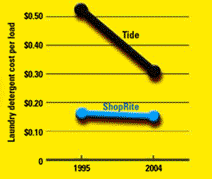
Better information transmission reduces the value of brands that have an objective quality but branding is unlikely to decline for products with subjective quality. I don’t expect Coca-Cola to disappear anytime soon. Indeed, as information about objective quality increases we can expect brands to try to position themselves in a subjective "lifestyle space" rather than in a measurable "attribute space." It’s hard to compete with Coca-Cola when consumers are buying more than the taste.
Better information transmission also raises the profitability of product evaluators. Roger Ebert has used the web to become a profitable brand. And of course you already know the top-of-the-line brand for economic analysis.
Football and Old Growth Forests
My hometown of New York City, where a rigorous political process weeds out all but the nuttiest ideas, is considering building a $1.4 billion stadium to bring the Jets back across the river from New Jersey, where they share quarters with the Giants. New York city and state would ante up $300 million each even though NFL football teams only play eight home games a year. Are communities crazy to do this kind of thing?
Not necessarily, according to economists Jerry Carlino and Ed Coulson, whose highly readable recent paper on the subject tries to take account of the intangible value people derive from sports teams. "We found that once quality of life benefits are included in the calculus," they write, "the seemingly large public expenditure on new stadiums appears to be a good investment for cities and their residents." The authors liken having an NFL team to having an old-growth forest–it’s something people enjoy even if they never visit. This is to say nothing of the pleasure and unity they derive from rooting, discussing, etc.
That would account for why these stadium deals are politically popular; Pittsburgh area households, for instance, said in a survey they’d pay an extra $5.57 annually each to keep the NHL Penguins–which works out to a present value of $66 million at 8% over the presumed 30 year life of a stadium. Carlino and Coulson worked from their estimate of the effect NFL teams have on local rents (for some reason football seems to raise them) to determine that teams bestow an amenity value of $184 per person. In metro New York, this could be huge. Then again, the Jets are already *in* metro New York.
My take: I’m not qualified to comment on the researchers’ methodology, but broadly speaking I think they’re onto something. My sons and I get great pleasure following the Yankees, for instance, and would gladly pay some small annual tax to keep them. But my guess is that the intangible value of an NFL team would be inversely proportionate to the importance of a city. You can’t take the Packers out of Green Bay, but Los Angeles doesn’t seem to mind having no team at all. Then again, maybe it’s just the weather.
The Pregnant Mare’s Lesson
Here again is Avorn:
The former colony is the United States, the time is now; the drug is the family of hormone replacement products that include Prempro and Premarin (manufactured from pregnant mare’s urine, hence its name.) For decades, estrogen replacement in postmenopausal women was widely believed to have "cardio-protective" properties; other papers in respected medical journals reported that the drugs could treat depression and incontinence, as well as prevent Alzheimer’s disease. The first large, well-conducted, controlled clinical trial of this treatment in women was not published until 1998; it found that estrogen replacement actually increased the rate of heart attacks in the patients studied. Another clinical trial published in 2002 presented further evidence that these products increased the risk of heart disease, stroke and cancer. Further reports a year later found that rather than prevent Alzheimer’s disease, the drugs appeared to double the risk of becoming senile. The studies resulted in a reduction, but not an end, to the long-term use of these products.
The Secret Sins of Economics
This text by Deirdre McCloskey is now on-line. I have not read it, but am a big fan of her ideas and her writing.
Hope for Hart Schaffner Marx
Find you can’t get much done at home? Now we know why. Researchers at Stanford University…
carried out a number of studies in which they exposed individuals to objects common to the domain of business, such as boardroom tables and briefcases, while another group saw neutral objects such as kites and toothbrushes. They then gave all of the participants tasks designed to measure the degree to which they were in a cooperative or competitive frame of mind.
In every case, participants who were "primed" by seeing the business objects subsequently demonstrated that they were thinking or acting more competitively. The effect was the strongest when they had to respond in situations that were deliberately ambiguous.
"Competitively" meant that when quizzed they finished the word "wa_" with an r, and finished the word c__p___tive as "competitive" rather than "cooperative." But apparently the business objects exercised their influence subliminally:
Participants denied that being exposed to business-related objects had influenced their behavior in any way.
That’s not all. In a variant on a well-known experiment,
Participants were given $10 and asked to decide how much they were willing to share with a partner. The catch was that the partner could refuse any offer perceived to be too low, in which case neither participant would receive anything. While subjects exposed to neutral pictures generally split the money 50-50, only 33 percent of those who looked at business-related objects did, showing that they had become less cooperatively oriented. Results were similar when participants were exposed in the experiment room to actual business-related objects, such as a briefcase and an executive pen, as opposed to a backpack and a wooden pencil.
You can read a fuller account here. To me the implications are clear: no more nerf ball and blue jeans at the office. And for those of us who work at home, this is the month to climb out of our pajamas and unload all that Danish modern.
Heavy Going for Airlines
America’s airlines are beset by higher fuel prices, cut-throat competition and costly labor agreements. The industry’s total profits, since its inception, are probably around zero. Now this:
Through the 1990s, the average weight of Americans increased by 10 pounds, according to the Centers for Disease Control and Prevention. The extra weight caused airlines to spend $275 million to burn 350 million more gallons of fuel in 2000 just to carry the additional weight of Americans, the federal agency estimated in a recent issue of the American Journal of Preventive Medicine (fee req’d).
The extra fuel burned also had an environmental impact, as an estimated 3.8 million extra tons of carbon dioxide were released into the air, according to the study.
The full story is here.
My take: The most persuasive explanation for the fattening of America in the past 25 years (two-thirds of adults are now overweight) is technology, including advances not just in computing but also food preparation. What we’re seeing now is what Edward Tenner would call a classic revenge effect, in which technological solutions create new problems–usually, problems requiring constant vigilance. Ed explores this at length in his marvelous book Why Things Bite Back.
Medicare considers obesity an illness, but the costs and benefits haven’t adequately been explored. If obesity has this effect on airline fuel consumption, just think about driving! Look for OPEC to roll out a line of snack foods or soft drinks. My vote for best brand name: "Tank Up."
The Social Security Inversion
Everyone seems to agree that in reforming social security we should not cut benefits to the already or soon-to-be retired. The political reasons for this are obvious but economically and morally the idea is as bankrupt as the program itself. It’s the current (and past) retirees who have gotten the best deal from social security – many of them did better than they could have done in any other investment.
Ida May Fuller was the first social security recipient. She paid in a total of $24.75, retired in 1939, lived to be 100 years old in 1975, and in the process collected $22,888.92 in benefits. Ida May is an extreme example but it is true that for current and past retirees benefit increases, a growing economy and longer life expectancy made social security a real deal. It’s today’s workers and children for whom social security is a raw deal. Even if the system does not go bankrupt, current workers will receive a very poor return on their "investment."
In refusing to cut benefits to current and soon-to-be retirees the costs of any reform are forced onto those people for whom the system is already a poor return. It would be fairer to spread the costs to all recipients especially to those who have benefited from social security the most.
Tyler in WSJ
All this week the WSJ will feature Tyler and John Irons in an open forum.
Congestion fees are working in central London
Ben Muse links to a summary of current knowledge. Here is one bit:
The aim of the congestion charge was honest and explicit: to reduce traffic congestion by reducing traffic volume by 10 to 15 per cent. To achieve this, drivers are required to pay £5 per day if they enter central London between 7am and 6.30pm, Monday to Friday. In the event the reduction in traffic has been greater than anticipated. Overall traffic entering the zone is down 18 per cent during charging hours, with a reduction in car traffic of 30 per cent and a similar reduction in congestion. There has been little displacement of traffic into areas round the zone or additional congestion on the ring road. Motorists themselves have benefited; for those who still drive in the zone, journeys are quicker and more reliable…
Guest blogging at The Wall Street Journal
For the next week (Monday-Friday), I will be guest-blogging over at WSJ.com, the on-line edition of The Wall Street Journal. The on-line Journal usually requires a subscription and password, but for this coming week it will be open to everyone. I will pass along the direct link once it is up and open, but you can find it by going through the Economy section, starting sometime early on Monday.
The blogging will be a set of exchanges with John Irons. John has a Ph.d. in economics from MIT and writes for the blog Argmax.com, one of the earliest and still most useful economics blogs. He now works at the Center for American Progress. I would describe his perspective as further to the left than mine, so you can expect to see some vigorous disagreement, but perhaps a few areas of unity as well.
We will, of course, continue to offer you content on MR as well, plus we will be welcoming a new guest-blogger.
How can neuroscience inform economics?
Colin Camerer, George Loewenstein, and Drezen Prelec have produced the longest and most substantive survey article on neuroeconomics to date. For those of you familiar with the basic methods, the punchlines start on p.30.
Neuroeconomists don’t just do brain imaging. Most generally they study how the human nervous system interacts with economic phenomena.
What is the bottom line to neuroeconomics? Does it offer new (and valid) predictions?
Wikipedia makes an ambitious claim:
…neuroeconomics may lead to significant changes in how we educate children, plan finances, manage employees, react to advertising and marketing, elect politicians, regulate government and industries, prove guilt beyond a reasonable doubt, select courtroom juries, monitor terrorist threats, and much more.
Neuroeconomics, in its current state, is most effective at helping adjudicate outstanding normative controversies. Do ads brainwash or inform us? When are savings decisions made on the basis of long-term planning? Which parts of the brain help us choose politicians? Do we allocate money the same way we allocate time? Think of neuroeconomics as a measuring device rather than a new body of theory. Look for better and more reality-tested answers to extant questions, not novel predictions, at least not yet.
Over time neuroeconomics will make our theories less universal and more context-dependent. This development will prove most important for normative economics and policy analysis, where realism is at a premium. If you’re still talking about how Friedman 1953 and how plants maximize received sunlight, neuroeconomics won’t make you very happy.
What I would want most: A testable neuroeconomic theory of why risk premia vary over time in securities markets. But that is very far away.
Here is my earlier post on neuroeconomics, replete with additional links. Here is Randall Parker’s excellent post on Coke vs. Pepsi, as measured by brain imaging.
Tyler’s Ideas for Bush’s Second Term
Here from an earlier post are Tyler’s ideas for a second term. Good ideas all. Keep your fingers crossed.
1. Eliminate all farm subsidies, tariffs, quotas and price supports.
2. Tell Western Europe it is paying for its own defense from now on.
3. Admit that the Medicare drug prescription bill was a mistake. Repeal it, and consider a revenue-neutral benefit that does not discriminate against prescription drugs. Introduce means-testing for Medicare to stop that program from bankrupting us. I would rather cut this benefit than repeal the tax cuts [tax shifts, correctly, though spending discipline could turn them into real tax cuts.] The long-run benefits of greater capital accumulation remain significant.
4. Negotiate bilateral free trade agreements as rapidly as possible. Start with Japan, the second largest economy in the world.
5. Strengthen America’s commitment to science. This will have implications for educational policy, immigration policy, and regulatory policy. Don’t restrict stem cell research. Hope that science comes up with affordable and politically sustainable solutions for global warming and clean energy independence. You might have libertarian objections to science subsidies, but the realistic alternative today is more government intervention.
6. Strengthen early warning systems against infectious diseases. Increase research into cures, vaccines, immunity, and the like. We don’t want the world to lose fifty million people to avian flu or some other malady.
7. Take in more immigrants, but demand higher levels of skills and education. At the very least, take in any revenue-positive immigrant.
8. Abolish the Department of Education.
9. Abolish the Department of Energy.
10. Repeal all corporate welfare.
11. Repeal the corporate income tax. Repeal the Alternative Minimum Tax. Admittedly these are “ifs,” depending on fiscal considerations.
12. Get on TV and tell the nation that a free economy is a critical source of our strength. Tell them you mean it, and then mean it. Economic growth is the greatest long-run gift we can give to the world.
Outsourcing Bangalore
I mean outsourcing from Bangalore, not outsourcing to Bangalore. Apparently production costs are rising out of control in a city that accounts for a third of India’s software exports. The major culprit is congestion; a seven-kilometer commute can now take ninety minutes. Population has grown by a third since 1995, and the new metro and airport are badly behind schedule. Bombay has had similar problems.
The remedy? Madras (Chennai) is rising in popularity as is Calcutta, despite its propensity to elect communist governments.
The bottom line: Indian infrastructure is chaos. This economy has only a limited ability to absord outsourcing ventures. For instance it is common for current enterprises to supply their own electricity and other public services.
I have drawn on conversations and the November 1 Business Week.