Category: The Arts
Mullah maximization
It turned out the Shah's curators knew what they were doing. They had bought some outstanding contemporary paintings — including Warhol's Suicide (Purple Jumping Man) and the stellar Woman III — to fill the museum that was never built. Say what you want about the Ayatollah, but despite his public rhetoric about the decadence of the West, his regime knew valuable assets when it saw them. The regime hung onto the paintings, rather than burn them along with the American flag.
That is from Richard Polsky's new and fun i sold Andy Warhol (too soon). The book is a sequel of sorts to Polsky's earlier I Bought Andy Warhol. I am also a fan of Polsky's earlier Art Market Guides.
How to achieve artistic immortality
…now a Canadian writer is using science to create a poem that could live forever..
Christian Bök, an experimental poet and associate professor of English at the University of Calgary, is working on a piece he plans to encipher and insert into the genetic code of an "extremophile" bacterium, one that is tough enough to survive conditions that would wipe out the human race.
He notes that others have already stored enciphered text in strands of bacterial DNA, including the lyrics to It's a Small World After All. But his poem will be the first that actually contains instructions for a protein or, as he sees it, a second poem.
That is from a piece by Anne McIlroy in the 5 September Globe and Mail; the article is not yet on-line. "Each letter of the alphabet is assigned to a tiny piece of DNA that codes for an amino acid…", which limits the vocabulary. It is noted that the author is having trouble coming up with the fifty words or so which deserve immortality. Here is background information on the poet. You can follow his tweets here.
I will make the more general observation that Canadian newspapers remain underblogged.
Alex Colville, painter from Nova Scotia
David Hume on the posts of honour
Were MOLIERE and CORNEILLE to bring upon the stage at present their
early productions, which were formerly so well received, it would
discourage the young poets, to see the indifference and disdain of the
public. The ignorance of the age alone could have given admission to
the Prince of TYRE; it is to that we owe the Moor: Had
Every man in his humour been rejected, we had never seen
VOLPONE.
That's from Hume's Of The Rise and Progress of the Arts and Sciences. I discuss related points in my What Price Fame? The proximate pointer is from Dan Klein.
Andy Warhol would be happy
David Reilly at Bloomberg notes that the pricing of credit default swaps on both the US government debt and Campbell’s is the same…
Here is the link. Hat tip goes to TheBrowser.
What if culture froze and had to be recycled?
Robert Wiblin, a loyal MR reader, asks:
Thought experiment for MR: what if the law said we couldn't make any new art (movies, novels, music etc). And perhaps said we ought to rerelease each year the art that first appeared 50 or 30 years ago. How would people's leisure activity and society's cultural evolution change?
I pose a similar question in my book Good and Plenty: The Creative Successes of American Arts Funding. After the adjustment process, I believe that matters would settle in an orderly fashion, although whether we pick the art from 30 or 50 years ago would make a big difference in terms of the required rejiggling of our aesthetic sensibilities. We would pick out bestsellers from 30 or 50 years ago and some of them would be in demand, if only because people wish to share common cultural experiences. Overall it is the more obscure books from that era that would likely rise to be the bestsellers today.
1979 is barely an aesthetic leap; could not The Clash be a hit today? How about Madonna? Is it so ridiculous to think that people still might go hear The Rolling Stones or Paul McCartney in concert? How about buying a Stephen King book? Here are the top songs from 1959 (yikes!), but recall that same year brought many excellent jazz albums.
The entire process would work better if the material from the past were temporarily unavailable prior to its rerelease.
It's an interesting idea to relive the release of the culture of the past but with today's sensibilities. What we would like to think we would like is probably not what we would like at all. And maybe some works we like only because they are in our past.
Finally, everyone is so ga-ga over arts subsidies, but it is remarkable how many models with microfoundations instead imply that we should tax the arts.
My favorite things Sweden
Most of the answers seem too obvious to list. I will say only that there is more to Swedish detective fiction than Stieg Larsson (start with Henning Mankell), lingonberries are usually a good idea in a meal, "Honey Honey" is the most underrated Abba song (it didn't make Greatest Hits I), there are more excellent Bergman movies than most people think even if you don't like the stereotypical ones, Carl Milles's greatest work is in a Fairfax/Merrifield cemetary on Rt.29 in Virginia, Emanuel Swedenborg is unreadable, and the world music group Simbi really does make note-perfect copies of native Haitian musical styles. The Cardigans are better than their reputation and Knut Wicksell's 1898 Interest and Prices still has unmined insights. The pizza is surprisingly good. Robert V. Eagly's book on the 18th century Swedish bullionist controversies is excellent and neglected. Everyone should read Staffan Burenstam Linder's The Harried Leisure Class. The country has long appreciated the merits of floating exchange rates. Ann Margret was from Sweden too.
My favorite things Sicily
1. Novel, set in: The Leopard, by Giuseppe di Lampedusa.
2. Movie, set in: This is a tough one. But I'll opt for Visconti's The Leopard (big screen required, don't bother with Netflix) over Coppola's Godfather sequence, not to mention La Terra Trema and L'avventura. Wow. Is there a Sicily scene in Patton?
3. Chess opening: 5…a6, the Najdorf. Chess is a good example of the more general point that it takes a long time to discover which innovations turn out to be valuable and which not. Thirty years ago, who would have thought that 6.Be3 would become the most common response?
4. Playwright: Luigi Pirandello, but I would call this a "favorite only because I can't think of anyone else."
5. Opera composer: Bellini, especially the first Act of Norma, sung by Maria Callas. There is also Alessandro Scarlatti but I don't know his music well.
6. Musical arranger: Pete Rugulo, yes he was born in Sicily and later he arranged for Stan Kenton. That music still sounds impressive to me.
7. Philosopher: Gorgias was smart but cynical (if we trust Plato). Empedocles was sooner a natural scientist in my view. Archimedes I would count as a mathematician.
8. Painter: Antonello de Messina is a clear first choice, unless you count De Chirico as Sicilian. Here is a very good Messina image.

9. Movie director: Frank Capra was born in Sicily; see my comments on Pirandello. Note by the way that I am not considering Sicilian-Americans unless they were born in Sicily.
They have a bunch of accomplished writers and poets I'm not familiar with, other than Lampedusa, so I don't have a favorite there.
The bottom line: A nice, diverse list, with numerous surprises.
My favorite things Mars
This was a reader request, so here goes:
1. Song about: Venus and Mars, by Paul McCartney and Wings. The melody is nice, the synthesizer is used well, and the song doesn't wear out its welcome.
2. Album about: David Bowie's Ziggy Stardust and the Spiders from Mars. Venus and Mars is not overall a good album; it is mostly dull and overproduced. So Bowie is a clear winner here.
3. Novel about: The Martian Chronicles, by Ray Bradbury. Worth a reread, especially if you first encountered it when young. Red Mars by Kim Robinson is a runner-up. What else am I missing?
4. Film about: Mission to Mars. Underrated de Palma, much better on a big screen, where it has a nice poetry of motion. I already know that some of you hate this movie, so there is no need to pillory me again on this count. I have never seen The Eyes of Laura Mars. What's that old science fiction movie modeled after The Tempest?
5. TV show about: Veronica Mars, especially season one. Excellent dialogue, and it asks what family really consists of. One of my favorite years of any TV show. Is the British show Life on Mars good? I vaguely recall My Favorite Martian from when I was a kid. Was it actually about being gay?
6. Musician: Sun Ra.
7. Mars, painting of: Jacques Louis David probably wins this one. This image is from Pompeii.

8. Best Cato Institute essay about Martian economics: By Ed Hudgin.
The bottom line: It's not just a culture, they've got a whole planet to work with.
My favorite things Alabama
1. Popular music. Emmylou Harris is from Birmingham and I like her albums with Gram Parsons. "The New Soft Shoe" is an excellent song. While I appreciate Nat King Cole in the abstract I never choose to put it on. Lionel Richie has a nice voice but the sound is too bland for my taste.
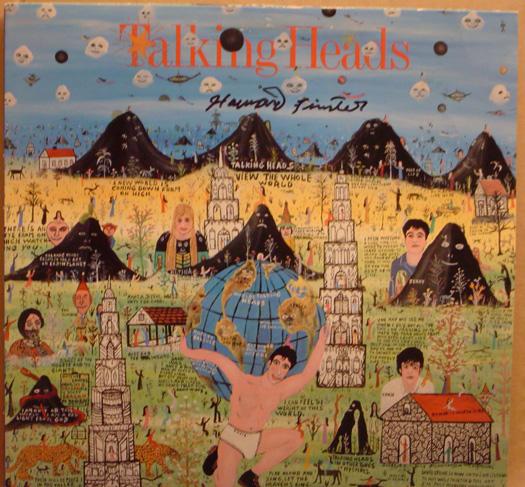
2. Painter: The early Howard Finster is excellent, although he churned out weak material for a long time later on.
3. Jazz: Lionel Hampton is the obvious choice, but I will pick Sun Ra, who is a musical god of sorts for me. Jazz in Silhouette is the best place to start, although it does not communicate the overall diversity of his work. He remains an underrated musical figure.
4. Country music: Hank Williams. Even if you hate country music you should buy the two CDs of his collected works. I also love Shelby Lynne; start with I am Shelby Lynne.
5. Bluegrass: The Louvin Brothers. Tragic Songs of Life is one of my favorite albums as it has a deeply scary and tragic feel; again you can love it even if you hate country and bluegrass. Do you know the song "The Great Atomic Power"?
6. Writer: I can't make my way through To Kill a Mockingbird. Who else is there? Wasn't one of Charles Barkley's books funny? I've never finished a Tobias Wolff novel, too stilted. Booker T. Washington and Martin Luther King were very good writers, though they don't quite fit the category. Same for James Agee. Truman Capote would be an easy pick except I don't enjoy his books. Zora Neale Hurston was born in the state though I am inclined to classify her under "Florida."
7. Quilters: From Gee's Bend, Alabama, there is an entire tradition. The traveling exhibits of these works are excellent.

8. Gospel: Blind Boys of Alabama. They transfer better to disc than do a lot of gospel groups.
9. Song, about: Don't go there.
10. Movie, shot in. Close Encounters of the Third Kind. As for "Movie, set in" here is a worrying list. Maybe I'll go with Fried Green Tomatoes, although the book is supposed to be better and more open about the sexuality of the main characters.
The bottom line: There are some major stars here and I haven't even mentioned the famous athletes.
My favorite things Nevada
I am flying there tonight, to speak at www.freedomfest.com. But yikes people, this is a tough one. I never finished Walter van Tillburg Clark's The Ox-Bow Incident and what else can I think of? Wikipedia tells me that Curtis Hanson, who directed L.A. Confidential, is from Reno. Does Wayne Newton somehow enter this equation? The Killers are OK.
How about this?
1. Movie, set in: Viva Las Vegas, with a number of strong runner-ups, including Ocean's Eleven, Leaving Las Vegas, the still under-rated Casino, Diamonds are Forever, Showgirls, Austin Powers (partly, I recall), and you might even squeeze Godfather II into the category. Catch this erotically supercharged clip of Elvis singing to Ann Margaret. Wasn't Them set in Nevada?
2. Song, set in: Viva Las Vegas, with Las Vegas, by Gram Parsons and Emmylou Harris, as runner-up.
3. Architecture book, set in: Robert Venturi, Learning from Las Vegas.
The state has excellent food, but overall I come no further.
The bottom line: You tell me. If you're wondering, I've never gambled, although I have visited the city four times. I genuinely cannot understand why so many other people find gambling to be an appealing pastime. It's negative expected value! There are so many positive expected value things to do.
Malcolm Gladwell dissents from Chris Anderson’s *Free*
Here are excerpts and the full original article. Excerpt:
Credit Suisse estimates that YouTube will lose close to half a billion
dollars this year. If it were a bank, it would be eligible for TARP funds.
I haven't read the book yet, but hope to report back when I do. For this pointer I thank Eric Wignall.
Addendum: Via Chris F. Masse, Anderson responds.
The Powerpoints of Emily Glassberg Sands
Find them here and they are excellent. One thing we learn is that women playwrights are more likely to write stories about other women. Women playwrights are also more likely to write plays with fewer major characters (slide 19). Outside evaluators are most likely to perceive the story's characters are less likable, if they believe a given script was written by a woman (slide 31). They also judge the economic prospects of a script to be poorer (slide 32). It is female artistic directors who have the harshest judgments of scripts submitted under female names (slide 34). Women writing plays about other women have the toughest time (slide 36). On Broadway, female-written shows are 18 percent more profitable than male-written shows yet they do not have longer running times (slides 44 and 45).
The original paper is here. She'll be on The Colbert Show on July 2.
Hat tip goes to the indispensable Literary Saloon blog.
The economics of ticket scalping
This is quite a good piece, here is one excerpt:
For the scalpers' business to work, they will often need to limit the
supply of tickets–and tear up the extras instead of selling them at
face value. Or in other cases, they create a perceived shortage of
tickets by dribbling them out slowly at auctions with fans not knowing
whether tickets are really available. The result of this is unhappy
fans and empty seats. This has some potentially bad long-term
consequences. On Broadway, to take one example, theater owners are
eager to create buzz around a show by keeping seats filled. If the
venue is going to be half-empty, they'll even "paper the house" by
having anyone connected to the production distribute free tickets.
Short-run gains for scalpers create long-run problems for theater
owners and performers.
This is different from the usual explanation that lower prices create desirable clientele effects. The piece also offers a good discussion of Eric Crampton and Trent Raznor as well. Hat tip goes to Felix Salmon.
Cumulous Brand
Here is more.