Category: The Arts
*Apollo’s Angels: A History of Ballet*
That is the new book by Jennifer Homans and it is one of the very best non-fiction works of the year, impeccably written and researched. Here is the excerpt of greatest interest to most economists:
None of the Russian ballet's many admirers, however, would be more central to the future of British ballet than John Maynard Keynes. Keynes is usually remembered as the preeminent economist of the twentieth century, but he was also deeply involved with classical dance and a key player in creating a thriving British ballet…
For Keynes…classical ballet became an increasingly important symbol of the lost civilization of his youth…With Lydia at his side, Keynes plowed his talent and considerable material resources into theater, painting, and dance, even as he was also playing an ever more prominent role in political and economic affairs on the world stage.
The couple's Bloomsbury home became a meeting place for ballet luminaries (Lydia's friends) and a growing coterie of artists and intellectuals who saw ballet as a vital art…When Diaghilev died in 1929, many of them joined Keynes in establishing the Camargo Society, an influential if short-lived organization devoted to carrying Diaghilev's legacy forward — and to developing a native English ballet. Lydia was a founding member and performed in many of the society's productions…Keynes was its honorary treasurer.
In the mid-1930s, Keynes also built the Arts Theatre in Cambridge, funding it largely from his own pocket…As Britain sank into the Depression, Keynes's interest in the arts also took on an increasingly political edge: "With what we have spent on the dole in England since the war," he wrote in 1933, "we could have made our cities the greatest works of man in the world."
I did, by the way, very much enjoy Black Swan (the movie), despite its highly synthetic nature, a few disgusting scenes, and its occasional over-the-top mistakes. So far it's my movie of the year along with Winter's Bone, the Israeli movie Lebanon, and the gory but excellent Danish film, Valhalla Rising.
My favorite recording of Swan Lake (and my favorite classical CD of 2010) is conducted by Mikhail Pletnev (controversial but there is a good review here), who was recently cleared of child abuse charges in Thailand.
Apichatpong Weerasethakul
I find it increasingly hard to resist the notion that he is the most enduring director of our time. I've now seen Syndromes and a Century (the best place to start), Blissfully Yours, and Tropical Malady and wish to rewatch them all. Uncle Boonmee Who Can Recall His Past Lives (not yet on DVD) won the Golden Palm at Cannes this year. Themes of his movies include dreams, medicine and its authority relationships, sex and eroticism, homosexuality, the nature of cinema itself, memory, sudden fractures of reality, surrealism, and the modernization of Thailand. [Insert Dancing About Architecture cliche here.] You could frame most of the shots from these movies and turn them into stunning photographs. The plot structure is stronger than it appears at first. These movies also have notable (though quiet) soundscapes, as you would find in a Tarkovsky film.
If you expect to disagree, try then the excellent Ong Bak.
For the original pointer to Apichatpong Weerasethakul, I thank Andrew Hazlett. Here is an MP3 on pronouncing his name properly.
How willing are you to believe another human being?: the case of Picasso’s alarm installer
A 71-year-old retired electrician is at the centre of a legal battle after coming forward with more than 200 hitherto unknown paintings by Pablo Picasso, a French newspaper reported Monday.
Experts who have examined the collection have estimated it could be worth some 60 million euros (80 million dollars), Liberation reported.
…Le Guennec said he had worked installing alarm sytems at a number of Picasso's residences, including a villa in Cannes in the south of France, during the last three years of Picasso's life — he died in 1973.
He said he had had been given the works as presents, either by Picasso's wife or from the artist himself. The collection included 271 works, Liberation reported.
For the pointer (more here) I thank Chris F. Masse.
The career of a paper mill writer (MIE)
From one of those people who writes other peoples' term papers for a living:
I do a lot of work for seminary students. I like seminary students. They seem so blissfully unaware of the inherent contradiction in paying somebody to help them cheat in courses that are largely about walking in the light of God and providing an ethical model for others to follow. I have been commissioned to write many a passionate condemnation of America's moral decay as exemplified by abortion, gay marriage, or the teaching of evolution. All in all, we may presume that clerical authorities see these as a greater threat than the plagiarism committed by the future frocked.
The article is interesting throughout. The fellow can write a 75-page paper in two days, has never visited a library for his work, and earns far more — $66k last year — than most ostensibly professional writers.
For the pointer I thank David B.
A theory of optimal tattoos
David Stearns, a loyal MR reader, asks:
How would you pick a tattoo, if you decided you were going to get one? How would you pick something that your future self is most likely to be glad to have? A favorite piece of art? Follow Leeson's lead and get an economics-related tattoo? Names of family members are off-limits, as are answers like "get a small dot in my armpit that nobody would see."
I would pick a country which I loved visiting, such as Mexico or Brazil, both of which have distinct shapes. It would be an excuse to narrate previous visits and I don't think it would repulse many people, other than the fact that it is a tattoo. An artwork in tattoo form would look low-brow. A Celtic geometric design would be another option. The obvious alternative would be to pick something which looked criminal, but I don't think that would mesh well with my other strategies in life. For some men it would pay off.
Here is Dan Ariely on tattoos.
Richard T. Gill
Richard T. Gill, in all statistical probability the only Harvard economist to sing 86 performances with the Metropolitan Opera, died on Monday…He was 82.
The article is here. Gill wrote many widely used texts and oddly he did not begin vocal training until he was almost forty. Up until that point, he had little acquaintance with classical music and he smoked two and a half packs of cigarettes a day. He first performed in a staging of Figaro at Harvard, directed by John Lithgow and conducted by John Adams (the John Adams). Later, he was in the world premiere of Philip Glass's Satyagraha. Gill continued to write and edit textbooks throughout his singing career.
In 1971 he gave up his tenure at Harvard. In 1984-85 he hosted a 28-part PBS show on economics. In the 1990s he wrote two books, one on population the other on the decline of the American family. Here is Gill's proposal for a Parental Bill of Rights. His short stories for Atlantic Monthly and The New Yorker were widely anthologized and in 2003 he published his first novel.
Here is his home page. At the time of his death he was working on a three to four-volume autobiography. As a Harvard undergraduate he was a successful boxer and somehow he ended up as an Assistant Dean at Harvard by age 21 and later Master of Leverett House.
Adventures in El Salvador
Tyler, Garett Jones and I visited El Salvador for a few days, just for fun. Here is a travelogue of some of our adventures.
The moment we exit customs Tyler grabs a driver and starts speaking in rapid Spanish. Neither Garett nor I are fluent but we are laughing because we know exactly what 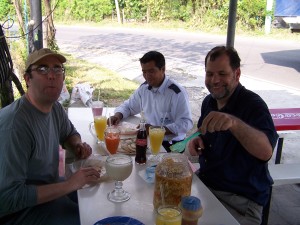 Tyler is saying. Tyler wants pupusas and not pupasas turÃsticos but estilo familiar. The driver understands as well so we jump into his van and he brings us to a pueblo with about 8 or 9 pupuserÃas in direct competition–we learn later that this is the town speciality. We get Pupusas de chicharrones, queso and lorocco, a herb that is hard to find in the United States. Bien Gusto. Tyler is sated so we continue on to Suchitoto, the small colonial town that will be our base of operations.
The next day we take a boat tour of Lake Suchitlan, an artificial lake nestled among hills and volcanoes. We ask our guide  to take us to a local village–it’s an unusual request but we are the only tourists in town so why not.
We climb a long hill, it’s blazing hot but we have a look around, get a drink and having seen all there is to see start to head back down to the boat. That’s when we hear the sirens and gunshots–other people hear it as well and stop walking. Only now do I remember the advice from Apocalypse Now, “Never get out of the boat!”
Tyler asks the guide what is going on. He isn’t sure either but he asks a local and tells Tyler it’s “the running.” Tyler is puzzled and looks as confused as I am–this is not a good sign–the word has many meanings, it could be the running of the bulls, the running of the race, the running? Well it seems not to be gunshots so I joke to Tyler that it would be awesome if it were the running of the bulls.
Not 15 seconds later I turn around and I am confronted with an angry bull bearing down on me. It looks like this:

Tyler, Garett and I jump out of the way. What the hell is going on?! With a second or two to recover, I realize the bull is being driven by a gaucho. The bull is snorting and none too happy, the sirens and shots are making it skittish, but the guacho slaps it hard, gets it under control and then, as if in a dream, the gaucho and bull vanish around the corner. We breathe a sigh of relief.
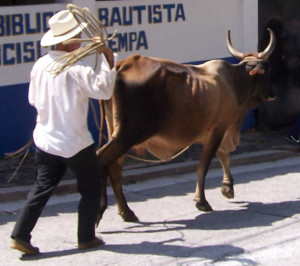
The running of the bull–as Tyler, Garett and I have coined the event–however, was not the running.
It was at about this time that things started to get a little surreal.
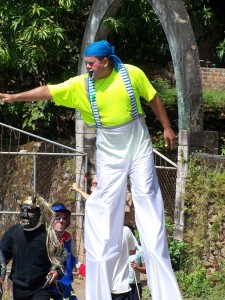 The sirens are approaching, the “gunshots” are getting louder and we see a strangely dressed man coming up the hill towards us. He appears to be tall, very tall, wait…am I in a Fellini movie?
The man is on stilts and is accompanied by a coterie of devils.
As the group passes, we are handed a handsome annual report with pictures of the mayor and the year’s accomplishments. Ah, this is fiscal policy! Now we understand.
We head back to the boat, pleased with our luck and well satisfied with the day’s events. 
Addendum: If you go here are few practical things to bear in mind. El Salvador is not geared towards tourists–this has positive and negative aspects. On the positive side you can believe the prices you are quoted, there is not yet a “take the tourist for all they are worth” culture. On the negative side, there isn’t much to buy. There aren’t many indigenous people and, in part because there isn’t a tourist market, there isn’t a strong artisinal culture, as there is in say Guatemala. There are a few Mayan ruins but nothing as extensive as in Guatemala or Mexico. Few people speak English, even at hotels and restaurants. The pupasas are great but the food variety is limited. We were perfectly happy exploring for two days but this is one of the less exotic countries of Central America.
(By the way, do you see the devil at right, so oddly framed between the bars of the truck. Why is he looking at me this way?)
 We stayed in Suchitoto at a small (6-8 room) hotel called Los Almendros de San Lorenzo. It’s run by a former El Savadorean diplomat who lived 30 years abroad and his partner, an interior decorator. Highly luxurious and recommended but anomalous, don’t take this as representing Suchitoto.
El Salvador has a very high murder rate, more than 10 times the US rate. Suchitoto, however, is safe and San Salvador seems fine for walking around in the main sections although every shop with anything of value has a guy with a shotgun standing outside.
On the way back from the village after the boat ride we were going to take the bus back into town. We asked some locales where the bus stop was and they volunteered to give us a ride in the back of their truck. Here’s a nice photo of Tyler (taken by Garett) as we traveled the bumpy road back into town. I believe we discussed Mundell and optimum currency areas.

Words of wisdom
The best advice about how to conduct yourself at work is to know yourself, and get new information–from outside your own experience–about what is possible in the world. And that is what fiction, and plays, and poetry, and this blog, are about.
More here. I thank Alex and Garett for having done a short (very short) jaunt to El Salvador with me; more on that soon.
Mario Vargas Llosa wins Nobel Prize
That's for literature, sadly he never had the chance to win a prize for economics, as his political career as a Peruvian classical liberal was cut short by electoral defeat. He has many fine books but I have two particular favorites: The War of the End of the World (serious and epic, concerning a millenarian revolt in Brazil) and Aunt Julia and the Scriptwriter (a fun story and spoof of telenovela culture). Conversation in the Cathedral is sometimes considered a classic but I find it unreadable. I suspect his early The Green House will resonate more with Latin Americans. His last major novel, The Bad Girl, was entertaining but not entirely satisfying and it reminded me a bit too much of an older man writing about sex. The Feast of the Goat is a very good study of political power. Here are previous MR mentions of Mario Vargas Llosa.
Here is Wikipedia on Vargas Llosa. Alex has done a good bit of work with Alvaro Vargas Llosa, son of Mario and a prominent writer on classical liberal themes, and perhaps he will relate some of that to us.
Are there advantages to prosopagnosia?
The artist Chuck Close, who is famous for his gigantic portraits of faces, has severe, lifelong prosopagnosia. He believes it has played a crucial role in driving his unique artistic vision. "I don't know who anyone is and essentially have no memory at all for people in real space," he says. "But when I flatten them out in a photograph I can commit that image to memory."
That is from a recent NY article by Oliver Sacks, not on-line but gated here. Sacks himself has this condition, as did Jane Goodall, including when she worked with chimpanzees.
Are cruise ships saving the theatre industry?
Cruise entertainment doesn't have the best of reputations, but I took my maiden voyage earlier this year and it was a real eye-opener. I was there to review shows on board the Celebrity Eclipse, and both the productions and facilities were extremely impressive. The theatre itself was actually of a far higher standard than many of the West End's crumbling playhouses – more comfy seats, better sightlines, excellent acoustics and high-end equipment.
Celebrity spends up to $1m per show for three 60-minute productions on every ship in its line. Each vessel has a 1,150-seat theatre, employs a cast of 18, plus nearly 40 musicians, a stage crew of six and various other technical crew across the music lounges on the ship.
And cruising is a huge growth area in the entertainment business. Looking across some of the other lines – P&O has its own on-board theatre company with more than 100 entertainers, Royal Caribbean is staging cruise versions of Hairspray and Chicago, and elsewhere there are licensed versions of Andrew Lloyd Webber musicals or other popular shows such as Saturday Night Fever.
But no Chekhov. The full story is here.
What is emblematic of the 21st century?
A recent reader request was:
What things that are around today are most distinctively 21st century? What will be the answer to this question in 10 years?
Here is what comes to mind and I think most of it will remain emblematic for some time:
Technology: iPhone, Wii, iPad, Kindle. These are no-brainers and I do think it will go down in American history as "iPhone," not "iPhone and other smart phones." Sorry people.
To read: blogs and Freakonomics, this is the age of non-fiction. I don't think we have an emblematic and culturally central novel for the last ten years. The Twilight series is a possible pick but I don't think they will last in our collective memory. Harry Potter (the series started 1997) seems to belong too much to the 1990s.
Films: Avatar, Inception (for appropriately negative reviews of the latter, see here, here, and here). Both will look and feel "of this time." Overall there have been too many "spin-off" movies. Keep in mind this question is not about "what is best."
Music: It's been a slow period, but I'll pick Lady Gaga, most of all for reflecting the YouTube era rather than for her music per se. I don't think many musical performers from the last ten years will become canonical, even though the number of "good songs" is quite high. Career lifecycles seem to be getting shorter, for one thing.
Television: The Sopranos starts in 1999, so it comes closer to counting than Harry Potter does. It reflects "the HBO era." Lost was a major network show and at the very least people will laugh at it, maybe admire it too. Battlestar Galactica. Reality TV.

What am I missing? What does this all add up to? Pretty strange, no?
p.s. Need to add Facebook and Google somewhere!
Sentences to ponder
Gabriel Josipovici, a research professor at the University of Sussex, is disenchanted with the absence of disenchantment with the world.
Why do we like adventure stories with guides?
Robin Hanson asks:
I’ve been sick, so watched tv more than usual. Watching Journey to the Center of the Earth, I noticed yet again how folks seem to like adventure stories and games to come with guides. People prefer main characters to follow a trail of clues via a map or book written by someone who has passed before, or at least to follow the advice of a wise old person.
Dante of course provides another example, as does Sibyl and Aeneas. And Robin's conclusion?:
This has a big lesson for those who like to think of their real life as a grand adventure: relative to fiction, real grand adventures tend to have fewer guides, and more randomness in success. Real adventurers must accept huge throws of the dice; even if you do most everything right, most likely some other lucky punk will get most of the praise.
If you want life paths that quickly and reliably reveal your skills, like leveling up in video games, you want artificial worlds like schools, sporting leagues, and corporate fast tracks. You might call such lives adventures, but really they pretty much the opposite. If you insist instead on adventuring for real, achieving things of real and large consequence against great real obstacles, well then learn to see the glorious nobility of those who try well yet fail.