Markets in everything: Gresham’s Law inverted
Zimbabwean bank notes. They’re selling above face value in many cases. The 50 billion note [sic] is going for about $12.
I thank David Welton for the pointer.
Why is the slowdown not so bad
Via Mark Thoma, the highly intelligent Tim Duy offers an explanation. Here’s one small bit:
The impact of the consumer slowdown is partially offshored, a point which
I think deserves greater attention. This shifts job destruction to an overseas
producer.
Most important, in Duy’s view, are the ongoing injections of liquidity from abroad. And here’s a new NBER paper on the sources of the great moderation; the abstract reads:
The remarkable decline in macroeconomic volatility experienced by the
U.S. economy since the mid-80s (the so-called Great Moderation) has
been accompanied by large changes in the patterns of comovements among
output, hours and labor productivity. Those changes are reflected in
both conditional and unconditional second moments as well as in the
impulse responses to identified shocks. Among other changes, our
findings point to (i) an increase in the volatility of hours relative
to output, (ii) a shrinking contribution of non-technology shocks to
output volatility, and (iii) a change in the cyclical response of labor
productivity to those shocks. That evidence suggests a more complex
picture than that associated with "good luck" explanations of the Great
Moderation.
Other work suggests that superior inventory policies, and information technology, have smoothed out slowdowns. It might also help that wages have lagged productivity for some time down; negative shocks might lead to less unemployment than otherwise would be the case. Here’s a look at the international evidence, which shows a moderation across many countries and points a finger at monetary policy and inventories. Jim Hamilton looks at oil and the great moderation; read here too. Circa Jan. 2007, Mark Thoma thought financial innovation was not the answer.
I don’t think it is crazy to cite "globalization" as the best single-word, seat of the pants response. But for any longer treatment, the answer is quite complex.
Sentences to ponder
[T]he statement "All models are wrong, but some are useful"
is itself a model (of an epistemological system, with many competing
models) and thus is paradoxical, being true only if it isn’t. Moreover,
although it asserts directly that some models are useful and indirectly
that others are not, the statement tells as [sic] nothing as to which is which, so it is not, itself, useful.
That’s from Germany, by the way (original source here). Now ponder it! Even better, the same guy offers (useful) tips on how to cut health care costs.
The original indirect tip is from Seth Roberts.
NFL Player IQ by Position Played
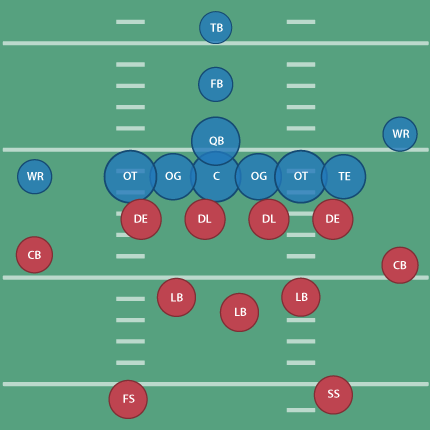
Very good sentences
…it’s been a revelation and confirmation of an intuition: in some ways,
gay men may benefit from marriage more than any other group.
That’s Andrew Sullivan, responding to the spot-on Megan McArdle, who also believes that men benefit more from marriage than do women.
Beer prices vs. wine prices
Josh writes to me:
This might not be normal,
but last night I started wondering why beer prices are not listed on
menus, while wine prices are. My next thought was "Tyler Cowen would
know the exact answer to that". I know you are busy and it is a rather
trivial question, but I was wondering if you could explain the
differences in wine and beer that lead restaurants to include the price
of one and not the price of the other on their menus.
Only sentence two is foolish but at least on this I am meta-rational and I appeal to you for help. One possibility is that wine prices don’t have such a tight upper bound so you had better get the customer’s buy-in for a relatively expensive bottle. Or if fine bottles are being sold relatively cheaply that is worth screaming about but how much can you discount a quality beer?
Tyrone on the fall in housing and asset prices
I was sitting here peacefully, weeping, when I received the strangest email from Tyrone:
Tyler, cheer up! The decline in housing prices is a godsend. Isn’t it a standard line — from both left and right — that we are spending too much on the elderly and not enough on the young? Isn’t lack of upward mobility, for the generation on its way into the world, the new problem? Aren’t the American poor to expect an even greater squeeze in the future? There’s a simple remedy for all of these problems at once — lower housing prices! Lower stock prices too! You don’t even have to get a bill passed through Congress, or overcome AARP, and we all know how hard that is these days. The housing stock is still there, the relatively established homeowners are a bit poorer, and those poor strugglers on the way up can now buy their dreams at lower prices. Even better, lots of the laid-off construction workers are Mexican immigrants, who for years have been keeping wages down for low-skilled American workers. This is an economic nationalist’s wish list, no?
Poor, poor, deranged Tyrone. Isn’t this what you would expect from an abject failure who has never managed to buy a home? Tyrone isn’t even subprime.
Trivial but neglected points
If there is one message writ large within the annals of anthropology, it is to beware the solid truths of one’s own culture. If we contrast our views with those of others, we find that what we take to be "reliable knowledge" is more properly considered a form of folklore.
That is from Kenneth J. Gergen’s often quite interesting The Saturated Self: Dilemmas of Identity in Contemporary Life.
Where should you cast your vote?
Jonah Berger, Assistant Professor of Marketing at the Wharton School of
Business, conducted a terrific study where he demonstrates that where people vote affects how they vote.
Essentially, people whose voting booth is located in a church are more
likely to put more weight into social issues, people voting in fire
houses care more about safety, and people voting in a school tend to
put more weight on things like education.
Admittedly there is a problem here of isolating causation. Perhaps you go to the polls whose location you know, and if you have kids you know how to find the school, if you are religious you know how to find the church, and so on.
Auren Hoffman, whom I will see next week in Quebec City, concludes:
Your gut might be much better at telling you what not to do than giving
you good direction on what to do. If your gut tells you something is
wrong with someone, than you probably do not want to entrust your kid
with her. But a positive gut-check often does little good (at least for
me).
In Defense of Short-Selling
Props to Dean Baker.
Short-selling can play a very important role in the market. If
informed investors recognize that a stock is over-valued they perform a
valuable service by selling it short and pushing down its stock price.
This can both deprive the company of capital and be a signal to other
actors in the market that the company might not be as healthy as is
generally believed.The economy would have benefited enormously if large numbers of
traders had shorted Fannie and Freddie 4 years ago when they were
buying up hundreds of billions of mortgages issued to buyers who bought
homes at bubble-inflated prices. This would have stopped the bubble
years ago. Similarly, we could have prevented the financial chaos at
Merrill Lynch, Citigroup, Bear Stearns and the rest, if traders had
recognized their financial shenanigans and aggressively shorted their
stock. In the same vein, heavy shorting by informed investors could
have prevented the boom and bust of the tech bubble.The decision to intervene against short-selling is completely
inconsistent with the belief in the wisdom of the markets. Of course
short-sellers can be wrong and depress stock prices more than is
justified by fundamentals, but so what? The government doesn’t
intervene when it thinks investors have exaggerated the true value of a
stock. The public has no more reason to fear under-valued stock prices
than over-valued stock prices. This one-sided intervention by SEC is
hard to justify on any grounds.
Assorted links
1. Fifty outstanding translations, via Bookslut.
2. The cost of being Batman, via www.geekpress.com
3. More on the file-sharing controversy
4. The new "Big Mac" index, so to speak
Risk Free No Longer
Wow, we usually think about U.S. bonds as being the "risk-free" asset but with a credit default swap you can buy insurance on a US default and the price of such insurance is way up.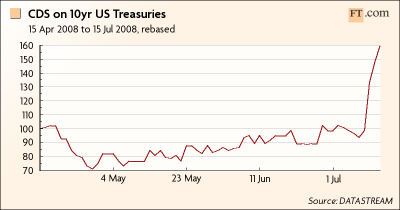
The change in price is a shock but to put things in perspective do note that the price for insuring US debt is now higher than for German debt but similar to that for Japanese and British debt. We are still far from Argentinian levels.
Hat tip to at, in the comments to my post on the peso problem.
Spend More Today
In Nudge Thaler and Sunstein motivate their Save More Tomorrow plan with the following unfortunate illustration:
Consider, for example, the case of Tony Snow, the former White House press secretary, who resigned at age fifty-two in 2007 to return to the private sector. He said his motivation for leaving was financial. "I ran out of money," he told reporters…Before serving as press secretary, Snow worked a much more lucrative gig as a Fox News Channel anchor. But he arrived at the White House not having learned Retirement 101 lessons. "Snow conceded: ‘As a matter of fact, I was even too dopey to get in on a 401(k).’
Sadly, Snow’s choices now look optimal. Ok, I know that may be in poor taste but let’s try to rescue this observation with some theorizing. Are we more likely to commit the error of saving too much or too little?
There are people who don’t save much because they have very low incomes, their behavior does not seem to be in error, especially when we take into consideration the various welfare programs that will cover people in their old age.
So let’s focus on people with moderate to high incomes. Thaler and Sunstein say that we are more likely to make errors when the benefits are upfront and the costs are delayed. Eating too much chocolate being a classic example. Ok, that suggests we may save too little.
T. and S. also argue that the less frequent a decision the more likely are errors. Frequency, however, cuts both ways – we only die once – so that’s a wash.
Over confidence and in particular the idea that we are special and will live a long life suggests the error is saving too much. Note that we also tend to think that our partner will be alive as well. My wife once asked me whether we were saving enough for "our" retirement. "Sure," I said, "don’t forget one of us will probably die before the other and I’m not saving for your future husband." "Why," she replied with a sigh, "can’t economists be more human?"
Availability bias probably also suggests we save too much – we see people who saved too little in the street but the ones who saved too much are dead and gone.
In theory, optimal saving equalizes the marginal utility of income across one’s lifetime – some programs like Kotlikoff’s ESPlanner attempt to calculate such an eqi-marginal utility flow and Kotlikoff’s finding is that a large fraction of Americans, some 40%, are saving too much. Kotlikoff’s program takes into account that we may need less wealth when we are old and retired (e.g. less transportation for work related reasons) but not that the marginal utility of wealth may be lower when we are old. (e.g. Money’s not so valuable if you don’t need it to or can’t use it to attract a mate.) Thus over-saving may be even more common than Kotlikoff suggests.
I do not know which error is more prevalent but if we are to be neither spendthrift nor miser we need to recognize both types of error.
How can the price of oil move so much in one day?
Over the two previous days oil fell $10.50 a barrel. By definition this is driven by news about supply and demand but has so much news come out so quickly?
Here are two ways to think about the mechanisms at work. First, some producers could supply more but they figure that China will be buying more tomorrow so maybe it is better to wait. If they see a signal that future global demand will be lower, they are less likely to let oil sit in the ground. In other words the market develops the expectation — true or not — that oil supply will rise more rapidly than had been thought (or "decline less rapidly" may in some cases be a more accurate phrase but the net direction of the effect is the same). Lower expected demand is thus paired with greater expected supply and that tends to make price volatile. Higher expected demand is paired with lower expected supply in similar fashion. noting in either case that you can make lots of different assumptions about the relative timing of the expected changes.
Second, any new information leads to more trading and to more trading at different ranges of price and quantity. This trading reveals more information about the elasticities of market supply and demand curves and that information in turn feeds back into the market price. In a nutshell, some initial price and quantity movements lead to further price and quantity movements.
Neither of these phenomenon are correctly called "bubbles" but neither do they fit the story where the price of oil is determined by fundamentals alone. "Expectations" is a central word here, noting that only time will tell whether or not the expectations are rooted in reality or not.
Do not buy art on cruise ships
In case you did not know. Here is one example of a fool:
It was only after Mr. Maldonado landed back in California that he did
some research on his purchases. Including the buyer’s premium, he had
paid $24,265 for a 1964 “Clown” print by Picasso. He found that
Sotheby’s had sold the exact same print (also numbered 132 of 200) in
London for about $6,150 in 2004.
Of course the corruption and foolishness runs deeper than the article lets on. If you shop for contemporary prints in entirely "reputable" Georgetown galleries, they will charge about twice the going auction rate for the prints. They might tell you that the prints are "hard to find" when in fact usually they are not. A good New York dealer, used to dealing with well-informed customers, might charge only 10-15 percent above auction (full price including buyer’s premium). The bottom line is that you should never spend more than $1500 on art unless you know at least roughly what it is worth at auction. One of life’s good rules of thumb.