End the State Veto on Power Lines
It’s one of the peculiarities of American regulatory history that a natural gas pipeline can cross state lines with a single federal permit, but oil and electricity must run a gauntlet of state approvals. When a power line crosses one state to reach another, for example, the intervening state often imposes exorbitant tolls or, worse, vetoes the project entirely. It’s the holdout problem played out among the states.
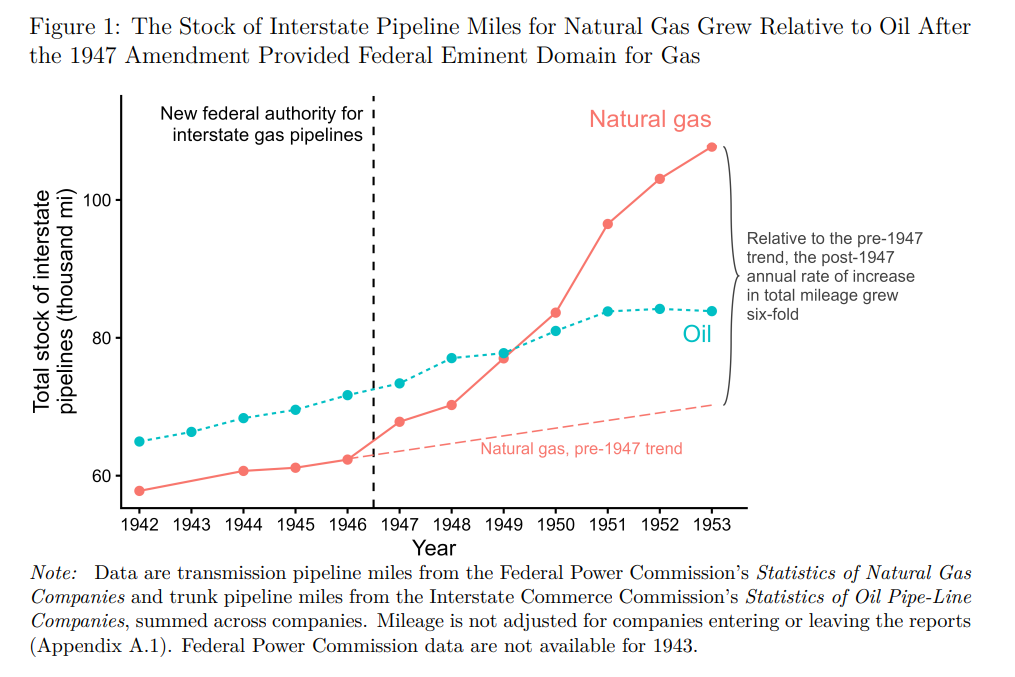
In a new paper, Liscow, Shapiro and Williams show that after Congress ended the states’ veto over interstate gas pipelines in 1947, miles built per year rose nearly sixfold. Oil pipelines, which still had to run the state gauntlet, held steady. Lower transaction costs let natural gas flow to where it was most valued, creating a national market.
Today, as Liscow and Shapiro write in the Washington Post, the issue is electricity:
An interstate power line, however, typically needs approval from every state it crosses. That gives each state a veto over projects in which the benefits often flow mostly to its neighbors.
New England has experienced the consequences. In 2016, Massachusetts attempted to import Canadian hydropower. New Hampshire, which would have hosted the power lines without getting the same influx of cheap energy, rejected it. A second route through Maine was blocked in a referendum and didn’t deliver power until January. Meanwhile, Massachusetts households paid some of the highest electricity prices in the country.
As with natural gas, electricity is cheapest to produce far from where it is most valued, so to get the most from our national resources we need to transmit electricity across the country.
The Bipartisan American Affordability and Jobs Act, which faces a Senate cloture vote on Monday, would let FERC approve an interstate line that a state has blocked or stalled for a year, a big step toward a national market in electricity.
Let the power flow!