Ed Glaeser reviews Richard Florida
Here it is; excerpt:
But while I agree with much of Florida’s substantive claims about the real, I end up with doubts about his prescriptions for urban planning. Florida makes the reasonable argument that as cities hinge on creative people, they need to attract creative people. So far, so good. Then he argues that this means attracting bohemian types who like funky, socially free areas with cool downtowns and lots of density. Wait a minute. Where does that come from? I know a lot of creative people. I’ve studied a lot of creative people. Most of them like what most well-off people like–big suburban lots with easy commutes by automobile and safe streets and good schools and low taxes. After all, there is plenty of evidence linking low taxes, sprawl and safety with growth. Plano, Texas was the most successful skilled city in the country in the 1990s (measured by population growth)–it’s not exactly a Bohemian paradise.
Matt Yglesias has kind words for my book
Here is his brief review; he calls my main argument "the most counterintuitive thesis ever." Bryan Caplan does not like such talk, but I take it as praise. Here Matt picks San Antonio over Detroit in the playoffs, which I consider the second most counterintuitive thesis ever.
Tomorrow
Do look out for my first New York Times column tomorrow, Business Section, "Economic Scene." I will alert you to future columns as they appear.
How to rebuild New Orleans: legalize shantytowns
This is me, from Slate.com:
Many economists have suggested it is not worth rebuilding New Orleans
at all. But they belie their own discipline by not asking, "At what
price?" Hurricanes or no hurricanes, the devastated areas in New
Orleans remain more valuable than most parts of the world, if only
because they lie in a famous U.S. city. At some price, people will want
to work and live there. City planners simply need to acknowledge that
this price is lower than it used to be…What is the advantage of turning wrecked wards into shantytowns? The
choice is between cheap real estate or abandonment. The land will not
sustain high-rent, high-quality real estate. Given the level of risk,
much of it will not even support bland middle-income housing. Imagine
that the government took a spot suitable for a McDonald’s but mandated
that subsequent restaurants should have fancy décor and $30 steaks. The
result would not be a superb or even middling bistro but rather an
empty spot. No one would set up shop because the market could not be
made profitable at that quality and price. A similar principle applies
to New Orleans real estate. If various levels of government try to
mandate higher values than the land will support, the private sector
will simply withdraw its participation, leaving nothing behind.
Read the whole thing, as they say, and look out for further Slate.com installments on Louisiana each day this week.
Claims my Russian wife laughs at, a continuing series
"Even if you care more that we go to this event together, that is only choice at the margin. Looking at the total summation of our time, I need you more than you need me. Husbands need wives more than vice versa; the data on this are clear."
"I don’t care how tall he is. If you can’t see the top of his [Kobe Bryant’s] head, the specifications on the TV screen are causing distortion."
"Hey, I’ m more efficient than you are!"
The best sentences I read Sunday
In an economy of stuff, the laws of property govern who owns stuff. In an attention economy, it is the laws of intellectual property that govern who gets attention.
The center of gravity for formal inquiry changes places too. In an economy of stuff, the disciplines that govern extracting material from the earth’s crust and making stuff out of it naturally stand at the center: the physical sciences, engineering, and economics as usuallly written. The arts and letters, however, vital we all agree them to be, are peripheral. But in an attention economy, the two change places. The arts and letters now stand at the center. They are the disciplines that study how attention is allocated, how cultural capital is created and traded. When your children come home and tell us that they have decided to major in English or art history, no longer need we tremble for their economic future.
That is all from Richard Lanham’s excellent The Economics of Attention: Style and Substance in the Age of Information. The truly discerning will in particular appreciate the merits of pp.39-40 in this book, but I am not going to give them away…
Markets in everything
Virtual reality games your pets can play with you, and also against you.
The first chapter of my book
Good and Plenty: The Creative Successes of American Arts Funding, now chapter one is here on-line.
Thanks to the ever-indispensable www.politicaltheory.info for the pointer (hey, isn’t it my book?). And here is the first chapter from economist Jay Hamilton’s All the News That’s Fit to Sell: How the Market Transforms Information into News.
How will the web affect TV shows?
Shortly you will be able to see Lost episodes for free on the web, albeit with commercials (btw, my theory is that they have entered a parallel universe and are being tested by a non-omnipotent God). I’ve bought Battlestar Galactica episodes through iTunes.
But how will this affect the content of TV programs? I see a few possibilities:
1. Individual episodes are more complex and less likely to be self-contained. To watch only one show of Lost or BSG leaves you baffled. But who can make sure he catches every episode? What if you want to leave the country for a while? Now if you have missed a show, you can use the Web to keep in touch with the longer and more integrated story. You will do this even if you, like I, find web viewing distasteful and inconvenient. Not everyone can afford TiVo, and some of us still need Yana to operate the remote and indeed the service itself.
This mechanism will raise the intellectual quality of TV.
2. Perhaps the time lengths of programs will vary more. Has The Sopranos gone on a nearly two-year hiatus? How about a fifteen-minute web shortie to keep us interested?
3. (Some) webcasts will be reproducible on iPods. You will show the highlights of episodes to your friends. Perhaps many producers will make episodes to stress "the best two minute stretch or skit" rather than the show as a whole. Just as the song is outliving the album, perhaps the skit will outlive the show.
4. Might it, as Mark Cuban suggests, support soap operas in real time? What better to watch on your work computer, during work hours? In the longer run, the more entertaining your computer becomes, the more people will be paid by commission; blame blogs for that too.
5. TV on the web, in essence, shortens the release window for ancillary products. How big a deal is the DVD in six months’ time if a web version exists now? And what does shortening the release window do? It will be harder to figure out what is a hit. It will lower movie budgets. It will increase the relative advantage that low-cost drama has over special effects spectaculars. Surely you can think of more effects on this count.
Comments are open…
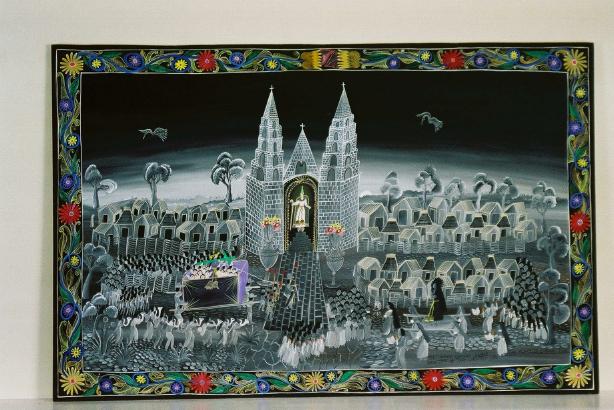
Easter painting from Mexico
In San Agustin, they are reenacting the final scenes from their Passion Play today. The artist is Juan Camilo Ayala. On the left is Christ in a box (purple wrap, green cross) being carried to his killers:
Markets in everything — Scriabin rising
Screenings of Colin Farrell’s latest film will be accompanied by a series of smells at a cinema in Japan.
Seven fragrances will waft from machines under back row seats during historical adventure The New World [TC: much underrated, but you need the big screen].
A floral smell will accompany love scenes, with a mixture of peppermint and rosemary for tear-jerking moments.
Cinemas across the country will be able to download
programmes to control various sequences of fragrances for other
upcoming films.
Illegal downloading and competition from the small screen will encourage further moves into live experiences which cannot be replicated at home. Anyone up for a live voodoo ceremony? Note, however, that a programmable home version provides "aromatheraphy" for work or horoscope readings. Here is the story.
Department of Uh-Oh, a continuing series
Reading web sites raises my estimate of the benefits of being already married:
Half of all women make their minds up within 30 seconds of meeting a man
about whether he is potential boyfriend material, according to a study
on speed-dating.The women were on average far quicker at making a decision than the
men [emphasis added] during some 500 speed dates at an event organised as part of
Edinburgh Science Festival.The scientists behind the research said this showed just how
important chat-up lines were in dating. They found that those who were
"highly skilled in seduction" used chat-up lines that encouraged their
dates to talk about themselves in "an unusual, quirky way".The top-rated male’s best line was [TC: yikes, and what kind of British abomination is this?] "If you were on Stars In Their
Eyes, who would you be?", while the top-rated female asked bizarrely:
"What’s your favourite pizza topping?"Failed Casanovas were those who offered up hackneyed comments like "Do
you come here often?", or clumsy attempts to impress, such as "I have a
PhD in computing".
Here is the link, and yes sadly I prefer my pizza plain. Perhaps some of you must now, over longer periods of time, simply blog your potential conquests into submission. By the way, the researchers also suggest that "travel" is the best topic of conversation for spurring a connection and future dates.
New blog on economics and journalism
By Dean Baker, beatthepress.blogspot.com. The pointer is from Brad DeLong.
The Neapolitan Enlightenment
No, it has nothing to do with debt-collecting strategies of the Sopranos. Rather it refers to the kind of book I dream of. The Case for Enlightenment: Scotland and Naples 1680-1760, by John Robertson, compares the Neapolitan and Scottish Enlightenments.
There is Ferdinando Galiani, the brilliant midget who understood supply and demand, outlined subjective value theory, formulated an early version of the price-specie flow mechanism, and yet opposed freedom of the grain trade.
Antonio Genovesi held the first European chair of political economy. He believed economic growth was the path to happiness. No clergy were allowed in the post.
Giambattista Vico — well, where does one start? History is cyclic, rhetoric is all-important, poetry is a primary source of knowledge, and the Cartesian method does not apply to the public sphere. He believed, correctly, that the true wisdom of mankind could be received through a sufficiently deep reading of Homer. The history of ideas is never quite the same after reading Vico.

If you want to know how these people relate to Hume and Bayle, this is your book. It does not go far enough or deep enough — why so little talk of Plato and the Gnostics? — but it is about time we can hold something like this in our hands. In the meantime we should get this guy to publish his stuff.
The best idea I heard today
…in a wonderful but still unpublished paper titled "Should Taxes Be Independent of Age?" my Harvard colleague Michael Kremer suggests that younger workers should face lower income tax rates than older workers.
Quite simply the elasticities of the young are larger; Greg Mankiw has more. Get this:
Kremer estimates that young workers are about four times more responsive to work incentives than the middle aged.