Category: The Arts
The most amazing cultural events of 2006
Here is a Slate.com feature; here is my response:
In January and February 2006, Lincoln Center presented a festival of
live music called The Passion of Osvaldo Golijov. Golijov, an
Argentinian Jew, is the first breakthrough composer of the new
millennium. His Ayre (song cycle), Passion According to St. Mark, and Aindamar (opera) make classical music passionate and popular and theatrical once
again. In particular, I am amazed that a mix of tango, klezmer music,
gospel, Cuban music, and the classics can bear so many repeated
listenings. Golijov also reflects the growing role of Latin America in
North American high and popular culture.
Marginal Revolution Goes Avant-Garde
David Morris, New York City theater artist and long-time reader of MR, is one of the creators of Routine Hearing: Exercises for the Body Politic.
Exercises for the Body Politic
moves to the beat of an original score featuring the luminaries of
political oratory. From the golden oldies of Goldwater and
McGovern to the modern sounds of Limbaugh and Moore, your headphones
will set the stage for this auditory grand ballet. Enjoy a glass
of wine, a game of cards and the company of your fellow citizens as one
of HERE’s favorite design teams–David Evans Morris & Juliet
Chia–hit shuffle on the political soundtrack of 21st century.
The lastest installment of Exercises will feature selections from Tyler’s paper Self-Deception as the Root of Political Failure. Alas, no selections from your truly but if Nixon going to China can become an opera I have high hopes for the musical, Believe in Pascal’s Wager? Have
I got a deal for you!
You can get tickets to Routine Hearing which plays Jan. 2-3 at the above link.
Addendum: Here are Tyler and I on An
Economic Theory of Avant-Garde and
Popular Art, or High and Low Culture (JSTOR link).
How to appreciate Shakespeare
…right now, at this very moment, one can see more great Shakespeare, one can find more transformative Shakespearean experiences, from what is already on film even in the form of tape or DVD on a television screen than the average person, even the average critic, will see on stage in a life time.
That is from Ron Rosenbaum’s generally quite good The Shakespeare Wars. His list:
1. Orson Welles, Chimes at Midnight [TC: also Welles’s best movie]
2. Peter Brook, King Lear
3. Richard III, with Laurence Olivier
4. Hamlet, with Richard Burton
To this list I would add Welles’s Othello and — more controversially — Baz Luhrmann’s William Shakespeare’s Romeo and Juliet, Haitian voodoo scenes and all; Rosembaum is more positive than negative about that one, but it doesn’t make his list.
The Power of Philanthropy
The British Museum is one of the world’s premier arts institutions. But last year it spent less than a million pounds on new acquisitions. Compare this to the more than 55 million pounds spent by the Metropolitan Museum of Art in New York, or the more than 20 million pounds spent by MOMA. The Met figure is inflated above normal levels because of the purchase of an expensive Duccio painting but the comparison remains. The Louvre spent 16.8 million pounds in the same year, coming in third internationally. The Getty was fourth and the Rijksmuseum fifth.
That is from The Art Newspaper, December 2006, p.25. Here is a good article on a Frenchman who has realized the power of decentralized philanthropy. Here is a good article on NYU’s obsession with philanthropy.
In Honor of Newton’s Birthday

My favorite things Brazil
1. Painter: Candido Portinari is the obvious choice, try this one, or here, but he is not well-represented on-line. Jose Antonio da Silva, the naive painter, is a personal favorite; here is one image, here are two more.


2. Movie: Black Orpheus, if seen on a big screen, is splendid from beginning to end. Imagine Rio with empty, unpopulated hills. More recently, I am fond of Central Station, and regard City of God as just a bit overrated.
3. Music: This topic needs a post all its own, and you will get one soon enough.
4. Novel: Brazil (or is it the translators?) is oddly weak in this category. I’ll nominate Jorge Amado’s Dona Flor, or Machado de Assis, his still underrated Epitaph of a Small Winner. Here are more authors, but I await your guidance. By the way, I think Paulo Coelho’s Eleven Minutes is a good read but I haven’t been able to finish any of the others by him.
5. Natural wonder: Iguassu is one of the best natural sights in the world. Imagine a big waterfall 17 km long, and with coatimundis, amazing butterflies, and churrascaria nearby.
6. Non-fiction books about: I love Nancy Scheper-Hughes’s transcendent Death Without Weeping: The Violence of Everyday Life in Brazil. My runner-up pick would be Alex Shoumanoff, Capital of Hope, about Brasilia. The classic works of Gilbert Freyre are good background on the country, as is Brazil: Once and Future Country.
7. Sculptor: Avant-garde Helio Oiticica is all the rage these days. They put two of his works out at MOMA, a big Tropicalia show in the Bronx, plus a big solo show is coming to Houston, I hope to see it there. The on-line images destroy the angles and the content of the boxes, maybe try this one, but best to see it live.
8. Favorite food: The small towns near Curitiba, in the south, have the world’s best beef plus amazing pasta.
The bottom line: Might Brazil be the best place, period? To visit, that is.
Global Orgasm Day
Today is global orgasm day. Why? Well, why not? But the organizers do have a larger goal: "To effect positive change in the energy field of the Earth through input of the largest possible surge of human energy, a synchronized Global Orgasm."
Lest you think this is purely prurient, do note that there is an interesting scientific component. The Global Consciousness Project is a peculiar project run out of Princeton University that has for many years been running experiments correlating random output devices with human consciousness. Results from 12 years of experiments show small but highly statistically significant results.
Beginning in 1998 the group started to record data from "eggs" (non-deterministic random number generators) located around the world. The data show or seem to show higher than random correlations with "global events" such as the funeral of Princess Diana (the events are designated in advance or before examining the data). The eggs will record whether today’s global orgasm is associated with a perturbation in the global consciousness field.
Do I believe any of this? No. Will I participate in the experiment? Anything for science.
Markets in Everything: Power Flower
Carnivorous Plant of the Month Club. Question: Is someone who eats carnivorous plants a vegetarian?

My favorite things New Jersey
1. Music: There is Count Basie, Lauryn Hill (download "I Just Want You Around"), Paul Robeson, and Deborah Harry’s best songs; my favorite is the reggae-inspired "The Tide is High." Paul Simon was born in New Jersey, and of course there is sax player Wayne Shorter. Even at age 44, I’m still not into Frank Sinatra. Bruce Springsteen I now find mostly unlistenable (monotonous rhythm sections), but parts of Born to Run still send a thrill through my heart.
2. Author: Philip Roth is the obvious pick, but I prefer Norman Mailer’s Harlot’s Ghost, a neglected masterpiece, and the first half of his Executioner’s Song. Stephen Crane is from the state, but somehow he doesn’t count in my eyes as a New Jerseyan. Mencken had the bottom line on James Fenimore Cooper.
3. TV show: Duh. I still don’t get the appeal of The Wire; for obvious biographical reasons, I’d rather watch white New Jerseyans kill each other than black Baltimoreans.
4. Poet: William Carlos Williams, here is a quickie poem.
5. Comic: Jason Alexander, by far the funniest guy on that show. Bud Abbott is another pick. James Gandolfini (Tony Soprano) can be funny when they let him.

6. Director: Steven Spielberg, AI is about how morally superficial people can be; Sugarland Express and Close Encounters (director’s cut) are other favorites of many. There is also Brian de Palma, his best film is the Hitchcockean Dressed to Kill.
7. Non-fiction writer. John McPhee has raised the bar for all of us.
8. Painter: Jacob Lawrence, especially the early works. There is also George Inness, who painted Montclair, and Ben Shahn, here is my favorite of his.


9. Sculptor: George Segal I am not so fond of, but otherwise I draw a blank.
10. Economist: Milton Friedman.
11. Movie, set in: Here is a list, plus there is Clerks and other Kevin Smith creations, not to mention Big (Tom Hanks) and Buckeroo Bonzai. I opt for Harold and Kumar go to White Castle. What else am I missing?
12. Mom: Mine.
The bottom line: Too obvious to state.
The second bottom line: Population density is a wonderful thing.
My favorite things Minnesota
No, I am not there, but this is atonement for my unintended slight of the state on Saturday.
Music: Dylan, Dylan, and Dylan. Bringing it All Back Home is his best album, and don’t forget Blood on the Tracks and Love and Theft, among many others. Did I mention the guy is a first-rate author, an amazing DJ, and a passable actor as well? I’ve found that relatively few intelligent people appreciate Dylan as a vocalist (don’t forget the Bing Crosby influence) and guitarist (one of the best of his time, though not technically), don’t be distracted by the lyrics.
But yes there is more. My favorite Prince songs include "Starfish and Coffee," "Glam Slam," the Purple Rain "medley" on side one, and "Seven," most of all the acoustic CD single version. My favorite Replacements songs are "I Will Dare" and "Skyway."
Film: The Coen brothers have many good films, most of all Fargo, Raising Arizona, and Brother, Where Art Thou? Much of Fargo is set in Minnesota.
Literature: F. Scott Fitzgerald is an obvious first, Sinclair Lewis I don’t enjoy much. Tim O’Brien’s Going After Cacciato is a neglected classic. Ole Rolvaag isn’t bad. I believe Anne Tyler is from the state, Breathing Lessons is worth reading for a tale of dysfunctional families.
Artist: Duane Hanson — the guy who makes the sculptures that look like people — is the obvious pick. Any painters other than (ugh) Leroy Nieman?

Small town: "Small" isn’t quite the right word, but Duluth is a beauty, and yes Highway 61 runs up there.

Museum: The Walker Art Center is one of the most dynamic arts institutions in the United States. Here is a good article on the arts scene in Minneapolis.

I won’t call them "best", but Winona Ryder, Charles Shulze, and Garrison Keillor count for something.
The bottom line: Education and intellect kick in here in a big way. Minnesota is one of the best states.
Happy Thanksgiving
My favorite things Indiana
A brief trip it will be, but here goes:
1. Music: Michael Jackson is from Gary, and his most underrated song is "She’s Out of My Life." There is also Cole Porter (overrated in my view, compared to Jerome Kern) and Ned Rorem. Wes Montgomery has a few good albums, usually they are live; it is a shame he wasted his immense talent on muzak.
2. Literature: Sorry, but I find Kurt Vonnegut unreadable, and don’t tell me about Harrison Oberon. Dreiser? I’ve never read Newton Tarkington, who wrote The Magnificent Ambersons. I’ll go with Philip Jose Farmer and his Riverworld series.
3. Painter: I am only slightly fond of Robert Indiana (yes he is from the state), or for that matter William Merritt Chase; here is my favorite Chase painting.


4. Favorite small town: Alex recommends Columbus, Indiana, for wonderful architecture. I defer to him.
5. Movie, set in: Hoosiers and Breaking Away do not sit well with me, so help me out if you can.
6. Blogger and libertarian crusader for civil liberties: Radley Balko.
The bottom line: I don’t even like James Dean. Radley is great, but my favorite thing Indiana is in fact Liberty Fund.
Christmas gifts
This is not quite a year-end "best of" list, but if you are looking for gifts, here are my off-the-cuff picks in some select areas.
1. TV show: Season one of Veronica Mars. Matt Yglesias and Dan Drezner are fans as well.
2. Classical music: Maurizio Pollini, Chopin’s Nocturnes.
This recording has none of the flaws that Pollini would have shown in
these pieces 20 years ago; they are lyrical and beautiful. For something
new try Golijov’s Ayre song cycle, and don’t neglect the accompanying Berio pieces. Richard Egarr’s Goldberg Variations is the only harpischord recording which stands up to Glenn Gould. Finally, Paul McCartney’s Ecce Cor Meum was better than most other new releases, and yes I hated Liverpool Oratorio but he finally figured out how to do it.
3. Non-fiction: Daniel Gilbert’s Stumbling Upon Happiness, or for the economist David Warsh’s Knowledge and the Wealth of Nations. Google back to my reviews if you don’t remember them.
4. Fiction: A slow year for this category, maybe I will pick Suite Francaise. I’ll bet against the new Thomas Pynchon being any good but if I am wrong I will let you know.
5. DVDs: You might try Solo con Tu Pareja, the new Criterion release of the 1991 Mexican film by the guy who did Y Tu Mama Tambien. After that, stick with TV, at least for the time being.
6. Popular music: You could try the new Dylan, or the new Beck, but so far I think the new Justin Timberlake is — against my will I might add — more interesting than either. My real pick here is the Argentine sensation Juana Molina. Buy Son.
Acoustic guitar, clear voice, light percussive rhythms, ringing bells,
sheer magic. This is that "isn’t it amazing I never heard of her
before" CD you were looking for…
7. Jazz CD: The new Monk/Coltrane find is the obvious pick, but the new Ornette Coleman release is one of his best.
Gerald Dworkin writes to me
How about best shortest sentences? My favorite is Ring Lardner’s: Shut up, he explained. For five words Woody Allen: I am two with nature.
Please give us other candidates, either from others or your own. Here is my previous post on six-word novels.
From Wired, here are more six-word stories. I like:
He read his obituary with confusion.
And, from Orson Scott Card:
Please, this is everything, I swear.
Paintings to see before you die
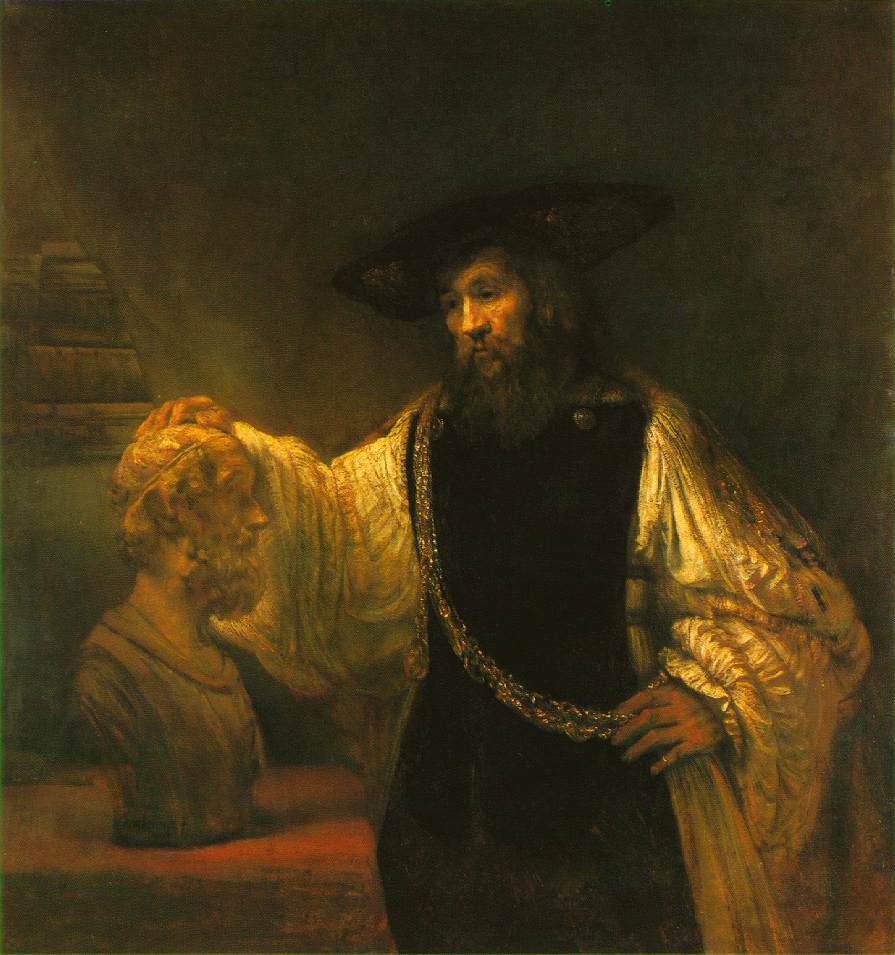
Here is a Guardian list, via CrookedTimber. It is not bad, but surely Giotto’s Padua murals (this panel is clearer) should be added, Rembrandt’s Anatomy Lesson of Dr. Tuyp is far better than his Aristotle Contemplating the Bust of Homer, and how about Thomas Eakins’s The Gross Clinic? I am not anti-Picasso but Guernica is in my view overrated. How about this one? El Greco’s Toledo picture is another contender.




Try this list too. Your thoughts?
