Category: Uncategorized
Assorted links
1. Marc Gunther’s blog on food, sustainability, economics, and related matters. It is analytical, not just the usual rhetoric on these topics.
2. Does Hayek’s welfare state lead to serfdom? And how to unfold a rhino (short video).
3. Summary of the No-sterity debate.
4. Have we been underestimating the extent of the growth of the middle class in developing nations?
It would be premature to use the words “free fall”
Nonetheless those are the words which come to mind, to me, in my safe Fairfax home, far from China and European bank jogs:
Chinese consumers of thermal coal and iron ore are asking traders to defer cargos and – in some cases – defaulting on their contracts, in the clearest sign yet of the impact of the country’s economic slowdown on the global raw materials markets.
The deferrals and defaults have only emerged in the last few days, traders said, and have contributed to a drop in iron ore and coal prices.
“We have some clients in China asking us this week to defer volumes,” said a senior executive with a global commodities trading house, who warned that consumers were cautious. “China is hand to mouth at the moment.”
A senior executive at another large trading house also confirmed there had been defaults and deferrals in both thermal coal and iron ore.
Here is more, and here is a bit more detail.
Assorted links
Assorted links
1. Is Sweden or England the paragon of “austerity”? Scott Sumner comments.
2. Has Australia been avoiding economic stagnation?
3. Criticisms of Aishwarya Rai.
4. Giant turtle dined on crocodiles.
6. Via Chris F. Masse, Peter Thiel in New Zealand.
Four underrated European masterworks
1. The Ravenna mosaics, most of all at St. Vitale.
2. Monreale, the Norman church outside of Palermo, Sicily.
3. Matthias Grünewald’s Isenheim altar, in Colmar, France.
4. Tiepolo’s paintings in the Residenz, in Wurzburg.
I much prefer any of those to the Mona Lisa, and to my prejudiced taste they are all among the very greatest of artistic masterpieces. They are all worthy of pilgrimages.
Assorted links
1. Romanian uh-oh.
2. The beloved FT Alphaville launches a Tumblr.
3. The new Brian Doherty book on Ron Paul.
4. James Crabtree worries about India and India facing stagflation. This whole matter is already looking worse.
5. The bank jog, a deadly picture.

Words of wisdom, from men of wisdom
Mauldin’s claim is that we are in what he calls the “endgame,” meaning that the Keynesian option of increasing government borrowing is no longer available to European countries. The only willing lenders are banks, which in turn need to be propped up, and ultimately they can only be propped up by printing money.
My take-away from Mauldin is that, contra the mainstream media narrative, the real dilemma in Europe is not fiscal–deciding whether to maintain government spending or not. The real dilemma is financial–whether to recognize losses and absorb defaults (by both governments and banks) or turn loose the monetary printing presses.
Creo que si. It is increasingly clear that Spain’s recent “austerity” has been forced, rather than a voluntarist mistake. Here is yet more wisdom from Scott Sumner:
… if I thought higher demand was needed, I’d recommend that the fiscal authorities raise their inflation target from 2% to 4%. Oddly, I’ve never seen a fiscal proponent make that recommendation. Why not? My hunch is that deep down they know that fiscal authorities can’t really control inflation. But in that case, how can they control aggregate demand?
Dollars, dollars, everywhere, and not a dollar to drink?
Is the shortage [sic] of dollars in China the real global financial ticking time bomb? This post, from Isabella at FT Alphaville, is essential reading. The world will not be safe again until FT Alphaville is neutered into irrelevance, unfortunately that won’t be anytime soon.
Assorted links
What is austerity?
Or should that read what is “austerity”?
The May 11 IHT has a headline “German line on austerity appears to soften,” and the article is about monetary policy and inflation targeting (I don’t see it on line). While monetary policy has ramifications for fiscal policy and output, I would not refer to tight money as “austerity,” in spite of the mood affiliation.
I googled “austerity define” and Wikipedia reports this:
In economics, austerity is a policy of deficit-cutting, lower spending, and a reduction in the amount of benefits and public services provided.
Notice that is mostly about spending, and notice the word “and.” I find this definition confusing, especially if one interprets the “and” strictly. Tax hikes are then mentioned:
Austerity policies are often used by governments to try to reduce their deficit spending while sometimes coupled with increases in taxes to pay back creditors to reduce debt.
That seems to make the “tax hikes” something other than “austerity policies.” The Macmillan on-line dictionary makes it all about spending and not about taxes at all.
A financial source in the top ten, Investopedia, reports this:
A state of reduced spending and increased frugality in the financial sector. Austerity measures generally refer to the measures taken by governments to reduce expenditures in an attempt to shrink their growing budget deficits.
That starts with spending, then shifts to the financial sector (?), and the second sentence shifts back to spending. That’s confusing too. How do higher taxes fit in? What are the baselines?
Krugman I do not think has offered a definition or measure of austerity (he spends more time doing a link-less attacking of others, including possibly myself, for claims about austerity which he does not document anyone making or they simply did not make), but he seems to think that automatic stabilizer-driven spending increases do not count as spending increases for the purpose of defining austerity. Neither does spending on bank bailouts count for him.
I could imagine a definition something like this: “the net effect of all government fiscal policies on ngdp, relative to the baseline of a stabilized path for expected ngdp growth.” Or should it read: “…relative to what will happen to ngdp growth in the absence of budgetary changes”? I wonder if some Keynesians have in mind the baseline of “the expansionary policies which I think would be appropriate,” in which case doing less than the Keynesian optimum is always a form of austerity. Angus notes correctly that clear definitions of austerity are hard to come by.
In Bucharest I cannot alas consult my library for further definitions.
In any case, austerity is a misleading and often misunderstood word. It is better if we describe policies more concretely, and in fact that is not hard to do. Furthermore, insisting on a clearer accounting should not be equated with “austerity denial.”
Assorted links
1. An old but still interesting Bertola and Drazen paper on fiscal policy (pdf): “We propose and solve an optimizing model which explains counterintuitive effects of fiscal policy in terms of expectations. If government spending follows an upward-trending stochastic process which the public believes may fall sharply when it reaches specific “target points,” then optimizing consumption behavior and simple budget constraint arithmetic imply a nonlinear relationship between private consumption and government spending. This theoretical relation is consistent with the experience of several countries.”
2. Should Greece default now or later?
3. Bahrain and Saudi Arabia to move toward a closer union.
4. 2005 me on the end of the euro; “It would be ironic if the strongest argument against the Euro was simply the eventual need to dissolve it.”
Assorted links
1. Via Chris F. Masse, how large is the Chinese art market really?
2. The economics of HBO, and conditioning on a collider.
3. Good analysis of Spanish debt restructuring; “Should there be some form of Spanish sovereign bond restructuring, the amounts required to recapitalize the banks would be astronomical.”
4. Is the multi-year, multi-volume biography dead?
5. Banana battles, and how is America’s helium crisis developing?
Assorted links
1. Via Robert Martinez, interview with Kevin Shields, on labor market hysteresis and other matters. Excerpt:
I’ve got my own studio, just down the road from here. And in the ten years I’ve had it, I’ve only used it in three of them. The other seven years it’s been empty. I feel quite sad about that.
But I made a few big promises to myself when I was a kid, about 17. And so far I’ve managed to keep them. I was discovering all this great music, and I kept noticing this pattern of bands making great records and then tailing off. I thought “I don’t want to ever do that.” If for some reason I can’t make a great record, I won’t make a record at all. Because all you get is a little bit of money, which goes really fast anyway. It’s easier to do nothing and live on nothing than it is to do something and live on something when you’re running around compromising.
It’s better to do nothing than to do bad work.
KS: I think so. It’s like, being on the dole is better than being in a shit job, so long as you’ve got an interest in your life. Because if you’re in a shit job you don’t really have that much more money, and then after a few years your will to live begins to dissipate. The idea that it’s good to do stuff just for the sake of doing it, it’s a myth, I think. It’s a lie. It’s a very 80s concept – everything, everything being about productivity.
My favorite things Romania
1. Schubert pianist: Radu Lupu.
2. Conductor: Sergiu Celibadache. A high variance obsessive, Amazon doesn’t seem to carry his important recordings. At his peak he is one of the best conductors ever and can force a total rethink of the music upon you. He demanded so much rehearsal time, and so much perfection, that he was often impossible to work with. There is a short YouTube bit here.
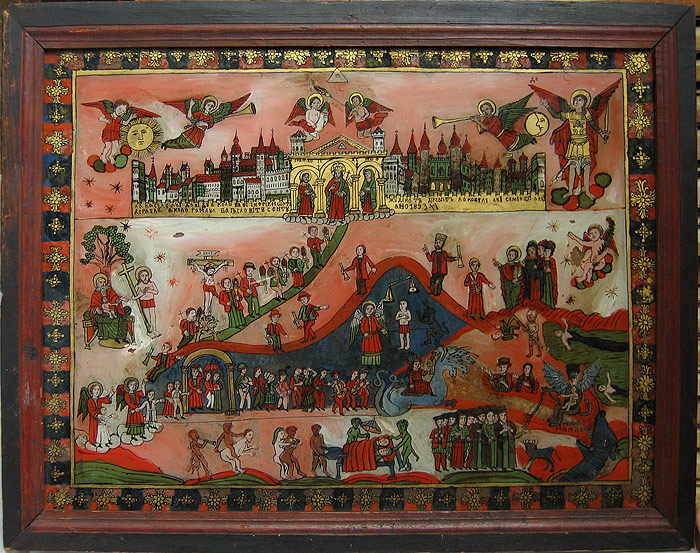
3. Painter: I can’t name one, sorry. I have seen some nice folk art icon paintings on glass, see the image at the bottom of this post.
4. Sculptor: Constantin Brâncuşi, with a preference for Bird in Space.
5. Chopin pianist: Dinu Lipatti, especially the Waltzes.
6. Producer of maxims: Emil Cioran. I have enjoyed all of his books.
7. Poet: Paul Celan. I am surprised he is not more widely read in the United States. At his peaks I don’t think any 20th century poet is better or more important.
8. Novelist: Herta Müller, better in German than English, both linguistically and culturally.
9. Violinist: Georges Enescu, of course he was a composer too.
10. Mozart pianist: Clara Haskil.
11. Movie: I’ve tried a bunch of the famous recent ones, but I can’t get through them and this is from a man who gladly watched the entire 7 hour, 12 minute Sátántangó .
12. Former NBA basketball center: G. Muresan.

13. Economist: Nicholas Georgescu-Roegen.
The bottom line: There is some real beauty here, and aesthetic romance, but I don’t have a good theory for why novels and painting are not stronger.