Category: Uncategorized
*The Occupy Handbook*
I have an essay in that book co-authored with Veronique de Rugy. Other contributors include Paul Krugman, Robin Wells, Michael Lewis, David Graeber, Peter Diamond, Emmanuel Saez, Ariel Dorfman, Barbara Ehrenreich, Jeff Sachs, and Nouriel Roubini, among others.
Our essay is an…outlier…in the volume. Here is one bit:
Wall Street has contributed to some very real problems, but the core issues for poor Americans are often health care, education, and the cost of renting an apartment of buying a house. The best way to improve living standards and increase options for future success is to move toward greater competition and accountability in each of those areas, areas that usually have little to do with the financial sector per se.
Our goal is to propose an alternative vision for what OWS should focus on. You can buy the book here.
Assorted links
2. Game show based on game theory (video).
3. Legal troubles at Great Wall, the Chinese supermarket featured in An Economist Gets Lunch.
Assorted links
1. I want to praise Robin Hanson, yet I also want him to become more trendy with the trendy people. Sometimes I think he already is trendy, yet he is certainly not shallow. What to do? Here is Robin’s CBA for uploads.
2. Will Disney manage to do away with lines?
3. The geographic flow of music: which cities lead in terms of listening habits? Oslo, for one, and Montreal, Atlanta for rap music.
4. Ask a Korean, on Korean food, from a self-proclaimed “Korean food Wahhabbist.”
Two tweets from Dani Rodrik
Josef Joffe is precisely wrong: Europe’s crisis IS about macroeconomics — not microeconomics: http://mobile.bloomberg.com/news/2012-04-16/germany-reformed-its-social-model-europe-can-too.html
I would say it is about the connection between microeconomics and macroeconomics. I understand full well that Sweden is doing fine (despite a very recent slowdown), but I do not get why so many Keynesian economists are so reluctant to condemn the legal and regulatory policies, and rent-seeking practices, of the eurozone periphery. Stronger nominal aggregate demand is called for but it cannot make everything there fine.
Unfortunately Argentina’s government has been giving unorthodox policy a bad name by associating thuggish behavior with it.
I would say this correlation is no accident, and that there are credibility reasons why many economically small countries are so reluctant to break with consensus approaches and international agreements. An Ireland trying to mimic Iceland would have had a very tough time of it, and it remains to be seen which country has the stronger long-run prospects. Moisés Naim put it well:
Argentina suffers from high inflation, slowing economic growth, ballooning subsidies, price controls, capital flight, decaying infrastructure and a less than welcoming environment for foreign investors.
Perhaps the good news is this:
It has had limited access to the international financial system since defaulting on its debts in 2001.
We should expect unorthodox approaches and thuggish behavior to be correlated, even if there is no causal connection between the two. If you then think of the choice variable as “political culture,” rather than “policy today,” that suggests unorthodox approaches are not nearly as good as they may seem upon first glance.
Assorted links
1. The decline of the New York Public Library?
2. Ungated Acemoglu paper on the future of the world and the rights revolution.
3. Elinor Ostrom makes Time’s 100 most influential list.
4. Class notes from a Peter Thiel lecture on business.
5. Arabic words to Bach’s religious music, a video, sung by Fadia el Hage.
Assorted links
1. The hug a Coca-Cola vending machine advertising campaign that is Singapore.
2. U. Michigan economics Ph.d student running for Congress, web site here.
3. Annie Lowrey profile of Piketty and Saez, and here is a list of French economists supporting Hollande, Piketty is on the list, via CFM.
5. Via Chris F. Masse, “The revolutionary calculator that shows the answer only when you also enter a suitable mental estimate.”
Assorted links
1. Carrying costs > liquidity premium, German dead body edition. Raise the price of a donation, I say.
2. Liquidity premium > carrying costs, German live body edition, disintermediation; “He meets 10 to 15 women a month.” Recommended, I read it twice.
3. Jeff Sachs toys with the idea of a three-child limit for Nigeria (for fathers? mothers? probably de facto just the latter, then won’t it boost polygamy?). In any case it would be a huge tax on rural Nigerians and it is a very bad idea, not to mention a massive violation of personal liberty. Wouldn’t a more right-wing thinker have encountered a firestorm for a similar proposal? (Addendum: a related set of links and commentary from Chris Blattman.)
5. Me in El Diario, on El Paso and Ciudad Juárez, sister cities of a sort, a wonderful near-controlled experiment on how the law influences our food (in Spanish).
Why is U.S. higher education so dominant? And why is Harvard #1?
Shailendra Raj Mehta reports:
The key innovation was alumni control of the Board of Trustees. This is what made possible several desiderata on the Rosovsky (1991) and (Aghion, Dewatripont et al. 2007) lists in the first place. This is what simultaneously allowed autonomy, continuity of purpose, large endowments and the ability to weather turbulence. The role of alumni trustees has not been fully examined so far. Now, to be sure, Rosovsky does talk about the role of independent trustees. Certainly it is true that in one sense the trustees of US schools are often truly independent in that they provide a buffer against interference from the political and other domains. Further, they are usually able to take a view of the institution independent of the interests of the faculty. But, in fact, the trustees are not independent or uninterested observers at all. This is on account of the fact that the Board of Trustees, at least in the top US schools, consists primarily of alumni, the group which has the highest permanent stake in the reputation of the university.
…Therefore, whichever measure of school quality that we use – rank, school selectivity or endowment, we find that same result – the greater the degree of alumni control, the higher the quality of the school.
…so why is Harvard #1? This question, then becomes easy to answer. Except for a few brief years in its early days and a decade in the middle, for almost its entire existence, a period of nearly 400 years, Harvard has been controlled by its alumni.
The paper is here (pdf), interesting throughout.
Assorted links
Assorted links

Robert Mundell’s tips on how to accept a Nobel Prize
Assorted links
Six Rules for Dining Out
The Atlantic Monthly feature article from An Economist Gets Lunch is now on-line, excerpt:
When you enter a restaurant, you don’t want to see expressions of disgust on the diners’ faces, but you do want to see a certain seriousness of purpose. Pull out a mirror and try eating some really good food. How much are you smiling? Not as much as you might think. A small aside: in many restaurants, it is a propitious omen when the diners are screaming at each other. It’s a sign they are regular customers and feel at home. Many Chinese restaurants are full of screaming Chinese patrons. Don’t ask me if they’re fighting, I have no idea—but it is a sign that I want to be there too.
And:
If you’re asking Google, put a “smart” word into your search query. Best restaurants Washington will yield too much information, and will serve up a lot of bad restaurants, too. That’s a lowest-common-denominator search query. Google something more specific instead, like best Indian restaurants Washington, even if you don’t want Indian food. You’ll get to more reliable, more finely grained, and better-informed sources about food, and you can then peruse those sources for their non-Indian recommendations. Google Washington best cauliflower dish, even if you don’t want cauliflower. Get away from Google-for-the-masses.
Here is a good video bit of me exploring a new Vietnamese restaurant in Eden Center.
You can pre-order the book on Amazon here. For Barnes & Noble here. For Indiebound.org here.
Assorted links
1. World’s first commercial 3-D chocolate printer, story here, beware noisy video at that link.
2. Cardboard arcade made by a nine-year-old boy, hat tip to Karina and Chad.
3. Tightening antibiotic use for livestock; let’s hope it works, a partial but not complete Coasian trade says it won’t, in a pinch farmers will buy vets. More here.
Publication day for *An Economist Gets Lunch*
Adam Ozimek writes:
Cowen’s history of how American food came to be so mediocre is a strong counterargument to those who look to blame the phenomenon on commercialization, capitalism, and excess of choice. In contrast to the usual narrative, Cowen tells us how bad laws have played an important role in shaping our food ecosystem for the worse over time. This includes prohibition’s negative and long lasting impact on restaurants, and the government aggressively limiting one of our greatest sources of culinary innovation: immigration. This is not to lay the blame entirely on the government. Television and a culture that panders to the desires of children have also incentivized poor culinary trends.
The book contains many other other important arguments against popular food ideas, including defenses of technology and agriculture commercialization against critiques of locavores, slow foodies, and environmentalists. For example, if you live in an area where it takes a lot of energy and resources to grow food — like the desert — the most environmentally friendly way may be to grow it somewhere else and ship it. An apple grown locally may be refrigerated for months, which consumes a lot of energy, whereas it may be both fresher and better for the environment to grow it elsewhere and ship it in from afar by boat. He also defends genetically modified crops as the likely cures to the biggest food problem we have today, which is not obesity but malnutrition.
But Cowen is not an apologist, and he doesn’t argue that we can just deregulate our way to a better food system. In fact he has many words of support for policies and values often supported by progressives.
…If there is one overarching lesson it is that looking at food through the framework of supply and demand can help you both understand our food system better, and also help you be a smarter consumer and get more out of every meal.
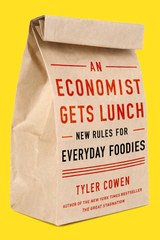
You can pre-order the book on Amazon here. For Barnes & Noble here. For Indiebound.org here.