*The Map and the Territory*
That is the new Michel Houellebecq book, available from UK Amazon, out January in the US. It is worth the shipping costs. Yet, while waiting for it to arrive, I saw a copy on sale in Rome, above a PPP price. In my desire to read it sooner rather than later I bought it, that was worth it too. It’s worth both prices put together, and then some, at pretty much any dollar/euro exchange rate or any dollar/pound sterling exchange rate, you can imagine.
I was relieved to see that Houllebecq understands the connection between his ideas and those of Charles Fourier (an underrated thinker).
Libraries destroy books carrying costs exceed liquidity premia no free disposal edition
The first and most obvious objection is, why not give the books to the poor? They need stuff to read. Or to prisoners? Or to sick kids? Or to struggling independent booksellers? It doesn’t cost a thing to give something away, right?
The problem is the situation for a library is more complicated than when you just take a bunch of old clothes and unwanted porn down to the Salvation Army. A library book is stamped and bugged and cataloged so that the library knows that it belongs to them. When a book is given away or sold, the library has to go through and remove all that crap, so whoever winds up with it can prove they didn’t just steal it off the shelf. I’m not kidding about that, either — some people who wind up with such books helpfully return them to the library.
And we’re talking about a lot of books here — these libraries are having to cut down their stock in a hurry. Imagine you’re the manager of a library, and some accountant tells you that you need to get rid of 100,000 books, and do it in a week. You really have two options. One, you can get a bunch of academics to scour your collection and painstakingly rate each book according to its value and importance. Then you can hire a bunch of people to take down the 100,000 least important books and painstakingly stamp and debug them, one by one. Your second option is to get the computer to spit out a list of the 100,000 least borrowed books, and hire a few people to walk down the aisles with their arms out, throwing those books in a shredding machine.
That second option is much quicker and much cheaper. Sometimes you can find a paper recycling centre that will pay you for the pulp, so destroying the books leads to a net profit. Nobody likes it, but for a librarian it’s like your best friend just got bitten by a zombie and you’re the only one with a gun.
Also, remember that the stuff worth saving is buried among a lot of other books that are basically garbage. Though everyone realizes that extremely valuable books are going to inevitably get caught in the same net, there’s not much that can be done about it. Nobody is going to order a first-edition Moby-Dick from a library warehouse if the 2011 reprint is sitting right there on the shelf. A computer list that ranks books by popularity can’t tell the difference.
Another downside to this option is that you have to ensure total destruction. You can’t just throw the books in a Dumpster for some asshole to come along and grab later. If you go the Dumpster option, you have to tear out chapters so that people won’t want them, or just fill the Dumpster with detergent. You don’t want people to get in the habit of treating your Dumpster like the clearance rack — it’s dangerous and messy for everyone involved.
Assorted links
1. Via Chris F. Masse, a weird house.
2. What the silent bank run looks like.
3. David Rothschild on why Hermann Cain has it tough.
4. What exactly is the health care productivity problem?
5. “My date with Keynes” (video, but is it Straussian?)
The George Soros plan to save the eurozone
Let’s have the banks and the governments shore up each other:
I am afraid that the leaders are contemplating some inappropriate steps. They are talking about recapitalising the banking system, rather than guaranteeing it.
A fair enough point, but where will the money come from to do that?
In exchange for a guarantee, the major banks would have to agree to abide by the instructions of the ECB. This is a radical step but necessary under the circumstances. Acting at the behest of the member states, the central bank has sufficient powers of persuasion. It could close its discount window to, and the governments could seize, the banks that refuse to co-operate.
The ECB would then instruct the banks to maintain their credit lines and loan portfolios while strictly monitoring the risks they take for their own account. This would remove one of the main driving forces of the current market turmoil.
The other driving force – the lack of financing for sovereign debt – could be dealt with by the ECB lowering its discount rate and encouraging countries in difficulties to issue treasury bills and prompting the banks to subscribe.
Um…if it all is a liquidity crisis, this might work, public choice problems aside. Otherwise it is calling for possibly insolvent banks to prop up not only the real economy but the governments too, which in turn will guarantee the banks, which by the way now have to keep on making bad loans.
The Negative Externality of Voting
Here is Jason Brennan:
How other people vote is my business. After all, they make it my business. Electoral decisions are imposed upon all through force, that is, through violence and threats of violence. When it comes to politics, we are not free to walk away from bad decisions. Voters impose externalities upon others.
We would never say to everyone, “Who cares if you know anything about surgery or medicine? The important thing is that you make your cut.” Yet for some reason, we do say, “It doesn’t matter if you know much about politics. The important thing is to vote.” In both cases, incompetent decision-making can hurt innocent people.
Commonsense morality tells us to treat the two cases differently. Commonsense morality is wrong.
…In The Ethics of Voting, I argue that…voters should vote on the basis of sound evidence. They must put in heavy work to make sure their reasons for voting as they do are morally and epistemically justified. In general, they must vote for the common good rather than for narrow self-interest. Citizens who are unwilling or unable to put in the hard work of becoming good voters should not vote at all. They should stay home on election day rather than pollute the polls with their bad votes.
Aggregate job creation and destruction (quarterly), or is creative destruction slowing down?
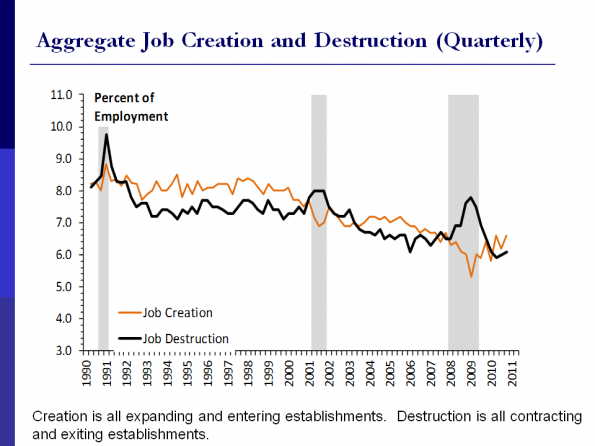
Is the U.S. labor market becoming less dynamic? Here is much more (hat tip to Mark Thoma, but from John Haltiwanger, paper here, slides here), and an excerpt from the FT:
Yet there’s obviously a meaningful secular story as well, but it’s more complicated and, indeed, remains something of a mystery, as Haltiwanger can only posit a few educated guesses.
Among them are the increasing share of US employment moving to businesses six years or older; the shift to large-scale retail chains; the aging of the US labour force (and therefore less willingness to experiment); declining job creation rates for startups; economic uncertainty; policy uncertainty.
Has the Keynesian IS-LM model made good predictions lately?
I’ll skip context and links and cut right to the chase. Reinhart-Rogoff and nominal gdp perspectives and TGS views also have been predicting a slow recovery, so while IS-LM has done OK here it wins no special prizes.
What about the “no crowding out” prediction? Since at least the early to mid 1980s, it has been well-known in macroeconomics that U.S. budget deficits do not forecast real interest rates very well and that includes under periods of full or near-full employment. Here is a brief survey by Alan Reynolds on the topic (you can follow up on his references), and he is usually considered a villain by the Keynesians and so he is hardly a Keynesian himself.
There may be a few reasons for the general lack of a connection between deficits and real interest rates in the United States:
1. The supply of capital to the United States is fairly elastic, either domestically or internationally.
2. We don’t have good identifying restrictions on the empirics in the first place. For one thing, controlling for monetary policy is tricky.
3. We haven’t yet seen budget deficits big enough to matter.
4. We are not measuring budget deficits correctly because what matters is the consolidated fiscal stance of the U.S. government, a’la Robert Eisner.
5. Ideas related to Barro’s Ricardian Equivalence hypothesis.
Anyone — Keynesian or otherwise — paying attention to the last thirty years of empirical macro never expected much crowding out of financial capital in the first place. It simply has not been in the cards.
To put it more bluntly, the “no crowding out” result is not much of a predictive victory for Keynesian economics, IS-LM, the liquidity trap, and so on, even though I have read it claimed as such many times. It is a strike against some predictors who were wrong in the first place, especially in the right-wing popular press circa 2009-2010, plus some Republicans who jumped ship on the issue, perhaps because they wanted to attack Obama.
What’s a unique prediction we might look at? It is a common Old Keynesian claim these days, at least from Krugman, that the AD curve is upward-sloping because of a liquidity trap. That would imply that harsh and binding minimum wage hikes, and other wage-propping mechanisms, should prove expansionary. That claim, at least for the Great Depression, has been knocked down fairly conclusively by Scott Sumner. If there is no comparable test on today’s data, it is because we have grown that much wiser.
Martin Feldstein’s mortgage adjustment plan
To halt the fall in house prices, the government should reduce mortgage principal when it exceeds 110 percent of the home value. About 11 million of the nearly 15 million homes that are “underwater” are in this category. If everyone eligible participated, the one-time cost would be under $350 billion. Here’s how such a policy might work:
If the bank or other mortgage holder agrees, the value of the mortgage would be reduced to 110 percent of the home value, with the government absorbing half of the cost of the reduction and the bank absorbing the other half. For the millions of underwater mortgages that are held by Fannie Mae and Freddie Mac, the government would just be paying itself. And in exchange for this reduction in principal, the borrower would have to accept that the new mortgage had full recourse — in other words, the government could go after the borrower’s other assets if he defaulted on the home. This would all be voluntary.
Here is more.
Assorted links
1. Why don’t we hire more servants?
2. Michael Lind’s critique of libertarianism.
3. The role of Kevin Murphy in the NBA negotiations.
4. Long profile of Nouriel Roubini and his firm.
5. Stephen Smith, market-based urbanist, now blogging at Forbes.
A test of Siri
View it here, this will be a big deal. I have been stunned to hear people claim that the new iPhone 4S has no significant advance over the old. Here is one article on Siri.
Siri will get better. Just ask Siri.
IS-LM Keynesianism, why not and which alternatives?
I am sad that the IS-LM debate devolved into IS-LM vs. close substitutes, because I meant to raise a broader set of objections to one particular kind of technocratic curve-shifting as the foundation for macroeconomic thought. Let me list a few alternative starting points for macroeconomics:
1. Public choice economics (still the most underrated, in today’s profession)
2. Growth theory (as distinct from the view that all business cycles are simply fluctuations in the rate of growth)
3. The New Institutional Economics of property rights and incentives
4. Financial asset pricing theory (as distinct from the view that financial markets are always efficient)
To see what this all means, let’s consider the euro crisis. I start with #4, financial asset pricing theory, and consider whether, if “euros in Greek banks” and “euros in German banks” are fundamentally different assets, perhaps they should have different prices. If prices cannot adjust, quantities will.
An IS-LM approach will focus on flows and be distracted — incorrectly — by claims that Ireland, Spain, etc. were not in bad fiscal positions before the crisis hit. That’s wrong, they were writing intolerable naked puts all along.
A macro approach should then move to public choice theory and interpret the governance of the EU and ECB and the coalitions in the various European governments. It wasn’t (for the most part) deliberately set up so that politicians could play short-run fiscal games, but that is in fact why a lot of politicians supported the eurozone. Cheap borrowing brought a big party, but it was a ticking time bomb from the beginning, as recognized by Milton Friedman and others. Based on Buchanan and Tullock (Calculus of Consent), the analysis can move forward with some understanding of why its governance is unworkable in a crisis, and with an understanding of why the Germans originally insisted on such a governance scheme at all. I also wouldn’t mind a citation to Hayek and his critique of French rationalist constructivism, you won’t find that in the IS-LM model either.
We can put all that together, combined with a theory of bank runs, and then we see there will be strong and perhaps intolerable deflationary pressures. Maybe one could use IS-LM for this part of the modeling, but I’ll stick with the kind of ideas you find in Irving Fisher or Scott Sumner. They are simpler and retain the core point that deflationary pressure can be very bad. As Scott notes, the sort of interest rate issues raised by IS-LM are more of a distraction than anything, at this point for this problem. And no, the eurozone for the most part has not been in a liquidity trap. Nonetheless aggregate demand really does matter in this setting.
One often reads that Italy is the linchpin of the euro crisis. To understand Italy we should look to growth theory, the new Institutional Economics, the theory of corruption, theories of political gridlock, and related ideas. Toss in Edward Banfield. Italy’s growth problems predate the immediate mess in the eurozone and they are not plausibly pinned on deflationary forces; the country hasn’t grown much in a decade. IS-LM is absolutely silent here, but if Italy were growing at two percent a year probably the whole mess would be manageable. Demographics matter too, and if this is a messier version of economics sign me up.
The idea that Ireland is seeing a partial recovery, piled on top of some deep structural problems in its domestic sectors, flows more naturally from institutions-based approaches than from IS-LM.
The all-important interplay between monetary and fiscal policy, critical for understanding this crisis, is forced out of the box by IS-LM.
For the final denouement, if indeed it arrives, there is Minsky and the theory of speculative attacks. Keynes in his chapter 12 of the GT had a good understanding of how expectations can switch so suddenly, a key factor at several stages of the euro crisis.
There is more, but you get the point. IS-LM should not be foundational for an analysis of this problem, IS-LM is not necessary, and arguably it is better not to invoke the model at all. And if I had to give undergraduates only one point on one part of the blackboard, I would use the comparison between Greek and German banks.
IS-LM leads one to the mistaken attitude that macro is fundamentally simple, and that all would be well if only people and politicians understood the need to “get tough” with expansionary policy rather than austerity. It’s a lot more complicated than that, yet we can understand these complications by building up from some fairly simple and intuitive models. It’s a better approach to use public choice incentives to understand why the current situation is unworkable, rather than preaching about why the flows should be different than they are. When I hear so much preaching, I tend to think the preacher is using a model with a missing variable or two.
Here is a good post from Philip Levy on why macro is hard, and how that relates to the recent Nobel Prizes.
Soon I’ll turn my attention to whether IS-LM Keynesianism has been making uniquely good predictions during this crisis.
Markets in a Few Things
NYTimes: “The Rason government will do our best to provide favorable conditions for investment,” said Hwang Chol-nam, the vice mayor in charge of economic development. “Please tell the world.”
A common refrain from a mayor, unremarkable, except for the fact that Rason is in North Korea.
North Korean leaders are slowly opening their isolated nation to foreign investment.
A thrust of their strategy is to develop previously created “free trade and economic zones” on the borders that have languished. Here, about 30 miles from China, the combined towns of Rajin and Sonbong, called Rason, are central to the new push.
…“The policy environment has been improving continuously,” said Zheng Zhexi, 58, the company’s vice president. “It’s moving towards a market economy.”
He pointed to the official tolerance for the bazaar, where merchants rent stalls from the government to sell goods that they buy from Chinese traders. Prices fluctuate and shoppers haggle. The bazaar has proved so successful that it is expanding to six times the current size.
An interesting experiment that one hopes will expand. Don’t expect too much, however, consider this rather amazing survey of Chinese business people and what they say North Korea needs.
The Peterson Institute for International Economics, based in Washington, recently published conclusions from a 2007 survey of 250 Chinese companies doing business in North Korea. The authors found that while nearly 90 percent were profitable, the companies “generally have a negative assessment of the business environment” for reasons like poor infrastructure and lack of rule of law.
Amish mob violence
An Amish mob is accused of breaking into several homes and cutting off the beards and hair of other Amish men.
Now, the group is the focus of four police investigations in Ohio.
Police say the assaults are the work of members of the “Bergholz Clan.”
In one attack, the men allegedly packed a horse-drawn buggy, rode to a home and cut the hair off some men and women in the house.
The violent haircuts are meant to humiliate and punish those Amish who are supposedly weak in the faith.
The link is here, hat tip goes to Yana.
*Thinking, Fast and Slow*, by Daniel Kahneman
It is a very good book, clearly written, engaging yet sober, substantive in every chapter, and it does not oversell its material. If you are familiar with the underlying papers you will not see much new here, but as a readable introduction to the work of Kahneman (and Tversky) I give it an A or A+.
It is evident throughout that the author is a psychologist and not an economist; your mileage may vary, but you will not find a response to John List in here. Here is a bit about those unreliable judges, this time in Germany rather than Israel:
The power of random anchors has been demonstrated in some unsettling ways. German judges with an average of more than fifteen years of experience on the bench first read a description of a woman who had been caught shoplifting, then rolled a pair of dice that were loaded so every roll resulted in either a 3 or a 9. As soon as the dice came to a stop, the judges were asked whether they would sentence the woman to a term in prison greater or lesser, in months, than the number showing on the dice. Finally, the judges were instructed to specify the exact prison sentence they would give to the shoplifter. On average, those who had rolled a 9 said they would sentence her to 8 months; those who rolled a 3 said they would sentence here to 5 months; the anchoring effect was 50%.
You can pre-order the book here; it is due out October 25th.
Italy fact of the day
Italy’s guarantees make up 18 per cent of the [EFSF] system.
That’s Italy as guarantee source, not Italy as recipient! The bottom line is this:
If you double or treble the size of the EFSF without changing its underlying structure,all you do is double or treble the lack of credibility. If you really want to increase the size of the EFSF without destroying it, then you are left with two options: you have to back it through an unlimited guarantee by the ECB, the only organ in the eurozone that is in a position to give such a commitment. Or you have to change the EFSF’s legal status through the adoption of joint and several liability. This means that member states jointly agree everybody’s debt. The two options ultimately mean the same. The liabilities of the system will be shared jointly by all of its participants. If you want to annoy certain people, you could also call the latter a eurobond.
The article, by Wolfgang Münchau, is excellent throughout.