Capitalist Kibbutz or from Marx to Rawls
The Israeli kibbutzim are surprisingly successful examples of voluntary socialism. Even today about 2% of the Israeli population lives on a kibbutz and they account for a significant share of output; about 4% overall (using data from 2004 from here and here) and much higher in some industries such as agriculture where the kibbutzim account for some 40% of Israeli output.
Nevertheless, the kibbutzim aren’t growing and, under economic and social pressure, many are privatizing in various ways. Most notably, beginning in 1998 many kibbutzim lowered the marginal tax rate from 100% (!) to about the same level as in the rest of Israel, 20-50%. The reduction in taxes meant that for the first time there were large wage differences for members of a kibbutz and, most importantly, there were large potential wage differences for those who increased their productivity.
In How Responsive is Investment in Schooling to Changes in Redistribution Policies and in Returns (free here) Ran Abramitzky and Victor Lavy look at the acquisition of human capital for high school students living on kibbutzim before and after the reduction in taxes (using a dif and dif strategy on early and late adopters). The authors find (from an NBER summary):
…The effects of the reforms were relatively small for students from highly educated families, in contrast to relatively large effects for students from families with lower parental education who had been covered by the pay reform for all of their years in high school. This group’s high school completion rates increased by 4.4 percent, their mean exam score went up by 8.3 points, their qualification rate for the Bagrut diploma increased by 19.6 percent, and the fraction of students with university qualifying scores increased by 16.8 percent….boys were most strongly influenced by the change.
The pay reform produced larger increases in educational outcomes than monetary bonuses for Bagrut diploma qualifying scores, a school choice program that allowed students to choose their high school in seventh grade, or a teacher bonus program that paid teachers of math, English, and Hebrew bonuses when their students did well on the Bagrut.
The authors argue that there are general lessons to be learnt:
Our findings have important implications beyond the Israeli context. First, they shed light on the educational responses that could result from a decrease in the income tax rate, thus are informative on the long-run labor supply responses to tax changes. Second, they shed light on the educational responses expected when the return to education increases. For example, such changes might be occurring in many countries as technology-oriented growth increases the return to skills.
I am less confident that the numerical results can be generalized, although of course the general point that incentives matter is well-taken.
The results, however, raise another issue. The original kibbutz were inspired by a combination of Marxism, socialism and Zionism. In the capitalist kibbutz, there is an opportunity for a new principle. Taxes can be set not according to Marx but according to Rawls and his second principle of justice: inequalities are to be allowed so long as they benefit the least-advantaged members of the society/kibbutz.
Thus, it would be interesting to know if any of the kibbutz have tried to adjust taxes so as to implement a Rawlsian approach to inequality (if not, perhaps Israeli taxes are already above Rawlsian levels.)
Assorted links
1. World power swings back to America.
2. Straussian claims about Plato, more here.
3. The Ken Jennings Watson talk, at the Singularity Summit, I enjoyed this very much.
4. The culture that is Fairfax.
Markets in everything, Hallmark card for job loss
It does not mention the ZMP idea, so perhaps Mark Thoma’s blog has had more influence at Hallmark: the cover states “Life Isn’t Fair” and the inside reads:
You didn’t cause this.
You don’t deserve this.
You simply have to get through it.
And I know you will,
Because I know you!
For the pointer I thank Jerry Brito.
Somebody’s culture, I am not sure whose
Last week, restaurant in Edinburgh, Scotland, held a competition to eat the extra-hot Kismot Killer curry. Some of the competitive eaters were left writhing on the floor in agony, vomiting and fainting.
According to reports, two British Red Cross workers overseeing the event at the Kismot Indian restaurant in Edinburgh but became overwhelmed by the number of casualties and ambulances were called. Half of the 20 people who took part in the challenge dropped out after witnessing the first diners vomiting, collapsing, sweating and panting.
It turns out that eating a few pounds of the stuff probably can kill you; hat tip goes to Steve Silberman.
Where to eat in Naples
1. Friggitoria-Pizzeria Giuliano, Calata Trinia Maggiore 33, open at 7 a.m. or so, one of the best pizzas I’ve had, and for only four euros.
2. Mandara, Via Ponte di Tappia 90-92, doesn’t look like much, more of a deli than restaurant, order at the counter and mimic the choices of others. Go before the line heads out the door.
3. Il Piccolo Ristoro, Calata Porto di Massa, inside the port, not really on a street, the cabbies seem to know where it is, only a few tables, one of the best seafood meals I’ve had. Not outrageously expensive.
Recently I had two and a half days in Naples, following a meeting in Rome, and it is one of my favorite cities. To live in, it combines the worst of Europe and the developing world…to visit, it combines the best of Europe and the developing world.
Why is Italy doing so much worse these days?
Here is the graph from yesterday. So why has Italy done so much worse? During 1950-1990 or so it was a stellar growth performer, though some of this was catch-up growth from wartime destruction. It does not satisfy me to cite Italy’s corrupt and dysfunctional political culture, since that has been the case for a long time, maybe forever.
A good introduction to the bright side of Italy’s economy is Michael Porter’s 1998 The Competitive Advantage of Nations; Porter portrays Italy as having some vital clusters of family-owned businesses, largely in the North. Do you want your kitchen redone with some nice marble tile? Italy can supply just the right stuff. This neat graph shows just how much Italy has specialized in small business.
Perhaps therein lies the problem. With the advent of modern communications and information technologies, arguably the return to “small family firms” has fallen. The return to “largish projects consummated over large distances” has gone up. For Europe, the big winners here are the Nordic countries, which have worked very effectively with information technology and which do not rely so much on family ties to get efficient, non-corrupt management. The losers are Italy and Greece and Portugal too; read this superb paper on how Portugal is cursed by being stuck with all these small firms, inefficiently small for legal and regulatory reasons. These countries seem to be locked out from some of the major sources of contemporary economic growth.
Here is a very important and insufficiently appreciated sentence from the Portugal paper: “…the largest part of the productivity gap between developed and developing countries can be attributed to the inefficient allocation of resources across firms in the latter countries.” And alas Italy stands with one foot in the underdeveloped world; I am reminded of Yana’s excellent sentence, voiced upon visiting Sicily for the first time: “This reminds me of Mexico (pause) — except it’s not as nice!” (Fear not people, she loved Sicily, as do I.)
And those are the countries with the biggest problems in the eurozone. Ireland is closer to the Nordic model, as they do lots of software and hardware with MNCs, and you can see them recovering from this mess more quickly. AD matters, but real shocks and competitiveness matter too. Negative real shocks don’t have to involve “forgetting how make ice cubes.” Ex ante, countries specialize in production methods and networks, and the subsequent evolution of technology does not always bear out their choices as wise.
Viewed in these terms, it is hard to see policy changes bringing a quick Italian recovery. Italy remains good at what it long has been good at, and you can think of their superb restaurants as further and highly visible examples of small, family-run firms. Sadly for them, those efficiencies are not worth quite as much these days.
Addendum: Here is one extensive look at Italy’s growth slowdown in the 1990s.
What I’ve been reading, not reading, or is in my pile
1. Eyes of God, a novel by Philip Babcock, economist at UC Santa Barbara. It is about intrigue and Indonesia.
2. By page 200 I got bored of the new Eugenides novel. The Barbarian Nurseries reaps high praise and is well-written but it feels too ordinary for me.
3. Ladies of Liberty: Women Who Made a Difference in American History, by John Blundell. Biographical sketches of libertarian and libertarian-themed women in U.S. history. Includes Rose Wilder Lane, Isabel Patterson, Rose Friedman, Jane Jacobs, others.
4. Michael Nielsen, Reinventing Discovery: The New Era of Networked Science. The best book on the potential for open, networked science, looking forward. Joshua Gans on the book here and here, the latter having a link to Michael’s TEDx talk.
5. Robert Trivers, The Folly of Fools: The Logic of Self-Deceit and Self-Deception in Human Life. Brilliant, insightful, with occasional lapses of taste, quintessential Trivers, now the go-to book on its topic, recommended.
100 Degree Chinese Cuisine
There is now a real Hunan restaurant in Fairfax, near Fair Oaks Mall, menu here, their web site is here, 3903 Fair Ridge Drive, Unit H, in the mall with the Harris Teeter. It attracts an almost exclusively Chinese clientele and, to my untrained eye, some of them seem to be the Uighur group which hangs out in Fairfax but does not (yet?) have a restaurant of its own.
This place is not cooking at the exalted level of Sichuan Pavilion in Rockville, but it is competitive with the other semi-authentic Chinese places in this region. I sampled five dishes and all were very good. I have yet to figure out the optimal dishes to order but I may post more when I do so. Recommended to anyone with an interest in real Chinese food.
Italy’s growth disaster
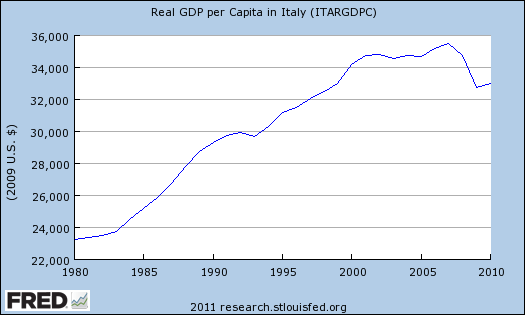
Hat tip goes to Matt Yglesias. At the risk of sounding like a broken record player, we are not sufficiently thinking through what it means for an advanced society to have basically zero net economic growth for a ten to twenty year period. It’s very possible, and this is (more or less) the same Italy that was praised in the 1980s for its dynamism and which overtook the UK in terms of per capita income, at least for a while.
*Creating Wine: The Emergence of a World Industry, 1840-1914*
That is the new book by James Simpson, home page here, with free chapter one. Excerpt:
In Britain, taxes on all types of alcohol contributed 36 percent of national revenue in 1898-99, but they were also 19 percent in France (1898), 18 percent in Germany (1897-98), and 28 percent in the United States (1897-98).
Anyone interested in the economic history of wine and drink should read this book; you may already know John Nye’s War, Wine, and Taxes.
Assorted links
1. Dinosaur origami.
2. Concordance of Murakami reviews, Laura Miller here. You may recall I read a chunk of the book last year and quite liked it, I will resume with it when my copy arrives Tuesday.
3. My TGS talk at the Singularity Summit, some summaries and other talks here.
4. Disaggregating the PIIGS, it’s about competitiveness.
5. Markets in everything: “the Shalit shirt.”
6. Elyn Saks update.
How to exit the eurozone, or Lord Wolfson, how about fifty quid for a blog post?
There is no easy way out of the eurozone, as Tim Harford explains with eloquence and good humor. But here is my best guess at Wolfson’s query:
1. Issue a surprise announcement that all euro deposits in Ruritania will be converted into pesos (or whatever) at a new and lower yet defensible rate. If I try to withdraw my ten euros from my bank, I receive an IOU for ten pesos which is worth say six euros. Over time the government will replace these IOUs with a new paper currency.
2. Let physical currency euros leave the country, and stress they will be honored, in any case they are not easy to confiscate or convert. And a country may need them as a partial money during the transition. Not trying to confiscate them will mean that a lot of the euro currency stays. There will be a dual currency regime for some time to come, but the medium of account will become pesos not euros.
3. If you borrowed money denominated in euros, from a Swiss or German bank, that is between you and them. Obviously a lot of borrowers will be in partial or total default, given the whack to their bank accounts. Let the northern nations bail out their banks, they won’t send tanks to extract the funds from good ‘ol Ruritania. Who knows, the rest of the eurozone might be prompted to set up a sensible bank resolution mechanism — working through the ECB of course — though don’t count on it.
4. The assets of Ruritania banks, namely loans to Ruritania citizens, will be redenominated to pesos. Labor and rental contracts will be redenominated too.
5. Nationalize parts of the banking system if need be, so much the better if you can pass on this one. If the bank is essentially empty, that is a deflationary shock. Have the government take over the bank and fill it with new printed money to restore deposits and counter the deflationary shock. If the country cannot trust its nationalizers, they should just print up more pesos and nail them to the bank balance sheets, risking the resulting corruption and drain of funds.
Are we on track so far? The consumption of imports will fall I believe.
6. What about default? If your country is running a primary surplus (Italy yes, Greece no), partially default on your debt but make strict promises to resume payments ASAP. Capture some wealth from the foreign banks and start the game all over again. Without a significant primary surplus, the (temporary?) cessation of foreign borrowing would mean that the country has to cut government spending further. Make a political judgment here but consider not defaulting; default may be unavoidable for Greece in particular but you can’t blame my plan for how deep in the hole they are.
Let’s sum up which problems have been addressed and which not. The domestic banking system is saved, at least provided the new conversion rate is credible enough that no one expects a repeat of the depreciation. It’s key to make that first announcement a real surprise, good luck! A negative wealth shock will come anyway and my plan has accelerated the arrival of that shock; the best one can do is to combine it with monetary expansion and the positive export shock from devaluation. To fix the external banks, the wealthier countries will need to exercise and perhaps improve their LOLR powers, but that is the case under any plan, not just this one.
Admittedly this plan makes the wealth loss in Ruritania quite transparent, which may be politically unpopular, but that transparency eases the economics of the transition.
Voila! Rinse and repeat as necessary. A lot of this would be eased by high inflation from the eurozone itself but a) that would involve collateral costs on the healthier economies, and b) in any case it doesn’t look like it will happen. I’m sticking with what a small country can do on its own.
No need to write in the comments section that this is “illegal.” Breaking the three percent deficit rule, as France and Germany did, was illegal too. Ruritania will not be hauled before a court of law and I also predict Ruritania will not be ejected from EU per se. Maybe their agricultural subsidies will be cut, let them eat floating exchange rates I say.
Self-recommending eBook
Race Against The Machine: How the Digital Revolution is Accelerating Innovation, Driving Productivity, and Irreversibly Transforming Employment and the Economy, by Erik Brynjolfsson and Andrew McAfeee.
There is a partial summary of the book here, I ordered my copy last night. Here are the authors on the book.
Markets in everything the culture that is Japan
Meanwhile, in Japan, a new fashion has women paying to have their straight teeth purposefully disarranged.
A result of tooth-crowding commonly derided in the United States as “snaggleteeth” or “fangs,” the look is called “yaeba” in Japanese or “double tooth.” Japanese men are said to find this attractive: blogs are devoted to yaeba, celebrities display it proudly, and now some women are paying dentists to create it artificially by affixing plastic fronts to their real teeth.
“It’s not like here, where perfect, straight, picket-fence teeth are considered beautiful,” said Michelle Phan, a Vietnamese-American based in Los Angeles, who wrote about the phenomenon on her popular beauty blog. “In Japan, in fact, crooked teeth are actually endearing, and it shows that a girl is not perfect. And, in a way, men find that more approachable than someone who is too overly perfect.”
Here is more, thanks to Jack Kessler for the pointer.
Yesterday was the 200th birthday of Franz Liszt
I don’t usually like to reprise previous posts, but here goes:
1. Franz Liszt: The “late, serious” pieces are important but I don’t think they are much fun to listen to. I recommend the Transcendental Etudes, performance preferences here. “Funerailles,” played by the young Lazar Berman. “Years of Pilgrimage, the Swiss years,” by Aldo Ciccolini. The Hungarian Rhapsodies, played by Cziffa or Robert Szidon. Many of the opera transcriptions are subtler than they are made out to be, as creative examples of early mash-ups. The B Minor Sonata is a bit too long but Clifford Curzon has a lovely version. The organ music remains undervalued and the instrument well suited the composer’s chromatic tendencies.
The Alan Walker biography of Liszt is an excellent look at the nineteenth century and they are among my favorite biographies. Has anyone written the book — in any language — on what the career of Liszt shows about the decline of mainstream classical liberalism?
I very much like the recent Liszt CD by Haiou Zhang; amazing that we can have such a pianist and hardly anyone has heard of him.