If only it were true
George Bush during the second debate:
Non-homeland, non-defense discretionary spending was raising at 15 percent a year when I got into office. And today it’s less than 1 percent, because we’re working together to try to bring this deficit under control.
Kevin Drum makes it simple.
Here’s the truth about non-defense discretionary spending over the past six administrations:
Nixon/Ford: 6.8% per year
Carter: 2.0% per year
Reagan: -1.3% per year
Bush 1: 4.0% per year
Clinton: 2.5% per year
Bush Jr: 8.2% per year
All percentages are adjusted for inflation. The chart on the right shows raw figures for the past three administrations (from the Congressional Budget Office).
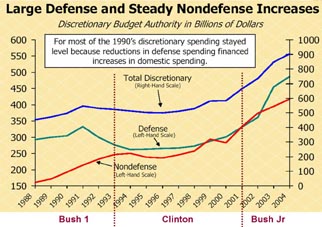
My goof
In my recent post on pharmaceutical regulation I wrote:
In the pharmaceutical market the major costs are all fixed costs (they don’t vary much with market size) so profit =P*Q-F. Acemoglu and Linn look at changes in Q but a 1% change in P has exactly the same effects on profits, and thus presumably on R&D, as a 1% change in Q.
But as Bernie Yomtov pointed out to me a reduction in P will increase Q. Ugh, an economist who has to be reminded about the law of demand. Embarrassing. The argument goes through if demand is quite inelastic which makes sense for a lot of drugs given that the price to the final consumer is low to begin with due to insurance – nevertheless the result is not so clean. Indeed, because of the envelope theorem a small change in P will have only a very small change in profits. Sadly, I teach this to my students regularly. Did I mention that I have had the flu this week?
Are asset price bubbles good?
“A bubble is good for growth because it creates a low cost environment for experimentation.”
Here is the full argument. I am prepared to believe that the government should not try to regulate or otherwise restrict bubbles. Why should we think that governments can outguess traders? And bubbles help finance socially worthwhile ideas that may not have high private returns. But would I wish that traders had less “bubbly” temperaments?
Thanks to www.politicaltheory.info for the link.
Markets in everything
Who needs an entire boyfriend, when you can have just one part? The Japanese have an answer to this question.
Thanks to Yana for the pointer.
Who benefits from R&D?
…the main finding — that R&D capital stocks of trade partners have a noticeable impact on a country’s total factor productivity — appears to be robust… [consider] a coordinated permanent expansion of R&D investment by 1/2 of GDP in each of twenty-one industrial countries. The U.S. output grows by 15 percent, while Canada’s and Italy’s output expands by more than 25 percent. On average the output of all the industrial countries rises by 17.5 percent. And importantly, the output of all the less-developed countries rises by 10.6 percent on average. That is, the less-developed countries experience substantial gains from R&D expansion in the industrial countries [emphasis added].
That is from Elhanan Helpman’s just-published The Mystery of Economic Growth. I’ll add that, more generally, Europe is a massive free-rider on American investments in pharmaceutical R&D; see Alex immediately below.
Are you looking for a good and readable summary of what economists know about economic growth? Helpman’s book is the place to start. And here is my earlier post on external returns from innovation.
Price Regulation of Pharmaceuticals
How much would a 10% reduction in price reduce pharmaceutical research and development? That is the key question in debates about reimportation of pharmaceuticals from Canada, price controls, and using the power of Medicare to bargain with pharmaceutical companies. In a recent paper from the Quarterly Journal of Economics, Daron Acemoglu and Joshua Linn suggest an answer.
Acemoglu and Linn’s paper is formally about a different issue; the effect of market size on innovation. What they find is that a 1 percent increase in the potential market size for a drug leads to an approximately 4 percent increase in the growth rate of new drugs in that category. In other words, if you are sick it is better to be sick with a common disease because the larger the potential market the more pharmaceutical firms will be willing to invest in research and development. Misery loves company.
Although they don’t mention it, this finding has implications for price controls. In the pharmaceutical market the major costs are all fixed costs (they don’t vary much with market size) so profit =P*Q-F. Acemoglu and Linn look at changes in Q but a 1% change in P has exactly the same effects on profits, and thus presumably on R&D, as a 1% change in Q.
[I no longer think the above is correct but I leave it here for the historical record, see My goof.]
We can expect, therefore, that a 1% reduction in price will reduce the growth rate of new drug entries by 4% and a 10% reduction in price will reduce new drug entries by 40%. That is a huge effect. I suspect that the authors have overestimated the effect but even if it were one-half the size would you be willing to trade a 10% reduction in price for a 20% reduction in the growth rate of new drugs? No one who understands what these numbers mean would think that is a good deal.
Fannie Mae update
Daniel Gross explains the risks of Fannie Mae:
Fannie Mae has convinced itself that massive exposure to interest-rate volatility can be a low-risk business. It has propounded the notion that a giant financial company, through efficient hedging, can produce earnings that are as smooth and predictable as those reported by General Electric in Jack Welch’s heyday. The people who owned Fannie’s stock–worth $74 billion just two weeks ago–explicitly bought into this belief.
The desire to have earnings conform to some pre-existing plan is a recipe for trouble at a large corporation. One of the most damning segments of the OFHEO report (see Pages 7-12) discusses how, in order to be perceived as low risk, Fannie felt it had to present regular earnings growth. The meeting of earnings goals was so crucial that bonuses for top executives were pegged to them. In 1998, bonuses were based on hitting targets: earnings of $3.13 a share for the minimum bonus, $3.18 for the target bonus, and $3.23 or above for the maximum bonus. “Remarkably the 1998 EPS number turned out to be $3.2309,” OFHEO deadpans. In order to meet the target, OFHEO suggests, Fannie Mae may have improperly deferred some $200 million in expenses.
When it comes to risk, as with everything else, there is no free lunch (with apologies to Kenneth Arrow). Read the whole thing. And here is my previous post on Fannie Mae.
New economics and public policy blog
VoxBaby this one is called, and it is written by Andrew Samwick, a first-rate economist at Dartmouth. His research covers such diverse areas as executive compensation, social security reform, and pension reform. We welcome Andrew to the blogosphere.
Markets in everything
A woman [Yuolanda Taylor] who police say sold stones to rioters in a southwest Michigan city last year and used the money to pay her cable television bill has pleaded no contest to inciting a riot.
Police said Taylor toted rocks through a riot-wracked neighborhood, selling small ones for $1 each and bigger ones for $5. Prosecutors said the rocks were thrown at police.
Taylor told police she collected about $70 selling rocks, but quit when she got hit by one herself.
Here is the full story. Thanks to blogger John Wilson for the pointer.
The X,Y, and Z Prizes
The founders of the X Prize are going to offer new prizes “to meet the greatest challenges facing humanity in the 21st century.” But they have not yet settled on exactly what fields or what accomplishments and they are soliciting public input. I’ve already given my suggestion you can give yours here.
The sponsors offer some valuable thoughts on how to choose appropriate fields and prizes:
The X PRIZE competition focused on jumpstarting a private space industry has re-proven the principle – strongly proven in the early years of the 20th century for the aviation industry – that innovation can indeed be catalyzed. ….
Although the idea of using the X PRIZE concept work in other areas is at first glance a simple and attractive one, a great deal of up-front thought needs to go into what challenges/opportunities would be selected. One could argue that there were certain qualities about the challenges and opportunities in both the aviation field and the space field that lent themselves extremely well to a private sector competition of the sorts which have occurred. Variables to be looked at might include:
The maturity (or lack thereof) of the technology around which the competition would be based?
The maturity (or lack thereof) of the related industries from which a new industry would be born
The number of potential “competitors” potentially able to meet the challenge or at least the depth of the pool from which potential competitors could be drawn
The level of the specificity of the challenge
The financial resources potentially available to finance the potential competitors
The financial resources potentially available to finance the Prize itself
How potentially compelling and exciting is the field around which the challenge would be based
The amenability of the target area to a threshold change in public expectation
The replicability of the challenge to other areas?
The level of the presumed long-term benefit to business and society
The list of questions above is by no means exhaustive, but does give a sense of how the selection of a new challenge is not as first as simple as it may seem. It is absolutely key that the right challenges are selected – sufficiently exciting to compel hearts and minds, sufficiently ambitious to reach beyond what is already likely going to occur soon and to have a truly substantial impact, and sufficiently focused to have a good chance of succeeding within a reasonable timescale.
How bad is McDonald’s for you?
Bad enough. But beware the Michelin-starred restaurant as well:
I haven’t seen Supersize Me yet, but since I heard of the idea behind the movie, I thought it was a bit shallow. Of course you can eat yourself ill at McDonalds. I am almost certain I could eat myself ill in the same manner at a Michelin starred restaurant that serves classical French food. For example, take a typical French Michelin starred menu or look through Gordon Ramsay’s or Thomas Keller’s recipe books. To start, I could have some sort of foie gras terrine, for a main course I could have lobster cooked in butter or meat that might be served with pommes puree (which can contain up to 50% of their weight in butter), and then there are the cheese and desserts. Eating this type of food 14 times a week is probably not good for you.
Here is a good commonsense conclusion:
You might have a fast metabolism, be genetically fortunate, or exercise sufficiently to get away with it, but the point is that you can eat unhealthily anywhere. McDonald’s does not have a monopoly here. Since it is probably impossible to force everyone to eat + live healthily, and definitely a waste of resources to try, policymakers (and their lobbyists) should focus on reducing incentives to offload healthcare costs, thereby increasing incentives to live healthily.
Anyway, McDonalds is trying to change + diversifying its menus. You would have thought this is a good thing, or will the anti-McDonalds lot only be happy when the evil Ronald is 6 feet under?
If you are looking for a good blog by a libertarian chef, Peter Rossi is the guy.
Nobel Prize update
Here is new information from the betting market. Ed Prescott has opened up a lead (then Barro, then Krugman), and Thomas Schelling has joined the list. Read my previous comments; the winner will be announced Monday.
As for tomorrow’s literature prize, John Updike, Margaret Atwood, and Philip Roth are the leaders.
Update: Here is the dark horse who won the literature prize, I am not a big fan.
Making money from niche demand
The average Barnes & Noble carries 130,000 titles. Yet more than half of Amazon’s book sales come from outside its top 130,000 titles. Consider the implication: If the Amazon statistics are any guide, the market for books that are not even sold in the average bookstore is larger than the market for those that are… In other words, the potential book market may be twice as big as it appears to be, if only we can get over the economics of scarcity. Venture capitalist and former music industry consultant Kevin Laws puts it this way: “The biggest money is in the smallest sales.”
Here is a good article on how falling fixed costs (my terminology) will revolutionize the world of culture. Thanks to Eric Crampton for the pointer.
Should the government subsidize mortgages?
Fannie Mae has $1 trillion in assets and owns or guarantees more than one-quarter of all American mortages. While the company is owned by private shareholders, its securities have an implicit guarantee from the federal government. In essence private debtholders, through the company, can fund mortgages at lower risk.
It now turns out that the company has engaged in questionable accounting and financial practices; the Wall Street Journal called them “stunning.”
Put aside the details of the current scandal, should Fannie Mae exist at all? Should we privatize the entity and move away from government guarantees?
There are two core arguments for government involvement in the mortgage market:
1. There are external social benefits to home ownership.
2. The mortgage market will otherwise be stunted by credit rationing.
On the first, while I enjoy suburban sprawl, I see no good reason to subsidize it.
How about credit rationing? Are there Americans who, in economic terms, should get homes but could not in a free market? A key assumption of most (Pareto-inefficient) credit rationing models is that you know your probability of loan repayment better than does your lender. (In that case lenders are afraid to extend a full menu of loans, for fear that the “lemons” will borrow the most.) I doubt if this informational asymmetry is true today. In most cases the lender, through statistical profiling, probably has a better predictive sense of the future than do self-deceiving borrowers. And for some skeptical empirical evidence on credit rationing, see this volume. Or just try reading your spam.
Even if some Pareto-inefficient credit rationing exists, I would rather wait for information technologies to alleviate the problem. The Fannie Mae behemoth involves financial risk for the taxpayer and sets a bad precedent for government involvement in capital markets.
The origins of Monopoly
The board game that is, not the economic phenomenon. It appears to have sprung from the Henry George movement. George, of course, was obsessed with land monopoly and its unproductive rents. It is no accident that the board game assigns such extortionary power to landholders:
On January 5, 1904, Lizzie J. Magie, a Quaker woman from Virginia, received a patent (view patent) for a board game. Lizzie Magie belonged to a tax movement led by Philadelphia-born Henry George; the movement supported the theory that the renting of land and real estate produced an unearned increase in land values that profited a few individuals (landlords) rather than the majority of the people (tenants). Henry George proposed a single federal tax based on land ownership believing a single tax would discourage speculation and encourage equal opportunity.
Lizzie Magie wanted to use her game, which she called “The Landlord’s Game” as a teaching device for George’s ideas. The Landlord’s Game and Monopoly are very similar, except all the properties in Magie’s game are rented not acquired as in Monopoly and instead of names like “Park Place” and “Marvin Gardens” one finds “Poverty Place”, “Easy Street” and “Lord Blueblood’s Estate”. The objectives of each game are also very different. In Monopoly the idea of the game is to buy and rent or sell property so profitably that one becomes the wealthiest player and eventually monopolist. In The Landlord’s Game, the object was to illustrate how (under the system of land tenure) the landlord had an advantage over other enterprisers and to show how the single tax could discourage speculation.
When I was young I had a counterproductive obsession with owning the yellow properties.
Here is the full story. Here is an NPR account of the origins of monopoly. I am indebted to an email from Lauren Landsburg and Russ Roberts for the initial historical reference.