Monday assorted links
1. Do firearm norms explain the variation in interstate teen suicide deaths?
2. Rukmini S on the Tim Harford BBC podcast, and more here on data for India.
3. Italian village with 46 residents has 30 local election candidates.
4. Camille Paglia’s school closes (NYT). And more here, accreditation was pulled suddenly.
5. Aurelian Criautu and Ben Klutsey on moderation and liberalism.
6. Anton Jäger on Belgium (NYT).
7. On Milei’s fixer (FT).
8. Helen Dale on personality and politics.
9. Supermajorities in Mexico, good luck with that.
10. Ashlee Vance on Cradle and Laura Deming (Bloomberg). “The company says it’s successfully cooled and rewarmed a slice of rodent brain and found the sample retained the electrical activity in its neurons.”
Wealth Inequality in a Low Rate Environment
Contra Piketty:
We study the effect of interest rates on wealth inequality. While lower rates decrease the growth rate of rentiers, they also increase the growth rate of entrepreneurs by making it cheaper to raise capital. To understand which effect dominates, we derive a sufficient statistic for the effect of interest rates on the Pareto exponent of the wealth distribution: it depends on the lifetime equity and debt issuance rate of individuals in the right tail of the wealth distribution. We estimate this sufficient statistic using new data on the trajectory of top fortunes in the U.S. Overall, we find that the secular decline in interest rates (or more generally of required rates of returns) can account for about 40% of the rise in Pareto inequality; that is, the degree to which the super rich pulled ahead relative to the rich.
That is from a recent piece by Matthieu Gomez and Émilien Gouin-Bonenfant in Econometrica. Here are less gated copies. Via M.
Can we survive deculturation?– Olivier Roy’s *The Crisis of Culture*
I have been reading Olivier Roy’s new book The Crisis of Culture: Identity Politics and the Empire of Norms. It is the best book on culture in years, and if you enjoy Martin Gurri and Bruno Macaes you should try this one too. This book actually got me excited at the theoretical level.
Early on in the book you will read the key question:
Are we living in a new culture or, conversely, is this expansion of normativity the sign of a profound crisis in the notion of culture itself?
Perhaps it is the latter. To some extent the internet drives the process, by chopping things up into bits and enabling and indeed sometimes requiring greater literality. But it is also a cultural trend that predated the primacy of internet life. There has been an ongoing erasure of shared implicit understandings, and that is a key variable driving many global trends.
Roy applies those insights to current problems with immigration and assimilation (which is now tougher), how to understand algorithmic social media, self-sufficiency in Japanese culture (a precursor of broader trends), the prevalence of memes (deculturation personified), by the elevation of folklore by UNESCO and others, autistics doing better in the contemporary world, arguments over reparations (more of a whining than an actual politicized struggle), the EU (extreme deculturation), and our current obsession with food (and also food writing) as a form of compensating for a decultured world.
Here is one interesting passage of many:
Therefore, it is not that English is becoming dominant, along with its cultural underpinning, but that the use of English is becoming decultured. This is why the linguistic phenomenon definitely does not reflect an Americanisation of world culture. The aim is to avoid any misunderstanding and any need to refer to implicit understandings that might not necessarily be shared. Jokes are banned and emotions have to be expressed explicitly using an emoji with a pre-defined meaning. Emotion is allowed, of course, but it must be immediately understood by addressees, wherever they may come from, so it is “sourced” from a list that, while remaining open, is pre-prepared.
The conclusion of the book serves this up for a start: “The trilogy of declaration, coding and normativity seems now to structure all debates and strategies on every side…”
French thinkers remain underrated in the Anglosphere. It is also notable how little coverage Olivier Roy receives in the “on-line world,” which is all the more reason to read this one and absorb its alpha.
You may recall that Roy wrote the earlier The Failure of Political Islam, which I also found very interesting. So he is one of today’s top intellectuals, and still going strong at 74 years of age. I still am not sure how many of his propositions I agree with, but I feel he is making real progress on the issues under question.
*In This Economy*, by Kyla Scanlon
The subtitle is How Money & Markets Really Work. I am a big fan of Kyla Scanlon (see the link for her other work), who is a force of nature. She graduated from Western Kentucky University in 2019, and she has a new and very effective approach to how to talk. I first learned of her through her explanatory videos, and it turns out she does one almost every day.
Apart from being very well done, this economics book has two notable features. First, it elevates Kyla’s notion of “vibes” as a significant determinant of economic activity. I use the older (and less vibey) terminology of “cultural contagion,” but in any case I consider this a neglected and under-analyzed set of forces, including in the economic realm.
Second, this is the first popular economics book I have seen that takes 2024 seriously. Imagine you trained a “large language human” on what people actually talk and worry about today, and set that human loose to write an economics book. This is what you would get. It is a good and bracing shock to those who have trained their memories on some weighted average of the more distant past.
As an aside, here are some of Kyla’s favorite poems. Why are there no major MSM profiles of her?
Sunday assorted links
Kal Mansur
My first commissioned art work. A piece by artist Kal Mansur who I met in high school. It’s not a painting but an embedded 3D sculpture so the work changes in different lights and angles. You will perhaps note a homage to Frank Lloyd Wright.

*American Covenant*
The author is Yuval Levin and the subtitle is How the Constitution Unified Our Nation — And Could Again. Excerpt:
The greatest obstacle to our understanding of the US Constitution is our familiarity with it.
Everything by Yuval is highly intelligent, this book included.
Santa Marta, Colombia notes
The Santa Marta region of northern Colombia has, within a ninety minute radius, the Caribbean, the snow-capped peaks of the Sierra Nevada, desert with plentiful cactus, and rain forest. The diversity of birds is remarkable, which is what induced my sister to suggest this locale for our trip. We showed up wondering “how to find the birds,” but before that sentence was finished, some birds swooped down and stole part of our breakfast.
The “Tower” is a wonderful lookout point in Minca, a small town about thirty minutes away from Santa Marta. You stand in an elevated gazebo, surrounded by beautiful mountains, and watch various birds go by. The host family doesn’t even charge you for the drink of water. Until not too long ago, Minca was a “no go” zone, ruled by drug lords and guerrillas. Now there is a very peaceful revenue-generating compromise, with a lid on all the violence. British women visit and order avocado toast, before setting off on their birding tours.
My sister has seen dozens of “lifers” on this trip, namely birds she had not seen before. For me they are almost all lifers, except the pigeons.

You can take a several hour small boat trip to see a village on stilts, Pueblo Palafito. The locale supports 1000 or so people, all using water taxis to get around and mostly working as fishermen. It is not near anything else, and their power source is solar, due to a gift from the Italian government. This was the highlight of the trip. I am told families there typically average five children, and the schools were indeed full of enthusiastic young people. Best is this video, you don’t need to understand the Spanish.
In the city of Santa Marta there are two (!) separate monuments to the 1958 Smith-Corona typewriter, both at major intersections. They are intended as a tribute to the region’s best-known author Gabriel García Márquez.
The local economy is too dependent on coal export, but overall it feels bustling and reasonably prosperous.
The best food there is seafood, most of all fish and shrimp, in addition to coconut rice and various forms of plantains. You can eat very well here but I would not stray from the area’s basic strengths. Maracuya juice is consistently good. I don’t usually order desserts, but here they are consistently interesting and original, often using honey, or sometimes waffles.
I would strongly recommend the Marriott hotel there, the one on the beach. It is essentially an $800 a night quality place, with very direct beach access, but at far, far lower prices. And you end up with the ocean and also the three swimming pools pretty much to yourself. (Where is everyone?) For the entire trip, and for the hotel, safety levels are just fine.
This is what the Caribbean should be, but rarely is. Visiting Santa Marta, as a trip, is so far ahead of most better-known beach outings it isn’t funny. From Virginia I can fly to Colombia in about five hours, and then Santa Marta from Bogotá is a mere 90-minute extra flight.
It is a common trope that genetic influences on individual behavior strengthen as people age. If you take a trip with your sibling, you will see further evidence that this is true.
It is rare for me to get on a plane for reasons that have basically no work components. That said, it is also easy to get work done here.
The influence of economics Ph.Ds in the Fed is declining
A decade ago, 12 out of 17 Fed governors and presidents had economics doctorates, or ca 70 per cent. When Hammack replaces Mester in August, only 10 out of 19 will have one, or 53 per cent. There are now also four former lawyers, outnumbering the bankers (assuming we haven’t screwed up anyone’s background; if so, profuse apologies).
Two decades ago the reign of econ PhDs was even more dominant, with 14 out of 19 of the top jobs held by people with dismal science doctorates — almost 74 per cent, stats fans. And several of the remainder had solid economics credentials (Olson had a BA in economics, Geithner had an MA and Sandra Pianalto had both a BA and MA and was a Fed economist lifer).
Saturday assorted links
1. The Coller-Dolittle Prize for Two-way Inter-species communication.
2. The home countries of political leaders’ spouses influence where foreign aid allocations go.
3. Five ways to spot talent late bloomers.
4. Robot solves Rubik’s Cube in 0.305 seconds.
5. Small steps toward a much better world.
Caplan and Cowen
A hilarious but also informative rapid-style debate between Bryan Caplan and Tyler on YIMBY and NIMBY.
Where do you find high net wealth in Africa?
56 percent of Africa’s millionaires and over 90 percent of its billionaires lived in just five countries in 2023 – South Africa, Egypt, Nigeria, Kenya and Morocco, according to The Africa Wealth Report 2024 published by Henley & Partners and New World Wealth. There were 135,200 people who owned wealth of 1 million U.S. dollars or more living in the continent that year, as well as 342 centi-millionaires and 21 billionaires, Statista reports.
As the following chart shows, South Africa had the highest number of so-called high net worth individuals (HNWIs) with 37,400 millionaires, 102 centi-millionaires and 5 billionaires. It was followed by Egypt with 15,600 millionaires, 52 centi-millionaires and 7 billionaires, while Nigeria placed 3rd on the continent with 8,226 HNWIs. Rounding up the top ten were Kenya (7,216 HNWIs), Morocco (6,836), Mauritius (5,115), Algeria (2,809), Ghana (2,706), Ethiopia (2,704) and Namibia (2,303).
Here is the full article, by Anna Fleck, via Anecdotal.
Neuroticism and the political Left
From Greg Lukianoff and Andrea Lan:
Liberal students have worse mental health than moderate and conservative students
At the extremes, 57% of very liberal students in our study reported feelings of poor mental health at least half the time, compared to just 34% of very conservative students. Let that sink in. 34% is really quite bad, but 57% is approaching a figure of 2 out of every 3 very liberal students.
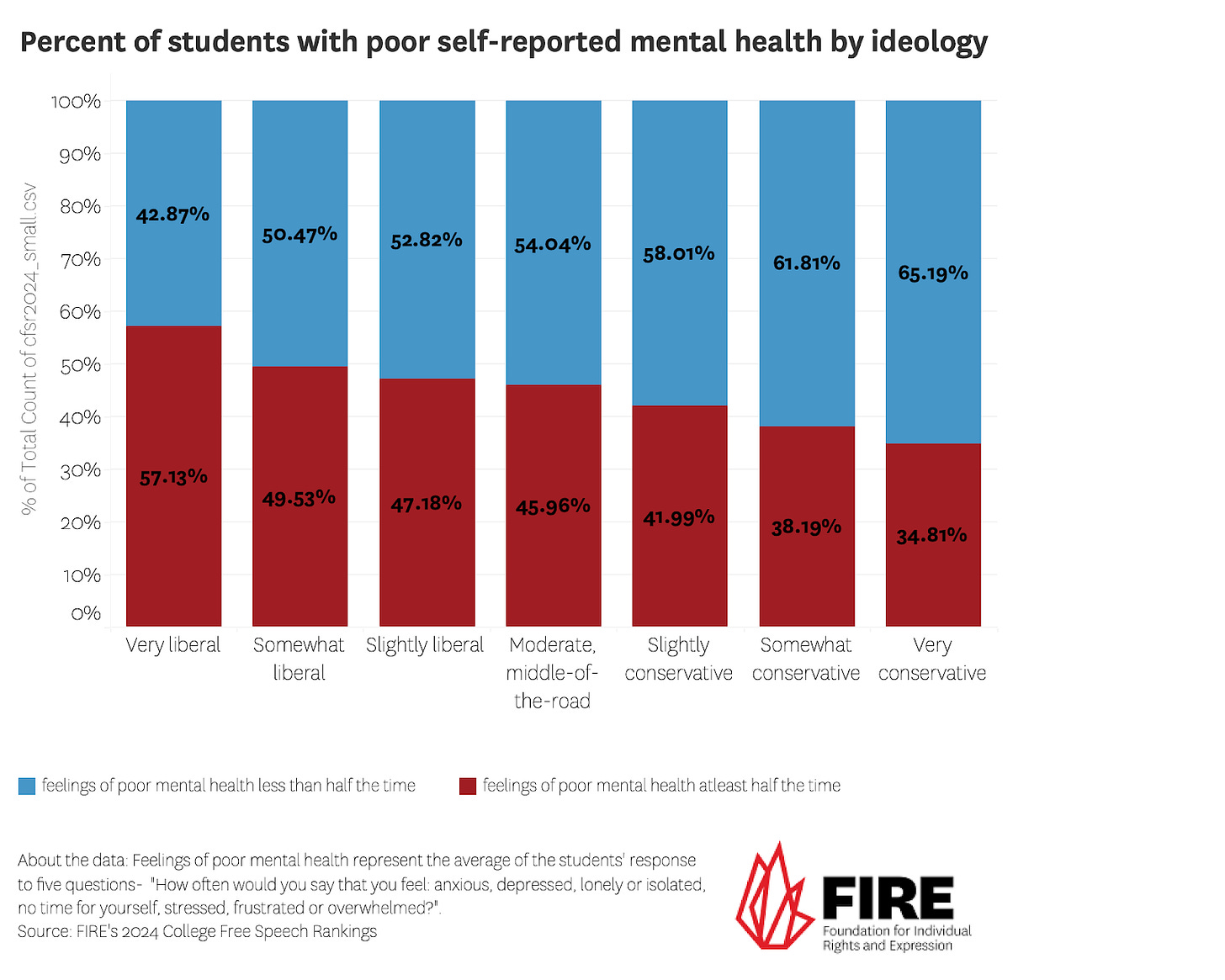
The graph above shows that as students move further to the left, they are more likely to have poor mental health — suggesting that it’s not just liberal ideology that impacts mental health, but also the extremity of their beliefs. Analysis of variance (ANOVA) tests show ideology is a statistically significant predictor of mental health. Post-hoc tests demonstrate it predicts in the direction as shown: more liberal, worse mental health. So far, the data is consistent with the findings of others (Zach Goldberg and Jon Haidt using Pew Research’s data, and Gimbrone et al.), and supportive of the hypothesis that “social justice fundamentalism” can be contributing negatively to the mental health of those who adopt it.
Via the excellent Arnold Kling. I’ve been on this bandwagon for a while, it is one of the more important truths for understanding current American political discourse. I would, however, insist that in this context the word “liberal” is especially misplaced.
What to think of Luka?
I am receiving inquiries as to whether I have upgraded my view of Luka, as his last series against Minnesota was masterful, above say the Larry Bird level.
For a while I have thought he has the potential to become a generational, “best in the NBA” (or second best?) quality player. But he has not been, either. Let us hope the regime has shifted.
But do keep in mind, eleven days ago ESPN ran an article ranking him as the 5th best player in the playoffs through the first two rounds. At the time no one took umbrage at that accurate assessment. Of course that is still very, very good, but not the Luka we have seen as of late. So we’ll see which Luka we get moving forward. Top players do make major upgrades in their games as they move forward, but we also need to tone down the recency bias here. Pre-playoffs he was rated at #2, implying that his performance for the first two rounds was a bit of a disappointment.
In the playoffs more generally:
…Doncic’s production (28.3 points and 9.1 assists per game) and efficiency (49.7% effective field goal percentage) has dipped significantly from his historic regular-season numbers (league-high 33.9 points, 9.8 assists, 57.3% effective field goal percentage).
Of course part of that is exactly the good news as well. Luka reduced his usage rate from 40.3% in the playoffs two years ago (he missed the playoffs last year) to 32.1% this year, a too-high usage rate having been his biggest shortcoming. And the other Mavericks truly have stepped up to fill the gap. Remember when ESPN marked the Kyrie Irving trade a “D”?
By the way, no need to use injuries as an “excuse” — they are common amongst high-usage players, and they count as “quality” every bit as much as healthy performance on the court.
Friday assorted links
1. What is the “robustness reproducibility” of articles in the AER? Twitter thread here.
2. New Thomas Sargent paper “Macroeconomics after Lucas.” And how to be respected as a teen girl.
3. Why is myopia sweeping the world? Real myopia, not the behavioral econ stuff.
4. “Renewables and nuclear power generated 49.4% of USA’s electricity in March!”
5. Kevin A. Bryan on France and the French economy. A good thread.