Santa Marta, Colombia notes
The Santa Marta region of northern Colombia has, within a ninety minute radius, the Caribbean, the snow-capped peaks of the Sierra Nevada, desert with plentiful cactus, and rain forest. The diversity of birds is remarkable, which is what induced my sister to suggest this locale for our trip. We showed up wondering “how to find the birds,” but before that sentence was finished, some birds swooped down and stole part of our breakfast.
The “Tower” is a wonderful lookout point in Minca, a small town about thirty minutes away from Santa Marta. You stand in an elevated gazebo, surrounded by beautiful mountains, and watch various birds go by. The host family doesn’t even charge you for the drink of water. Until not too long ago, Minca was a “no go” zone, ruled by drug lords and guerrillas. Now there is a very peaceful revenue-generating compromise, with a lid on all the violence. British women visit and order avocado toast, before setting off on their birding tours.
My sister has seen dozens of “lifers” on this trip, namely birds she had not seen before. For me they are almost all lifers, except the pigeons.

You can take a several hour small boat trip to see a village on stilts, Pueblo Palafito. The locale supports 1000 or so people, all using water taxis to get around and mostly working as fishermen. It is not near anything else, and their power source is solar, due to a gift from the Italian government. This was the highlight of the trip. I am told families there typically average five children, and the schools were indeed full of enthusiastic young people. Best is this video, you don’t need to understand the Spanish.
In the city of Santa Marta there are two (!) separate monuments to the 1958 Smith-Corona typewriter, both at major intersections. They are intended as a tribute to the region’s best-known author Gabriel García Márquez.
The local economy is too dependent on coal export, but overall it feels bustling and reasonably prosperous.
The best food there is seafood, most of all fish and shrimp, in addition to coconut rice and various forms of plantains. You can eat very well here but I would not stray from the area’s basic strengths. Maracuya juice is consistently good. I don’t usually order desserts, but here they are consistently interesting and original, often using honey, or sometimes waffles.
I would strongly recommend the Marriott hotel there, the one on the beach. It is essentially an $800 a night quality place, with very direct beach access, but at far, far lower prices. And you end up with the ocean and also the three swimming pools pretty much to yourself. (Where is everyone?) For the entire trip, and for the hotel, safety levels are just fine.
This is what the Caribbean should be, but rarely is. Visiting Santa Marta, as a trip, is so far ahead of most better-known beach outings it isn’t funny. From Virginia I can fly to Colombia in about five hours, and then Santa Marta from Bogotá is a mere 90-minute extra flight.
It is a common trope that genetic influences on individual behavior strengthen as people age. If you take a trip with your sibling, you will see further evidence that this is true.
It is rare for me to get on a plane for reasons that have basically no work components. That said, it is also easy to get work done here.
The influence of economics Ph.Ds in the Fed is declining
A decade ago, 12 out of 17 Fed governors and presidents had economics doctorates, or ca 70 per cent. When Hammack replaces Mester in August, only 10 out of 19 will have one, or 53 per cent. There are now also four former lawyers, outnumbering the bankers (assuming we haven’t screwed up anyone’s background; if so, profuse apologies).
Two decades ago the reign of econ PhDs was even more dominant, with 14 out of 19 of the top jobs held by people with dismal science doctorates — almost 74 per cent, stats fans. And several of the remainder had solid economics credentials (Olson had a BA in economics, Geithner had an MA and Sandra Pianalto had both a BA and MA and was a Fed economist lifer).
Saturday assorted links
1. The Coller-Dolittle Prize for Two-way Inter-species communication.
2. The home countries of political leaders’ spouses influence where foreign aid allocations go.
3. Five ways to spot talent late bloomers.
4. Robot solves Rubik’s Cube in 0.305 seconds.
5. Small steps toward a much better world.
Caplan and Cowen
A hilarious but also informative rapid-style debate between Bryan Caplan and Tyler on YIMBY and NIMBY.
Where do you find high net wealth in Africa?
56 percent of Africa’s millionaires and over 90 percent of its billionaires lived in just five countries in 2023 – South Africa, Egypt, Nigeria, Kenya and Morocco, according to The Africa Wealth Report 2024 published by Henley & Partners and New World Wealth. There were 135,200 people who owned wealth of 1 million U.S. dollars or more living in the continent that year, as well as 342 centi-millionaires and 21 billionaires, Statista reports.
As the following chart shows, South Africa had the highest number of so-called high net worth individuals (HNWIs) with 37,400 millionaires, 102 centi-millionaires and 5 billionaires. It was followed by Egypt with 15,600 millionaires, 52 centi-millionaires and 7 billionaires, while Nigeria placed 3rd on the continent with 8,226 HNWIs. Rounding up the top ten were Kenya (7,216 HNWIs), Morocco (6,836), Mauritius (5,115), Algeria (2,809), Ghana (2,706), Ethiopia (2,704) and Namibia (2,303).
Here is the full article, by Anna Fleck, via Anecdotal.
Neuroticism and the political Left
From Greg Lukianoff and Andrea Lan:
Liberal students have worse mental health than moderate and conservative students
At the extremes, 57% of very liberal students in our study reported feelings of poor mental health at least half the time, compared to just 34% of very conservative students. Let that sink in. 34% is really quite bad, but 57% is approaching a figure of 2 out of every 3 very liberal students.
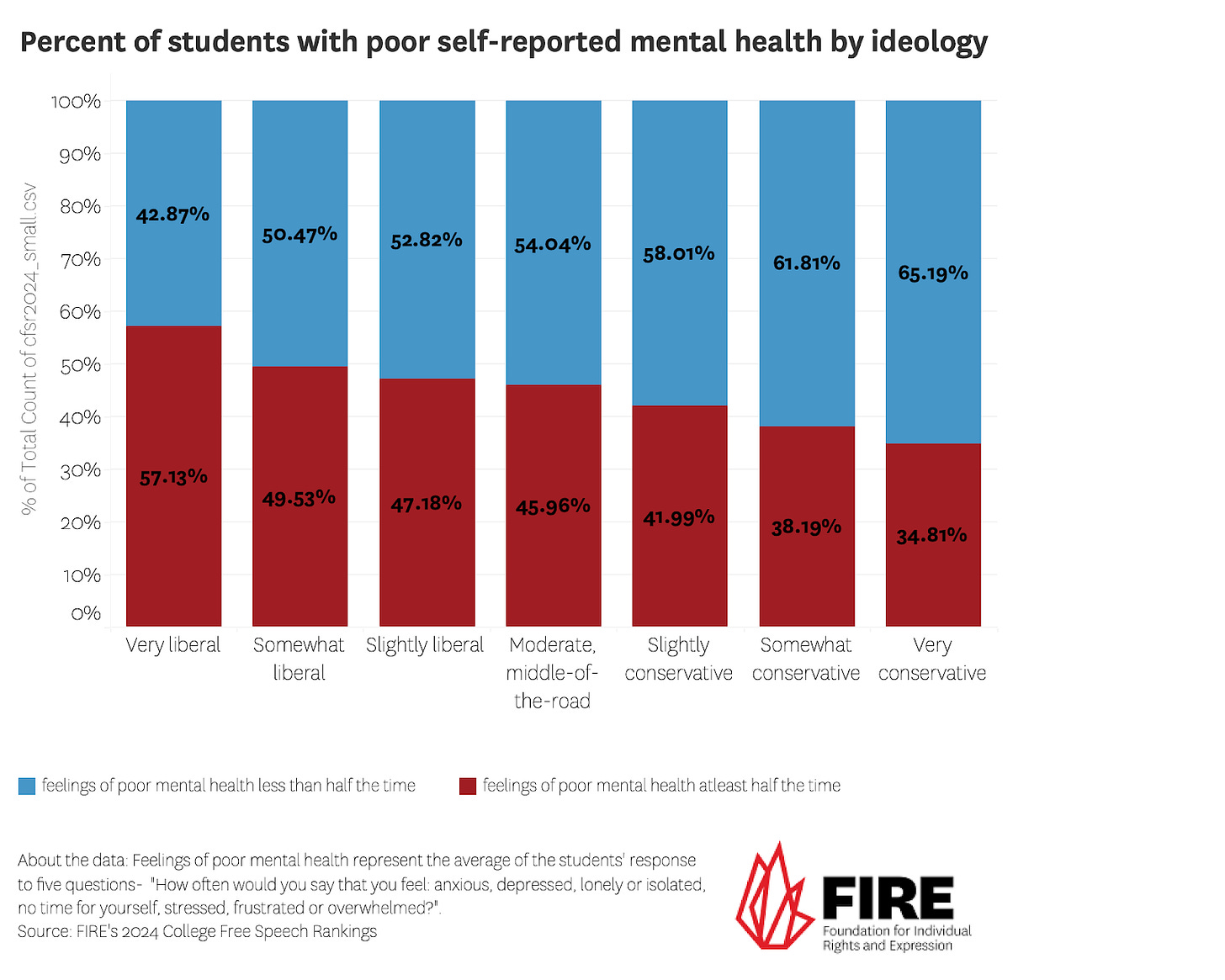
The graph above shows that as students move further to the left, they are more likely to have poor mental health — suggesting that it’s not just liberal ideology that impacts mental health, but also the extremity of their beliefs. Analysis of variance (ANOVA) tests show ideology is a statistically significant predictor of mental health. Post-hoc tests demonstrate it predicts in the direction as shown: more liberal, worse mental health. So far, the data is consistent with the findings of others (Zach Goldberg and Jon Haidt using Pew Research’s data, and Gimbrone et al.), and supportive of the hypothesis that “social justice fundamentalism” can be contributing negatively to the mental health of those who adopt it.
Via the excellent Arnold Kling. I’ve been on this bandwagon for a while, it is one of the more important truths for understanding current American political discourse. I would, however, insist that in this context the word “liberal” is especially misplaced.
What to think of Luka?
I am receiving inquiries as to whether I have upgraded my view of Luka, as his last series against Minnesota was masterful, above say the Larry Bird level.
For a while I have thought he has the potential to become a generational, “best in the NBA” (or second best?) quality player. But he has not been, either. Let us hope the regime has shifted.
But do keep in mind, eleven days ago ESPN ran an article ranking him as the 5th best player in the playoffs through the first two rounds. At the time no one took umbrage at that accurate assessment. Of course that is still very, very good, but not the Luka we have seen as of late. So we’ll see which Luka we get moving forward. Top players do make major upgrades in their games as they move forward, but we also need to tone down the recency bias here. Pre-playoffs he was rated at #2, implying that his performance for the first two rounds was a bit of a disappointment.
In the playoffs more generally:
…Doncic’s production (28.3 points and 9.1 assists per game) and efficiency (49.7% effective field goal percentage) has dipped significantly from his historic regular-season numbers (league-high 33.9 points, 9.8 assists, 57.3% effective field goal percentage).
Of course part of that is exactly the good news as well. Luka reduced his usage rate from 40.3% in the playoffs two years ago (he missed the playoffs last year) to 32.1% this year, a too-high usage rate having been his biggest shortcoming. And the other Mavericks truly have stepped up to fill the gap. Remember when ESPN marked the Kyrie Irving trade a “D”?
By the way, no need to use injuries as an “excuse” — they are common amongst high-usage players, and they count as “quality” every bit as much as healthy performance on the court.
Friday assorted links
1. What is the “robustness reproducibility” of articles in the AER? Twitter thread here.
2. New Thomas Sargent paper “Macroeconomics after Lucas.” And how to be respected as a teen girl.
3. Why is myopia sweeping the world? Real myopia, not the behavioral econ stuff.
4. “Renewables and nuclear power generated 49.4% of USA’s electricity in March!”
5. Kevin A. Bryan on France and the French economy. A good thread.
Bailouts Forever
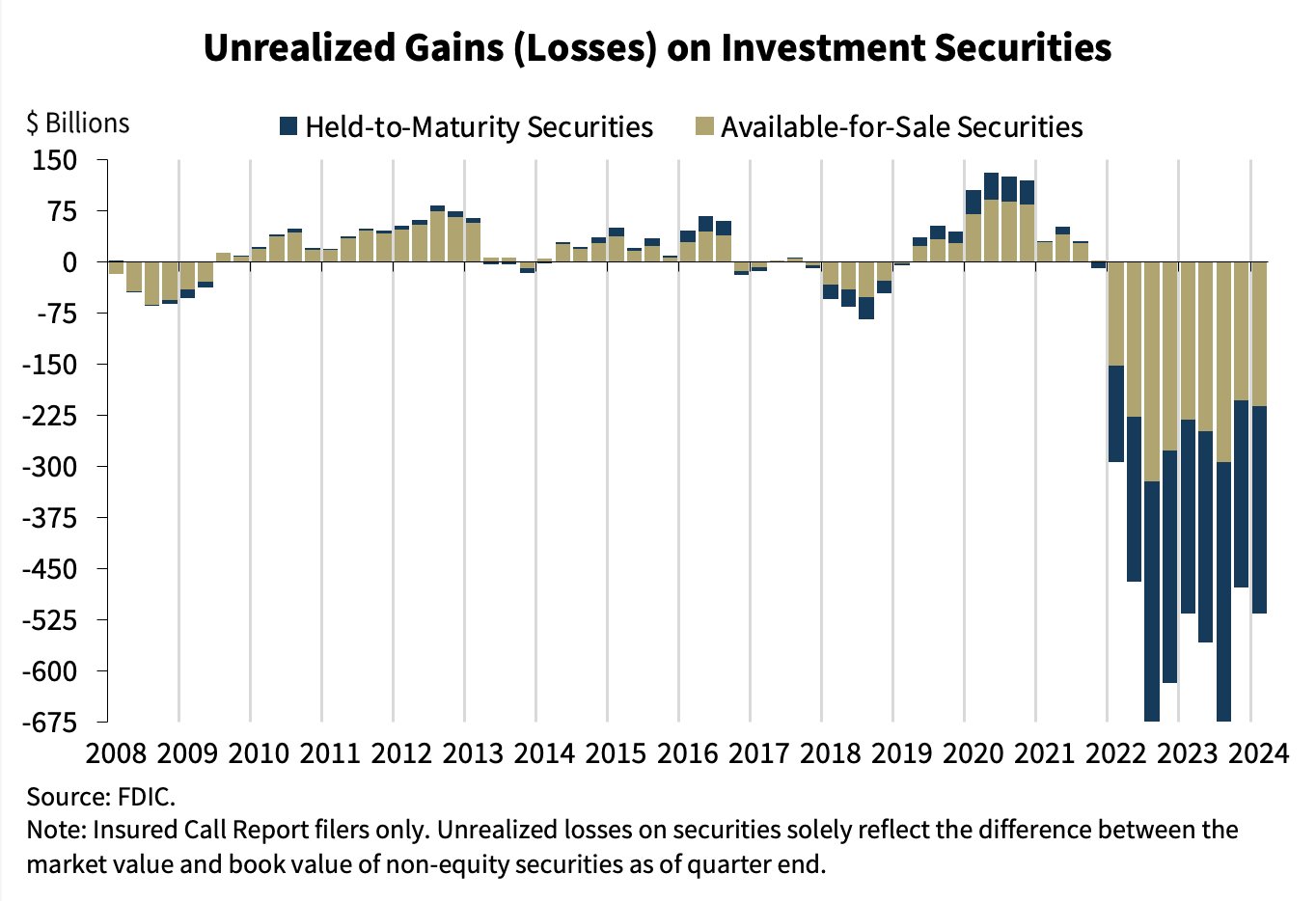
When interest rates rise, the price of long-term assets falls. Consequently, when the Fed began raising interest rates in 2022, the value of bonds and mortgages dropped, causing significant accounting losses for banks heavily invested in these assets. Silicon Valley Bank went bust, for example, because depositors fled upon realizing it was holding lots of Treasury bonds.
Interest rates remain high and many banks have large unrealized losses on their books. According to the latest FDIC data (see below) unrealized losses currently total $516.5 billion, far exceeding levels seen during the 2008-2009 financial crisis. Price risk is not the same as default risk and if the banks can hold onto their assets until maturity then they will be solvent. The real danger, as with SVB, is if unrealized losses are combined with a deposit run. So far that doesn’t seem to be happening but it’s well within the realm of possibility.
In other news, Hypertext has an issue devoted to Anat Admati and Martin Hellwig’s The Banker’s New Clothes. Admati and Hellwig write:
The 2010 Dodd-Frank Act in the United States promised the end of bank bailouts and “too-big-to-fail” institutions. The European Union’s 2014 legislation for dealing with banks likely to fail was claimed to provide “a framework” to “deal with banks that experience financial difficulties without either using taxpayer money or endangering financial stability.” In November 2014, Mark Carney, at the time the governor of the Bank of England and chair of the Financial Stability Board (FSB), a body of financial regulators from around the world, announced triumphantly that an agreement about new rules for the thirty largest and most complex, “globally systemic” financial institutions would prevent bailouts in the future. Many people in politics and the media believed these claims.
Two From the Tabarrok Brothers
Maxwell Tabarrok offers an excellent review of an important paper.
Taxation and Innovation in the 20th Century is a 2018 paper by Ufuk Akcigit, John Grigsby, Tom Nicholas, and Stefanie Stantcheva that provides some answers. They collect and clean new datasets on patenting, corporate and individual incomes, and state-level tax rates that extend back to the early 20th century. The headline result: taxes are a huge drag on innovation. A one percent increase in the marginal tax rate for 90th percentile income earners decreases the number of patents and inventors by 2%. The corporate tax rate is even more important, with a one percent increase causing 2.8% fewer patents and 2.3% fewer inventors.
Especially useful is Max’s back of the envelope calculation putting this result in the context of other methods to increases innovation.
Read the whole thing.
For something completely different, Connor Tabarrok offers an update on Charlotte the Stingray:
A “miracle pregnancy” picked up by national news brought huge business to a small-town aquarium, but months after the famous stingray was due, there are still no pups. Are we being scammed by a fish?
I particularly liked this line:
Taking all of this into account, my stance is that even if they got it on, it’s unlikely that this shark will have to dish out any child support to Charlotte’s pups.
Read the whole thing.
Are MR readers more interested in tax policy or virgin birth stingrays? We shall see.
Nationalism in Online Games During War
We investigate how international conflicts impact the behavior of hostile nationals in online games. Utilizing data from the largest online chess platform, where players can see their opponents’ country flags, we observed behavioral responses based on the opponents’ nationality. Specifically, there is a notable decrease in the share of games played against hostile nationals, indicating a reluctance to engage. Additionally, players show different strategic adjustments: they opt for safer opening moves and exhibit higher persistence in games, evidenced by longer game durations and fewer resignations. This study provides unique insights into the impact of geopolitical conflicts on strategic interactions in an online setting, offering contributions to further understanding human behavior during international conflicts.
That is from a new paper by Eren Bilen, Nino Doghonadze, Robizon Khubulashvili, and David Smerdon. Imagine if there is some addition Sino-Indian conflict right before the Ding vs. Gukesh WCC match…
For the pointer I thank various MR readers.
Why some additional regulation would help crypto
That is the topic of my latest Bloomberg column, here is one part of the argument, which focuses on the bill that recently passed the House but may stall in the Senate:
As for the policy details: Is this a good bill? Mostly, yes. Without a coherent regulatory framework, the US crypto sector won’t be competitive with those of other nations. That damages the potential for American innovation, encourages some entrepreneurs to take their businesses abroad, and could eventually limit the integration of crypto with mainstream financial infrastructures, which would put the US financial sector at a disadvantage.
The bill has the critical provision of requiring crypto infrastructures to be sufficiently decentralized, at least if that infrastructure is to fall under the jurisdiction of the CFTC rather than the SEC. These decentralized crypto infrastructures, which would include Bitcoin and the Ethereum network, are considered to be “digital commodities,” and are granted greater freedom. Such assets are not like shares of Apple stock, where the buyer expects a very particular kind of corporate responsibility and predictable financial reporting. So the bill stipulates that, for many crypto assets, initial issuance must involve tighter disclosure and regulation, with a role for the SEC. Over time, as the blockchain for that asset became more mature and well-established, regulation would relax.
Any particular proposal for such rules will necessarily involve some ambiguities and be susceptible to being gamed (by companies) or abused (by regulators). What is considered “adequate” decentralization, for example, is ultimately a subjective question. Still, this bill seems like a reasonable place to start for crypto regulation.
The alternative to such regulations of course is complete regulatory discretion, which is currently part of the status quo. And here is Alex’s recent post on crypto regulation.
The who and how of campaign spending on Meta
Trump targets horse riding, Biden targets football, and RFK Jr. targets comedy.
Trump also can claim Ted Nugent fans, here is the full story. Via A.
AI passes the restaurant review Turing test
Surprisingly easy, it turned out. In a series of experiments for a new study, Kovács found that a panel of human testers was unable to distinguish between reviews written by humans and those written by GPT-4, the LLM powering the latest iteration of ChatGPT. In fact, they were more confident about the authenticity of AI-written reviews than they were about human-written reviews.
Here is the full story, via Sarah Jenislawski.
Thursday assorted links
1. Alex Ross on Yuja Wang (New Yorker).
2. More on the South Korean gender gap.
3. Kyla Scanlon now has a book.
4. The San Francisco highway to NIMBYism.
5. Aristotle suggests a reverse Turing test (video). And Sam Hammond on the new California AI bill.