Will there by an H5N1 pandemic for humans?
Manifold Markets is currently putting the chance at 12%. That seems high to me, but maybe two percent? Which I still regard as leading to a high expected cost, to be clear. There is now mammal-to-mammal transmission. Zeynep Tufekci considers possible preparatory steps (NYT), including more surveillance.
Saturday assorted links
1. I am not convinced, but a novel and serious new hypothesis about unemployment.
2. Sam says.
3. Shruti and I discuss talent and India for Interintellect.
4. Might Google unveil on February 8? And Google announces Dreamix, a model that generates video based on prompts. Amazing what is happening every day. And further explanation here.
Industrial policy is the new globalization
That is the topic of my latest Bloomberg column, here goes:
It would be a mistake, however, to think that these [industrial] policies represent a move away from globalization. In fact they are an extension of globalization — and they likely will enable yet more globalization to come. That sounds counterintuitive, so let me explain.
Start with the domestic subsidies for green energy, as embodied in 2022’s Inflation Reduction Act. Those policies favor domestic firms in industries such as electric vehicles, batteries, and solar power. You could call that nationalism or even mercantilism. Yet those subsidies rely not only on a prior history of globalization but also an expected future for globalization. To the extent the US is able to extend its domestic battery production, it is because more lithium and other raw materials can be produced overseas and exported to the US. To the extent the US succeeds with its domestic solar industry, it is by drawing upon earlier advances in Spain, Germany and China — and undoubtedly future advances to come.
Even the most successful “nationalistic” industrial policies rely on a highly globalized world. If carried out strictly on a one-nation basis, industrial policy is doomed to fail. Globalization has been so thorough, and has gone so well, that at least a little industrial policy is now thinkable for many nations.
And this:
Just as globalization can enable or support nationalist industrial policy, so the converse is true. Assume that these various industrial policies meet with some degree of success, and that China, the EU and the US all become more self-sufficient in various ways. Those same political units are more likely to then embrace and support further globalization…
Some conservatives criticize globalization while praising industrial policy. They are playing right into the hands of the Davos globalizing elite. In fact, that is the best argument for many of these ideas: Today’s industrial policy is not an alternative to globalization. It is preparing the world for the next round of it.
I don’t think the Nat Cons have fully digested this lesson yet.
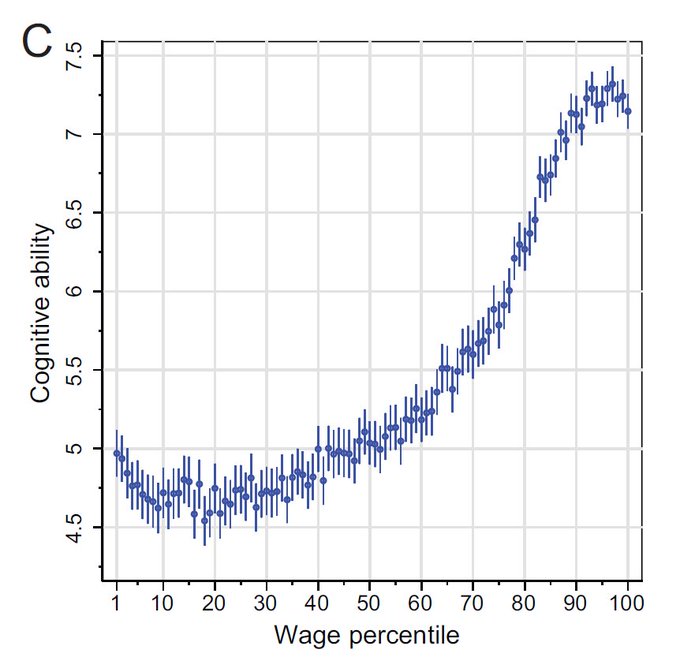
The plateauing of cognitive ability among top earners
Are the best-paying jobs with the highest prestige done by individuals of great intelligence? Past studies find job success to increase with cognitive ability, but do not examine how, conversely, ability varies with job success. Stratification theories suggest that social background and cumulative advantage dominate cognitive ability as determinants of high occupational success. This leads us to hypothesize that among the relatively successful, average ability is concave in income and prestige. We draw on Swedish register data containing measures of cognitive ability and labour-market success for 59,000 men who took a compulsory military conscription test. Strikingly, we find that the relationship between ability and wage is strong overall, yet above €60,000 per year ability plateaus at a modest level of +1 standard deviation. The top 1 per cent even score slightly worse on cognitive ability than those in the income strata right below them. We observe a similar but less pronounced plateauing of ability at high occupational prestige.
That is from a new paper by Marc Keuschnigg, Arnout van de Rijt3, and Thijs Bol.
Friday assorted links
1. David Brooks on AI (NYT). And a new AI tool for diagnosis. And what to do when you have to make a phone call in your second language. And connect Chat to your 3-D printer. And claims about Bing (speculative and unconfirmed). And Google might activate?
2. On the military potential of balloons.
3. David Wallace-Wells on why excess deaths remain high (NYT).
What should I ask Noam Chomsky?
I will be doing a Conversation with him. No need to suggest questions on foreign policy (this is the Conversation I want to have), what else?
Real Return Bonds–Not a Loony Idea
The Canadian government has said it will stop issuing real return bonds, i.e. inflation indexed bonds. Real return bonds are extremely useful to anyone who wants a steady stream of income that keeps up with inflation—retirees, for example. A real return bond would also be ideal for funding an endowment such as a university chair or scholarship program. I agree with John Cochrane and Jon Hartley writing in the G&M that ending sales of these bonds is a bad signal.
So why stop issuing real return bonds? The government may suspect that inflation will go up a lot more, and it will then have to pay more to bondholders. Non-indexed debt can be inflated away if the fiscal situation worsens. The cumulative 11-per-cent inflation since January, 2021, has inflated away 11 per cent of the debt already. Argentines have seen a lot more.
But issuing indexed debt makes sense if the government plans to be responsible. Tax payments and budget costs rise with inflation, and fall with disinflation, so the budget is stabilized if inflation-indexed bond payments do the same. And issuing indexed debt that can’t be inflated away is a good incentive not to turn around and inflate debt away.
Rasheed Griffith on the need for a Caribbean think tank
Worth another link! Here is one bit:
In my opinion, the first priority for a Caribbean think tank or program should be to advocate for the implementation of dollarization, which involves the replacement of all existing Caribbean currencies with the United States Dollar (USD) as the sole currency. This idea is based on the numerous fiscal and monetary shortcomings exhibited by Caribbean governments. The benefit of this proposal is its widespread latent approval and straightforward nature, making it easier to garner support and understanding among the Caribbean people…
The domestic money of Caribbean countries are only useful in the tiny land area of the earth where they are issued. For example, Barbados is 166 square miles and the Barbados Dollar (BBD) only has value in that small space. Why exactly should people be forced to exchange their labour for money that has such a limited use?
You might say that they can easily exchange the Barbados Dollar (BBD) for USD. But that is untrue. Barbados maintains strict capital controls because it cannot allow people to exchange too much BBD for USD as that would cause a crisis for the fixed exchange rate. This is a kafkaesque policy since virtually everything imported into and exported from Barbados is priced and invoiced in USD.
Moreover, the government abuses its position as the issuer of money. Primarily to finance its spendthrift operations by arbitrarily creating new money. This is the evident across the region. In Trinidad & Tobago, the government limited citizens to only a $250 USD allotment for international purchases on credit cards. This forced the black market rate to unprecedented levels, with everyone desperate to acquire USD. It came to a point where some services would give discounts if you pay in USD.
Basic point: Caribbean people are severely disadvantaged by being forced to use money that has no global acceptance. Caribbean governments will perpetually mismanage their domestic money to the detriment of citizens.
The manifesto covers many other issues, interesting throughout.
Where will the impact of ChatGPT fall? (from my email)
One dialogue that is missing from the current GPT conversations is about where these technologies will be primarily implemented.
There are two places GPTs can be used:
- Product-level: Implemented within products that companies buy
- Process-level: Implemented within processes of a company by an analyst – similar to how companies use data analysts today
If the future has primarily Product-level GPT, then companies like Microsoft clearly win because they have the products (like Teams) where the tech will be embedded and if you want the productivity gains from GPTs you have to go through them.
If the future has more Process-level GPT, companies like Zapier and no-code platforms win, because they will be the tools that companies use to implement their custom prompts. (although maybe a “Microsoft Teams Prompt Marketplace” wins as well)
The advantage to Process-level GPT is that companies don’t have to go through expensive change management to fit imperfect processes decreed by an external product – they can have their prompts designed to fit their specific needs. This would lead to higher productivity increases than a world with purely Product-level GPT.
To me, it comes down to the question of how much technical debt a custom prompt represents. If each prompt requires lots of maintenance and testing, then MSFT dominates. If someone who has 1 year of experience and used ChatGPT to write their papers in college can make a robust prompt, then Zapier wins.
Between the iterations of GPT3 so far (from davinci-001 to davinci-003/ChatGPT), we’ve seen the robustness of prompts increase exponentially. If this continues, it seems possible that the future has more Process-level GPT than we’ve seen so far.
Not edited by ChatGPT,
Neil [Madsen]
Prophets of the Marginal Revolution, chess edition
This is pretty crazy: decades of computers and video games and the #1 game going viral is still chess. The Lindy effect is real. https://t.co/CYC3OMjMo5
— Nabeel S. Qureshi (@nabeelqu) February 2, 2023
Here is my 2018 Bloomberg column on chess being a killer app for the internet and due for a boom. I think people love seeing what the computer thinks of how the humans are playing. What does that imply for the AI boom more generally? Which other human activities will we enjoying seeing criticized, scrutinized, and sometimes praised, all in front of the eyes of the public? Without computer assessments, watching chess games just didn’t have much built-in suspense for most viewers. So where else will the new built-in suspense be coming?
Thursday assorted links
1. ChatGPT Plus now to sell for $20 a month, not $40 a month. I view that as the result of high demand, not low demand (ever look at the book market and its prices). And new LLM app for lawyers to use for contract review. And David Rozado on ChatGPT moderation systems, tweet storm here. And the plan for Microsoft Teams Premium. AI-powered meetings are on the way.
3. Dwarkesh interviews @pmarca. And Age of Infovores interviews Daniel Klein. And Benjamin Yeoh podcast with Kanjun Qiu.
4. What should a Caribbean think tank do? Important post, and not just for the 44 million people in the Caribbean.
5. New Yunchan Lim (Byrd, Bach, Beethoven Bagatelles and more). It is amazing how many different kinds of music he can play so extraordinarily well at age eighteen.
*Empire, Incorporated*
The author is Philip J. Stern, and the subtitle is The Corporations that Built British Colonialism. Too many history books run through various motions, whereas this one tries to explain “how things really were” for the interested reader.
Here is one representative bit:
As great as its ambitions were, at its origins the East India Company was, like its predecessors and contemporaries, essentially a tentative experiment fueled by a hesitant and hybrid institutional and financial structure. The “company” did not have a single permanent stock. Rather, it was organized as a series of consecutive quasi-independent stock subscriptions, at first opened on a per venture basis and later established for set terms in years. In its early days, the limited number of shareholders could “take in men under them,” in theory dividing any individual share into a subsidiary, shadow joint stock. As in many other ventures, the East India Company spent its early years chasing down under- and unpaid subscriptions.
The book has plenty of good coverage of Borneo and also Africa as well, the latter sections being especially relevant to some of the charter cities plans of our current day. And there is plenty of Edward Gibbon Wakefield, who brought the ideas of agglomeration externalities into economics, and promoted a version of charter cities for southern Australia. How sadly neglected he is these days.
I had not known that the Falklands Island Company still controls so much in the Falklands. Recommended, due out in May.
Is there any reheating scenario?
It is not the most likely scenario, but is nonetheless worth a ponder, as I outlined in my latest Bloomberg column:
Consider a simple scenario involving output and money, much of which takes the form of credit expansion by banks and other intermediaries. In a well-functioning economy, money and output grow at roughly the same rate.
When economies experience turnarounds, however, conditions on the ground can change rapidly. In such circumstances, the growth of the money supply might outpace the growth in output — even if the central bank does not intend such a result. The reason is that output can take a while to grow. Businesses might have to expand capacity or hire more workers, and right now there is still a labor shortage. Even when an economy is functioning well and business conditions are good, output often grows with a lag.
The money supply, however, need not suffer from a lag. Banks, for instance, can extend credit quickly if they foresee that a recovery is stronger than expected. Even if a bank is in the midst of processing a loan, it can simply lend out more than it was planning.
Thus there can be periods when, for entirely natural reasons, the money supply is rising faster than output. That situation requires only a sudden burst of good news. And indeed there has been exactly that with the recent favorable inflation reports and the surprisingly good recent GDP report. The irony is that a positive market response to low inflation and strong growth cheers up market participants and could lead to … a new dose of inflation.
Another possible pathway for these scenarios involves interest rates. During a normal disinflation, the Federal Reserve raises rates and keeps them high for a long period of time while the economy adjusts slowly — often passing through recession. But inflation has fallen more rapidly than expected, and so the market may expect the Fed to lower interest rates sooner than planned. And an expected cut in interest rates can encourage expansionary pressures just as much as an actual cut in interest rates.
It is a funny world in which slow inflation can cause faster inflation. It’s the logic of expectations that makes it possible, albeit far from certain.
Inflation isn’t going back up to where it was, but please do keep in mind that numbers can move in both directions.
That was then, this is now
ChatGPT, the popular chatbot from OpenAI, is estimated to have reached 100 million monthly active users in January, just two months after launch, making it the fastest-growing consumer application in history, according to a UBS study on Wednesday.
Here is the full article, via Steven Kaufman.
Recent economic development stars
Development stars of the Era of Globalization: pic.twitter.com/8VOKPpFTSA
— Noah Smith 🐇🇺🇸🇺🇦 (@Noahpinion) January 27, 2023
And of course all be getting Noah Smith’s Substack…