Month: March 2025
Germany fact of the day
German borrowing costs surged by the most in 17 years on Wednesday, as investors bet on a big boost to the country’s ailing economy from a historic deal to fund investment in the military and infrastructure.
The yield on the 10-year Bund surged 0.21 percentage points to 2.69 per cent, its biggest one-day move since 2008, with markets braced for extra government borrowing.
Chancellor-in-waiting Friedrich Merz late on Tuesday agreed with the rival Social Democrats (SPD) to exempt defence spending above 1 per cent of GDP from Germany’s strict constitutional borrowing limit, set up a €500bn off-balance sheet vehicle for debt-funded infrastructure investment and loosen debt rules for states.
Here is more from the FT, noting that crowding out is still “a thing.” Of course it is wrong, or at least not obviously correct, for the article to report that “investors bet on a big boost to the country’s ailing economy…” I would sooner regard this as bad news for German consumption, naming that trying to address some of their problems will involve significant opportunity costs. Share prices did go up, and in part you can think of this as a transfer of resources from German individuals to defense and infrastructure firms. You might think additional German defense spending is necessary, as I do, but still that does not boost living standards. The additional infrastructure might, let us hope they are able to find ways to cut other spending along the way, surely it is not all super-efficient?
Janan Ganesh’s latest FT Op-Ed is titled “Europe must trim its welfare state to build a warfare state,” let us hope they can make that work. So far I am waiting to see the evidence.
Wednesday assorted links
1. Some new survey results on work from home.
3. Liu Jiakun wins the Pritzker Prize, photos at the link.
4. The ideology of AI governance. Can AI rule be interpretable to humans? Weird stuff, don’t worry I don’t understand it either.
5. Three Wikipedia pages for great economists.
6. Robert Mundell singing on the David Letterman show. And the direct YouTube links.
Is Social Security a Ponzi Scheme?
Elon recently re-opened the perennial debate about whether Social Security is a ponzi scheme. Here’s my, lightly edited post from 2011.
Elon is in good company calling social security a ponzi scheme. First up is Nobel prize winner Paul Samuelson who wrote:
The beauty of social insurance is that it is actuarially unsound. Everyone who reaches retirement age is given benefit privileges that far exceed anything he has paid in — exceed his payments by more than ten times (or five times counting employer payments)!
How is it possible? It stems from the fact that the national product is growing at a compound interest rate and can be expected to do so for as far ahead as the eye cannot see. Always there are more youths than old folks in a growing population. More important, with real income going up at 3% per year, the taxable base on which benefits rest is always much greater than the taxes paid historically by the generation now retired.
…A growing nation is the greatest Ponzi game ever contrived.
Samuelson wrote that in 1967 riffing off his classic paper of 1958. By “as far as the eye cannot see” he apparently meant not very far because it soon became clear that the system could not count on waves of youths or rapid productivity growth to generate the actuarially unsound returns that made the program so popular in the early years.
Milton Friedman and Paul Samuelson rarely agreed on much but Friedman also called social security a Ponzi scheme. In fact, he called it The Biggest Ponzi Scheme on Earth but perhaps Friedman is too partisan so let’s go for a third Nobel prize winner who recognizes the Ponzi like nature of social security, none other than…..Paul Krugman (writing in 1996):
Social Security is structured from the point of view of the recipients as if it were an ordinary retirement plan: what you get out depends on what you put in. So it does not look like a redistributionist scheme. In practice it has turned out to be strongly redistributionist, but only because of its Ponzi game aspect, in which each generation takes more out than it put in. Well, the Ponzi game will soon be over, thanks to changing demographics, so that the typical recipient henceforth will get only about as much as he or she put in (and today’s young may well get less than they put in). (ital added, AT)
Of these, I agree the most with Krugman. Social Security is not necessarily a Ponzi scheme but it only generated massive returns in the past because of its Ponzi-like aspects. The Ponzi-like aspects are now over and social security is turning into what is essentially a forced savings/welfare program with, as Krugman recognizes, crummy returns for average workers. Social security is thus a Ponzi scheme which has not gone bust but it has gone flat.
The Role of Unrealized Gains and Borrowing in the Taxation of the Rich
Of relevance to some recent debates:
We have four main findings: First, measuring “economic income” as currently-taxed income plus new unrealized gains, the income tax base captures 60% of economic income of the top 1% of wealth-holders (and 71% adjusting for inflation) and the vast majority of income for lower wealth groups. Second, adjusting for unrealized gains substantially lessens the degree of progressivity in the income tax, although it remains largely progressive. Third, we quantify for the first time the amount of borrowing across the full wealth distribution. Focusing on the top 1%, while total borrowing is substantial, new borrowing each year is fairly small (1-2% of economic income) compared to their new unrealized gains, suggesting that “buy, borrow, die” is not a dominant tax avoidance strategy for the rich. Fourth, consumption is less than liquid income for rich Americans, partly because the rich have a large amount of liquid income, and partly because their savings rates are high, suggesting that the main tax avoidance strategy of the super-rich is “buy, save, die.”
Here is the full piece by Edward G. Fox and Zachary D. Liscow. Via the excellent Kevin Lewis.
Should OneQuadrillionOwls be worried?
IMO this is one of the more compelling “disaster” scenarios — not that AI goes haywire because it hates humanity, but that it acquires power by being effective and winning trust — and then, that there is a cohort of humans that fear this expansion of trust and control, and those humans find themselves at odds with the nebulously part-human-part-AI governance structure, and chaos ensues.
It’s a messy story that doesn’t place blame at the feet of the AI per se, but in the fickleness of the human notion of legitimacy. It’s not enough to do a good job at governance — you have to meet the (maybe impossible, often contradictory) standards of human citizens, who may dislike you because of what you are or what you represent in some emotional sense.
As soon as any entity (in this case, AI) is given significant power, it has to grapple with questions of legitimacy, and with the thorniest question of all — how shall I deal with people who are trying to undermine my power?
Here is the relevant Reddit thread. Change is tough!
Tuesday assorted links
1. Perplexity, Deutsche Telekom, and an AI smartphone.
2. GPT 4.5 and Bishop Berkeley!
3. Stocks vs. flows, blah blah blah you still can compare two numbers.
4. “That men once stood before the Rokeby Venus and gawped means nothing to us.”
5. GDP forecasts getting worse.
6. Australian who blood saved the lives of 2.4 million babies dies. James Harrison, RIP.
Regime Uncertainty
Robert Higgs coined the term regime uncertainty to illustrate the challenge faced by business under Franklin Roosevelt’s New Deal, when a flurry of unpredictable legislation such as the expansive and often unclear mandates of the National Industrial Recovery Act (NIRA), attempts at court packing, abrupt tax increases, and shifting labor policies, meant businesses couldn’t reliably forecast returns or risks. Uncertainty magnified bad policy causing investment to collapse and remain unprecedently low.
For the eleven-year period of 1930 to 1940, net private investment totaled minus $3.1 billion. Only in 1941 did net private investment ($9.7 billion) exceed the 1929 amount.
The data leave little doubt. During the 1930s, private investment remained at depths never plumbed in any other decade for which data exist.
Real options theory explains why uncertainty can reduce investment even more than predictable but unfavorable policies. Suppose you’re deciding whether to build a factory in North Carolina or South Carolina. Both locations are viable, but one of the Carolina’s might offer a tax concession—though the decision won’t be announced for six months. Even if investing immediately would still be profitable without the concession, you might choose to delay building the factory. The potential benefit of waiting (the real option) only needs to offset the costs associated with waiting. Thus, even modest uncertainty can incentivize investors to delay big investments. Recent studies confirm Higgs’ insights: spikes in uncertainty strongly correlate with declines in private investment.
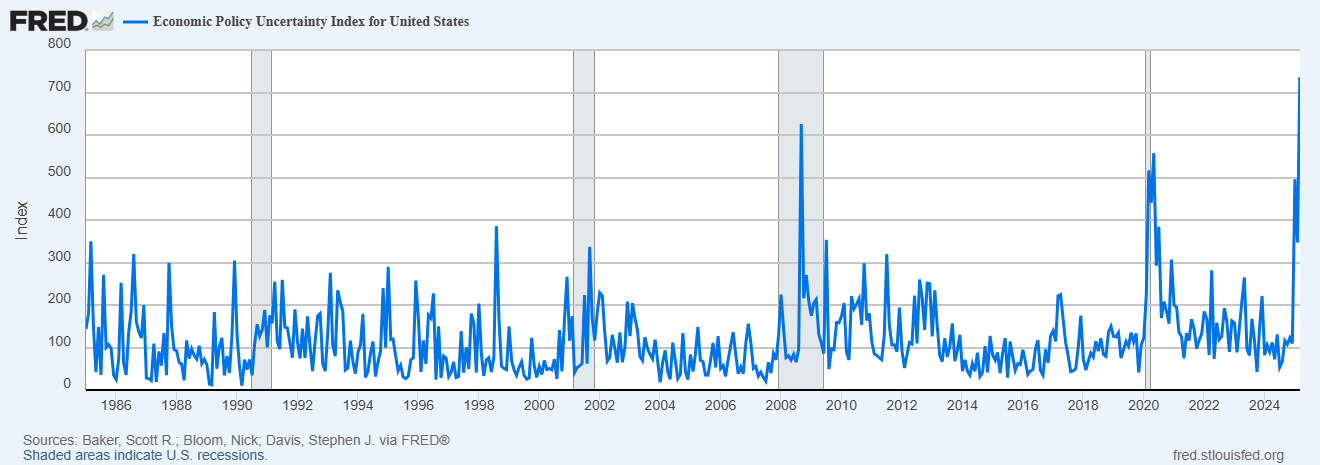
Ok, so where do we stand? We are now at a greater level of uncertainty than anything over the last 40 years, barring the worst weeks of the 2008 financial crisis (updated graph as of today!). Investment has begun a modest decline. Some, very preliminary data (take with a grain of salt) are already predicting a recession.
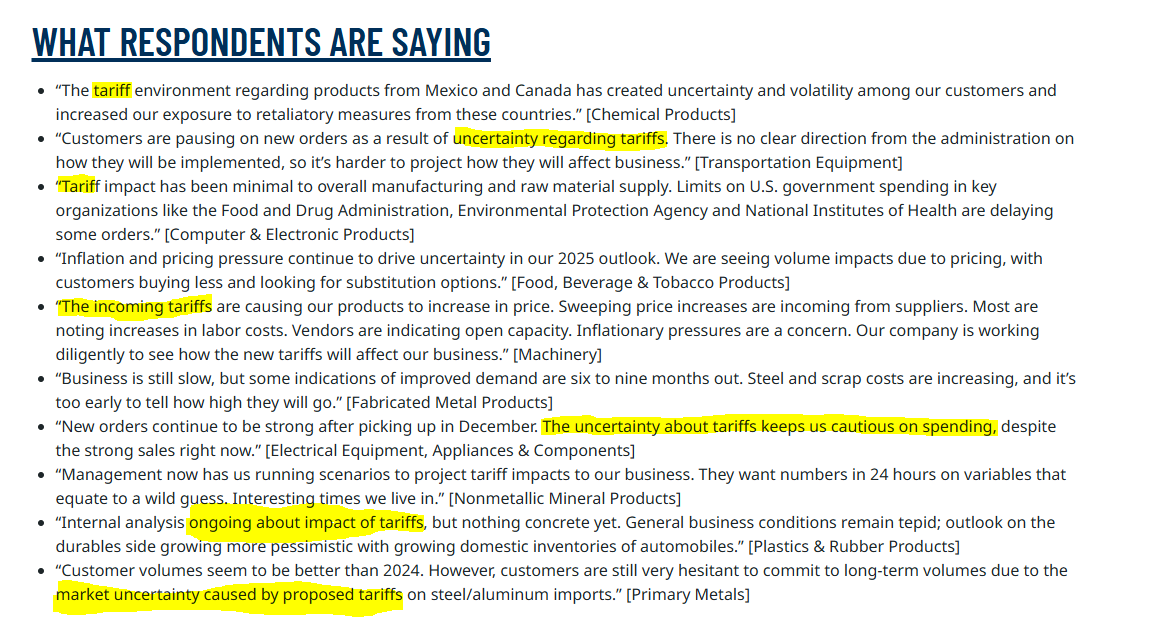
Tariff policy is especially bad because it is uncertainty about bad events. Here are comments from the latest ISM survey (h/t Joe Weisenthal).
Much of the Trump administration’s agenda promises long-term benefits, but chaos and uncertainty threaten its success. Tariff policy, in particular, is bad economics and even worse foreign policy. Even if Trump’s tariff strategy stabilizes, global responses—and their ripple effects—remain unpredictable and with potentially severe downsides. This uncertainty could spark an economic downturn, jeopardizing the administration’s otherwise strong policies.
All of this is unnecessary. We need to get back to the best case for a Trump Presidency.
New results on AI and lawyer productivity
From a new piece by Daniel Schwarcz, et.al., here is part of the abstract:
This article examines two emerging AI innovations that may mitigate these lingering issues: Retrieval Augmented Generation (RAG), which grounds AI-powered analysis in legal sources, and AI reasoning models, which structure complex reasoning before generating output. We conducted the first randomized controlled trial assessing these technologies, assigning upper-level law students to complete six legal tasks using a RAG-powered legal AI tool (Vincent AI), an AI reasoning model (OpenAI’s o1-preview), or no AI. We find that both AI tools significantly enhanced legal work quality, a marked contrast with previous research examining older large language models like GPT-4. Moreover, we find that these models maintain the efficiency benefits associated with use of older AI technologies. Our findings show that AI assistance significantly boosts productivity in five out of six tested legal tasks, with Vincent yielding statistically significant gains of approximately 38% to 115% and o1-preview increasing productivity by 34% to 140%, with particularly strong effects in complex tasks like drafting persuasive letters and analyzing complaints. Notably, o1-preview improved the analytical depth of participants’ work product but resulted in some hallucinations, whereas Vincent AI-aided participants produced roughly the same amount of hallucinations as participants who did not use AI at all.
Of course those are now obsolete tools, but the results should all the more for the more advanced models.
How Bureaucratic Practices Preserve Elite Multigenerational Wealth
Here is a new paper from Doron Shiffer-Sebba, I found this most amusing but yes tragic too:
How do wealthy families preserve their fortunes across generations? A historic peak in wealth inequality in the United States has inspired research on how economic elites benefit from markets, tax rates, and legal entities. However, the ongoing practices through which families maintain their fortunes across generations are less understood. Using six months of ethnographic observations at a wealth manager for the top 0.1 percent, as well as interviews with the manager’s clients and a wider sample of managers, I argue that wealthy families adopt what I call “bureaucratic practices”—activities like meetings, presentations, and signing documents—to preserve wealth intergenerationally. After erecting legal entities such as corporations, trusts, and foundations, wealth managers help wealthy families implement bureaucratic practices. These practices, which privilege bureaucratic form over substance, constitute a crucial behavioral layer atop the legal infrastructure, facilitating a greater degree of wealth preservation compared with using entities alone. Thus, preserving wealth at the top should be understood not merely as a set of discrete transfers from parents to children, but as an enduring multigenerational process of professional socialization that introduces new behaviors into family life.
Via the excellent Kevin Lewis.
Emergent Ventures, Taiwan cohort
Thanks to a very generous donor, we now will be starting a Taiwan cohort in Emergent Ventures. If you are in Taiwan, or know anyone in Taiwan who might be a good choice, of course consider applying or recommending as such. Thank you!
Male coaches increase the risk-taking of female teams—Evidence from the NCAA
Highlights from the article:
The coach’s gender has a sizable and significant effect on the team’s risk-taking, a finding that is robust to an instrumental variable approach.
Women’s teams with a male head coach make risky attempts 6 percentage points more often than women’s teams with a female head coach.
The difference is persistent within games and does not change with intermediate performance.
Risk-taking has a positive effect on winning a game and teams with a female coach would win more often if they chose risky attempts more often.
The gap in risk-taking of female teams by their coach’s gender is the greater, the more experienced their head coach is.
That is from a new paper by René Böheim, Christoph Freudenthaler, and Mario Lackner.
Monday assorted links
1. Increased (Platform) Competition Reduces (Seller) Competition.
2. GPT 4.5 on Bernard Williams. It is quite funny on the AI skeptics, I might add.
3. AI bookmarks. And AI-generated sheet music for classical music. And the Luddites they ain’t.
4. 2005 redux, my idea of how to clean up the house.
5. I never knew the median voter theorem was this powerful.
6. How is Australian state capacity doing?
Stripe’s Annual Letter
Stripe’s Annual Letter is eminently quotable and insightful. As a payments company, Stripe has a unique data on the entire business landscape. But who else about the Collison brothers would cite the O-ring model in their annual report?
Businesses on Stripe generated $1.4 trillion in total payment volume in 2024, up 38% from the prior year, and reaching a scale equivalent to around 1.3% of global GDP.
The businesses on Stripe span every chromosome of the economic genome.
The US corporate sector is both a cradle of invention and a densely populated graveyard of companies that had fabulous futures in their pasts.
How is AI making it’s presence felt beyond chatbots?
…we started with ChatGPT, but are now seeing a proliferation of industry specific tools. Some people have called these startups “LLM wrappers”; those people are missing the point. The O ring model in economics shows that in a process with interdependent tasks, the overall output or productivity is limited by the least effective component, not just in terms of cost but in the success of the entire system. In a similar vein, we see these new industry specific AI tools as ensuring that individual industries can properly realize the economic impact of LLMs, and that the contextual, data, and workflow integration will prove enduringly valuable.
Examples in this vein include Abridge, Nabla, and DeepScribe, which are rethinking medical and patient care, while Studeo is reshaping how real estate businesses market property. Architects are using SketchPro to instantly render designs with simple text prompts, restaurants are using Slang.ai to take phone reservations, and property managers are unifying customer support with HostAl. Harvey, whose Al legal assistant is used by many Fortune 500 companies, quadrupled revenue in 2024.
AI and SAAS make small businesses competitive with big business:
From 2005 to 2017, independent pizzerias in the United States saw a decline in numbers as the industry franchised. Then that trend in 2017. By 2023, more independent pizzerias in America than in any other year on record.
We think the rise of vertical SaaS is at least partly responsible. From a platform like Slice, dedicated specifically to the needs of pizzerias, new businesses can get a logo, website, payment system, ordering system, marketing toolkit, and branded boxes—basically everything else they need to operate their pizza
business (except an oven and the perfect sauce). They can remain independent while still benefiting from a franchisee’s economies of scale.
Crypto has found product market fit with stablecoins, “room temperature superconductors for financial services”.
Why care about stablecoins? Improvements to the basic usability of money make economies more prosperous. Consider the transitions from coins to banknotes, from the gold standard to fiat currency, and from paper instruments to electronic payments. Stablecoins are a new branch of the money tree. Such transitions occur with some regularity over the centuries, and the effects tend to be large.
Stablecoins have four important properties relative to the status quo. They make money movement cheaper, they make money movement faster, they are decentralized and open-access (and thus globally available from day one), and they are programmable. Everything interesting follows from these
characteristics.
(See also my talk to Congressional staff with Garett Jones on stablecoins and President Trump’s Crypto Executive Order.)
Finally, Europe needs to wake up:
We don’t think that anyone in Europe deliberately made it a policy goal to discourage the creation or success of new firms, but this has been the inadvertent result. GDPR alone is estimated to have reduced profits for small tech firms in Europe by up to 12%. Those cookie banners hurt, whether you accept them or not.
What I’ve been reading
1. Eric Topol, Super Agers: An Evidence-Based Approach to Longevity. Longevity research goes mainstream! Very clearly written, well argued, and focused on the science. I cannot pretend to evaluate the details of the material, but this seems a step ahead of the other, typically less serious books on the same topic.
2. Daniel Dain, A History of Boston, 772 pp., clearly written and consistently interesting. Most of all one receives the sense of Boston as a place with a long history of radical ideas. Has it moved away from that tradition or cemented it in? I find that more and more of America has little acquaintance with New England and its history, and this book is one good way to remedy that. Remember Rt.128? Paul Revere?
3. Stephen Macedo and Frances Lee, In Covid’s Wake: How Our Politics Failed Us. A reasonable, evidence-based, non-crazy account of governance failures and excesses during the Covid crisis. For me there was not so much new here, but I am glad to see saner voices moving into the discourse.
4. Making and Meaning: The Wilton Diptych, National Gallery of London. If you want to learn about a historical figure (in this case Richard II), read a book about an art work associated with them.

5. Zaha Hadid, Complete Works 1979-Today. Architecture, plus excellent preliminary sketches of the works. The Weil am Rhein works are my favorite of what I have seen by her. Exactly the kind of picture book that will become more valuable in an age of strong AI. Here are seventeen buildings by her.
John McWhorter, Pronoun Trouble: The Story of Us in Seven Little Words. Mostly about actual pronouns, not the PC debates.
There is Paul Bluestein, King Dollar: The Past and Future of the World’s Dominant Currency.