DeLong on the Symmetry Argument
Brad DeLong has an excellent post on the prisoner’s dilemma, the symmetry argument and Newcomb’s problem. He hits the nail on the head with this:
I am a dominant-strategy guy. If you find the Symmetry Argument
convincing–well, Grasshopper, you have once again failed to snatch the pebble
from my hand. But I feel the force of the other side: If you find the Symmetry
Argument an obvious fallacy–well, Grasshopper, you have once again failed to
snatch the pebble from my hand.
School Choice in Utah?
Utah could be getting a reasonably serious school choice program. In Friedman’s vision it is students that are funded not schools and students are funded equally regardless of where they choose to attend school – i.e. no fiscal discrimination. In the Utah plan, in contrast, the voucher money is still less than is spent per public school student and it is means tested. Nevetheless, the voucher is reasonably large and the program is state wide which together would make it the most significant voucher experiment in the United States.
Thanks to Fred Hastings for the pointer.
GMU and Prizes
GMU people study prizes, sponsor prizes and we win some also! Must be something in the water.
A George Mason University chemistry professor has won a $1 million
engineering prize for developing a simple and inexpensive means of
filtering arsenic from well water, an advance that is already
preventing serious health problems in hundreds of thousands of people
in his native Bangladesh and could help millions of others around the
world.The 2007 Grainger Challenge Prize for Sustainability,
administered by the National Academy of Engineering, will go to Abul
Hussam of Centreville, academy officials announced yesterday…His final creation — an easy-to-make, maintenance-free, two-tiered
system that uses sand, charcoal, bits of brick and shards of a widely
available kind of cast iron — removes virtually every trace of arsenic
from well water. It wowed an independent panel of engineering academy
judges who, under the rules of the prize, were looking for an
affordable, reliable, socially acceptable and environmentally friendly
solution to the arsenic problem that did not require electricity.Prize
rules also required that the product be proven in field conditions, not
just in a lab….The 2007 sustainability prize is the first in a series to be funded by
the Grainger Foundation of Lake Forest, Ill., created in 1949 by an
electrical engineer.
Thanks to Nitpicker for the pointer.
Go for the Gold!
Here from Business Week is a very cool story on a prize I had not heard of before.
A few years back, Toronto-based gold mining company Goldcorp (GG)
was in trouble. Besieged by strikes, lingering debts, and an
exceedingly high cost of production, the company had terminated mining
operations….Chief Executive Officer Rob McEwen needed a miracle. Frustrated that
his in-house geologists couldn’t reliably estimate the value and
location of the gold on his property, McEwen did something unheard of
in his industry: He published his geological data on the Web for all to
see and challenged the world to do the prospecting. The "Goldcorp
Challenge" made a total of $575,000 in prize money available to
participants who submitted the best methods and estimates…Within weeks, submissions from around the world were flooding into
Goldcorp headquarters. There were entries from graduate students,
management consultants, mathematicians, military officers, and a
virtual army of geologists….The contestants identified 110 targets on the Red Lake property,
more than 80% of which yielded substantial quantities of gold. In fact,
since the challenge was initiated, an astounding 8 million ounces of
gold have been found–worth well over $3 billion. Not a bad return on a
half million dollar investment.
Price Controls on Pharmaceuticals
Frank Lichtenberg uses a novel strategy to estimate the effect of price controls on innovation. Simplifying (see the paper for details) Lichtenberg argues that the profit from a pharmaceutical is essentially P*Q-FC where P is price, Q is quantity and FC is fixed cost. Most of the fixed cost is due to research and development and getting through FDA hurdles.
The key to Lichtenberg’s strategy is to note that changes in Q have the same effect on profit and thus on the incentive to innovate as changes in P (this is not really true since changes in P also influence Q but Lichtenberg adjusts for the elasticity of demand). Moreover we can estimate the effect of changes in Q on innovation by looking at how the incidence of a disease influences innovation. Lichtenberg finds, for example, that pharmaceutical innovation is higher among cancers with greater incidence (e.g. lung versus pancreatic cancer). Using the Q to innovation relationship he estimates that a 10% reduction in price would reduce pharmaceutical innovation by 5%.
We know that pharmaceutical innovation saves lives and has a very high benefit to cost ratio. Thus, price controls or other restrictions that reduce prices are almost certainly a bad idea.
Indeed, as I have argued before, health care spending on the margin has very low value. We know, for example, that Medicare regions that spend twice as much on patients have no better outcomes. Spending on health care research and development, however, has very high value. Thus price controls would be a disaster – reducing high value R&D and replacing it with low value current spending.
I fear that short-term thinking by politicians and the public will destroy the US pharmaceutical industry.
Walter Williams is Drafted
Our colleague, Walter Williams, is truly famous.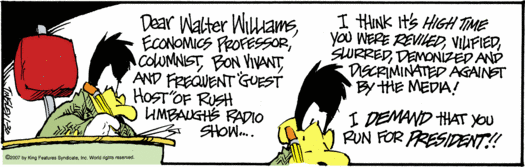
Onion or not Onion?
Three
Death Row inmates say the three-drug cocktail used in lethal injections have
not been approved by the Food and Drug Administration for executions and want a
federal judge to issue an injunction to stop the state from using the drugs
until it complies with federal drug laws.
According to sources at the Allstate Insurance Company, CIA
Director Michael Hayden purchased nuclear-attack insurance Wednesday, paying a
$100,000 monthly premium for his homes in suburban Washington, Pittsburgh, and
near Cheyenne Mountain, CO.
Thanks to Monique van Hoek and Daniel Rothschild for pointers.
1000 Word Rebuttal
The tax code, [Bush] said, “unwisely encourages workers
to choose overly expensive, gold-plated plans. The result is that insurance
premiums rise, and many Americans cannot afford the coverage they need.”Again, wow. No economic analysis I’m aware of says that when Peter chooses a
good health plan, he raises Paul’s premiums.
Rebuttal:

Digital Cash
A glamorous Whole Foods market just opened in my neighborhood. You can pay for your groceries using just the swipe of your fingerprint. Cool.
Abigal Alliance v. FDA
In May I wrote about the stunning ruling by the DC Circuit Court of Appeals that dying patients have
a due process right to access drugs once they have been through
FDA approved safety trials. (See the link for some amazing quotes from the ruling.) The case is now on appeal and possibly headed to the Supreme Court and I am thrilled to have a role.
I am one of the authors of an Amici Curiae brief, a friend of the court brief. The DC Circuit Court of Appeals made it’s ruling based on the right to control one’s own body:
A right of control over one’s body has deep roots in the common law. The
venerable commentator on the common law William Blackstone wrote that the right
to “personal security” includes “a person’s legal and uninterrupted enjoyment
of his life, his limbs, his body, [and] his health,”…barring a terminally ill
patient from use of a potentially life-saving treatment impinges on this right
of self-preservation.
But the court noted that a patient’s fundamental right could be rebutted if the FDA can show
that its policy of barring access to these drugs is "narrowly tailored
to serve
a compelling governmental interest."
The brief, submitted by Jack Calfee, Dan Klein, Sam Peltzman, Benjamin Zycher and myself, argues that barring access to experimental drugs does not serve a compelling governmental interest and in fact reduces patient welfare.
Unfortunately, I do not think that the Abigail Alliance can win the case; recognizing the rights that the DC Circuit of Appeals recognized would be too big a blow to our nanny state. Nevertheless, if we can help the court to be aware of some of the tradeoffs involved with drug regulation that will be valuable and it’s also great to be on a paper with Peltzman.
Thanks also to Ted Frank and others for acting as Counsel for the Amici Economists.
They thought they had me, but I had them! Maybe.
In a moment of weakness after my furnance broke down I bought a service contract. Now every few months I get a "free cleaning" during which the furnace repair guy tells me about all the other products I need.
The salesman, sorry, I mean furnace repair guy, seems honest and genuinely concerned about my ambient body temperature. Of course, I never listen to him or buy anything and this makes me very happy. See, I figure that most people do purchase additional services from such a fine young man. If so, then perhaps the real purpose of selling the insurance contract is not the insurance- it’s to get the salesman in your door several times a year. And that means that the insurance qua insurance contract ought to be reasonably priced, maybe even under-priced, or at least not jacked up as high as it would be if it didn’t lead to further sales.
Thus, I have cleverly reasoned my way out of foolishness and towards brilliance – such reasoning is to be distrusted. Nevertheless, I wonder whether the argument does not generalize.
Hard to make this stuff up department
Daniel Gross’s best argument for FDR is that FDR was better than Hitler.
Roosevelt scared investors and businessmen? Did he scare them as much as, oh,
Stalin, who controlled one of the world’s largest economies and was expanding
his influence? or as much as Mussolini? Or as much as the fascist government of
Japan? Or as much as Hitler, who was confiscating property of Jewish
investors and businessmen?
So there you have it. FDR not as bad as Hitler, therefore, FDR a good president. Compare with Bryan Caplan’s actual argument.
Not Normal on the New Deal
Readers will not be surprised to know that I am not normal. Indeed, I have not been normal for a long time as this post from 4 years ago attests:
Roosevelt and the Great Depression
I was amused to see Conrad Black writing with shock:
Jim Powell of the Cato Institute (cited approvingly in a recent column by Robert L. Bartley) argues in a new book that FDR actually prolonged the Depression!
Of course, Powell is correct. Imagine, increasing the power of
unions to strike and raise wages during a time of mass strikes and mass
unemployment. Imagine thinking that cartelizing whole industries
thereby raising prices and reducing output could improve the economy.
Not everything Roosevelt did was counterproductive – he did end
prohibition (although in order to raise taxes) – but plenty was and
worst of all was the uncertainty created by Roosevelt’s vicious attacks
on business. (See, for example, the work of Bob Higgs especially this important paper and historian Gary Dean Best’s overlooked classic Pride, Prejudice and Politics.)
Business investment failed to recover because business people
legitimately feared a regime change like that which had occured in
Germany and Italy. Sound extreme? Roosevelt himself threatened/promised
this in his first inaugural:
…if we are to go forward, we must move as a trained and
loyal army willing to sacrifice for the good of a common discipline,
because without such discipline no progress is made, no leadership
becomes effective. We are, I know, ready and willing to submit our
lives and property to such discipline, because it makes possible a
leadership which aims at a larger good… I assume unhesitatingly the
leadership of this great army of our people dedicated to a disciplined
attack upon our common problems….in the event that the Congress shall
fail to take one of these two courses, and in the event that the
national emergency is still critical, I shall not evade the clear
course of duty that will then confront me. I shall ask the Congress
for… the power that would be given to me if we were in fact invaded
by a foreign foe.
My wild self gets in big trouble
My wife was not at all happy about my recent post on the wild self.
The bottom line? If you want to please the economist in me, send me
cash. If you want to please my wild self (you know who you are!) use
your imagination.
Her words: "Your wild self is getting socks and don’t think any different. Thank goodness my friends don’t read your blog." Uh oh, now I am in real trouble.
Comments are not open.
Vive La Resistance
My anti-authoritarian, free-wheeling, libertarian colleagues and I easily found a dealer in downtown Chicago willing to sell us an illegal substance. Don’t tell the man but if you are in Chicago and want the good stuff ask for Kevin.