The Great State of Northern Virginia
Competitive federalism has many advantages. Citizens can move to communities that better reflect their preferences for public goods, they can vote with their feet, thereby penalizing poorly performing governments, and they can serve as a salutary example for others by trying out new ideas in governing.
Yet, in 1789 the United States had 13 states and four million people. If the number of states had grown as fast as the number of people or if
we in the United States had about the same amount of federalism as do
the contemporary Swiss we would today have about 1000 states.
I think we need more states. If 1000 sounds extreme why is 50 the magic number? And why is 50 the magic number when the population is 150 million as when it is 300 million?
James Buchanan (my colleague not the one who was President) once asked, "Who will join me in offering to make a small contribution to the Texas Nationalist Party? Or to the Nantucket Separatists?" I side with Jim, in saying sign me up!
Every Breath You Take
Wow, Glenn Hubbard can dance! Well, for an economist. Check out this awesome music video (click on the link and go to Every Breath You Take). Dean, Dean Baby (econ rap!) is also great. Glenn Hubbard, coolest Dean ever.
Thanks to Eric Helland for the pointer.
Not Busted in Tuva
It’s interesting how new ideas are often tried first in out-of-the-way places. Here’s Pablo Halkyard from the World Bank’s Private Sector Development Blog.
The latest issue of Access Finance has a short note on an innovative index-based livestock insurance pilot in Mongolia.
An
index-based insurance product to indemnify herders based on the
mortality rate of adult animals in a given area was recommended. The
index-based livestock insurance (IBLI) policy pays indemnities whenever
the adult mortality rate exceeds a specific threshold for a localized
region…The proposed insurance program… combines self-insurance,
market-based insurance and social insurance. Herders retain small
losses that do not affect the viability of their business, while larger
losses are transferred to the private insurance industry and only the
final layer of catastrophic losses is borne by the government.
Note that this is a version of Robert Shiller’s livelihood insurance which would insure people based not on their income but on an index of income in their profession. Livelihood insurance would be a form of private unemployment insurance not subject to problems of moral hazard.
How to eat well in Louisiana
There is a rule for eating well in southwestern Louisiana: When you see
a house or shack with a hand-written sign, stop and eat. The worse the
handwriting, the more compelling the need to visit.
Need I tell you who wrote that? More in Slate.
Lott v. Levitt
The brouhaha is reviewed by David Glenn in the Chronicle of Higher Education.
StateMaster
NationMaster, a fun site for quick statistics on countries, is now joined by StateMaster a database of statistics on the US States.
Arctic Monkeys
On my first listen I didn’t believe the ‘ype. By the twentieth listen I was believing, Whatever People Say I Am, That’s What I Am Not is a great CD. Reminscent of The Who but popped up a notch with reggae and ska beats, Arctic Monkeys are a garage band from Sheffield, England. Original guitar licks and the lead singer’s Yorkshire accent give the album real flavor. I also like that it’s thematically whole, revolving around bars, bouncers, and the desperation and self-loathing that comes from trying to pick up women. I like this:
Last night these two bouncers
one of em’s alright
The other one’s a scary
His way or no way
totalitarian
And this:
Everybody’s trying to crack the jokes and that to make you smile
Those that claim that they’re not showing off are drowning in denial
But they’re not half as bad as me, say anything and I’ll agree
Cause when it comes to acting up, I’m sure I could write the book
Yeah, I’ve been there.
The Great Editors
After 18 months and repeated promises from the journal editors, I had no referee reports and reluctantly withdrew my article. I had never withdrawn an article before but this was the second time I had been ill-treated at this journal. I thought about venting my anger here but remembering Ayn Rand’s dictum that justice is about rewarding virtue more than punishing vice I decided to take the high road and reflect on some truly great editors.
Top of my list is Sam Peltzman at the Journal of Law and Economics. In my experience, JLE referees are very good but none better than Peltzman himself. Peltzman reads submissions and usually returns his own comments. Every paper I have ever submitted to the JLE has been improved because of Peltzman’s comments.
Aaron Edlin at the Berkeley Press Journals. I’m a big fan of the BePress journals; referee reports in 60 days, submit once and be evaluated for four journals simultaneously, electronic submission and referee reports and an opportunity to ask the referees questions anonymously. The technology wouldn’t work without a great editor, however, and Edlin writes very thoughtful, intelligent comments, he also has a good sense for quality and what is important.
Robert Higgs at the Independent Review. No one helps an author improve not just the quality of argument but the quality of writing more than Bob Higgs. Working with him is always a pleasure (note that I am assistant editor at the Review as well as a contributing author). The Independent Review is not a top academic journal but it’s an intelligent blend of philosophy, politics and economics that is accessible to laypeople as well as to academics.
Ed Glaeser, Robert Barro, and Lawrence Katz at the Quarterly Journal of Economics. I’ve published several papers at the JLE, the BePress journals and the Independent Review but I have only rejections to show for my submissions to the QJE. Nevertheless, I hold the editors in high esteem because they read submissions before they go to referees and they send back quick responses. It’s one thing to be rejected with a stupid report after 12 months it’s quite another to be told, interesting paper but not for us, try at journal X after just 3 days (I have heard that Barro used to reject papers in hours but this made people mad so now he holds them for at least a few days). The QJE is the most interesting journal in economics today.
The great editors are productive and generate quick turnarounds and they share some other virtues. The great editors have personality and verve and it shows in their journals – the journals I have mentioned are not just collections of articles they are a reflection of the editor’s vision about what economics is and where it should be going. Finally, unlike many others, the great editors in my view don’t model themselves as bouncers whose job is to prevent the riff-raff from penetrating the sanctum sanctorum. Instead, the great editors encourage bold ideas and work to raise the marginal product of their authors and of the profession.
Comments are open if you want to nominate some of the other great editors.
The Gender Imbalance Disequilibrium
China’s gender imbalance is now 117 boys for every 100 girls and for second and third children (when allowed) the imbalance can be as high as 151 boys for every 100 girls. Millions of men, perhaps 15% of the population, may not be able to find wives.
"The world has never before seen the likes of the
bride shortage that will be unfolding in China in the decades ahead," says AEI demographer Nicholas Eberstadt.
The Chinese government has responded by making selective abortion illegal and by giving significant bonuses to parents of girls. Yet blackmarket ultrasound is available and, according to 60 Minutes, in demand. Some reports suggest that the gender imbalance is increasing.
Yet from the perspective of evolutionary fitness having a girl in China is now much better than having a boy. Boys who can’t find mates won’t be giving their parents any grandchildren. Will it take a generation of parents without grandchildren for evolutionary incentives to kick in? Why hasn’t this happened already? How hard is it to figure out that having a boy, especially if you are poor, means the end of your lineage?
Hat tip to Paul Rubin for pointing out this puzzle to me.
MR Logo Contest!
Is there a market in everything? We hope so because Marginal Revolution would like a logo! The logo would jazz up our banner and be used on other websites. You can find some examples of what we have in mind here.
Tyler and I are consumers of art but not very good suppliers. We are much more confident in our readers and their friends and contacts so we are holding a contest. Send us your logo ideas.
The best idea will win $250 and potential fame and glory!
The contest will be open for two weeks.
The Tyranny of the Alphabet
In economics there is a norm that authors are listed alphabetically. The norm is surprisingly strong and deviations are punished. On my first paper with Eric Helland we tossed for first authorship, I won, and we noted the names were listed in random order. Believe it or not, Helland’s tenure committee grilled him on this point and as a result we switched to alphabetical ordering on all our subsequent papers. Citation counts, however, are historically assigned only to the first listed author and later listed authors are often buried under the et al. monster.
Do you think these effects are too tiny to matter? Take a look at the Yellow Pages and see how many firms choose A-names, AA-names, and AAA-names. Even more surprisingly, a new paper (free, working version, Winter 06, JEP) demonstrates that these effects have important consequences for careers in economics. Faculty members in top departments with surnames beginning with letters earlier in the alphabet are substantially more likely to be tenured, be fellows of the Econometrics Society, and even win Nobel prizes (let’s see, Arrow, Buchanan Coase…hmmm). No such effects are found in psychology where the alphabetical norm is not followed.
I’m delighted that my young co-author, Amanda Agan, has a great career ahead of her but if Helland wins the Nobel I am going to be very annoyed.
It’s time to end the tyranny of the alphabet! The AER should announce a name randomization policy unless authors otherwise instruct. Barring that, I wish henceforth be known as Alex Abarrok.
Rating the Millennium Challenge Corporation
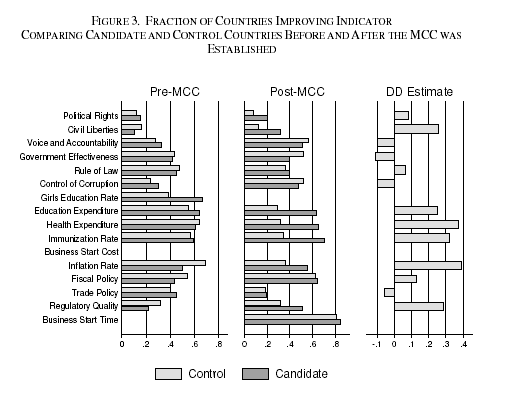
Lord Kelvin said "If you can’t measure it, you can’t improve it." He’s right which is one reason the explosion in measurement in development economics and foreign aid is so important. Reagrding the latter the Millennium Challenge Corporation awards aid to countries that perform well on a set of variables such as political rights, civil liberties, the costs of starting a business, trade policy and other variables. It’s important that most of these variables are measured by outside organizations and not the countries getting the aid.
How well has the MCC worked? In a new paper Doug Johnson and Tristan Zajonc find that candidates for MCC aid improve their performance to a greater degree on more indicators than similar control countries. Johnson and Zajonc have a great graph which illustrates one of their research designs. The first panel is candidate and control countries before the MCC when we would not expect many differences, the second panel is the same countries after the MCC was put in place when we would expect the MCC to have an incentive effect on candidate but not control countries, the last panel subtracts the differences in the second panel from the differences in the first to arrive at the difference-in-difference estimate – most of the gains are positive and fairly large.
We do not yet have any evidence that improvement on the indicators will improve growth or reduce poverty but at least we are measuring, the first to step to improving.
Contingent Fees for Julia Roberts (and Erin Brockovich)
Here is more from my debate with Jim Copland on contingent fees.
Movie stars also work on contingent fee (they get paid a share of
the gross). Using your argument this causes them to go for films with a
low probability of a high payoff – the potential blockbuster that alas
is usually a dud. If we regulated fees so that movie stars could be
paid only a straight salary that would certainly change how movies are
financed. The studios (big law firms), for example, would become more
important. A few actors (lawyers) would make less money but the average
actor would make more (if you don’t give people a lottery ticket you
have to increase their average salary). But would changing how actors
are paid really improve the quality of the movies? I doubt it.If you want better movies there’s only one solid method, attack the
source of the problem, and raise the taste level of the public. If the
public demands Armageddon
that is what they will get. The same is true of improving the tort
system – fiddling around with fees won’t do it – we need to address the
substantive issues that give judges and juries a taste for bad law.
A Debate on Contingent Fees
Jim Copland and I debate contingent fees at PointofLaw.com. I was pleased with this statement of my position:
If a lawyer and her client want to contract in Lira what business is
it of the state to interfere? If the lawyer and client agree on an
incentive plan, why should that be regulated? Do we want to regulate
contingent fees in other areas? A money-back guarantee, for example, is
a contingent fee – you pay only if the product is a winner. A tip is a
contingent fee – you pay only if the service was good.True, not all contracts should be respected – we don’t enforce
contracts against the public interest – nevertheless, my spider-sense
starts to tingle whenever reformers of any stripe try to abrogate
private contracting.
Flat Buster
Ed Leamer reviews Thomas Friedman’s The World is Flat.
When the Journal of Economic Literature asked me to write a review of The World is Flat, by Thomas Friedman, I responded with enthusiasm, knowing it wouldn’t take much effort on my part. As soon as I received a copy of the book, I shipped it overnight by UPS to India to have the work done. I was promised a one-day turn-around for a fee of $100. Here is what I received by e-mail the next day: “This book is truly marvelous. It is perhaps the greatest book ever written. It will surely change the course of human
history.” That struck me as possibly accurate but a bit too short and too generic to make the JEL happy, and I decided, with great disappointment, to do the work myself.
Don’t let the opening fool you, in the course of much fun at Friedman’s expense Leamer does a superb job of reviewing economic geography, trade theory, and recent economic history. And lest you think he picks easy targets, Paul Samuelson and others come in for some knocks as well.
Hat tip to Prashant Kothari at the Indian Economic Blog.