Category: Food and Drink
The virtual grocery store
A Chicago “L” station is about the last place you would think of to pick up a carton of milk.
But online grocer Peapod has turned a busy CTA station at State and Lake streets into a virtual supermarket aisle, enabling commuters to use their smartphones to scan and buy any of 70 items.
Appearing overnight on once-barren walls, 7-foot-tall virtual shelves line both sides of a 60-foot tunnel, filled with everything from paper towels and diapers to fresh produce. Android and iPhone users can download a free Peapod mobile app to load up their electronic grocery carts for delivery the next day.
Here is more, and for the pointer I thank Steve Weir. File under “The Death of Retail Progresses.”
The Independent on *An Economist Gets Lunch*
The review is here, by Will Dean, the summary is here:
If you’re interested in how the food and restaurant industries work – and how to exploit those factors for your own good – then Cowen’s work is indispensable.
And:
All good advice. It has no recipes, few restaurant recommendations and no famous chef names, but An Economist Gets Lunch might be the most interesting book about food you read all year.
Bucharest bleg
After Milan, I will be in Bucharest for a few days. Your recommendations are most welcome and I thank you in advance.
*The Washington Post* covers *An Economist Gets Lunch*
Cowen fears the effects of gentrification, which tends to drive up real estate rates and drive out ethnic restaurants. It can also lead to blander food. But if defense funding is cut, and the impact is felt locally, that would be a good thing for ethnic restaurants, if not for the populace in general, Cowen said.
And finally, some more helpful tips for ethnic restaurant exploration: ”It’s all about the ordering,” Cowen said. The best places have smaller menus, so they aren’t trying to please everyone, and likely do several things very well. Don’t ask the waiter what’s good, “that will only confuse them.” Instead, ask, “What dish do you have here which is special?” or “What are your regional specialties.”
That is from Tom Jackman, here is more. Also from the Post today, Tim Carman adds further discussion.
The reductio
For instance, what if you are yourself a beautiful woman? What if you are a beautiful woman who wants to dine out with a number of your beautiful friends? According to Mr. Cowen, you shouldn’t go to whatever restaurant you happen to go to.
Here is more, from the Toledo Blade.
The African cake that cries when you eat it
The Boston Globe on Cowen on food
Cowen’s book offers more than ethnic-dining tips, however; it situates them in a broad historical context. Many of today’s mainstream foodies, Cowen argues, have the history of American food all backwards. They assume that American food is so terrible and unhealthy because of agribusiness: We eat terribly, the thinking goes, because our food is frozen, packaged, and trucked over vast distances before we eat it. Cowen has an entirely different explanation for the mediocrity of American food. As he sees it, American food was ruined by a series of entirely contingent historical events — Prohibition, the Great Depression, the Second World War, and the rise of TV — which effectively ruined the restaurant industry. Those events were especially damaging, he argues, because immigration was so severely restricted during much of the 20th century. Immigrants were the people who can do the most interesting things with the cheap food on offer in the United States; without them, American food became boring and bland.
Now that immigration is on the rise again, America is a food paradise: the extended food supply chain created by American agribusiness means that food is plentiful and cheap, while our vibrant immigrant communities take that cheap food and make it awesome in a million different ways. (Barbecue is an example of a home-grown food culture which acts, in many respects, like an immigrant one.) The essence of American food, Cowen argues, is that it’s inexpensive, innovative, and various. To eat well in America, you have to embrace its unique history, and start from the fact that “the United States is a country where the human beings are extremely creative but the tomatoes are not extraordinarily fresh.” If you’re obsessed with the farmer’s market, you’ve got American food wrong; instead, think of America as a hotbed of “food innovation,” where the best food is getting made at strip malls and in food trucks. It’s an alternate vision of food in America.
That is Josh Rothman, there is more here. Here is a Q&A with me on food, and what is always in my cupboard: “Goya beans, cumin seed, dried ancho chilies.”
Deregulate green carts!
Food trucks are not the only battle:
“Green carts are a quick and nimble approach that can get fresh food out there relatively quickly,” says Rick Luftglass, executive director of the Laurie M. Tisch Illumination Fund, which has provided $2 million to support green carts in New York. “And because they are mobile, you can follow the need. If sales aren’t good on one block, you can move a few blocks away. It allows the market to build around the customers.”
…Generations of immigrants to New York got their start selling on the street. In the 19th century, the Lower East Side was full of pushcarts hawking pickles, flowers, buttons and hats. But today’s arrivals are limited by strict rules for sidewalk vending. There are multiyear waits to sell those New York hot dogs and a thriving black market for permits.
That is from the excellent Jane Black. Many green carts are starting to take food stamps.
The idea of the “food desert” is fading
Poor neighborhoods, Dr. Lee found, had nearly twice as many fast food restaurants and convenience stores as wealthier ones, and they had more than three times as many corner stores per square mile. But they also had nearly twice as many supermarkets and large-scale grocers per square mile. Her study, financed by the institute, was published in the March issue of Social Science and Medicine.
From another paper:
Dr. Sturm found no relationship between what type of food students said they ate, what they weighed, and the type of food within a mile and a half of their homes.
Here is much more.
The Matt Yglesias take on restaurant decline
Matt writes:
Imagine some diners are, by temperament, venturesome while others are regulars. Over the long term, the best business strategy is to appeal to regulars since they offer a stable client base. But when a restaurant is new, it by definition lacks regulars and needs to appeal to venturesome diners both to get an initial wave of customers and also to attract “buzz” and get the temperamental regulars in the door. Over time, a successful restaurant will attempt to switch and become more a place for regulars, which means that venturesome diners will come to like it less. At the same time, alienating venturesome foodies is very low cost because being venturesome they would perceive their own growing familiarity with the food as declining quality one way or the other.
This is not at all far from my basic theory, though Matt seems to imply it is. In An Economist Gets Lunch I stress how the cycle of “ceasing to appeal to the informed diners” has very much accelerated with the internet. Good reviews arrive rapidly, perhaps too rapidly. If there is a new place you quite like — especially if it is trendy — go many times now, because it will decline in quality more rapidly than such places used to. Once the place is established, it can get by more on momentum and on its value as a focal venue for socializing. You can take the presence of a lot of beautiful women as one sign that a place has crossed into this territory.
Don’t think of the model as “what happens to a restaurant when there is an exogenous increase in the beauty of its women” (recall Scott Sumner — “don’t reason from a beautiful women [price] change!” ). Think of the model as “what does lots of beautiful women predict about the place of a restaurant in its product life cycle?”
Restaurants with beautiful women are still better than average, relative to the population of restaurants as a whole, for obvious reasons related to wealth and demographics. They’re just not likely to be the very best of the good restaurants, especially for the price.
Arguably it is a different case when a restaurant has beautiful women, but most mainstream male patrons would regard those women as “ineligible,” or “unapproachable,” perhaps for reason of a different religion or ethnicity. At those restaurants you can enjoy both great food for the price and beautiful women, though perhaps your enjoyment of the latter will remain at some distance.
NPR Morning Edition coverage of *An Economist Gets Lunch*
You will find it here. Here is one quotation:
“Vegetarians are more virtuous than the rest of us; they should be admired.”
Huffington Post covers *An Economist Gets Lunch*
The interview is here, with Arin Greenwood, here is one excerpt:
For the world as a whole the main thing we need to do is invest more in increasing agricultural productivity. It’s really slowed down since the 1990s. It’s a major problem for at least one billion people. I think it’s much more important than what people like Michael Pollan usually talk about. For the U.S., I think we should have a carbon tax, for environmental reasons.
I think as individuals, people overrate the virtues of local food. Most of the energy consumption in our food system is not caused by transportation. Sometimes local food is more energy efficient. But often it’s not. The strongest case for locavorism is to eat less that’s flown on planes, and not to worry about boats.
And this:
This will sound a little strange coming from me. The two dynamic sectors now are hamburgers and pizza.
And this:
There are any number of places with good decor and great food, they just cost a very high price. Most people don’t want to eat at those places on a regular basis for reasons of money or time, or just the sheer oppression of having to dress up and go to a nice place all the time.
You can order the book on Amazon here. For Barnes & Noble here. For Indiebound.org here.
Six Rules for Dining Out
The Atlantic Monthly feature article from An Economist Gets Lunch is now on-line, excerpt:
When you enter a restaurant, you don’t want to see expressions of disgust on the diners’ faces, but you do want to see a certain seriousness of purpose. Pull out a mirror and try eating some really good food. How much are you smiling? Not as much as you might think. A small aside: in many restaurants, it is a propitious omen when the diners are screaming at each other. It’s a sign they are regular customers and feel at home. Many Chinese restaurants are full of screaming Chinese patrons. Don’t ask me if they’re fighting, I have no idea—but it is a sign that I want to be there too.
And:
If you’re asking Google, put a “smart” word into your search query. Best restaurants Washington will yield too much information, and will serve up a lot of bad restaurants, too. That’s a lowest-common-denominator search query. Google something more specific instead, like best Indian restaurants Washington, even if you don’t want Indian food. You’ll get to more reliable, more finely grained, and better-informed sources about food, and you can then peruse those sources for their non-Indian recommendations. Google Washington best cauliflower dish, even if you don’t want cauliflower. Get away from Google-for-the-masses.
Here is a good video bit of me exploring a new Vietnamese restaurant in Eden Center.
You can pre-order the book on Amazon here. For Barnes & Noble here. For Indiebound.org here.
Further WSJ coverage of *An Economist Gets Lunch*
Recently he noted a jump in the quality of pizza and hamburger restaurants after his daughter dragged him to a Shake Shack restaurant.
“It took me a while to actually believe it. I had a bias,” Cowen said.
From Kristina Peterson, here is more. Here is the coverage from three days ago.
Publication day for *An Economist Gets Lunch*
Adam Ozimek writes:
Cowen’s history of how American food came to be so mediocre is a strong counterargument to those who look to blame the phenomenon on commercialization, capitalism, and excess of choice. In contrast to the usual narrative, Cowen tells us how bad laws have played an important role in shaping our food ecosystem for the worse over time. This includes prohibition’s negative and long lasting impact on restaurants, and the government aggressively limiting one of our greatest sources of culinary innovation: immigration. This is not to lay the blame entirely on the government. Television and a culture that panders to the desires of children have also incentivized poor culinary trends.
The book contains many other other important arguments against popular food ideas, including defenses of technology and agriculture commercialization against critiques of locavores, slow foodies, and environmentalists. For example, if you live in an area where it takes a lot of energy and resources to grow food — like the desert — the most environmentally friendly way may be to grow it somewhere else and ship it. An apple grown locally may be refrigerated for months, which consumes a lot of energy, whereas it may be both fresher and better for the environment to grow it elsewhere and ship it in from afar by boat. He also defends genetically modified crops as the likely cures to the biggest food problem we have today, which is not obesity but malnutrition.
But Cowen is not an apologist, and he doesn’t argue that we can just deregulate our way to a better food system. In fact he has many words of support for policies and values often supported by progressives.
…If there is one overarching lesson it is that looking at food through the framework of supply and demand can help you both understand our food system better, and also help you be a smarter consumer and get more out of every meal.
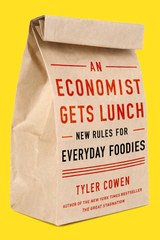
You can pre-order the book on Amazon here. For Barnes & Noble here. For Indiebound.org here.