Category: Political Science
Good sentences
But it’s much easier for Pakistani actors to manipulate US policy than the reverse.
There is more on Bhutto here and here. And here is another interesting post from The Atlantic.
Addendum: The second link is now corrected. Here is a new one as well.
Speak English, lower taxes
Megan McArdle writes:
It is hard for high levels of taxation to survive a right of exit;
Europe has mostly been protected (so far) by its many languages, which
make it harder to move. But as the EU increases labor mobility, expect
to hear more about harmful tax competition.
The story is about skilled Danes leaving the country so as to avoid higher taxes. The last time I was in Denmark I was struck how many service workers could not speak Danish (will a Spaniard or Hungarian really learn that language?) and in the workplace communicated in English. Greater policy competition is one of the most important results of so many Europeans speaking good English. High taxes and differential incomes, in turn, increase the incentive for people to learn good English, thereby creating a self-reinforcing dynamic. I’ve long thought that Europe will become more like the United States than vice versa, most of all through mobility and diversity, but I don’t think that is a very popular view.
Ron Paul as President
Bryan Caplan defends the prospect of a Ron Paul presidency. Here is Megan McArdle. Here’s yet another perspective. Here is Ezra Klein. Here is Paul himself.
The Ron Paul phenomenon reminds me of the old America First movement, with Misesian 100 percent reserve banking theory on top. He is making (one version of) libertarianism much more popular by allying it with nationalist and also states’ rights memes. That includes his stances on immigration, NAFTA, China, devolution of powers, and "The Constitution." Even when the policy recommendations stay libertarian, I fear that the wrong emotions will have the staying power. Evaluating a politician is not just about policy positions; for instance personally I am skeptical of most forms of gun control but I worry when a candidate so emphasizes a pro-gun stance.
Many libertarians see the Paul candidacy as their chance to have an impact and they may well be right. There is also no one else for them to support. But, raw milk or not, I am not myself tempted to take a stance this year in favor of any of the candidates, Paul included. Liberty is lacking in the United States but I’d like to see it more closely bundled with reasonableness, moderation, and yes pragmatism; I
am looking to advance on all fronts at the same time. Call me fussy if you wish.
I fear that Ron Paul is so taken with his own ideas that he is unable to see how or when his views might ever be wrong; it is in that sense I consider him insufficiently intellectual. (Admittedly all the other candidates are too open to whatever is politically popular at the moment.) Openness also means ability to improvise, which is a critical leadership quality; many of the challenges of the presidency are the surprises, 9/11 being one example of many.
The America Firsters, by the way, were right about many things, but
they were very wrong about a few very big things, such as World War II
and the civil rights movement. They also suffered a virtually total
eclipse for decades. I don’t see nationalist and states’ rights memes as a path toward a future with more human liberty.
Ron Paul is changing the ideological landscape of American politics and the fabric of modern classical liberalism. No matter what your point of view, I recommend that you take the Ron Paul phenomenon very seriously indeed.
Addendum: Here are good remarks from Arnold Kling and Steve Horwitz.
Faux Indian government
A fake government office has been discovered in northern India that collected taxes, provided civic services and even handed out birth and death certificates, a report said Monday.
An office was set up outside Jhansi town in Uttar Pradesh state and 20 people were employed to carry out jobs such as street sweeping.
I liked this part:
"He later seems to have decided to carry on with the office as it did not appear to be a loss-making proposition," an unnamed police officer was quoted by Times of India saying.
The scam only came to light after some employees complained about salary problems to superiors in the actual government department, the report said.
"We were shocked to hear this as we ourselves were not aware that our department had a branch office," R. Kulkshreshtra, an official with the Jhansi Municipal Corperation, told the newspaper.
Here is the story, here is another. Thanks to Sarah Jeong for the pointer.
Or if you’re interested in Indian outsourcing, try this, courtesy of Peter Clark.
My answer
The criticism personally offends him and he cannot tolerate it. Surely you have known people like this in conversation [and department politics?], and they didn’t even have any guns or nuclear weapons or polonium behind them.
That’s with help from Natasha. Here was Bryan’s question:
Putin is popular…what’s the point of persecuting the opposition?…if he’s really so popular, why risk looking like a paranoid despot?
CBO Director’s blog
You’ll find it here, the mission statement is here:
CBO has launched a Director’s Blog (at http://cboblog.cbo.gov/ ) that
will:
** introduce new reports and testimony,
** explain or clarify CBO’s analysis when there appears to be
significant misinterpretation or misunderstanding of that analysis, and
** link CBO’s work to relevant outside research from academic or other
institutions that may shed additional light on the issues the Congress
is working to address.
Thanks to a loyal MR reader for the pointer.
Simple public choice
Here is Dani Rodrik defending Hillary on trade, here is Paul Krugman. Here is the very good critique from Clive Crook. So what’s up? My uninformed default assumption is that Hillary wants to win the Iowa caucases. That means her goal is to signal protectionism to Iowa activists and voters, and sophisticated non-protectionism to the more trade-oriented elites and donors. Congratulations if you were able to pick out the latter signal, but don’t confuse it with a defense of what she said, why she said it, or when she said it.
Primaries
The voting weights implied by the estimated model demonstrate that
early voters have up to 20 times the influence of late voters in the
selection of candidates, demonstrating a significant departure from the
ideal of "one person, one vote."
Here is the paper, I cannot find non-gated versions. If we were aiming for efficiency, and the saving of time, rather than democratic equity, in which state should the first primary or caucus be held?
Is libertarianism the new “in” thing?
Here is the story. Nick Gillespie says:
"We’re the Sith Lords of American politics," he says, referring to
the "Star Wars" baddies. "We can show up in any group. We’re both
terrifying and devilishly attractive."
Since I’m not either of those things, and I’ve made other claims about the Sith Lords, I said something different:
Libertarian economist Tyler Cowen of George Mason University says
the new breed of Swiftian commentary found on shows such as "The Daily
Show" and "The Colbert Report," though not explicitly libertarian, also
has contributed to the current libertarian moment. "The way to be funny is to make fun of something," Mr. Cowen notes.
There is more by me at the very end of the article (yes, you too can look into my heart). In part libertarianism has become cool because Republicanism has become so uncool, thereby leaving a cultural gap which Hillary Clinton alone cannot fill.
What is wrong with Amtrak?
Megan McArdle tells us:
…why is America’s high-speed rail so dreadful? The Acela delivers
you, at enormous added expense, to Boston one hour ahead of the
regional. On the DC-to-NY run, the added benefit is 10-15 minutes. The
answer is that the Acela uses existing track, which is twisty, the
better to serve every congressional district between here and Boston.
Real high speed rail needs to be fairly straight, for the same reason
you don’t take hairpin turns at 120 mph in your car.
I had never heard the Congressional district argument before. I’ve also heard that freight railways crowd the lines and Amtrak doesn’t pay a high enough prices for access; the freight services had, way back when, pledged to the government to give Amtrak trains priority but of course that kind of cheap talk is not enough to get the job done; here is some relevant background, and more here. Here is a good summary of Amtrak critiques. It comes from a whole blog devoted to criticizing Amtrak.
Markets in Everything: Think Tanks
Why buy votes when you can buy the Bay Area Center for Voting Research? The BACVR analyzes voting trends in California and nationwide; they are best known for their ranking of the most liberal and most conservative cities (pdf) in the nation. The founders, however, want out and are selling all of BACVR’s intellectual assets, including the organization’s web site, past research, and well-known name on eBay. The perfect Christmas gift for that political junkie on your list.
Of course some people believe that all think tanks are for sale.
Should we let people sell votes?
Mankiw says no, Caplan says the real problem is voting itself. Of course we let private shareholders sell their votes all the time, and uncontroversially, so the real issue is how politics is different.
Say society has a 9999 people. The marginal private value of a (political) vote is almost zero, except for its feel-good benefit (see also Gelman on altruistic motives to motivate voting). Yet the total value of 5000 votes — a winning tally — is the size of the largest wealth transfer that the winner could impose on everyone else. The result will mimic a model of self-interested voting but with only one self-interested voter — the owner of the purchased votes — having a say. And that winner will be the conscience-less (non-liquidity-constrained) person who has the most to gain from buying up votes and getting things his way.
Of course Bryan, in other contexts, has shown that expressive voting is more likely than the self-interested voting model, at least under standard democracy. I would rather have expressive voting than what is explained directly above, even though expressive voting is somewhat irrational.
Maybe voters will end up with sudden attacks of conscientiousness and be unwilling to sell their votes; to that extent vote-selling won’t much matter and of course then it can’t bring gains either.
Now let’s go back to the corporate case. When it comes to policy, shareholders might not agree on means but everyone favors the same end of profit maximization. A winning coalition of shareholders can’t do much to extract rents from other shareholders, unless of course they are exploiting those other shareholders in their other roles as consumers or input suppliers. But such effects are usually small (as opposed to the widespread possibilities for redistribution through politics) and thus vote selling works just fine for corporations. There is no simple way that shareholder A can buy up the votes of shareholders B and C and then just screw them over.
Coda: There is a potential problem with vote-selling in corporations, again relating back to the difference between marginal and average value for a vote. Shareholders might be afraid to sell to a takeover artist, instead wishing to hold on for the ride and reap gains from the change in corporate control. But if no one sells the takeover cannot take place and no one reaps the gains. In other words, there is too little vote selling; that’s Grossman and Hart, 1980. Alex once wrote an excellent paper on this problem (but where is the link Alex?) and showed that the free-rider problem among shareholders can usually be solved by random Nash strategies; note that the final outcome will depend on whether there is a countable or uncountable infinity of shareholders; please don’t laugh!
The bottom line: There are good economic arguments for why we allow corporate vote-selling but not political vote-selling.
Why is Kasparov still alive?
One loyal MR reader wrote in the comments:
He’ll [Kasparov] be fine. Killing him would be too bad a move in terms of PR.
But that is exactly my worry. Putin has many would-be enemies. What better retaliation than to do something evil and make it look like Putin is possibly at fault? (That is in fact one theory about the polonium poisonings.) Maybe you think Putin has already signaled credibly that he wouldn’t kill Kasparov, but if that is the case then he could in fact turn around and order it done and not take the blame. Either way the equilibrium looks like assassination. The going rate for an assassin simply isn’t that high and surely somebody has at least that much at stake in the outcome.
When I was a little kid I saw TV coverage of the assassinations of Bobby Kennedy and Martin Luther King. I recall wondering why every famous politician, or at least every reachable famous politician, isn’t assassinated. Or why isn’t the equilibrium quantity of product sabotage — accompanied by options trading of course — very high? The sabotage doesn’t have to hurt people to lower share prices.
If some people find it worthwhile to send spam, why don’t many more? Is the cost structure really that heterogenous on the production side?
I might add these are important questions for understanding a future of extreme nuclear proliferation.
The economic consequences of Mr. Bush?
Joseph Stiglitz writes:
You’ll still hear some — and, loudly, the president himself — argue that
the administration’s tax cuts were meant to stimulate the economy, but this was
never true. The bang for the buck — the amount of stimulus per dollar of
deficit — was astonishingly low. Therefore, the job of economic stimulation
fell to the Federal Reserve Board, which stepped on the accelerator in a
historically unprecedented way, driving interest rates down to 1 percent. In
real terms, taking inflation into account, interest rates actually dropped to
negative 2 percent. The predictable result was a consumer spending spree. Looked
at another way, Bush’s own fiscal irresponsibility fostered irresponsibility in
everyone else.
Stiglitz seems to claim that Bush will go down with a lower reputation, in economic terms, than Herbert Hoover. I have not been a huge fan of Bush’s fiscal policy, but I can add: a) Bush is not to blame for loose Fed policy, b) it remains debatable among honest Democratic economists whether loose Fed policy was bad, c) U.S. consumption has been robust for a long time, and d) changes in real interest rates do not explain much of the variation in private consumption, and that’s even assuming you manipulate the ex ante vs. ex post distinction to suit your convenience. The first two sentences of this paragraph are plausibly true but then the text deteriorates rapidly and is determined to blame as many things on Bush as possible. The paragraph ends up attacking Bush for promoting a "consumer spending spree" when Stiglitz had started by arguing for traditional Keynesian fiscal stimulus, the purpose of which is to promote…a consumer spending spree.
Stiglitz also argues that Bush is in large part (he won’t say how large) to blame for high oil prices. In his view the war in Iraq led to political instability and stifled investment in the region, I say that Saudi oil wells are running dry anyway and increased demand — most of all from China — is the fundamental issue. Note also that for many plausible parameter values, political instability leads to more pumping today and thus lower prices; the counterweighing cycle of less exploration and exploitation can take a long time to kick in.
It’s also worth noting how much the arguments run counter to Stiglitz’s own (earlier) writings on macroeconomics. He used to preach that a) banks are excessively reluctant to lend to risky borrowers (compare to his discussion of the subprime crisis), b) changes in real interest rates generally don’t matter much, c) adverse selection makes it hard to sell non-transparent assets for a reasonable price (compare to his discussion of securitization), and d) we cannot expect monetary policy to be especially effective but rather we must focus on the extent of credit rationing. Stiglitz of course has the right to change his mind, but if the shift is so big surely this is news.
There are many good arguments against many of Bush’s economic policies, and many other arguments which are maybe wrong but at least plausible or possibly true. But essays such as this are not promoting the public’s understanding of economics.
The pointer is from Mark Thoma.
George Bush knows how to keep a meeting short
I used to think that short meetings were best. Clearly, I confused the private with the social optimum.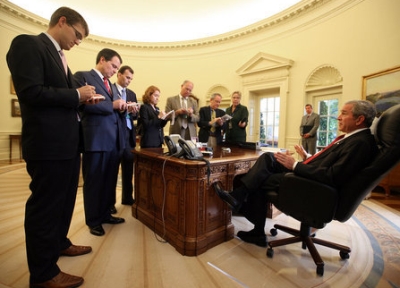
For bonus points compare the picture with Tyler’s discussion of meetings. How many items can you spot?
Meetings are not always about the efficient exchange of information, or
discovering a new idea. Meetings can be about displays of power,
signaling that a coalition is in place, wearing down an opponent,
staging "theater" to make someone feel better, giving key players the
feeling of being insiders, transmitting information about status, or
simply marking time until something better happens. It’s one thing to
hate meetings. But before you can improve them, make sure you know what
meetings are all about.
Hat tip to J-Walk Blog for the picture.