Category: Science
How to raise your child, or yourself, an atheist
That is a discussion from Justin L. Barrett’s new and interesting Born Believers: The Science of Children’s Religious Belief. He gives more than equal time to how to raise your child to be religious, but we’re already pretty good at that. Here are his atheism tips, noting that I am excerpting and paraphrasing:
1. Have less-than-average fluency in reasoning about minds.
2. Do not have children.
3. Stay safe.
4. Get in the habit of crediting or blaming humans for whatever you can.
5. Learn to like pseudoagents (including abstractions).
6. Take time to reflect.
7. Add to these factors indoctrination of the young against religion.
The key theme of Barrett’s book is HADD — Hypersensitive Agency Detection Device, and how pronounced it is in most human beings.
*The Social Conquest of Earth*
By Edward O. Wilson, Amazon link here. I am a big Wilson fan, but I didn’t find anything new in it, although for some readers it might be a good introduction to a variety of ideas such as eusociality.
I was surprised to see the main blurb as “A monumental exploration of the biological origins of the human condition!” — James D. Watson.
*The Idea Factory*
I loved this book and devoured it in a single sitting. The author is Jon Gertner and the subtitle is Bell Labs and the Great Age of American Innovation. Here is one excerpt:
Scientists who worked on radar often quipped that radar won the war, whereas the atomic bomb merely ended it. This was not a minority view. The complexity of the military’s radar project ultimately rivaled that of the Manhattan Project, but with several exceptions. Notably, radar was a far larger investment on the part of the U.S. government, probably amounting to $3 billion as contrasted with $2 billion for the atomic bomb. In addition, radar wasn’t a single kind of device but multiple devices — there were dozens of different models — employing a similar technology that could be used on the ground, on water, or in the air.
One lesson of this book is how much war can spur innovation. Here is one Gertner article on the themes of the book. Here is a review of the book. Anyone interested in the history of science, tech, or innovation should buy and read this book.
Walking Fast and Slow
In a famous paper psychologist John Bargh and collaborators gave students at NYU a test very similar to that described by Malcolm Gladwell in Blink:
In front of you is a sheet of paper with a list of five-word sets. I want you to make a grammatical four-word sentence as quickly as possible out of each set. It’s called a scrambled-sentence test. Ready?
- him was worried she always
- are from Florida oranges temperature
- ball the throw toss silently
- shoes give replace old the
- he observes occasionally people watches
- be will sweat lonely they
- sky the seamless gray is
- should not withdraw forgetful we
- us bingo sing play let
- sunlight makes temperature wrinkle raisins
The students were then sent to do another test in an office down the hall. Unbeknownst to them, walking the hall was the real experiment. Scattered in the sentences above are words like “worried,” “Florida,” “old,” “lonely,” “gray,” “bingo,” and “wrinkle.” Bargh reported that students who had been primed with these words took significantly longer to walk down the hall than those not primed with the “old” words.
In the original study there were only 60 participants and the subjects were timed with a stopwatch. A new paper doubles the sample size and uses more accurate infrared sensors. You will probably not be surprised to learn that the new paper fails to replicate the priming effect. As we know from Why Most Published Research Findings are False (also here), failure to replicate is common, especially when sample sizes are small. I haven’t yet described the real surprise, however.
The authors of the new paper, Doyen et al., then took the experiment meta; they ran the experiment again but this time they told half the people supposedly “running” the experiment that they expected the participants to walk slower and the other half they told that they expected the participants to walk faster. (A confederate provided evidence for this effect.) In the second experiment they again used the infrared sensors but they also asked the nominal experimenters to use a stopwatch as the sensors were said to be new and sometimes unreliable.
In the second experiment Doyen et al. were able to replicate the Bargh results. Namely, when using the stopwatch, the nominal experimenters reported that the group primed to walk slow did walk slow and they reported that the group primed to walk fast did walk fast. The results, however, were not entirely due to subtle experimenter bias because in the slow prime case the infrared sensors also found that the slow-primed group walked slow. The infrared sensors, however, did not report an increase in speed when the nominal experimenters expected an increase in speed.
Thus, the old-slow priming results appear to be due to a subtle mix of experimenter bias and standard priming which is cued or amplified via experimenter signaling. Given what are still relatively small sample sizes (50-60) the last should also be taken provisionally.
Important Addendum: Bargh has written a nasty attack on the new paper, the journal that published the paper, and Ed Yong who blogged the new paper for Discover Magazine. Bargh’s attack is a model of how not to respond to criticism new information. Ed Yong discusses Bargh’s response here. Like Yong, I am dismayed that Bargh quotes the new paper inaccurately. In his attack, Bargh also says things such as the overuse of elderly-related items reduces the effect of the prime. Yet in the methods paper he cites (and wrote) he says more prime stimuli generally results in bigger effects (p.11, effects can vary if the subjects consciously recognize the prime, a factor that the new paper tests). Bargh also entirely glosses over the main point which is that the authors did find priming effects when the experimenter knew and expected the effect to occur. Note that given the subtlety of the effects any experimenter bias appears to be entirely unintentional and Doyen never argue otherwise.
Sentences to ponder
Richard H. Thaler, a former colleague at Cornell and another contributor to the Economic View column, once remarked about an unsuccessful candidate for a faculty position, “What his résumé lacked was five bad papers.”
The rest is from Bob Frank.
American public opinion toward the space program
From Alexis Madrigal, this was news to me:
In thinking about the recent battles over NASA’s budget, it seems like the problem is simply citizen support. People don’t care that much about space, so space doesn’t get funded. Back in the Apollo days, people loved the space program! Except, as this Space Policy paper pointed out, they didn’t. A majority of Americans opposed the government funding human trips to the moon both before (July 1967) and after (April 1970) Neil Armstrong took a giant leap for mankind. It was only in the months surrounding Apollo 11 that support for funding the program ever reached above 50 percent.
*Turing’s Cathedral*
The author is George Dyson and the subtitle is The Origins of the Digital Universe. It is a first-rate, splendid book, causing us to rethink the origins of computing systems, the connections between early computers and nuclear weapons systems, how to motivate geniuses, and also the career of John von Neumann. Here is one excerpt, I may be giving you more:
In 1943, Bigelow left MIT, reassigned by Warren Weaver to the NDRC Applied Mathematics Panel’s Statistical Research Group. Under the auspices of Columbia University, eighteen mathematicians and statisticians — including Jacob Wolfowitz, Harold Hotelling, George Stigler, Abraham Wald, and the future economist Milton Friedman — tackled a wide range of wartime problems, starting with the question of “whether it would be better to have eight 50 caliber machine guns on a fighter plane or four 20 millimeter guns.”
Here is one Francis Spufford article about the book. Definitely recommended.
James Q. Wilson has passed away at 80
He was one of America’s leading social scientists, here is one appreciation. Here is his Wikipedia page. Here is a 1995 interview with Reason magazine. Here is Wilson on scholar.google.com. Here is his address on the moral sense (pdf). Here is one of his famous essays on police behavior. Here are some remarks in praise of Wilson. Here are many more links.
I think of him as one of the few people who had a truly famous and memorable middle initial.
There is no great stagnation
The drone of speakers who won’t stop is an inevitable experience at conferences, meetings, cinemas, and public libraries.
Today, Kazutaka Kurihara at the National Institute of Advanced Industrial Science and Technology in Tskuba and Koji Tsukada at Ochanomizu University, both in Japan, present a radical solution: a speech-jamming device that forces recalcitrant speakers into submission.
The idea is simple. Psychologists have known for some years that it is almost impossible to speak when your words are replayed to you with a delay of a fraction of a second.
Kurihara and Tsukada have simply built a handheld device consisting of a microphone and a speaker that does just that: it records a person’s voice and replays it to them with a delay of about 0.2 seconds. The microphone and speaker are directional so the device can be aimed at a speaker from a distance, like a gun.
In tests, Kurihara and Tsukada say their speech jamming gun works well: “The system can disturb remote people’s speech without any physical discomfort.”
Their tests also identify some curious phenomena. They say the gun is more effective when the delay varies in time and more effective against speech that involves reading aloud than against spontaneous monologue. Sadly, they report that it has no effect on meaningless sound sequences such as “aaaaarghhh”.
Kurihara and Tsukada make no claims about the commercial potential of their device but list various aplications. They say it could be used to maintain silence in public libraries and to “facilitate discussion” in group meetings. “We have to establish and obey rules for proper turn-taking when speaking,” they say.
Here is more, and for the pointer I thank Michelle Dawson, here is her recent dialogue.
Markets in everything the culture that is Japan
In theory the mechanism is really quite simple:
1. A sensor detects the rumblings of an earthquake.
2. Within .5 to 1 second an air tank pushes air in-between an artificial foundation and the actual structure of the home, lifting it as high as 3cm off the ground.
3. While the earth below violently shakes, the levitating home quietly and patiently waits, returning back to the ground once the tectonic plates have settled.
There are pictures and videos at the link, and the company claims it is implementing the idea at 88 sites. The final video is especially fine.
Charles Duhigg’s The Power of Habit
The skills necessary to ride a bike are multifaceted, complex and not at all obvious or even easily explicable to the conscious mind. Once you learn, however, you never forget–that is the power of habit. Without the power of habit, we would be lost. Once a routine is programmed into system one (to use Kahneman’s terminology) we can accomplish great skills with astonishing ease. Our conscious mind, our system two, is not nearly fast enough or accurate enough to handle even what seems like a relatively simple task such as hitting a golf ball–which is why sports stars must learn to turn off system two, to practice “the art of not thinking,” in order to succeed.
Habits, however, can easily lead one into error. In the picture at right, which yellow line is longer? System one tells us that the l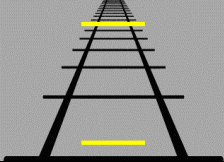 ine at the top is longer even though we all know that the lines are the same size. Measure once, measure twice, measure again and again and still the one at top looks longer at first glance. Now consider that this task is simple and system two knows with great certainty and conviction that the lines are the same and yet even so, it takes effort to overcome system one. Is it any wonder that we have much greater difficulty overcoming system one when the task is more complicated and system two less certain?
You never forget how to ride a bike. You also never forget how to eat, drink, or gamble–that is, you never forget the cues and rewards that boot up your behavioral routine, the habit loop. The habit loop is great when we need to reverse out of the driveway in the morning; cue the routine and let the zombie-within take over–we don’t even have to think about it–and we are out of the driveway in a flash. It’s not so  great when we don’t want to eat the cookie on the counter–the cookie is seen, the routine is cued and the zombie-within gobbles it up–we don’t even have to think about it–oh sure, sometimes system two protests but heh what’s one cookie? And who is to say, maybe the line at the top is longer, it sure looks that way. Yum.
System two is at a distinct disadvantage and never more so when system one is backed by billions of dollars in advertising and research designed to encourage system one and armor it against the competition, skeptical system two. Yes, a company can make money selling rope to system two, but system one is the big spender.
Habits can never truly be broken but if one can recognize the cues and substitute different rewards to produce new routines, bad habits can be replaced with other, hopefully better habits. It’s habits all the way down but we have some choice about which habits bear the ego.
Charles Duhigg’s The Power of Habit, about which I am riffing off here, is all about habits and how they play out in the lives of people, organizations and cultures. I most enjoyed the opening and closing sections on the psychology of habits which can be read as a kind of user’s manual for managing your system one. The Power of Habit, following the Gladwellian style, also includes sections on the habits of corporations and groups (hello lucrative speaking gigs) some of these lost the main theme for me but the stories about Alcoa, Starbucks and the Civil Rights movement were still very good.
Duhigg is an excellent writer (he is the co-author of the recent investigative article on Apple, manufacturing and China that received so much attention) It will also not have escaped the reader’s attention that if a book about habits isn’t a great read then the author doesn’t know his material. Duhigg knows his material. The Power of Habit was hard to put down.
Test-tube hamburger is on its way
The world’s first test-tube hamburger, created in a Dutch laboratory by growing muscle fibres from bovine stem cells, will be ready to grill in October.
“I am planning to ask Heston Blumenthal [the celebrity chef] to cook it,” Mark Post, leader of the artificial meat project at Maastricht University, said at the American Association for the Advancement of Science annual meeting in Vancouver.
The story is here. Both Alex and I have blogged about comparable (but less successful) projects in the past. Here is a longer article on the same development.
Conspiracy Über Alles
From Michael J. Wood, Karen M. Douglas, and Robbie M. Sutton:
Conspiracy theories can form a monological belief system: A self-sustaining worldview comprised of a network of mutually supportive beliefs. The present research shows that even mutually incompatible conspiracy theories are positively correlated in endorsement. In Study 1 (n = 137), the more participants believed that Princess Diana faked her own death, the more they believed that she was murdered. In Study 2 (n = 102), the more participants believed that Osama Bin Laden was already dead when U.S. special forces raided his compound in Pakistan, the more they believed he is still alive. Hierarchical regression models showed that mutually incompatible conspiracy theories are positively associated because both are associated with the view that the authorities are engaged in a cover-up (Study 2). The monological nature of conspiracy belief appears to be driven not by conspiracy theories directly supporting one another but by broader beliefs supporting conspiracy theories in general.
Here is the gated link, here is an ungated version, and hat tip goes to Kevin Lewis.
The boycott Elsevier movement
Many of you have asked me about this recent movement. A few points:
1. I largely agree with the goals and views of the perpetrators.
2. If I never published again in an Elsevier journal, it would not hurt my career (I have been tenured for twenty-six years). It would be a cheap endorsement for me personally.
3. In the past my career has benefited from publishing in Elsevier journals. They have provided useful outlets for some of my pieces and for some of the pieces of my friends and colleagues. Although I would prefer to move to a new and more open publishing model, I do count this past relationship for something.
4. In the future I likely will wish to help my students publish, including in Elsevier journals.
5. If I were to pick three boycotts to see through, would this be one of them?
My current conclusion is that I should not join this boycott in any formal sense, again while expressing support for the final vision. I do contribute to the open science idea in a number of ways, including through this blog.
In my forthcoming An Economist Gets Lunch: New Rules for Everyday Foodies you will find a more extensive discussion of the economics and ethics of boycotts.
Addendum: Via Claire Morgan, here is an interesting discussion of metrics for on-line influence.
An Economic and Rational Choice Approach to the Autism Spectrum and Human Neurodiversity
That is a new paper of mine, you will find the link here. Here is the abstract:
This paper considers an economic approach to autistic individuals, as a window for understanding autism, as a new and growing branch of neuroeconomics (how does behavior vary with neurology?), and as a foil for better understanding non-autistics and their cognitive biases. The relevant economic predictions for autistics involve greater specialization in production and consumption, lower price elasticities of supply and demand, a higher return from choosing features of their environment, less effective use of social focal points, and higher relative returns as economic growth and specialization proceed. There is also evidence that autistics are less subject to framing effects and more rational on the receiving end of ultimatum games. Considering autistics modifies some of the standard results from economic theories of the family and the economics of discrimination. Although there are likely more than seventy million autistic individuals worldwide, the topic has been understudied by economists. An economic approach also helps us see shortcomings in the “pure disorder” models of autism.
Some of you have asked me about the recent debates over the forthcoming DSM-V and autism (and here pdf) , here is one bit:
It is still possible to adhere to a DSM approach for practical fieldwork, and “autism identification,” while rejecting it as our best possible understanding of autism. Under one view, DSM does not “define” autism but rather the DSM standards provide useful information for identifying autistics who require assistance. Alternatively, in the context of both insurance companies and schools, DSM standards allow payments to be triggered if an individual is judged to be autistic according to the specified criteria. For systems of financial transfer to prove workable, perhaps the relevant legal definitions have to cite unfavorable outcomes rather than defining autism in a more fundamental way. We’ll return to this issue when we consider discrimination. For now the point is that the DSM standards don’t have to be applied to every autism-relevant question and should not be viewed as necessarily trumping other approaches.
The DSM standards also evolve. DSM-III defined autism differently than did DSM-IV and DSM-V will differ as well. It’s well known that the DSM process itself is, for better or worse, heavily influenced by various interest groups, including pharmaceutical lobbies. So DSM approaches have to be judged by some external standard and the cognitive profile approach (and a concomitant rational choice approach) can assist in this endeavor. Again, the DSM standard should not be construed as ruling out competing or more fundamental approaches.