Category: Uncategorized
Assorted links
1. Lots more in this comments section about Honduran charter cities.
2. Have the Chinese been enslaved by Friedrich Hayek?
3. Peter Chang to open new Sichuan place in Williamsburg. He plans to build up capital and then return to around here.
4. How much does poverty aid discourage work effort? (pdf)
5. The economy is indeed not so great for Obama, contra the new conventional wisdom.
Eurozone sticky wage update
From the always essential FT Alphaville:
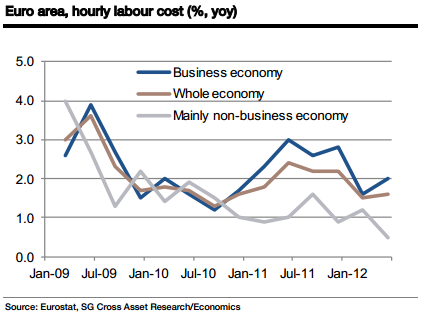
Société Générale points out that unit labour costs — basically, wages — have been falling quite rapidly in the peripherals, and that this is probably due to austerity measures. New data from Eurostat breaks out what the agency calls ‘non-business’ wages: the education, health services, and public administration sectors. In otherwords, ‘non-business’ is a rough proxy for the public sector:
The logical follow-on from the above being that “non-business” sectors are a big contributor to the rapidly falling unit labour costs in the periphery, especially given their large state sectors:
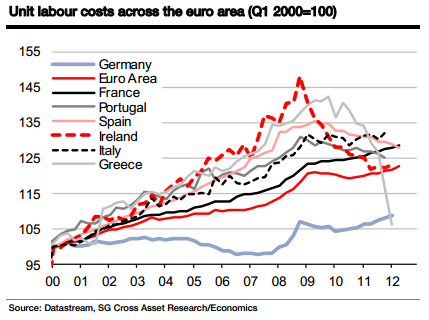
SocGen’s Michel Martinez writes that there are outright wage declines in Greece while in the other peripherals, labour productivity (as measured by ULC) is outpacing wage gains.
TC again: No one should doubt that depreciation and expansionary monetary policy are a much easier path to lower real wages. Yet the claim that wages are outright sticky for long periods of time, when economic pressures dictate wage declines, isn’t holding up that well.
And I would add this: They are not as wealthy as they thought they were.
Assorted links
1. Thomas Nagel reviews Plantinga, and a criticism of that review.
2. How much will the IRS enforce the mandate?
3. Miles Kimball reviews Cowen and Tabarrok Modern Principles.
4. New survey paper on what economists know about the “brain drain” (“brain gain”).
5. Malcolm Gladwell on how child molesters get away with it.
Should there be required labeling of GMOs?
Here is one on-the-mark take (of many):
…there have been more than 300 independent medical studies on the health and safety of genetically modified foods. The World Health Organization, the National Academy of Sciences, the American Medical Association and many others have reached the same determination that foods made using GM ingredients are safe, and in fact are substantially equivalent to conventional alternatives. As a result, the FDA does not require labels on foods with genetically modified ingredients because it acknowledges they may mislead consumers into thinking there could be adverse health effects, which has no basis in scientific evidence.
Or try the National Academy of Sciences from 2010:
Many U.S. farmers who grow genetically engineered (GE) crops are realizing substantial economic and environmental benefits — such as lower production costs, fewer pest problems, reduced use of pesticides, and better yields — compared with conventional crops, says a new report from the National Research Council.
Here is a good NYT summary Op-Ed on that report. There is not the scientific evidence for Mark Bittman’s recent evaluation that:
G.M.O.’s, to date, have neither become a panacea — far from it — nor created Frankenfoods, though by most estimates the evidence is far more damning than it is supportive.
It’s the tag there that is problematic. He doesn’t offer a citation, nor has he in past columns offered convincing material to back this evaluation (you can read here for a somewhat more detailed account from Bittman; it simply minimizes benefits and does not support “by most estimates the evidence is far more damning than it is supportive”). This earlier critique of Bittman is on the mark on virtually every point.
The standards of evidence being applied here are extremely weak. In that last Bittman link he wrote that:
…The surge in suicides among Indian farmers has been attributed by some, at least in part, to G.E. crops…
The link is to a sensationalistic Daily Mail (tabloid) story, yet that gets translated into “has been attributed by some.” In that story, the suicides were caused by indebtedness and supposedly the debts were in part caused by a desire by farmers to buy GMO crops. In comparable terms one could write that anything one spends money on could cause suicide through the medium of indebtedness.
By the way, the Wikipedia treatment gives some more detailed citations suggesting that GMO crops are not a significant cause of farmer suicides in India. The most careful study of the matter reports this:
We first show that there is no evidence in available data of a “resurgence” of farmer suicides in India in the last five years. Second, we find that Bt cotton technology has been very effective overall in India. However, the context in which Bt cotton was introduced has generated disappointing results in some particular districts and seasons. Third, our analysis clearly shows that Bt cotton is neither a necessary nor a sufficient condition for the occurrence of farmer suicides. In contrast, many other factors have likely played a prominent role.
I would in fact be more supportive of the GMO labeling idea if renowned food writers such as Bittman, and many others including left-wing economists, would come out and boldly proclaim the science about GMOs to their readers. Too often the tendency is to use a “I’ll try not to say anything literally incorrect, while insinuating there are big problems” method of scoring points against big agriculture. (Another common trope is to switch the discussion to “distribution” and to suggest, either explicitly or implicitly, that a net benefit technology such as GMOs is somehow unnecessary or undesirable; dare I utter the words “mood affiliation“?) GMO labeling is the one issue which has gained legal traction, so critics of “Big Ag” just can’t bring themselves to give it up.
Bittman’s whole column is about GMOs, but he gets at the important point only in his final sentence:
[With better information] We’d be able to make saner choices, and those choices would greatly affect Big Food’s ability to freely use genetically manipulated materials, an almost unlimited assortment of drugs and inhumane and environmentally destructive animal-production methods.
Overuse of antibiotics and animal treatment (both cruelty and environmental issues) — now those are two very real problems, backed by overwhelming scientific evidence. The fact that the California referendum is instead about GMOs — which have overwhelming scientific evidence for net benefit and minimal risks — is the real scandal.
It’s time that our most renowned food writers woke up to that difference. In the meantime, they are doing both us and themselves a deep disservice.
Assorted links
Assorted links
1. Anders Alsund on the Baltics, and growing economic troubles in Slovenia.
2. Can we (should we?) “cognitively enhance” monkeys? Is that even what we are doing? The paper itself is here.
3. Charles Murray on early intervention, see also the broader symposium.
4. Costs of bankruptcy illiquid collateral horse nationalism, and these are not ZMP goats.
Can Bernanke precommit?
The most visible effort to clip the Fed’s wings is a bill introduced in the House of Representatives by Kevin Brady, a Republican from Texas, who is vice-chair of the Joint Economic Committee of Congress. His bill would limit the central bank’s mandate to inflation, not employment, and restrict its monetary policy operations to short-term Treasury securities.
Were his bill now law, Mr Brady told the Financial Times, “the Fed would not be able to embark on this third round of quantitative easing”. He said the bill had taken off faster than he had hoped and already had 48 co-sponsors in Congress. “Everyone, whether they agree or not, believes it is the right time to have this discussion.”
And Mitt Romney speaks up for gerontocratic deflation:
“The value of your savings goes down. People who are living on fixed incomes don’t see much interest income any more. And the value of the dollar goes down, and the risk for long-term inflation goes up.”
The full FT story is here.
Assorted links
1. Andrew Coyne on the great stagnation.
2. Can a fungus make a cheap fiddle sound like a Stradivarius?
3. Poll about the rudest countries to visit (I disagree with the results at the top end of the scale, and might cite Morocco as the rudest).
Economists who are clergy
Your post on economist/artists got me thinking about economists/clergy.Obviously the most famous is Reverend Malthus. A Google search for “Economist Catholic priest” didn’t turn up much. “Economist rabbi” discloses that Israel Kirzner is the rabbi of a congregation in Brooklyn. “Economist clergyman” turned up Richard Jones but I’ve never heard of him. Economist/Jesuit turned up a number of names, all of them obscure to me.
My favored explanation is that “clergy” is an artificially higher bar than “artist”. Probably a large number of economists are and were devout people with learned and creative views on religion without having been ordained. E.g. Karl Homann is a first-rate theologian but not a priest. Robert Aumann is a first-rate Talmud scholar but not a rabbi. If the bar for “clergy” were parallel to that for “artist” these fellows would certainly make it.
Who else comes to mind? The School of Salamanca, and going back many medieval theologians wrote on economic issues. Paul Heyne. Heinrich Pesch. Galiani was an Abbey. Philip Wicksteed was a Unitarian theologian. The still underrated Richard Whately was the Archbishop of Dublin. Bishop George Berkeley wrote on monetary theory, as did Reverend Jonathan Swift.
The 18th century clergyman John Witherspoon wrote on monetary economics. Thomas Chalmers, who wrote on the Poor Laws and theories of underconsumption in the early 19th century, was ordained in the Church of Scotland.
Did all these 19th century figures really want to be economists, really want to be clergy, or both?
I thank Maria Pia Paganelli for a useful discussion of this point.
What do barter exchanges imply about depressions and recessions?
As was the case during the Great Depression, parallel currencies and barter exchanges are springing up around Spain and some other parts of Europe. Here is one account:
Psychologist Angels Corcoles recently taught a seminar about self-empowerment for women, and when she finished the organizers handed her a check with her fee. The amount was in hours, not euros.
But Corcoles didn’t mind. Through a citywide credit network that allows people to trade services without money, the 10 hours Corcoles earned could be used to pay for a haircut, yoga classes or even carpentry work.
At a time when the future of the euro is in doubt and millions are unemployed or underemployed with little cash to spare, a parallel economy is springing up in parts of Spain, allowing people to live outside the single currency.
In the city of Malaga, on the country’s southern Mediterranean coast just 80 miles from Africa, residents have set up an online site that allows them to earn money and buy products using a virtual currency. The Catalonian fishing town of Vilanova i la Geltru has launched a similar experiment but with a paper credit card of sorts. It implements a new currency worth slightly more than the euro when it is used at local stores.
You can find another series of accounts here.
One interesting feature of these enterprises is that they push a bit of emphasis away from sticky wage and price theories of depressions. In essence the sellers participating in these exchanges are price discriminating, by trying to sell more of their output — for lower prices — through credit or barter mechanisms. Getting back credits in return really is like receiving a lower price or wage. So these exchanges show that at least some people are wildly willing to cut prices, wages, and returns, if only to sell more.
(Please, no need for a lecture here on Keynes and downward price spirals; the ECB is keeping a price floor at the very least.)
So which factors behind depressions receive marginal support from the prevalence of these practices? First, these exchanges are a substitute for dysfunctional credit markets. Second, these exchanges attempt to solve the buyer-seller-buyer coordination problems analyzed by Clower, Leijonhufvud, and others.
Addendum: Here is Alex’s earlier post on barter and recessions. And Scott Sumner comments.
why are americans less stylish than europeans/japanese?
From Bob Unwin:
i mean style in clothing, but the same question could be asked about taste in architecture, interior design and other domains. (blog post by a fashion person: http://bangsandabun.com/2010/03/europeans-dress-better-than-americans-fact/)
1. greater average distance to a major fashion center. both physical and cultural distance.
2. less urbanization [these points 1&2 were maybe more important in the past]
3. distance from europe and few of the relevant european style-leaders emigrating
4. different signaling aims (more internal cultural diversity and weaker class distinctions; male clothing needing to be less ‘gay’ and more conventional).
5. any relation to the late blooming of US visual art and music on the world scene?
6. american is more informal in style and has been an influential exporter of informal styles (this doesn’t undermine the general point about the style difference)
related question: are there any fashionable american economists? i’d be especially interested in any that dress like artists or literary intellectuals.
Assorted links
1. What are the cues of distrust?
3. The throwing gap.
4. Chinese Straussians analyze America.
5. Cars that communicate with each other, and the road, are being tested in Michigan.
An empirical look at Austrian trade cycle theory
From Robert B. Lester and Jonathan S. Wolff:
Austrian Business Cycle Theory, as espoused by Mises (1912,1949) and Hayek (1935), predicts changes in the economy’s structure of production following an unexpected change in monetary policy. In particular, the theory predicts that following a credit expansion the production and price of goods further away from final consumption increase relative to the production of other goods in the economy. Despite the emphasis on the importance of relative prices and the structure of production, most of the existing empirical work discussing the relevance of the theory uses aggregate data. We rectify this, by using stage-of-process data to illustrate the relevance of the theory. We find that mechanisms emphasized by the theory are either not supported by the empirical results or are of second order importance in explaining the e ffects of monetary policy.
Is the urbanization of China inevitable?
From a loyal MR reader:
Now my economics question…
It’s often taken for granted in popular economics that China has an unalterable rate of urbanization. A good example would be this article by Stephen Roach (http://www.project-syndicate.org/commentary/china-is-okay-by-stephen-s–roach). In it he is arguing China’s growth worries are overstated because, essentially, its “urban population should expand by more than 300 million by 2030”. I don’t mean to reduce his argument to simply that statement, nor do I want to concentrate on this article in particular. I merely mention it because I’ve heard it (or something similar) many times before.
But it seems baked into this assumption that “China will add X more urban residents by date T” is some implicit growth factor. (Maybe the 8% growth target?) After all, why move to the city if it doesn’t have good, high paying jobs that can support an urban lifestyle? I mean, 300 million new urban residents at roughly 3 people per household is roughly 100 million new urban jobs! And perhaps the manufacturing/export sector can accommodate them, but since investment is 50% of the Chinese economy and simply by continuity arguments will have to remain a big piece of it for years to come, it seems unlikely that 100 million jobs can be created with the currently composition of economic activity, or anything similar. Also, the current mix of urban jobs has still left roughly half of the urban residents unable to afford high-rise apartment living, so those 100 million or so jobs will have to in essence be even better (higher paying, more stable) than what’s already available.
I find the “urbanization argument” perplexing and seemingly circular, especially when it is used to justify that it shall be the basis of growth. I know it’s not this simple, but am I missing something fundamental here? Stephen Roach is a pretty big name from what I can tell.
Scott Sumner comments on related issues. Here is an update on recent problems in Chinese real estate.