Category: Uncategorized
What’s up with the new Draghi plan?
I won’t recapitulate my core views on the euro crisis (see this talk), but here are a few points:
1. The aggregate numbers are workable, but the eurozone needs a unified solution of some kind. Putting any single country “in charge” would yield a solution, although the quality of solution would vary with the country. Still, it would be a solution.
2. The danger is that quasi-solutions will appease all countries in the short run, not really solve the core problems, and thereby walk the eurozone further down the plank of doom. This is the outcome I have been predicting, though it is not necessary in any logical sense.
3. The new plan puts the ECB in charge, and in fact gives the ECB semi-dictatorial powers over the weaker eurozone economies. If Draghi says “jump,” you had better jump. Many will consider this an untenable abrogation of democracy, see the remarks of Matt Yglesias and more generally ponder the Rodrik trilemma. I don’t know how long this arrangement can last. Up through now, and still, my view has been that at least one of these democracies will “crack” and pull the plug on whichever non-democratic dictatorial scheme happens to be in place at the time. I don’t see that the chance of that has gone down.
4. Some portray this as a loss for Germany and the Bundesbank, but I wonder. I tend to see the ECB as the new enforcer. The more the ECB is responsible for the money it hands out, and the larger the role the ECB takes in governance of the weaker economies, the more the perspective of the ECB will approach that of Germany. That the ECB can “money print” its way out of insolvency I don’t see as so important for the true incentives facing ECB leaders.
5. By the way, the ECB has renounced its senior place in line, at least for the new bond buying, how generally I am not sure from published reports.
6. Does the ECB have the stones to cut off or not start up with countries violating the terms of their bailouts? Greece and Spain are already way out of line. Yet it seems this new plan is directed at Spain, at the very least, so how credible can it be? I say the ECB becomes even more of a fudger.
7. The notion of “unlimited” but “sterilized” bond-buying interventions is a problematic one. How much “Dran-O” is there to remove the newly created money? Surely the ECB can’t respond by selling from its current portfolio of periphery bonds.
8. The afflicted countries now have an incentive to load up on short-term debt.
9. The theory of bureaucracy suggests that Draghi has delivered somewhat different messages to Merkel and to the periphery nations as to what this scheme really will mean.
In a few words I would say “The ECB as Old Testament God.” He wasn’t omnipotent either, and in Genesis you also will find intimations of henotheism.
Let’s see how good a job they do.
Assorted links
MR University is announced at the World Bank
As our blog posts went up (here and here), our plans for MR University were presented to an audience of World Bank economists, researchers, and practitioners, courtesy of PREM.
You can find the presentation here. The segment on MRUniversity starts at about 29:30, with the earlier part of the talk covering ideas related to The Great Stagnation.
You can sign up at www.MRUniversity.com. Our class on development economics starts October 1, and we are pleased to have been able to present it at the World Bank, and to you all, to start it off.
Kaushik Basu named as World Bank chief economist
Annie Lowrey has the scoop. Excerpt:
A paper he released last year caused a bit of a stir: While advising the Indian government, Mr. Basu argued that countries could reduce the incidence of “harassment bribes” – e.g., “I’ll approve this home renovation project for you for a small fee…” – by making it legal to give a bribe, though not to receive one.
“This will cause a sharp decline in the incidence of bribery,” Mr. Basu said. “After the act of bribery is committed, the interests of the bribe giver and the bribe taker will be at divergence. The bribe giver will be willing to cooperate in getting the bribe taker caught. Knowing that this will happen, the bribe taker will be deterred from taking a bribe.” (Mr. Basu notably argued against giving an amnesty for past incidents of bribery.)
Mr. Basu is to start at the bank Oct. 1. In the meantime, you can follow him on Twitter.
And do not forget:
He is also the creator of the two-player board game Dui-doku. He is also a Woody Allen fan.
An announcement is coming later today
From us, a short bit before noon. Today’s posts will go up at that time!
Higher education prices are too high

I know all about the literature on the rising returns to higher education. But there are two blades to the Marshallian scissors! Supply needs to do its job here.
Assorted links
1. Feldstein responds on the Romney tax plan, and in turn DeLong once again.
2. Mandates don’t stay modest.
3. Muslim women who choose Catholic schools.
4. The fate of Chinese steel traders, and good news for New Zealand farmers.
5. Paralympic video.
A short note on the gold standard
I do not favor a gold standard, nor do I for that matter favor price stability, nor do I think a gold standard brings short-run price stability. I think a gold standard today would be much worse than the 19th century gold standard, in part because commodity prices are currently more volatile and may be for some time. I do not favor commodity bundle standards. I favor some amount of ongoing inflation, and my reasons for this view are close to those of Larry Summers.
That all said, when I read recent critiques of the gold standard, occasioned by recent GOP debates on the topic, I feel I am living in a different universe than those who wrote them. A few points:
1. Jim Hamilton aside, hardly anyone has reported the denouement: “…the final document [the GOP platform] makes no mention of gold, and instead seems to have settled on a proposal that is unlikely to do any harm…”
2. Why is no one mentioning Christina Romer’s work on how discretionary macroeconomic management does not have a totally superb comparative historical record in lowering volatility? Start here, but there is more in this literature. She is still a prominent economist.
3. Dare anyone critical of the gold standard bring themselves to utter these (roughly true) words?: “For the Western world, the gold standard era, defined say as 1815-1913, was arguably the greatest period of human advance ever, at least in matters of economics, culture, and technology.” Chunks of the post-WWII era contend for this designation, but still this sentence is not a crazy one.
4. I remain baffled by treatments of Japan’s slow growth era as primarily a monetary phenomenon. Under such a view, how was Europe’s 19th century possible at all? Why wasn’t it a total economic disaster? Data from government bonds show that “expected inflation” across the period was close to zero, yet somehow “For the Western world, the gold standard era, defined say as 1815-1913, was arguably the greatest period of human advance ever, at least in matters of economics, culture, and technology.”
Good economics is to integrate #2 and #3 with the fact that one need not favor a gold standard. I’ve been seeing a lot of arguments against gold standards, many of which I agree with. What I haven’t been seeing is the integration with the broader set of relevant facts, which of course present a more complicated picture.
Assorted links
1. Austin Frakt replies on Medicare overhead, and here.
2. How many dogs in the world can track the scent of orca whale feces in the open water? (And does he like to swim?)
3. On-line education is flourishing in much of Asia.
4. The meaning of homes as a Chinese savings vehicle.
Assorted links
1. More on the Harvard cheating scandal, and the cheating isn’t even the interesting part of the story.
2. Jessica Crispin talks with Claudio Magris about his new book.
3. IBM plans pocket Watson for business uses, will it be a Siri-killer?
4. Good update on driverless cars, with some new information.
How high are Medicare overhead costs?
Yuval Levin makes a few points of relevance:
…many of Medicare’s most significant administrative costs are just covered by other federal agencies, and so don’t appear on Medicare’s particular budget, but are still huge costs of the program. The IRS collects the taxes that fund the program; Social Security collects many of the premiums paid by beneficiaries; HHS pays for a great deal of what you would think of as basic overhead, but doesn’t put it on the Medicare program’s budget. Obviously private insurers have to pay for such things themselves. Medicare’s administration is also exempt from taxes, while insurers pay an excise tax on premiums (which is counted as overhead). And private insurers also spend a great deal of money fighting fraud, while Medicare doesn’t. That might reduce the program’s administrative costs, but it greatly increases its overall costs. Some administrative costs save money, after all: The GAO has estimated that a $1 investment in pre-payment review of claims, for instance, would save $21 in improper Medicare payments.
My original source is this Reihan Salam post. I also would add the deadweight cost of taxation. Arguably that does not count as a cost of “overhead,” but very often it runs 20% or more and still it is a cost.
Assorted links
1. What Marilyn Manson apologizes for (NB: the link uses a cuss word).
3. “High-speed chases look like fun because they are.” Hat tip The Browser, remarkably still the best site on the web.
4. Most homeless youth use social networks.
5. Sumner responds again to Balding (toward the end).
Canada graph of the day
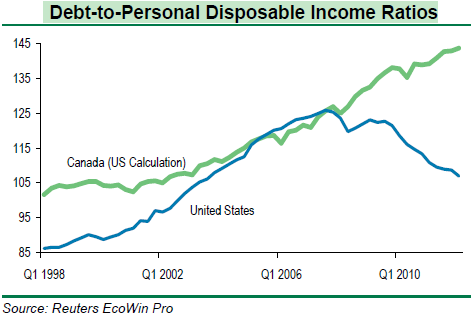
There is more here, from Sober Look.
Assorted links
Assorted links
1. Summary of the new Robert Gordon paper on stagnation, with good charts and graphs, and further coverage by Annie Lowrey here. Paul Krugman also comments.
2. Groupon coupon for “The Anger Room,” markets in everything.
3. Andrew Gelman on different ways of plotting income data.
4. Michael Blowhard seems to be blogging again, here, under “Paleo Retiree.”
5. Sumner on Balding, Sumner on Wang, and Caplan responds to Dickens.