Category: Uncategorized
Assorted links
1. Markets in everything bride price decomposition the culture that is Nigeria.
2. David Cronenberg interview.
3. How exactly do we know, from the photo, that she is on the political left rather than right? Seriously. Here is her blog and profile. Here is her Twitter feed. How do we know? And that we know — should it make you less confident in your own political beliefs? WWRHS?

4. Kling on Murray.
The new jobs report
All good news, 243k up but lots more information in the numbers, try @JustinWolfers or @BetseyStevenson for details and interpretation. The “big loser” here?: Old Keynesianism. You really can get a recovery when the real shocks are moderately positive. You will note, as we have been told many many times by many many sources, fiscal and monetary policy have not been extremely pro-active in recent times; in fact the stimulus has been trickling to a close. The big winners, apart from the American public?: real business cycle theory. It is part of any cyclical explanation, whether one likes it or not.
Another big loser is those liquidity trap theories which tell us that positive real shocks are bad for the economy because the AD curve has a perverse slope, etc., and that negative shocks might help spur recovery. That theory is looking very weak, again. I consider it the weakest economic theory that has any currency in the serious economics blogosphere.
Assorted links
1. Previous post on IPO auctions, plus this ungated link to the paper (pdf).
2. Is inequality connected to self-deception?
3. More on the markets for blood, and also love letter transcriptions.
4. Alena is raising the status of scientists, the only way that really counts. Or is it cheap talk?
Assorted links
1. Is the Volcker Rule simply a bad idea?
2. The blog of Simon Wren-Lewis.
3. The price-quality gradient for hamburgers.
4. Profile of Jonathan Haidt, one of the titans.
5. Robert Trivers (another one of the titans) has a blog post.
6. Good Kaufmann poll of what economics bloggers think (pdf).
Youth unemployment across Europe
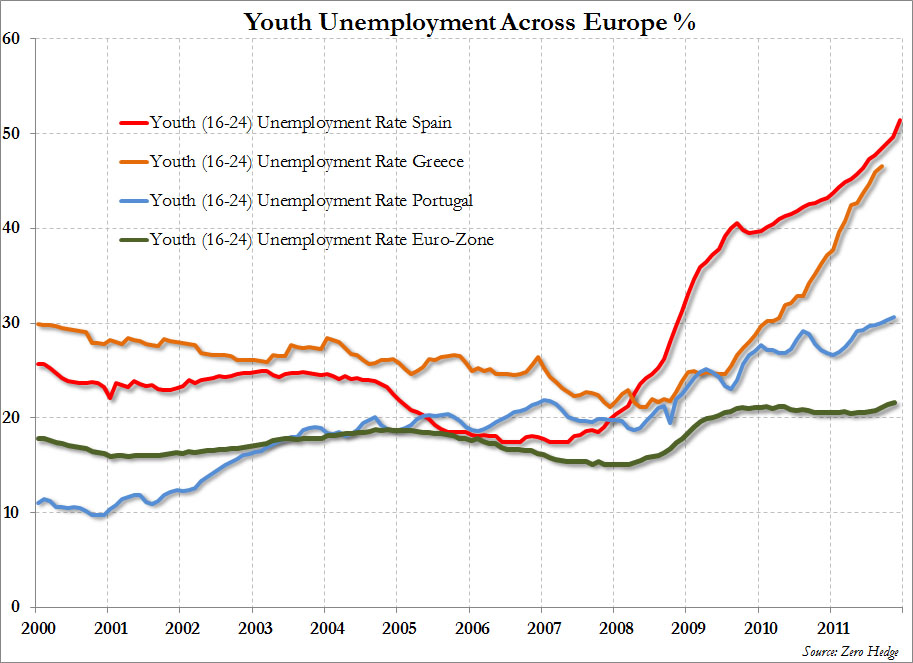
Here is more, hat tip goes to Greg Ip.
Addendum: Do read the excellent comment by Peter Whiteford, for instance:
The unemployment ratio – that is, the number of unemployed people over the population rather than the labor force is arguably a more consistent indicator across countries.
This shows that while in Greece for example, the unemployment rate for youth was around 46% the unemployment ratio was around 10% – nearly half of those in the labour force were unemployed, but only a little over 20% of all the people in the age group were in the labour force.

Assorted links
1. How they almost gave “Vertigo” a different title.
2. The Dynosphere.
3. Who will write the piece on Mormon Keynesianism?, and Spain does have a public debt problem (in Spanish, by XSiM, full blog here), and A Crisis in Two Narratives (Raghu Rajan).
4. Good R.A. analysis of recent British economic performance.
*Cato Papers on Public Policy*
It is a new journal, edited by Jeffrey Miron, summary:
This new publication is an annual volume of innovative, original articles on current and critical economic and public policy issues. Each article is written by a recognized national expert, most often a senior member of a prestigious university. The overarching goal of the publication is to provide in-depth, imaginative new research on key economic and public policy matters combined with a range of potential improvements and solutions.
The cloth version is $15, $6.99 for the eBook version. At the link you will find the first table of contents, I have not yet read any of my copy.
Very good sentences
From Tim Harford, about the UK:
…as Mr Summers pointed out, even China seems to have been shedding manufacturing jobs over the last couple of decades. Perhaps the data deceive here, but the Chinese manufacturing boom seems to be more about increasing output per worker than employing more workers. If the Chinese can’t generate jobs through manufacturing I am not sure we should be expecting too much from that strategy.
Assorted links
2. Is this what (American) austerity looks like?, and drug tests for legislators.
3. Two-hour Star Wars remix, not for everyone. For anyone?
4. Think of this as a “poem” about libertarians. Funny.
Assorted links
1. More on animal nationalism, a tweet.
3. Should we de-fund college libraries? A lot of publishing models would change, books too.
Can Greece now leave the eurozone?
Meg Greene writes:
I have long thought that the troika would cut Greece loose and let it default and exit the eurozone once eurozone banks had been sufficiently firewalled. Perhaps this aggressive proposal by Germany is one of the unintended consequences of the ECB’s three year long term refinancing operation (LTRO). If eurozone banks have as much access to cheap, three-year ECB funding as their collateral allows, perhaps Germany and the troika have decided that eurozone banks can survive a Greek default. Greece is clearly insolvent and must leave the eurozone to eventually return to growth. The German proposal may have accelerated the inevitable.
I recall someone on Twitter noting that if Greek leaders turned fiscal sovereignty over to Brussels, the relevant parties would end up hanged for treason, or something like that. I’ll predict against that outcome. Angus adds comment. The general point here is that apparent progress also makes it easier for parts of the Eurozone to unravel. In this context what counts as “good news” or “bad news” can be quite tricky.

Assorted links
2. Familial linkages between neuropsychiatric conditions and intellectual interests.
3. The real story of Watson and little Albert?
4. Might household formation remain slow?
5. How much is the life of an astronaut worth?
6. Hiromi Uehara(上原ひろみ)plays Rhapsody In Blue with Kazunori Kumagai’s tap dance (the culture that is Japan).
Assorted links
Assorted links

*Knowledge and Coordination: A Liberal Interpretation*
The author is Daniel Klein and you can buy it here. My blurb reads:
The best book on Smithian economics, or for that matter Austrian economics, in many years.
Here is a thirty-minute presentation of some themes from the book. Here is an associated podcast with Dan and Russ Roberts. Here is the syllabus for Dan’s class on economics and philosophy (pdf); here is the syllabus for his class on Adam Smith (pdf).