Category: Uncategorized
Assorted links
Claims without evidence
…perhaps the biggest sin of the lot was effectively to render all credit default swaps (a form of insurance against default) on sovereign debt essentially worthless, or void, by making the Greek default “voluntary”. This has made it impossible to hedge against eurozone sovereign debt purchases, and thereby destroyed the market. Worse, it’s made investors believe that the euro cannot be trusted, that it’ll repeatedly find ways of reneging on contract. That’s the point of no return. This is no longer a serious currency.
I am by no means sure this is correct, but I thought I would pass the argument along. The link is here, the pointer to the broader article is from dearieme, a loyal MR reader and commentator.
Assorted links
1. The pecan thieves, many of them will be felons.
2. Mexican economy slated to grow at 5.5% this year, in spite of drug war escalation.
4. TGS and Canada.
5. The fate of the arts in Norway?, and the UK tax on athletes isn’t working.
The economics of Black Friday
Robert H. Frank writes:
In recent years, large retail chains have been competing to be the first to open their doors on Black Friday. The race is driven by the theory that stores with the earliest start time capture the most buyers and make the most sales. For many years, stores opened at a reasonable hour. Then, some started opening at 5 a.m., prompting complaints from employees about having to go to sleep early on Thanksgiving and miss out on time with their families. But retailers ignored those complaints, because their earlier start time proved so successful in luring customers away from rival outlets.
This is portrayed as a zero-sum or negative-sum game, but I view the matter, at least in efficiency terms, more optimistically. The alternative to waiting in line and fighting the crush is to go shopping some other day, hardly a terrible fate. More analytically speaking, the average return in other endeavors limits how bad these rent-seeking games can get, otherwise just switch and stay home and read your blogs, as some of you perhaps are doing right now.
In fact it seems that early December has in general the cheapest prices of the year, not Black Friday.
Dare I suggest that some people like waiting in those lines with their thermos cups and stale bagels. You could try to argue they are “forced to do so,” to get the bargains, but in a reasonably competitive world each outlet will (roughly) try to maximize the consumer surplus from visiting the store, including the experience of waiting in line.
If your store does a crazy sale at 5 a.m., and mine does a crazy sale at 9 a.m., the somewhat saner people still can go to my store, if they prefer to, without losing any bargains. Maybe the truly early opening hour signals bargains, and customers would assume that a 9 a.m. opening means no bargains, but of course there are plenty of other ways to signal low prices, including through advertisements and the overall reputation of the store’s Black Friday over the years. I don’t see any line in front of Bon Chon Chicken, now at Fairfax Circle by the way on Old Lee Highway.
You might try a behavioral story that consumers are tricked by the prospect of low prices, yet shelves rapidly empty, but it’s hard to see that working year after year, or even in one year, if pissed off customers won’t buy anything else. More likely, the mix of low price and queue is a form of price discrimination, which as we know is generally welfare improving.
Although my efficiency prognosis is more optimistic than Frank’s, my underlying view of human nature — or perhaps economic growth — may be worse. Is that really what people want to be out there doing? I saw the Best Buy line last night and those people looked pretty normal. That’s scarier than postulating a bunch of negative-sum games.
Assorted links
1. Kevin Drum is always clear, even on doom.
2. Masochist (sadist) markets in everything (video).
3. That was then, this is now.
4. Claims about artists (sex), and Greek loan sharks.
Very sad news, Mark Blaug passes away, 1927-2011
Here is a very nice biography, summary and tribute. I chatted with Mark many times and always considered him a true scholar and gentleman. I grew up learning from all of his books and as a kid read his Economic Theory in Retrospect several times (it’s actually the book I learned neoclassical economics from), plus his book on Ricardian Economics and his pamphlet on the Cambridge Capital debates, as well as many many other contributions, including extensive writings on the economics of education and economic method. He was one of the best informed and wisest economists and I was very sorry to hear of this loss.
Here is Mark on scholar.google.com. Here is Mark on Google.
For the pointer I thank DG.
Assorted links
1. Italian markets in everything.
3. How much is “early development” decisive?
4. The energy intensity of gdp, the break in 2000, and evidence that Michael Mandel is right about offshoring.
Sentences of art and beauty
Indonesia’s growing wealth has also came into play as its collectors compete for the Balinese work of Mexican artist Miguel Covarrubias.
And the explanation is here:
“Before the Indonesians wanted the art but didn’t have the money to pay for it,” said Martin. “Now they do.”
At Christie’s in May, Covarrubias’ 1932 “Offering of Fruits for the Temple” set an auction record for the artist at $1.02 million, This week Covarrubias work on paper also hit a new high, selling for $290,500 also at Christie’s.
Here is the full report, mostly about the boom in Latin American art.
Assorted links
1. Ten questions for Charles C. Mann.
2. How to extract light from a vacuum, and how are those European bank runs coming along? Faster than light neutrinos no longer looking so likely.
3. Solyndra solar panels on eBay.
Lessons from the euro crisis, part II
Resilience and robustness, resilience and robustness, repeat three times after me.
Less than two years ago, it was a common meme that “Italy can handle all this debt, so can we.” And now suddenly they can’t. It is correct to point out that currency mismatch is a serious issue for Italy (though massive debt, inefficiency, and twelve years of no growth don’t help either!), but there are two points here.
First, it would be odd to argue that the importance of currency mismatch was misunderstood. Everyone has known about this factor for many years. The more plausible explanation is that the speed of fiscal collapse, and bond market adjustment, was underrated.
Second, let’s say the importance of currency mismatch had been underrated. Is it so convincing to proclaim “don’t worry, we won’t make that mistake again”? When currency mismatch is gone, is everything really OK?
What if we are misunderstanding something else about the current U.S. situation, just as previously the Italian situation had been misunderstood? Ever look at those Obama administration growth projections? Are they factoring in a partial collapse of the eurozone? The possibility of another “lost decade”? I don’t think so. Would a new Republican administration respect the need for medium-term fiscal balance? What if some “black swan” event hits?
And so on.
It remains the case that:
1. Short-term fiscal cuts usually hurt your gdp in the short-term and that can be disastrous. (It also may hurt social goals, since the cuts are not usually well targeted, for public choice reasons; has EU ag. spending gone down much?) It hasn’t worked for Greece for instance. The Keynesians have an absolutely essential point here and we ignore it at our peril. Still,
2. At some point, for most Western countries, those cuts will have to come,
3. Politicians don’t seem very willing to make those cuts in advance so you can’t count on technocratic fine-tuning, and
4. No individual should have such a firm or confident sense about the appropriate timing of such cuts. If nothing else, we don’t know when future cuts will be possible. And we don’t know when the bond market vigilantes will appear, just as we did not know for Italy.
The “pretense of knowledge” I have seen in these discussions is staggering. Roubini forecast the Italian crisis in 2006 (bravo to him), but overall how many people on the left were so wise to be calling for such Italian spending cuts in 2005, when the country had relatively low bond yields? How many, say in 2009, even ran the line of “It’s too late now, because of the Keynesian downward spiral problem, but they should have cut spending in 2006”? For that matter, are there 2011 left-leaning Keynesians insisting Italy should have cut spending radically in 2006, if only for reasons of resiliency and robustness? (Or is the preference to criticize German views on central banking and remain rather silent on Italian fiscal reforms?)
James Hamilton makes an essential point:
A year ago, the Italian government was able to issue 10-year bonds with an interest cost below 3.8%. Some might have argued that those low rates were a signal from the market that there was not much chance of Italy following Greece down the drain. At a visit to UCSD a few weeks ago, University of Maryland Professor Carmen Reinhart was asked whether that’s a correct inference to draw from a low government borrowing cost. Emphatically not, she said: “Yes, yields are low– until they’re not.” Historically, the changes can come pretty quickly, as the Italians discovered last week.
The correct response to the Italian situation is: “We didn’t think it could get so bad so quickly. We will take this as a sobering lesson more generally.”
That is not the response I have been seeing. There is too much at stake for us to take comfort in our own supposed abilities to foresee the future.
Assorted links
1. How much does the corporate income tax matter?, and how to argue using Siri (video, recommended, but one use of the f-word).
2. The do-nothing plan is now > $7 trillion. Maybe too much gridlock is not the best way to describe the problem…
3. I, too, would give Darth Vader free public land, and Scott Winship is Rybka.
4. I,toaster.
5. Bill Simmons on labor economics and sticky wages and the Coase theorem, essential reading.
Assorted links
1. Good interview with Jonathan Lethem, by the always-excellent Laura Miller.
2. Occupy World of Warcraft, rampant inequality, and more on those faster than light neutrinos, don’t write it off just yet.
4. How good is Amazon’s computer cluster?
Assorted links
1. More on the dim fate of solar power, and a lesson in the fallacy of mood affiliation.
2. Toward a theory of optimal swearing seigniorage.
3. Subsurface lakes on Europa?
4. Thai flood hacks.
Best economics books of the year
1. Best behavioral economics books of the year, Daniel Kahneman, Thinking, Fast and Slow, and Bryan Caplan, Selfish Reasons to Have More Kids.
2. Best economic history book, Alexander Field, A Great Leap Forward: 1930s Depression and U.S. Economic Growth.
3. Second best eBook of the year, Erik Brynjolfsson and Andrew McAfee, Race Against the Machine: How the Digital Revolution is Accelerating Innovation, Driving Productivity, and Irreversibly Transforming Employment and the Economy. By the way, here is my recent debate with Erik; we both agreed in advance to mix things up and generate controversy, so interpret the exchange accordingly. In reality, Erik and I agree about many many things and Matt Yglesias notes as much. (We do, however, seem to disagree about what this graph means.) Arnold Kling comments on the debate itself.
4. Best economics/business book of the year: Tim Harford’s Adapt.
5. Best Austrian or Austrian-influenced book of the year: Daniel B. Klein, Knowledge and Coordination: A Liberal Interpretation. It’s not out yet, I’ll cover it more when it appears, more information here.
6. Best economics textbook, Ahem! I don’t mean my favorite economics textbook (though it is that too), rather best economics textbook. The revised second edition of Micro just appeared, the macro is due out any day now.
Overall if I had to pick one, text aside, it might be the Alexander Field book, but this is a diverse lot with something for everybody.
Italy’s crashing money supply (Department of Yikes)
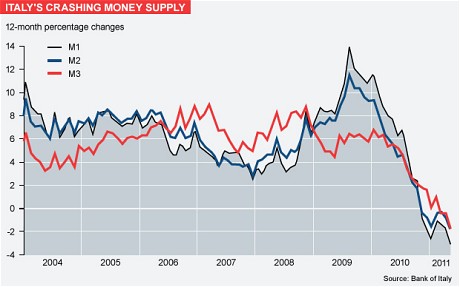
There is more here (though what can you really add?), hat tip goes to Nick Rizzo.