Category: Uncategorized
Assorted links
1. Luigi Zingales on the decline of meritocracy.
2. Blog on cocktail party economics.
3. Merkel calls for a minimum wage, and how the German post office is restructuring, and Italy is not multiple equilibria.
4. How the really desperate buy their automobiles, excellent story.
5. Hackers vs. Mexican drug cartel, who will win?
*Modern Principles: Microeconomics*, the second edition
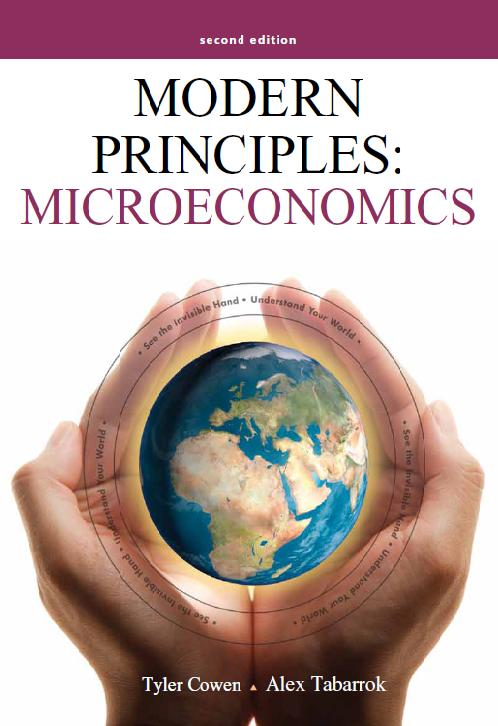
Coming soon to a Principles class near you.
Here is a discussion of what is new in the 2nd edition. Here is the resource bank associated with the book. Here is the etymology of the word “favorite.”
Assorted links
1. De Gustibus (disgusting).
2. Jeff Sommer on Thomas Sargent, and Stephen Williamson on same.
3. Are memoirs about your child always narcissistic and problematic?
4. Why Siri is a bigger deal than you think.
5. Arnold Kling has a very good blog post explaining the importance of the new book The Race Against the Machine.
Assorted links
1. Resolution of Fairfax legal case, hat tip Yana.
2. Resolution of New Hampshire legal case, or how to keep tenure.
3. Penelope Trunk Home School blog.
5. Can expectations be frustrated?, Interfluidity on NGDP targeting, and Scott Sumner’s response.
Paths out of The Great Stagnation
Thankfully, Thingiverse user Tom Lombardi invented a solution for this age old problem. Enter the Lucky Charms Sifter.
According to Lombardi, the humble-looking 3D printed cup removes over 90 percent of all the cereal, leaving only the marshmallowy goodness. All the user has to do is pour Lucky Charms into the cup and give it a good shake. The precision-printed holes are just large enough for the whole-grain hamster food to fall through, while still retaining the slightly larger marshmallows.
Here is more, hat tip goes to ModeledBehavior. And via Rob Nelson, here is 3-D printing for pet hermit crab shells.
That all said, 3-D printing is unlikely to end up being a transformative technology; transportation costs for what it can produce are already fairly low. The printers may in some longer run be cheaper than UPS, truck, and commercial rail, but that’s a moderate savings only, albeit a nice one.
The most likely paths out of TGS — by far — are artificial intelligence and natural gas supply (with some chance of E-Cat). Smart machines will be most successful in their least romantic, furthest from hard AI, most mundane forms, starting with Siri and Watson. Natural gas and other energy source developments will likely make North America the cheap energy power for much of the next fifty years; this may improve the quality of our foreign policy as a collateral benefit.
Assorted links
1. How to give a speech, and arrange the giving of a speech, and much more.
This is one of the best “essays” I have read on any topic and it builds very nicely from apparently humble beginnings. For the pointer I thank someone on Twitter, my apologies for having lost track of whom.
Assorted links
1. Dolphins have non-instrumental curiosity and orangutans have cultural transmission.
2. Phone storage trucks, markets in everything, also endangered species kakapo vomit remains.
3. Peter Chang update, including a feature film? Domestic mobility is way down, but still not for him.
4. They made me buy the new John Fahey box.
5. Peter Thiel’s latest project: independent entrepreneurial scientists.
Andrew D. Smith has a question
There are a lot of companies out there trying to help consumers reduce energy consumption, theoretically to save money AND the environment. The NYT had a long story on a smart thermostat company today: http://www.nytimes.com/2011/10/25/technology/at-nest-labs-ex-apple-leaders-remake-the-thermostat.html
Can you discuss whether this can possibly work? As I understand the power industry, such a high percentage of the costs are upfront (with nuclear plants in particular, but with carbon burning plants as well) and the marginal price of producing energy (up to plant capacity) is so low, that falling demand would mostly cause plants to cut prices until they were again operating at capacity.
So “saving” energy at the consumer level won’t really reduce total energy consumption or gas emission.
Is that right?
Assorted links
1. On the new EU deal, and here too, the Italian ten-year yield is down only a small amount.
2. On TGS, the excellent Edward Tenner.
3. Telemundo will start using some English subtitles and other smatterings of the language.
4. More on Italian small firms, and here is Henry’s post but I think Italian small firms have to do better than just OK, once you consider the volatility of different sectoral fates.
5. Observations about successful fiscal adjustments, and economics Haiku.
Assorted Links
1. I am impressed with Zite for iPad.
2. The growing problem of Greek debt, illustrated by Angela Merkel.
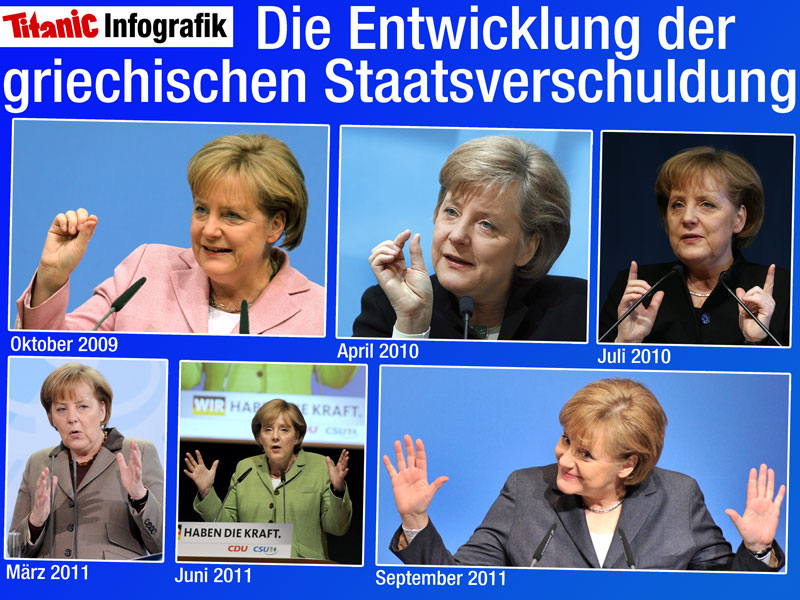
3. Jeff Miron says Greece should default.
4. Isaac Newton’s first paper, online. More here.
5. Apple granted patent on slide to unlock. Sigh.
Assorted links
1. MIE: “Why not create a chrome trout?” From Courtney.
2. The problem of female labor supply in Italy.
3. Simon Dale’s Hobbit House in Wales.
4. Scaring tourists with a stick for 60k a year? And here is growing etrogs.
5. Walking robot requires no power sources, just give it a push (video).
Assorted links
1. World power swings back to America.
2. Straussian claims about Plato, more here.
3. The Ken Jennings Watson talk, at the Singularity Summit, I enjoyed this very much.
4. The culture that is Fairfax.
Why is Italy doing so much worse these days?
Here is the graph from yesterday. So why has Italy done so much worse? During 1950-1990 or so it was a stellar growth performer, though some of this was catch-up growth from wartime destruction. It does not satisfy me to cite Italy’s corrupt and dysfunctional political culture, since that has been the case for a long time, maybe forever.
A good introduction to the bright side of Italy’s economy is Michael Porter’s 1998 The Competitive Advantage of Nations; Porter portrays Italy as having some vital clusters of family-owned businesses, largely in the North. Do you want your kitchen redone with some nice marble tile? Italy can supply just the right stuff. This neat graph shows just how much Italy has specialized in small business.
Perhaps therein lies the problem. With the advent of modern communications and information technologies, arguably the return to “small family firms” has fallen. The return to “largish projects consummated over large distances” has gone up. For Europe, the big winners here are the Nordic countries, which have worked very effectively with information technology and which do not rely so much on family ties to get efficient, non-corrupt management. The losers are Italy and Greece and Portugal too; read this superb paper on how Portugal is cursed by being stuck with all these small firms, inefficiently small for legal and regulatory reasons. These countries seem to be locked out from some of the major sources of contemporary economic growth.
Here is a very important and insufficiently appreciated sentence from the Portugal paper: “…the largest part of the productivity gap between developed and developing countries can be attributed to the inefficient allocation of resources across firms in the latter countries.” And alas Italy stands with one foot in the underdeveloped world; I am reminded of Yana’s excellent sentence, voiced upon visiting Sicily for the first time: “This reminds me of Mexico (pause) — except it’s not as nice!” (Fear not people, she loved Sicily, as do I.)
And those are the countries with the biggest problems in the eurozone. Ireland is closer to the Nordic model, as they do lots of software and hardware with MNCs, and you can see them recovering from this mess more quickly. AD matters, but real shocks and competitiveness matter too. Negative real shocks don’t have to involve “forgetting how make ice cubes.” Ex ante, countries specialize in production methods and networks, and the subsequent evolution of technology does not always bear out their choices as wise.
Viewed in these terms, it is hard to see policy changes bringing a quick Italian recovery. Italy remains good at what it long has been good at, and you can think of their superb restaurants as further and highly visible examples of small, family-run firms. Sadly for them, those efficiencies are not worth quite as much these days.
Addendum: Here is one extensive look at Italy’s growth slowdown in the 1990s.
What I’ve been reading, not reading, or is in my pile
1. Eyes of God, a novel by Philip Babcock, economist at UC Santa Barbara. It is about intrigue and Indonesia.
2. By page 200 I got bored of the new Eugenides novel. The Barbarian Nurseries reaps high praise and is well-written but it feels too ordinary for me.
3. Ladies of Liberty: Women Who Made a Difference in American History, by John Blundell. Biographical sketches of libertarian and libertarian-themed women in U.S. history. Includes Rose Wilder Lane, Isabel Patterson, Rose Friedman, Jane Jacobs, others.
4. Michael Nielsen, Reinventing Discovery: The New Era of Networked Science. The best book on the potential for open, networked science, looking forward. Joshua Gans on the book here and here, the latter having a link to Michael’s TEDx talk.
5. Robert Trivers, The Folly of Fools: The Logic of Self-Deceit and Self-Deception in Human Life. Brilliant, insightful, with occasional lapses of taste, quintessential Trivers, now the go-to book on its topic, recommended.
Assorted links
1. Dinosaur origami.
2. Concordance of Murakami reviews, Laura Miller here. You may recall I read a chunk of the book last year and quite liked it, I will resume with it when my copy arrives Tuesday.
3. My TGS talk at the Singularity Summit, some summaries and other talks here.
4. Disaggregating the PIIGS, it’s about competitiveness.
5. Markets in everything: “the Shalit shirt.”
6. Elyn Saks update.