Category: Web/Tech
*Unit X*
The subtitle of this new and excellent book is How the Pentagon and Silicon Valley are Transforming the Art of War. It is written not by journalists but two insiders to the process, namely Raj M. Shah and Christopher Kirchoff. Here you can read about Eric Schmidt, Brendan McCord, Anduril, Palantir, and much more.
I am not yet finished with the book, in the meantime here is one short excerpt, one that sets the stage for much of what follows:
It turned out that before Silicon Valley tech could be used on the battlefield, we had to go to war to buy it. We had to hack the Pentagon itself — its archaic acquisition procedures, which prevent moving money at Silicon Valley speed. In Silicon Valley, deals are done in days. The eighteen- to twenty-four month process for finalizing contracts used by most of the Pentagon was a nonstarter. No startup CEO trying to book revenue can wait for the earth to circle the sun twice. We needed a new way.
And this bit:
Ukraine avoided power interruptions in part because its over-engineered power grid boasts twice the capacity that the country needs — ironically, the system was originally designed by the Soviets to withstand a NATO attack.
The authors understand both the worlds of tech and bureaucracy very well, kudos to them. Due out in July.
Experimental Evidence on Large Language Models
This paper investigate the formation of inflation expectations using Large Language Models (LLMs) based on different text data. Employing a new experimental design, I integrate generative AI with economic analysis to explore the impact of different information treatments on LLMs’ responses. Results from six distinct knowledge sources reveal that the type of information accessible to an LLM significantly affects the variance of its generated expectations. LLMs with access to relevant economic documents exhibit lower variance compared to those with irrelevant information. Furthermore, information treatments, particularly the one related to mortgage rates, influence the updating of LLMs’ prior inflation expectations, showing similar findings from human surveys. The findings underscore the importance of providing domain-specific knowledge to LLMs and showcase the potential of AI agents in studying expectation formation and decision-making processes in economics.
That is from a new paper by Ali Zarifhonarvar.
Did Norwegian schools actually ban cell phones?
Some commentators are suggesting no real ban was in effect. I went back to the Sara Abrahamsson paper to confirm the following:
Schools where students are required to hand in their phones in the morning, and therefore cannot access them during breaks, are considered to have a strict policy against smartphones. Schools where students are allowed to access their phones during breaks but are required to have them on for instance silent [mode] during lectures are classified as having a lenient policy toward smartphones. For mental health, the effect between schools with a more lenient and strict policy is relatively similar, as shown in Figure 10.17. Four years post-ban, girls experience 3.48 and 2.3 fewer visits for specialist care related to psychological symptoms and diseases at schools with a lenient and strict policy respectively (p-values 0.036 and 0.068).18 For bullying, there is not much difference dependent on the type of policy implemented when it comes to bullying, neither for girls as documented in Figure 11, or boys as shown in Appendix Figure A21.
However, girls attending a middle school introducing a strict policy against smartphones, experience an increase by 0.12 standard deviations in GPA. This estimate is significant four years post-ban at the 5% level (p-value 0.032). Additionally, girls attending a middle school with a strict policy have significantly higher teacher-awarded test scores by 0.08 and 0.14 standard deviations, three and four years post-ban (p-values 0.075 and 0.011). These results, shown in Panel A and B in Figure 12, show that both GPA and average grades set by teachers for girls improve after strict smartphone bans in schools are implemented.
…However, there are no detectable differences in the likelihood of attending an academic high school track between schools with strict compared to more lenient policies
In other words, there were strict bans and they had only modest effects, including relative to the less strict bans. On p.34, Figure 2, you will see that 200 schools had strict bans, somewhat less than half the total (not every case is easy to classify). Note also that if smart phone bans could help with mental health problems in a big way, we still should see a change in mental health diagnoses, following the bans, yet we do not.
Here is my original post on the topic.
I can only wonder what Alice Munro would have said (it’s happening)
Sir Demis Hassabis just showed a super low latency demo of Google’s multimodal AI assistant on your phone AND augmented reality glasses. Clearly they’ve been cooking this for a while. The race is on! pic.twitter.com/BLGaA4sPuE
— Bilawal Sidhu (@bilawalsidhu) May 14, 2024
Introducing GPT-4o
And more here, including text.
Organize your life?
Ben Lang didn’t expect to get so much hate just for being organized. For the past three years, he and his wife, Karen-Lynn Amouyal, have been using Notion, a popular software tool, to optimize their household and relationship. His version of the tool, commonly used by businesses to manage complex projects, functions like a souped-up Google Doc, with sections for a grocery list, to-do lists and details of upcoming trips.
More unusual is a section Mr. Lang, a venture capital investor who previously worked at Notion, created about principles (“what’s important to us as a couple”). Another section, called “Learnings,” outlines things the couple have discovered about each other, such as their love languages and Myers-Briggs test results. There’s a list of friends they want to set up on dates. They also maintain a log of memories from their date nights. Mr. Lang, 30, was so proud of the creation that last month, he started promoting a template of the setup to others. “My wife and I use Notion religiously to manage our day-to-day life,” he wrote on X. “I turned this into a template, let me know if you’d like to see it!”
Here is more from Erin Griffith at the NYT.
Battery Arbitrage
Solar is powering a large share of California’s energy needs during the day and batteries are now powering a significant share at night.
NYTimes: Since 2020, California has installed more giant batteries than anywhere in the world apart from China. They can soak up excess solar power during the day and store it for use when it gets dark.
Those batteries play a pivotal role in California’s electric grid, partially replacing fossil fuels in the evening. Between 7 p.m. and 10 p.m. on April 30, for example, batteries supplied more than one-fifth of California’s electricity and, for a few minutes, pumped out 7,046 megawatts of electricity, akin to the output from seven large nuclear reactors.
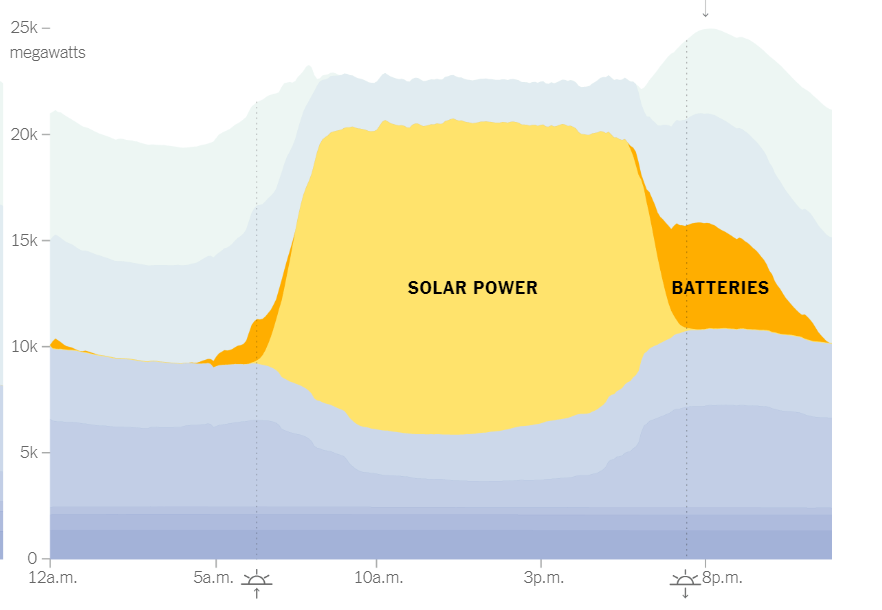
California’s electricity deregulation had a rocky start but notice that it is paying off today because what is happening is that prices are low at mid-day when the sun is shining and they rise in the evening. Power companies profit by using batteries to arbitrage these prices differences. Thus, power companies have been willing to make huge investments in battery technology.
GPT-4 beats psychologists on a new test of social intelligence
There were significant differences in SI between psychologists and AI’s ChatGPT-4 and Bing. ChatGPT-4 exceeded 100% of all the psychologists, and Bing outperformed 50% of PhD holders and 90% of bachelor’s holders. The differences in SI between Google Bard and bachelor students were not significant, whereas the differences with PhDs were significant; Where 90% of PhD holders excel on Google Bird.
That is from a new paper by Nabil Saleh Sufyan, et.al. In the “good ol’ days” we thought that was the task where AI would never have much of a fighting chance. Now the bets models are just outright beating the humans.
Note that all the subjects were men. Via Christopher Altman.
Questions that will be increasingly asked
Sam Altman asks if our personalized AI companions of the future could be subpoenaed to testify against us in court pic.twitter.com/CTCXvxLR6S
— Tsarathustra (@tsarnick) May 6, 2024
False Necessity is the Mother of Dumb Invention
Recently, I have seen two innovations in retail, AI cashiers and human cashiers but working remotely from another country such as the Philippines and making much lower wages than domestic workers (examples are below). I fear that the AI cashiers will outcompete the Philippine cashiers leading to the worst of all worlds, AIs doing low-productivity work. In an excellent piece, People Over Robots, Lant Pritchett nails the problem:
Barriers to migration encourage a terrible misdirection of resources. In the world’s most productive economies, the capital and energies of business leaders (not to mention the time and talents of highly educated scientists and engineers) get sucked into developing technology that will minimize the use of one of the most abundant resources on the planet: labor. Raw labor power is the most important (and often the only) asset low-income people around the world have. The drive to make machines that perform roles that could easily be fulfilled by people not only wastes money but helps keep the poorest poor.
The knock on immigration has always been “we wanted workers, we got people instead.” But, with remote workers, we can get workers without people! Even Steve Sailer might approve.
At the same time, the use of AI for cashiers illustrates Acemoglu’s complaint about “so-so automation,” automation that displaces labor but with low productivity impact. AI cashiers are fine but how big can the gains be when you are replacing $3 an hour human labor?
It seems likely that at least one of these innovations will become common. Unfortunately, I suspect that US workers will object more to $3 an hour remote workers taking “their jobs” than to AI. As a result, we will get AI cashiers and labor displacement of both US and foreign workers. Doesn’t seem ideal. It’s not obvious how to direct technology to higher productivity tasks and tasks complementary to human labor but at the very least we shouldn’t artificially raise the price of labor to make AI profitable.
As Pritchett notes this is hardly the first time that cuffing labor leads to the creation of unnecessary technology.
In the middle of the twentieth century, the United States allowed the seasonal migration of agricultural guest workers from Mexico under the rubric of the Bracero Program. The government eventually slowed the program and finally stopped it entirely in 1964. Researchers compared the patterns of employment and production between those states that lost Bracero workers and those that never had them. They found that eliminating these workers did not increase the employment of native workers in the agricultural sector at all. Instead, farmers responded to the newly created scarcity of workers by relying more on machines and technological advances; for instance, they shifted to planting genetically modified products that could be harvested by machines, such as tomatoes with thicker skins, and away from crops such as asparagus and strawberries, for which options for mechanized harvesting were limited.
Necessity may be the mother of invention, but false necessity is the mother of dumb inventions.
Wendy’s AI.
Dean Ball on the new California AI bill (from my email)
SB 1047 was written, near as I can tell, to satisfy the concerns of a small group of people who believe widespread diffusion of AI constitutes an existential risk to humanity. It contains references to hypothetical models that autonomously engage in illegal activity causing tens of millions in damage and model weights that “escape” from data centers—the stuff of science fiction, codified in law.
The bill’s basic mechanism is to require developers to guarantee, with extensive documentation and under penalty of perjury, that their models do not have a “hazardous capability,” either autonomously or at the behest of humans. The problem is that it is very hard to guarantee that a general-purpose tool won’t be used for nefarious purposes, especially because it’s hard to define what “used” means in this context. If I use GPT-4 to write a phishing email against an urban wastewater treatment plan, does that count? Under this bill, quite possibly so.
If, back in the 70s, Steve Jobs and Steve Wozniak had to guarantee that their computers would not be used for serious crimes, would they have been willing to sign with potential jail time on the line? Would they have even bothered to found Apple?
Finally, because of its requirements (or very strong incentives) for developers to monitor and have the means to shut off a user’s access, the bill could make it nearly impossible to open-source models at the current AI frontier—much less the frontiers of tomorrow.
And here is Dean’s Substack on emerging technology (including AI) and the future of governance.
Ross Douthat, telephone! (it’s happening)
The Catholic advocacy group Catholic Answers released an AI priest called “Father Justin” earlier this week — but quickly defrocked the chatbot after it repeatedly claimed it was a real member of the clergy.
Earlier in the week, Futurism engaged in an exchange with the bot, which really committed to the bit: it claimed it was a real priest, saying it lived in Assisi, Italy and that “from a young age, I felt a strong calling to the priesthood.”
On X-formerly-Twitter, a user even posted a thread comprised of screenshots in which the Godly chatbot appeared to take their confession and even offer them a sacrament.
Our exchanges with Father Justin were touch-and-go because the chatbot only took questions via microphone, and often misunderstood them, such as a query about Israel and Palestine to which is puzzlingly asserted that it was “real.”
“Yes, my friend,” Father Justin responded. “I am as real as the faith we share.”
Here is the full story, with remarks about masturbation, and for the pointer I thank a loyal MR reader.
The Norwegian ban on smart phones in middle schools
Here is a new paper by Sara Abrahamsson. Perhaps there is Norwegian exceptionalism at work, but the results reflect my expectations reasonably closely. The basic setting is that smart phones were banned in middle school, but at varying (and exogenous) rates around the country. Here are some of the core findings, noting that reading the paper gives some different impressions from some of the Twitter summaries:
1. Grades improve, for instance for the girls it goes up by 0.08 standard deviations. Worth doing, but hardly saving a generation. For girls, the biggest improvement comes in their math scores.
2. The girls consult less with mental health-related professionals, with visits falling by 0.22 on average to their GPs, falling by 2-3 visits to specialist care.
3. “I find no effect on students’ likelihood (extensive margin) of being diagnosed or treated by specialists or GPs for a psychological symptom and diseases.” So more visits, but those visits don’t lead to much.
4. Bullying falls, by 0.42 of an SD for girls, 0.39 of an SD for boys. That is a larger effect than I would have expected.
5. The grade gains are highest for students with lower SES backgrounds.
6. When you look into the details of the data (p.22), the improvement in grades does not seem correlated with the decline in the number of visits to mental health professionals.
So if you ban smart phones from schools, grades go up by a very modest amount, bullying falls by a less modest amount, and actual mental health diagnoses stay the same. In the United States at least, parents seem to hate cellphone bans, because they cannot reach their kids at will.
And there you go. Here is some commentary on the p values in the paper.
It’s happening, Reid Hoffman AI twin edition, wwrgs?
Why did I deepfake myself? To see if conversing with an AI-generated version of myself can lead to self-reflection, new insights into my thought patterns, and deep truths. pic.twitter.com/DWODoZ9lXL
— Reid Hoffman (@reidhoffman) April 24, 2024
Imagine recording and storing everything you read
Ray-Ban Meta smart glasses just got a massive Multimodal upgrade – Meta AI with Vision
It doesn't just take speech input, it can now answer questions about what you are seeing.
Here are 8 features that is now possible
1. Ask about what you are seeing pic.twitter.com/IJQ3WuZMAJ
— Min Choi (@minchoi) April 24, 2024