What’s with the eurozone update?
A few of you have emailed and asked. I understand the latest as follows: Draghi basically understands the problem, but is hemmed in by Germany. He is now to some extent freelancing and daring Germany to pull him back in. He’ll print money to target short-term yields for the debt of the periphery, which he feels Germany might eventually accept, for lack of better alternatives and because it also keeps up the pressure for policy reforms. He’s rather audaciously trying to redefine what the ECB’s mandate should be taken to mean by defining a lot of “extracurricular” activity as keeping the system up and running. He’ll push for the banking license for ESM (which would allow them to significantly expand what they do and in essence bypass some of the charter restrictions on the ECB itself), which he probably feels Germany won’t accept but what the heck he’s gotten this far so why not keep on trying? It’s easy enough to criticize him for not having made any kind of full commitment, but he’s already played more of a dare game than most observers thought possible. I say he is doing a high-quality tightrope act which probably will fail but which increases the chance of the whole thing pulling through.
He’s daring the Germans to zap him, knowing he stands some chance of going down in history as the central banker who saved the eurozone, knowing that he has nowhere else to go, knowing the Germans have nowhere else to go, and knowing that he has nothing to lose from being fired or otherwise emasculated. He also knows he has a lot of other eurozone nations on his side.
Just not the ones who will end up paying the bills.
Brad Plumer adds useful comment with a survey of opinion.
Stephen L. Carter has a new novel out
The Impeachment of Abraham Lincoln. I should teach it next year for my Law and Literature class…
EconJobRumors.com
That site specializes in…economics job market rumors. It is also a more general bulletin board for discussing matters involving the economics profession.
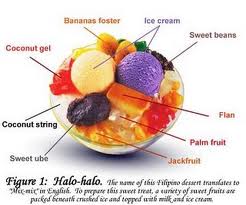
Halo-halo (yes I am in the Philippines)
Assorted links
2. Overview of why the Romney tax plan doesn’t add up.
3. The business of Bond, flip the toggle to adjust for inflation.
4. China markets in everything, hire a prison proxy.
Investment vs. the Warfare-Welfare State

In Launching the Innovation Renaissance and my Atlantic article The Innovation Nation vs. the Warfare-Welfare State I showed that the Warfare-Welfare state has crowded out federal investment in research in development.
In a short report titled Collision Course: Why Democrats Must Back Entitlement Reform, Jessica Perez, Gabe Horwitz, and David Kendall cut the data in a slightly different way but come to the same conclusion:

Entitlements are squeezing out public investments. In 1962, spending on investments was two and a half times that of entitlements. But today, as a result of this Great Inversion, entitlement spending is three times that of investments. And this trend will only accelerate in time as the Baby Boomers retire and their benefits grow faster than inflation and wages.
…The fact that entitlement spending is crushing investments is bad news for U.S. growth.
Hat tip: Arnold Kling.
What is a socially optimal level of bike-riding danger?
Maxim Massenkoff writes to me:
You’ve blogged about bike laws before; I have a question about a particular cyclist (me). As bikers go, I’m very considerate. I obey red lights and stop signs. But I’ve noticed that many DC drivers expect me to break the law, eg., if one reaches an intersection a little before me, he’ll often get frustrated when I stop and give him the right-of-way.
This makes me wonder: if my only goal is to save other bikers from injury and death, should I follow or break the rules? Say that right now 50% of bikers break rules and 50% don’t. Then I figure most normal drivers will be cautious and hesitant around bikers. But if only 5% break rules, then cycling for that subset is way more dangerous as drivers will expect law-abiding bikers.
This model is rather simplistic, as it certainly goes both ways–bikers adjust their strategies to the habits of drivers. But we can consider DC and the marginal effect of one additional rule-abiding or rule-breaking cyclist. Which side should I choose, given my selfless utilitarian preferences above?
Dennis Rodman on the Philippines
Apparently, aging former NBA stars do some barnstorming here, as my taxi driver from the airport told me almost immediately upon my arrival in Manila. From an excellent Grantland article on the topic, no love of sports required, here is one excerpt:
Before tip-off, a sideline reporter snags a short interview with Pippen. “Scottie, what have you heard of the Philippine league?” she asks. “Well, I haven’t heard too much about it.” The moment was a flashback to the unintentional comedy bonanza at the press conference the day before the game, where Pippen & Co. strained to find polite answers to questions like “Besides the Philippines, what other countries have you guys been to?” and “I’m not a press but how is it when you arrive here, how do you feel that you are playing in this country where basketball is one of the popular sports?” Rodman, predictably, punctured the air of false ceremony when he was asked how he found the Philippines on this, his second trip to the country. “The same [as] when I left it,” he said. “You guys still look the same, so what the hell.”
In contrast, I have been here only once.
*From Miracle to Maturity: The Growth of the Korean Economy*
That is the forthcoming book by Barry Eichengreen, Dwight Perkins, and Kwanho Shin. I just pre-ordered my copy to arrive in October…
Assorted links
1. From Washington Monthly: monetary policy, gargoyles, and the emotions. I say focus ruthlessly on substance and do your best to explore and present the limits and drawbacks of your own ideas and recommendations. Years down the road — or sooner — one will end up wiser and better informed. The reasoning in this article is an excuse to dismiss moderating or inconvenient ideas, or ideas which de-moralize a topic somewhat.
2. Wage stagnation isn’t due to a compositional shift.
3. Old Germans who die and leave their estates to Israel.
Short videos on business cycle theory
By me, here, with a mention of Scott Sumner in the Keynesian video, plus one on Austrian theory and one on real business cycle theory.
Goldman Sachs Invests in POP Bonds
Goldman Sachs is investing in a New York City pay on performance bond (POP bond also called a social improvement bond). The Pop bond is based on recidivism rates for adolescents, as described by the NYTimes:
The Goldman money will finance a program called Adolescent Behavioral Learning Experience…which seeks to improve prospects for black and Latino adolescents. The jail program, which will offer counseling and education for an estimated 3,400 incarcerated adolescent men each year, will be run by two nonprofit organizations, Osborne Association and Friends of Island Academy, and overseen by MDRC.
…If the program reduces recidivism by 10 percent, Goldman would be repaid the full $9.6 million; if recidivism drops more, Goldman could make as much as $2.1 million in profit; if recidivism does not drop by at least 10 percent, Goldman would lose as much as $2.4 million.
…Currently, nearly 50 percent of young men released from Rikers reoffend within a year.
As I wrote earlier:
For Pop bonds to work it is critical that outcomes be measured and marked to an appropriate, randomized, control group. If not carefully monitored, the private sector will also excel at innovative and creative gaming at the public expense.
The involvement of Goldman Sachs makes me fear that my last sentence will prove prophetic.
Very good quotations
“It’s not as if 50 people woke up one morning and said, ‘Today, instead of getting a real job, I’m going to go steal cardboard.’
And here is a bit on why cardboard theft has evolved into an organized business:
The city’s impound managers might want to phone China. That country, along with other developing nations like India, is driving the market by paying top dollar for used cardboard. The foreign recyclers then blend it down to remold into new products, such as containers for exports eventually shipped back to the United States.
Again, though the business may sound humdrum, it can be extremely profitable. In 2010, China’s richest woman was “cardboard queen” Zhang Yin, whose $5.6 billion recycling empire made her wealthier than Oprah.
The article is here, and for the pointer I thank Daniel Lippman.
The economics of Olympic success
Here is my new Grantland piece with Kevin Grier. Excerpt:
Predictions
1. Medal totals will become more diversified over time. The market share of the “top 10” countries will continue to fall (it was 81 percent in 1988) as economic and population growth slows in the rich world. The developing world has greater room for rapid economic growth, and most parts of the developing world also have higher population growth. The Olympic playing field will get more and more level.
2. Japan will continue to fade, mostly because of aging and population shrinkage.
3. Italy will follow Japan for similar demographic reasons, as well as because the Eurozone crisis will continue to cut into budgets, training and otherwise.
4. Since Rio is host to the next Olympics, Brazil should do better than expected due to the “pre-host” bump.
5. Many African nations will rise. Currently about half of the approximately 1 billion people in Africa have a cell phone, and the middle class is growing. The chance that an African star will be spotted and trained at the appropriate age is much higher than before. Africa also continues to grow in population, and that means lots of young people. Most of us still think of African nations as very poor, but infant mortality has been falling and per-capita income rising across Africa for the better part of a decade now.
6. China will level off and then decline as a medal powerhouse. In less than 15 years, the typical person living in China is likely to be older on average than the typical person living in the United States, in part due to the country’s one-child policy. As of 2009 the number of over-60s was 167 million, about an eighth of the population, but by 2050 it is expected to reach 480 million people older than 60, with the number of young Chinese falling. The country will become old before it is truly wealthy.
7. Bob Costas will make you cry.
Beijing notes
It is a gargantuan, imperial city, and while there is always a walking path the point of walking is not always clear. “The Middle Kingdom does Dubai.” There is no need to tell me about all the parts of the city which do not look like Dubai, I have seen many of them, and furthermore Dubai has such parts as well.
An iPad, plus Baidu access to Chinese characters, makes it easy to ask questions of strangers. Hardly anyone speaks even minimal English. It is less harried than I had expected. The sky rarely appears, at least in late July. The contemporary art district, 798, is worth more than one visit. I am not interested in seeing the Great Wall. My hotel, rather than having a “Medical Devices” conference, has a meeting on “Australian Property Holdings.”
The main problems here are the air pollution, and that no one, including taxi drivers, seems to know how to get anywhere. The rate of change is high and many people are from the provinces, so there is a real information gap.
The main upsides stem from what scale enables. Even if you have been to many places, Beijing will manage to astonish you.
Most of all, I am struck by how Taiwan is more Chinese than is China.