Healthy living vouchers: will they work?
Matt Ridley writes:
Drawing a direct analogy with the effect of vouchers in the education system, Messrs. Seeman and Luciani suggest “healthy-living vouchers” [TC: book is here] that could be redeemed from different (certified) places—gyms, diet classes, vegetable sellers and more. Education vouchers, they point out, are generally disliked by rich whites as being bad for poor blacks—and generally liked by poor blacks. A bottom-up solution empowers people better than top-down government fiat.
So instead of spending large sums on ads to shame us into better eating habits, spend the money on vouchers handed out to the overweight and let them find whatever provider of goods or services best meets their particular dieting needs. After all, the root causes of obesity are multifarious and new ones are being added all the time—such as diet sodas, gut bacteria, genes, sleep apnea, leptin levels, medication, depression, poverty and peer pressure. So the solutions need to be multipronged, too. What works for you may not work for me.
A few points:
1. How exactly does one identify who deserves the voucher? Or does everyone get them? (Do we at this point need another middleclass entitlement?) How much does the price of the good stuff go up?
2. The vouchers can be resold on secondary markets, as food stamps often are.
3. Portfolio effects: the unhealthy person might go to the gym with a voucher and then “make it up” by performing more of the unhealthy behaviors as recompense.
4. Income effects: if the voucher boosts the real income of the unhealthy person, they may well end up buying more stuff which is bad for them. I don’t see that the proposal calls for a simultaneous, income-neutral scheme of taxation. Buying more bad stuff and also more good stuff is not a wash, which brings us to:
5. It is easier to destroy than to preserve health, which suggests limiting the bad, or persuading individuals to limit the bad, will create more health benefits than encouraging the good.
I’m all for creative thinking here, but it’s hard to see this proposal working. If nothing else, though, it shows why this problem is so hard to solve.
The Kaufmann econblogger talks are up
I am told they are here. Megan McArdle had a very good talk on antibiotics. Arnold Kling did a folk dance. Interfluidity calls for a parliament of bloggers.
Assorted links
1. National serviceman needs maid to carry his backpack (Singapore, Adam Smith, decline of martial virtue, via Chris F. Masse).
2. Paul Krugman on the 1921 recovery.
3. Robin Hanson and Brian Christian.
4. Unemployment duration still going up.
5. Brad DeLong, slouching toward recalculation. And his response.
China price request of the day
Unilever, the Anglo-Dutch consumer goods group, has bowed to pressure from Beijing to delay planned price increases, highlighting a new regulatory risk in an inflationary climate.
…Chinese consumers, increasingly alarmed at the rising cost of living, cleared supermarket shelves this week of shampoos, soaps and detergents after state media said four consumer goods companies – including Unilever and Guangzhou Liby Enterprise Group – would raise prices by between 5 per cent and 15 per cent.
The full story is here.
Seminal books for each decade
Andrew asks a tough question:
what do you think is more or less the equivalent of the great gatsby in every decade after the 20s?
Here are my picks:
1930s: The Grapes of Wrath, John Steinbeck.
1940s: Farewell, My Lovely, by Raymond Chandler.
1950s: Invisible Man, by Ralph Ellison, with Kerouac’s On the Road as a runner-up.
1960s: Catch-22, by Joseph Heller, with The Bell Jar and Herzog as runners-up.
1970s: This is tough. There is Vonnegut’s Breakfast of Champions, Stephen King, and even Peter Benchley’s Jaws. I’ll opt for Benchley as a dark horse pick, note that these aren’t my favorites but rather they must be culturally central. Jonathan Livingston Seagull is another option, as this truly is an era of popular literature.
1980s: Tom Wolfe, The Bonfire of the Vanities.
1990s: The Firm, by John Grisham, or Barbara Kingsolver, The Poisonwood Bible. Maybe Brokeback Mountain.
2000s: Malcolm Gladwell, The Tipping Point.
The Hayek Twitter game
The game: Take a sentence or two on Hayek’s clause and qualification ridden Germanic prose, and turn it into a 144 character twitter feed.
Example. Here’s a brief passage from Hayek 1976 essay “Socialism and Science” posted a few days ago in the comments by Richard Ebeling:
“A society in which everyone is organized as a member of some group to force government to help him get what he wants is self-destructive. There is no way from preventing some from feeling that they have been treated unjustly — that feeling is bound to be wide spread in any social order — but arrangements which enable groups of disgruntled people to extort satisfaction of their claims — or in the recognition of an ‘entitlement’, to use the new-fangled phrase — make any society unmanageable.”
And here it is as a 144 character twitter feed:
When everyone is organized to force government to get them what they want, many will be left feeling that they have been treated unjustly.
Ho hum! I would have done “Rent-seeking groups lead to perceptions of unfairness.”
When did the big gains in agricultural productivity come?
I had the general and indeed correct impression that U.S. agricultural productivity has been rising for a long time. It’s less commonly known how big was the productivity acceleration in agriculture in the 1940s. Between 1880 and 1940, agricultural productivity in this country rose at the rather modest rate of about one percent a year. After World War II, the trend rate of growth jumps to 2.8 percent annually. Multi-factor productivity in agriculture skyrockets in the mid-1930s, not earlier.
The information is from Bruce Gardner’s American Agriculture in the Twentieth Century: How it Flourished and What it Cost, pp.20-21, p.44.
Tips for book recommendations
Nicoli asks:
Any tips, other than reading this blog, on how to find a good book recommendation? I want something like a netflix for books, but feel that system wouldn’t work given the significantly greater time and attention requirement for reading versus let’s say, watching Pee Wee’s Big Adventure.
1. Go to the public library and browse both the new books section and the “Books Returned” carts.
2. Read the archives of this blog, filed under “Books.”
3. Weight Amazon reviews by the intelligence of the writer, and the length of the review, not by whether it is positive or negative.
4. Every year read some of the classics on Harold Bloom’s list in The Western Canon.
5. The very best books in categories you think you cannot stand (“gardening,” “basketball,” whatever) will be superb. It is not hard to find out what they are.
My favorite things South Africa
Torr writes to me:
Please will you consider doing a “favorite things South Africa” on Marginal Revolution. I’m also curious: have you ever visited South Africa?
I have yet to go, but here is what I admire so far:
1. Visual artist (you can’t quite call him a painter): William Kentridge. He is one of the contemporary artists who is both a realist and has a lot of the emotional power of the classics. His extraordinary body of work spans film, drawings, prints, and mixed media. Here are some images.
2. Home design: I am an admirer of the Ndebele, some photos of their colorful homes are here. They are better represented in picture books than on the web.
3. Movies: I don’t know many. I enjoyed The Gods Must be Crazy, even though some might find it slightly offensive. Nonetheless I hand the prize to District 9 for its interesting take on ethnic politics, its deconstruction and mock of Afrikaaner settler myths, and its commentary on how South Africans view Zimbabwean immigrants to their country.
4. Movie, set in: Zulu, 1964 with Michael Caine.
5. Novels: My favorite Coetzee is Disgrace, though I like most of them very much, including the early Life and Times of Michael K and Waiting for the Barbarians and the later semi-autobiographical works. Nadine Gordimer I find unreadable, call the fault mine. Same with Alan Paton. A dark horse pick is Trionf. Agaat sits in my pile, waiting for the trip of the right length.
6. Music: Where to start? Malanthini, for one. As for mbqanga collections, The Indestructible Beat of Soweto series is consistently excellent. Singing in an Open Space, Zulu Rhythm and Harmony 1962-1982 is a favorite. Random gospel and jazz collections often repay the purchase price and in general random CD purchases in these areas bring high expected returns.
7. Economists: Ludwig Lachmann was an early teacher of mine and I owe him my interest in post Keynesianism and also financial fragility hypotheses. G.F Thirlby remains underrated. W.H. Hutt was one of the most perceptive critics of Keynes and his insights still are not absorbed into the Keynesian mainstream. His book on the economics of the colour bar remains a liberal classic. Who am I forgetting?
The bottom line: There’s a lot here. Here are previous MR posts about South Africa.
WKRP and the Tragedy of the Anti-Commons
The tragedy of the commons occurs when no one has the right to exclude users of a resource and, as a result, the resource is overused. The tragedy of the anti-commons occurs when many people have the right exclude users of a resource and, as a result, the resource is under-used. Case in point:
From Amazon’s review of the DVD of WKRP in Cincinnati:
One of DVD’s most requested titles, WKRP in Cincinnati is a blast from the past and an absolutely golden oldie. But this first-season set is bound to cause static with fans who have eagerly anticipated its release. Because of pesky music rights, the songs don’t remain the same. “Hot Blooded” is not playing when mild-mannered newsman Les Ness
man (Richard Sanders) puts on a toupee in anticipation of an awards-dinner date with bombshell station receptionist Jennifer (Loni Anderson). It’s “Beautiful Dreamer” and not “Fly Me to the Moon” that chimes when Jennifer’s doorbell is sounded. Any number of generic songs have replaced the contemporary and classic rock so vital to WKRP, which is, after all, set at a radio station…
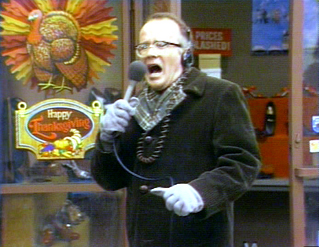
Wikipedia explains
Music licensing deals cut at the time of production were for a limited amount of time (approximately ten years). In addition, the show was videotaped rather than filmed because it was cheaper to get the rights to rock songs for a taped show. Once the licenses expired, later syndicated versions of the show did not feature the music as first broadcast, but rather generic “sound-alikes” by studio musicians to avoid paying additional royalties. In some cases (when the music was playing in the background of a dialogue scene), some of the characters’ lines had to be redubbed by sound-alike actors….
Notice that no one really gains here from the surfeit of copyright, not even the copyright holders. Is Foreigner really better off by excluding listeners from a few well-timed seconds of Hot Blooded? On the contrary, a little youthful nostalgia adds to demand. But the copyright holders, each in their eagerness to profit, raise the transaction costs of producing the whole product so much that it either isn’t produced at all or is produced, as in this case, in a way which greatly reduces consumer value.
WKRP in Cincinnati is not that important in the grand scheme of things but it is an illustration of how copyright and patent thickets can impede innovation.
Hat tip to Michael Heller’s excellent The Gridlock Economy.
Assorted links
Live streaming of Kaufmann Foundation econbloggers event
It starts tomorrow at 9:30-12, 2 p.m.-5:30, EST, watch it here. Many luminaries will be there, including the hard to catch Interfluidity.
Assorted links
1. Facebook and TGS, and Robin Hanson reviews TGS. Mike Mandel responds to Karl Smith.
2. Is envy a stronger motivator than admiration?
3. Passing to yourself off the backboard (video).
4. Yet another way of viewing our labor market troubles, or in other words, start-ups have suffered too (NYT blog).
5. Via Chris F. Masse, when will China overtake the U.S. in science? (NB: I’m not convinced by this article).
To Reduce Bribery, Make it Legal
India’s chief economic adviser Kaushik Basu argues (pdf; WSJ report) that to reduce bribery we should make the paying of bribes (not the demanding!) legal.
Under the current law…the bribe giver and the bribe taker become partners in crime. It is in their joint interest to keep this fact hidden from the authorities and to be fugitives from the law, because, if caught, both expect to be punished. Under the kind of revised law that I am proposing here, once a bribe is given and the bribe giver collects whatever she is trying to acquire by giving the money, the interests of the bribe taker and bribe giver become completely orthogonal to each other. If caught, the bribe giver will go scot free and will be able to collect his bribe money back. The bribe taker, on the other hand, loses the booty of bribe and faces a hefty punishment.
Hence, in the post-bribe situation it is in the interest of the bribe giver to have the bribe taker caught….Since the bribe taker knows this, he will be much less inclined to take the bribe in the first place. This establishes that there will be a drop in the incidence of bribery.
Basu notes that he intends this to apply to bribes where the person paying the bribe is receiving only what they are entitled to receive, e.g. when you have to bribe to get a business license that you are entitled to or to get your rice rations or get an income tax refund.
Hat tip to Sanjiv.
The fallacy of mood affiliation
Recently I wrote:
It seems to me that people are first choosing a mood or attitude, and then finding the disparate views which match to that mood and, to themselves, justifying those views by the mood. I call this the “fallacy of mood affiliation,” and it is one of the most underreported fallacies in human reasoning. (In the context of economic growth debates, the underlying mood is often “optimism” or “pessimism” per se and then a bunch of ought-to-be-independent views fall out from the chosen mood.)
Here are some further examples:
1. People who strongly desire to refute those who predicted the world would run out of innovations in 1899 and thus who associate proponents of a growth slowdown with that far more extreme view. There’s simply an urgent feeling that any “pessimistic” view needs to be countered.
2. People who see a lot of net environmental progress (air and water are cleaner, for instance) and thus dismiss or downgrade well-grounded accounts of particular environmental problems. There’s simply an urgent feeling that any “pessimistic” view needs to be countered.
3. People who see a political war against the interests of the poor and thus who are reluctant to present or digest analyses which blame some of the problems of the poor on…the poor themselves. (Try bringing up “predatory borrowing” in any discussion of “predatory lending” and see what happens.) There’s simply an urgent feeling that any negative or pessimistic or undeserving view of the poor needs to be countered.
4. People who see raising or lowering the relative status of Republicans (or some other group) as the main purpose of analysis, and thus who judge the dispassionate analysis of others, or for that matter the partisan analysis of others, by this standard. There’s simply an urgent feeling that any positive or optimistic or deserving view of the Republicans needs to be countered.
In the blogosphere, the fallacy of mood affiliation is common.