I voted
First time, ever.
Addendum: By the way, it took me less than 3 minutes (I was surprised) and I got a free coffee at Starbucks. Not bad on instrumental or expressive grounds.
My simple thought on voting
Most of what you do is for expressive value anyway, so you shouldn’t feel guilty about voting, if indeed you vote. The people who think they are being instrumentally rational by not voting are probably deceiving themselves more. They are actually engaged in an even less transparent form of expressive behavior (protest against the voting system) and yet cloaking that behavior under the guise of instrumental rationality. The best arguments against voting are simply if you either don’t like voting or if you don’t know which candidate is better. High-status people hardly ever offer the latter justification, even though the split of opinions among high-status people suggests that not all high-status people can in fact know which candidate is better.
In other words, both voting and not voting are motivated by the thought that you are better than other people. I am glad that we have an entire day devoted to this very important concept.
New models of voting
This paper, "Attitude-Dependent Altruism, Turnout and Voting," is from Julio Rotemberg, one of my favorite economists:
This paper presents a goal-oriented model of political participation
based on two psychological assumptions. The first is that people are
more altruistic towards individuals that agree with them and the second
is that people’s well-being rises when other people share their
personal opinions. The act of voting is then a source of vicarious
utility because it raises the well-being of individuals that agree with
the voter. Substantial equilibrium turnout emerges with nontrivial
voting costs and modest altruism. The model can explain higher turnout
in close elections as well as votes for third-party candidates with no
prospect of victory. For certain parameters, these third party
candidates lose votes to more popular candidates, a phenomenon often
called strategic voting. For other parameters, the model predicts
"vote-stealing" where the addition of a third candidate robs a viable
major candidate of electoral support.
Here is an ungated version.
China tax of the day
Last year China banned the sale of virtual currency in an effort to
shut down "gold farmers" — businesses that hire young Chinese to play
video games all day and sell the proceeds (in the form of game currency
or magic items) on eBay(EBAY) or online
The Chinese government did nothing to enforce its own ban, so it
remains to be seen whether Beijing follows up with its latest edict:
Gamers who sell virtual goods for a profit will be taxed at 20% of the
proceeds, the same rate applied to profits on real estate or other
transactions.In December 2005 the New York Times estimated 100,000 Chinese were employed full-time
in the gold farming industry, and consulting group iResearch says the
virtual currency trade is a $1.4 billion dollar industry growing at 15
to 20% a year.
Here is the story and thanks to Alex Rosen for the pointer.
China Worry of the Day
China’s economic difficulties are very worrying because in China an economic slowdown is not just an economic problem but a political problem. Will the Chinese leadership turn to nationalism to divert attention from problems at home? Interesting times. and this time that is a curse.
China needs to encourage domestic consumption and with a trillion dollars in reserves they have the funds. Spending the rainy day fund would benefit the U.S. as well, stimulating our exports. It may already be too late, however, to shift smoothly from export to domestic consumption which means that mass capital depreciation will occur as capital investments in export industries turn out to be worth less than first appeared.
Is Google happy with its book-scanning deal?
Google’s concession has made it more difficult for anyone to invoke fair use for book searches. The settlement itself is proof that a company can pay licensing fees and still turn a profit. So now no one can convincingly argue that scanning a book requires no license. If Microsoft starts its own book search service and claims fair use, the courts will say, "Hey, Google manages to pay for this sort of thing. What makes you so special?"
By settling the case, Google has made it much more difficult for others to compete with its Book Search service. Of course, Google was already in a dominant position because few companies have the resources to scan all those millions of books. But even fewer have the additional funds needed to pay fees to all those copyright owners. The licenses are essentially a barrier to entry, and it’s possible that only Google will be able to surmount that barrier.
Sure, Google now has to share its profits with publishers. But when a company has no competitors, there are plenty of profits to share.
The story of Gary Gorton and AIG
Recommended. I didn’t know he was such a collector of jazz LPs.
Voting Videos
Here’s a great little video from PBS (!) featuring Gordon Tullock on why he doesn’t vote and why you shouldn’t either. (Andrew Gelman and Noah Kaplan beg to differ in this article, but their theory applies only to altruists – not to Gordon!).
And from The Teaching Company here is a free video on voting theory, i.e. Arrow’s theorem, the Borda count and all that other good stuff.
How will the financial crisis affect the economics profession?
Paul, a loyal MR reader, asks:
What will be the impacts of the current situation for economics and economists. It seems clear that we have screwed up. We don’t even have the excuse that we understood what was going on but no one listened to us; economists have been in powerful positions for a long time, and it is generally agreed that Ben Bernanke is both a powerful and a well respected economist. Will demand for economics courses fall? (It seems obvious that demand for finance courses and so for finance professors will decline.) I am not teaching this semester, but I would like to know from those who are: What do you tell students when they ask what economics had to say about the current mess? It seems to me that this situation will have profound implications for economics as a scientific and also as an academic discipline and I would like to see a discussion. Your blog is probably an ideal place for such a discussion.
I believe that demand for economics classes will rise, as it often does in economically troubled times. Some of this will be "shaman demand" rather than "knowledge demand." The consulting incomes of finance economists will fall and fewer talented people will go into finance. Speaking fees will fall since fewer economists will give talks at hedge funds. The relative status of macroeconomists will rise and the relative status of microeconomists will fall. Economists will gain in fame and lose in income. What do you think?
Which countries does the NYT cover?
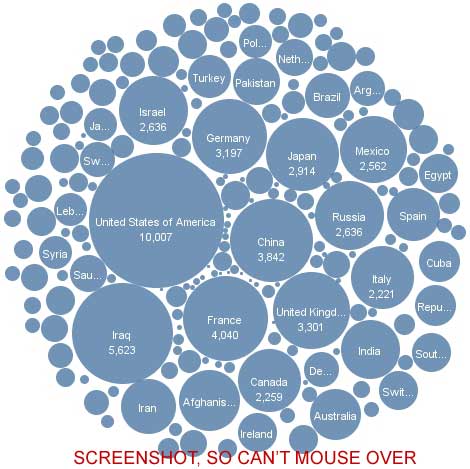
Here is further discussion, noting that I am a little confused about how the U.S. is counted and why it doesn’t appear more often.
Assorted links
1. How to Make a Difference blog (by Tim Harford’s wife)
3. Making health insurance competitive across state lines: how much would be saved? I don’t agree completely with this analysis but it is one place to start.
4. Best sports pieces ever written? (via Craig Newmark)
John Smith hasn’t made up his mind yet
John Smith reports:
I am ready to move on – perhaps for a career where deadlines are
honored, ideas are exchanged and gimmicks and fads are routinely
avoided because they distract from advancing the mission of gaining and
sharing knowledge. Yes, it is time to find another line of work, where
I can enjoy the fruits of my labor, even if I realize that the grass is
grayer, if not greener, elsewhere.John Smith is the pseudonym of a professor at a liberal arts
college. He asked to remain anonymous because he is continuing to teach
while he is job-hunting and doesn’t want his comments to reflect on his
institution.
Not from the Onion
From the Onion in 1993. Hat tip to Boing Boing. 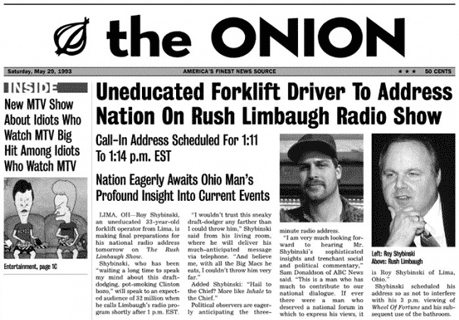
Petards
Wall Street unwittingly created one of the catalysts for the collapse of Bear Stearns, Lehman Brothers and American International Group by backing new bankruptcy rules that were aimed at insulating banks from the failure of a big client, lawyers and bankers say.
The
2005 changes made clear that certain derivatives and financial
transactions were exempt from provisions in the bankruptcy code that
freeze a failed company’s assets until a court decides how to apportion
them among creditors.However, experts say the new rules might have accelerated the demise
of Bear, Lehman and AIG by removing legal obstacles for banks and hedge
funds that wanted to close positions and demand extra collateral from
the three companies.“The changes were introduced to promote the
orderly unwinding of transactions but they ended up speeding up the
bankruptcy process,” said William Goldman, a partner at DLA Piper, the
law firm. “They wanted to protect the likes of Lehman and Bear Stearns
from the domino effect that would have ensued had a counterparty gone
under. They never thought the ones to go under would have been Lehman
and Bear.”
Here is the full story. Here is previous MR coverage of this topic. Here is a short article on petards. Here is Wikipedia on petards. Here are pictures of petards.
Book splat
Reflection of a Political Economist, Selected Articles, by William A. Niskanen; the nature of this book is self-evident. globalization: n. the irrational fear that someone in China will take your job, by Bruce Greenwald and Judd Kahn; a good introductory look. Hallelujah Junction: Composing an American Life, by John Adams; excellent for Adams fans, it helps make sense of the music. Jan Zalasiewicz, The Earth After Us: What Legacy Will Humans Leave in the Rocks? Not much. A very good, fun introduction to some issues of geology. Casanova: Actor * Lover * Priest * Spy, by Ian Kelly. An underrated figure, an underrated book. The Art of Strategy: A Game Theorist’s Guide to Success in Business and Life; a good introduction to game theory. The Princeton Companion to Mathematics; a very heavy book, in more ways than one.